
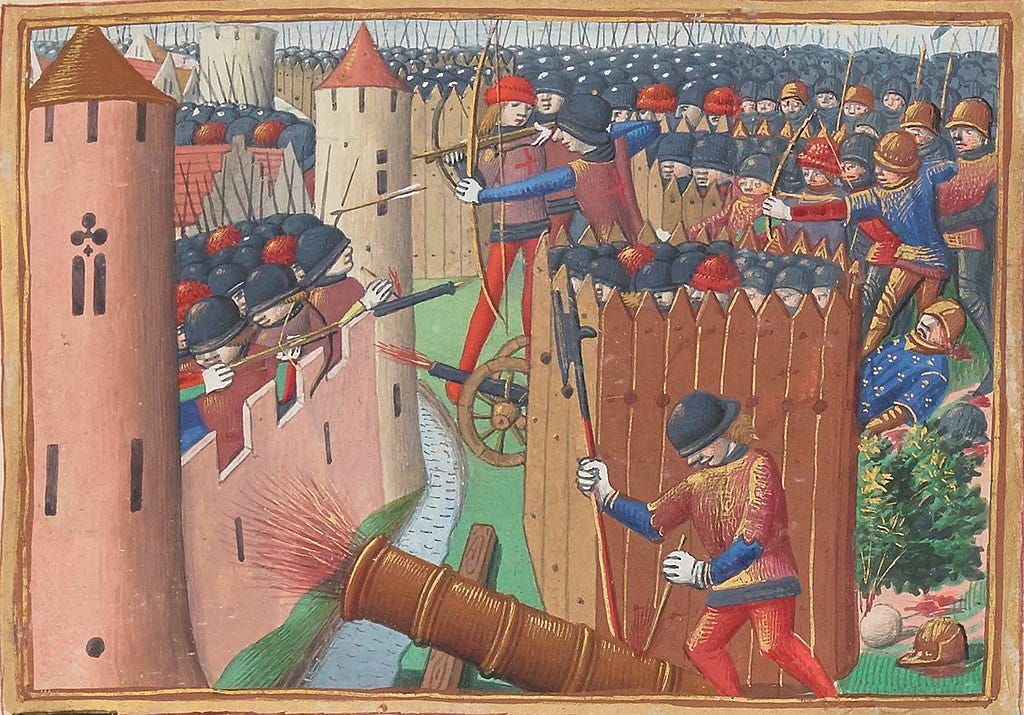
In the mid-fourteenth century, a strange new weapon appeared on European battlefields. It was loud, unreliable, and often more dangerous to the men firing it than to the enemy. Within two centuries it had reshaped how wars were fought, how fortresses were built, and how kings ruled.
The full story of gunpowder’s rise, from the crude pot de fer at Crécy to the colossal bombards that battered Constantinople, is one of the most dramatic technological transformations of the medieval world. Cannon grew from curiosities into instruments capable of levelling walls that had stood for centuries. Handheld firearms gave ordinary soldiers a weapon that could, in theory, bring down an armoured knight.
But “in theory” is doing a lot of work in that sentence. The popular version of this story-gunpowder arrives, castles crumble, knights vanish, kings triumph-compresses two centuries of uneven, contested change into a single dramatic turning point. Historians who study this period closely tend to be more cautious than the popular narrative allows.
Below, I want to look at where that popular narrative holds up, where it oversimplifies, and where it gets the causation backwards entirely.
Comments
Nothing yet. Say the first thing.
Sign in to join the conversation.