
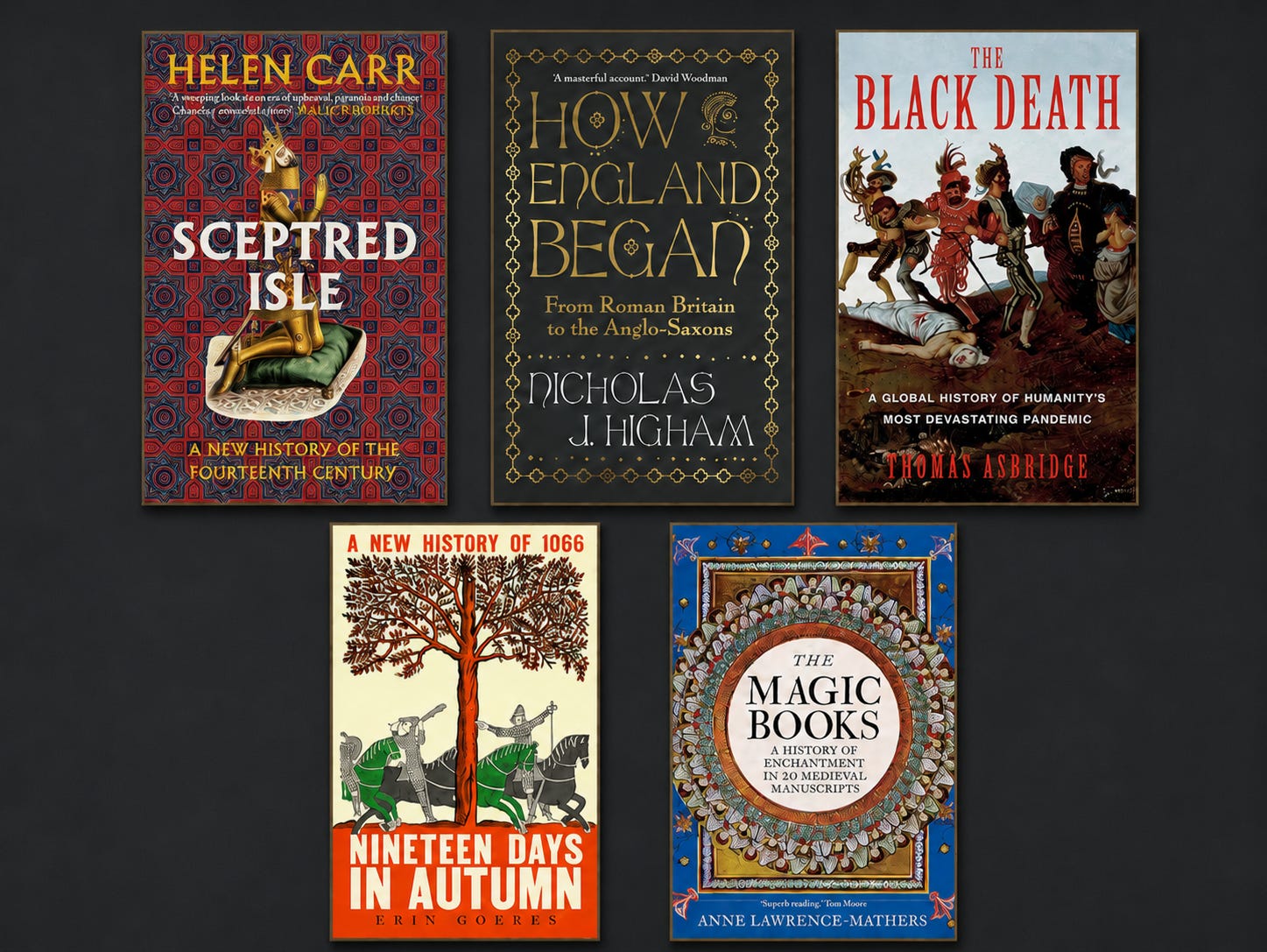
Holiday reading lists are usually an excuse to recycle the same three or four titles every outlet already covers. This one isn’t that.
This month’s selection runs from the collapse of Roman Britain to the manuscripts that recorded medieval magic, and it resists the temptation to retell 1066 or the Black Death as if nothing new has been written about either in years.
Helen Carr’s Sceptred Isle takes fourteenth-century England, a period usually flattened into “war and plague,” and gives it back its political texture: a kingdom under repeated pressure to redefine itself.
Nicholas J. Higham’s How England Began does something harder. It takes the two centuries after Roman withdrawal, an era where the evidence is thin and contradictory, and shows the actual mechanics historians use to reconstruct it. That transparency is rarer than it should be in popular history. I reviewed the book in full last month, and it held up on a second look.
Thomas Asbridge widens the Black Death outward, treating it as a genuinely global event rather than a European one with some foreign footnotes. Erin Goeres’s Nineteen Days in Autumn does the opposite with 1066, narrowing the focus to the nineteen days between Stamford Bridge and Hastings, restoring the uncertainty that hindsight tends to erase.
And Anne Lawrence-Mathers’ The Magic Books gets a second recommendation this year, not for novelty but because twenty manuscripts on charms, prophecy and celestial belief remain one of the more tactile ways into the medieval mind.
Five different angles on the same period. Worth knowing why each earned its place.
Comments
Nothing yet. Say the first thing.
Sign in to join the conversation.