
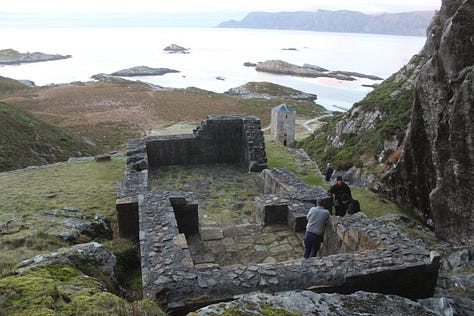
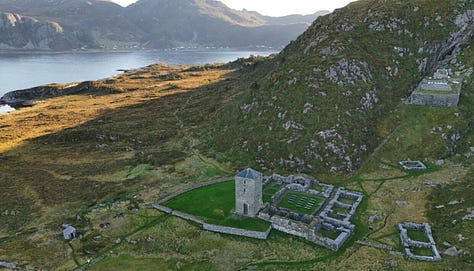

In July 2026, NIKU building archaeologist Regin Meyer traced a stone wall foundation running south from Selja’s harbour, well outside the known monastery's boundary. The radar survey followed it for at least 13 metres before the signal ran out underground. The wall itself is two metres thick, thick enough that Meyer described the construction as substantial in his own words to NIKU. Nobody yet knows what stood on top of it, when it was built, or which phase of Selja’s long religious life it belongs to.
That last uncertainty is the interesting part. Selja was, in sequence, a site associated with an early local cult, then the location of a bishopric founded around 1068, then home to a Benedictine monastery that kept expanding through the following three centuries. Each of those phases needed buildings the surviving ruins do not fully account for: stores, workshops, lodging for pilgrims, quarters for a small permanent population working outside the walls of the religious core. The new wall could belong to any one of these phases, or to something between them that current scholarship has not anticipated.
This is also not an isolated find. In 2024, NIKU identified an earlier stone church beneath the ruins of St Sunniva’s Church, with construction features that echo the Anglo-Saxon building tradition, a detail that matters because it points toward Selja’s ecclesiastical contacts running west to England as much as south to continental Europe. In 2025, a separate unrecorded ruin turned up northwest of the monastery. Three finds, three years, and in two of the three cases, no confirmed date or function.
What makes this run of discoveries possible now, rather than a century ago, is largely methodological. Radar survey and terrain modelling let researchers see structural traces beneath ground that centuries of visual inspection missed entirely. Meyer has now collected soil and material samples from the newest wall, and dating results should eventually narrow down which phase of Selja’s history it belongs to.
Until then, the honest position is to hold several possibilities open at once rather than assign the wall to whichever phase makes the best story. The paid section below sets out what those possibilities actually are, and why one of the more tempting explanations, that this was built specifically to house the pilgrims Sunniva’s cult drew to the island, needs to be treated with real caution.
Comments
Nothing yet. Say the first thing.
Sign in to join the conversation.