
Welcome or welcome back to History Buzz! If you’re a subscriber to the Buzz, thank you! If you’re new here, or you haven’t become a subscriber yet, hit that subscribe button to have History Buzz delivered directly to your inbox. If you can, please consider a paid subscription to support the research and writing that make History Buzz possible.
In March of 2026, the history center accepted photographs of a mid-century modern house at the top of Castle Heights Road. The photos had been taken in the fifties when the house was almost new. I was enamored. And the Oldsmobile wagon in the carport only made it better. The garden wall was part of the foundation of the old castle. “What old castle?” was the question that popped into my mind. A conversation with a friend who presently lives on Castle Heights Road piqued my interest even further.
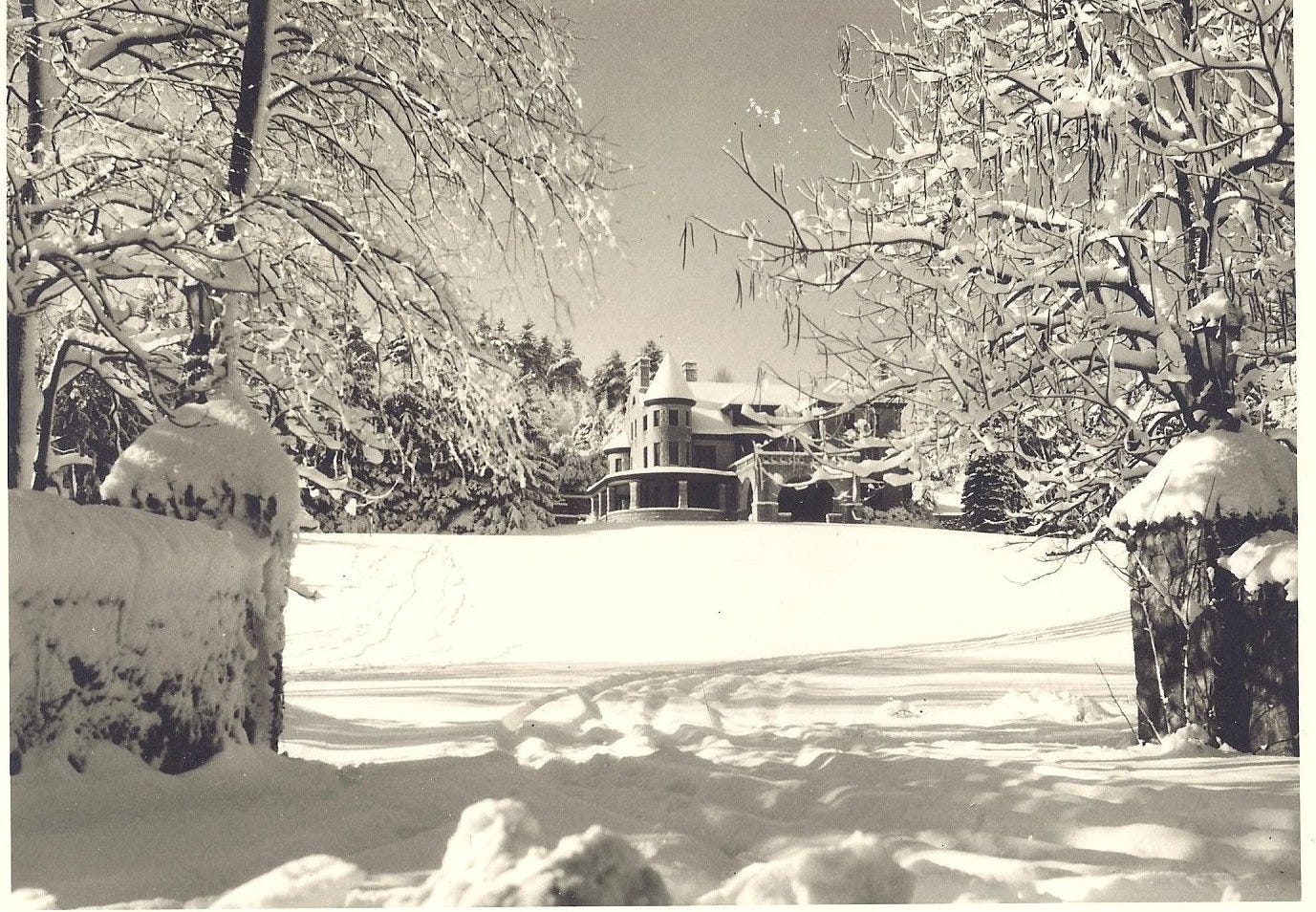
The castle was named Ledgecroft by its original owner, John Joyce. Mr. Joyce was born in Ireland and immigrated with his parents in the 1860s. He admired a castle near his childhood home and dreamed of having a castle just like it. Joyce had a talent for business and, with Maurice J. Curran, formed Curran & Joyce in 1877. The company manufactured and bottled their own soda water and ginger ale. Eventually, they became wholesale importers of liquor and also bottled the products of other local manufacturers. Joyce also invested in Gillette safety razors and in utilities.
The dream castle became a reality in 1912 and the Joyce family moved in the following year.
Lewis F. Dey, an architect from Philadelphia, drew up the plans. It has been said that Dey went to Ireland to copy the castle from Joyce’s childhood. His Andover castle was constructed from Deer Island granite, boasted 22 rooms, 5 of which were bathrooms. There was a stained-glass window in the dining room and the lighting fixtures were solid silver. The turret and porch on the south corner boasted views of the Shawsheen River and the meadows beyond. A granite retaining wall stood behind the castle. Those who don’t mind stairs could climb them up to a gazebo at the crest of the hill.
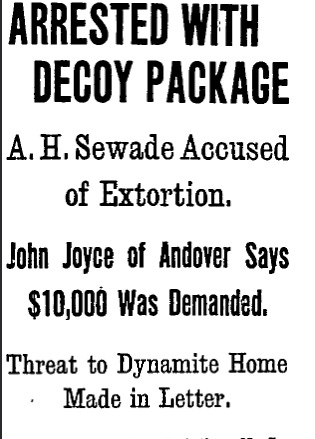
Life at Ledgecroft had its scary moments as well. In December (or perhaps late November) of 1914, the Joyce family were victims of extortion. If the family did not give $10,000 in cash to a man who called at their home, Ledgecroft would be dynamited. Arthur H. Seward, the suspect, wanted to buy a farm with his ill-gotten gains. Seward was arrested when he accepted a decoy package that the Joyces passed to his intermediary.
“Inspector Vose of the Lawrence police department stepped from his hiding place, where he had heard the conversation, and placed the man under arrest.”
Unfortunately, Mr. Joyce passed away in 1917. His wife died in 1919 and their daughters sold the castle to the Earle family from Lexington in 1921. The Earles kept it for less than a year. From there, the castle and its owners would fall on hard times.
Edward Rickard bought the castle in 1922. He was the president of a shoe manufacturing company, Rickard shoe, with facilities in Haverhill and Lynn. He was active in a long list of industry associations and clubs; including the Andover Country Club, the Boston Athletic Club, and even the Friars Club in New York City. Edward and his wife Vina were parents of eight children who all attended prestigious colleges. Joachim, their eldest son, was a passenger on the Graf Zeppelin’s first round-the-world flight in 1929. Rickard’s financial interests took a substantial hit in the stock market crash of 1929 and the depression ravaged the New England shoe industry. The castle was sold at a public auction in 1936.
Ledgecroft’s next (and last) owners were Theodore and Kathleen Hoffacker. The couple had two daughters, Gertrude and Patsy. Theodore was president of the Harvard Brewing Company in Lowell. John Joyce had been the first president of Harvard Brewing “pre-prohibition”.
Harvard Brewing went bankrupt in 1937 and came under new ownership. Unpaid taxes and mortgage debt forced the Hoffackers out of Ledgecroft in 1940. They relocated to Dallas, needing financial help from friends to make the trip.
A document from ACHC’s vertical files on 248 North Main Street (Ledgecroft’s former address) records the memories of Renate Sides, who used to visit the Hoffacker family. Renate’s father was a math teacher at Phillips Academy. Her mother was German.
“Renate will forever recall how special a treat it was to go play at the castle and to travel up the drive to it. The car stopped at an enclosed stone porch under an immense entrance way – a grand portico, the French call it a ‘Porte Cochere.’ There a great dane had his place outside. As a guard dog he barked an arrival and joined the festivities.”
There was white, spacious, beautiful stairway that welcomed those who entered the “residential area.” Even though the playroom was largely empty, the children had a governess named Hilda. The children liked to ride the elevator that accessed the upper floors and the servants quarters.
At the top of the turreted towers, there were benches where someone could sit and look out.
Theodore Hoffacker was mysterious. He is described as a heavyset, likeable, flamboyant person. At one dinner party, he left the dining room with its stained-glass window and “entertained his guests by throwing crystal champagne glasses into the enormous fireplace.” Despite their large home and Theodore’s flair for the dramatic, the family did not entertain very much.
Germany was hostile in 1940 and, even though this country was not at war, many people were frightened. Theodore’s heritage, coupled with the family’s swift departure from Andover led to much speculation about what went on behind closed doors. He was communicating with German submarines off the coast of Lynn! There were electronics in the basement! The family left their food on the table! The FBI searched the house!
I am not shocked by stories of U-boats lurking off the coast of Lynn. But that is for a blog post in a different forum. The Hoffackers lit out quickly. They may have been embarrassed, in dire straits with no place to stay, or hustling off to pursue employment where it was available. There is no proof that Mr. Hoffacker was using the castle to aid the Third Reich.
Ledgecroft came down quickly. The estate was so large that nobody wanted it. To make matters worse, a deed restriction prohibited the castle from being divided up into apartments. By the summer of 1941, the property was divided into “thirty lots”. The existing trees and the castle’s retaining wall would stay.
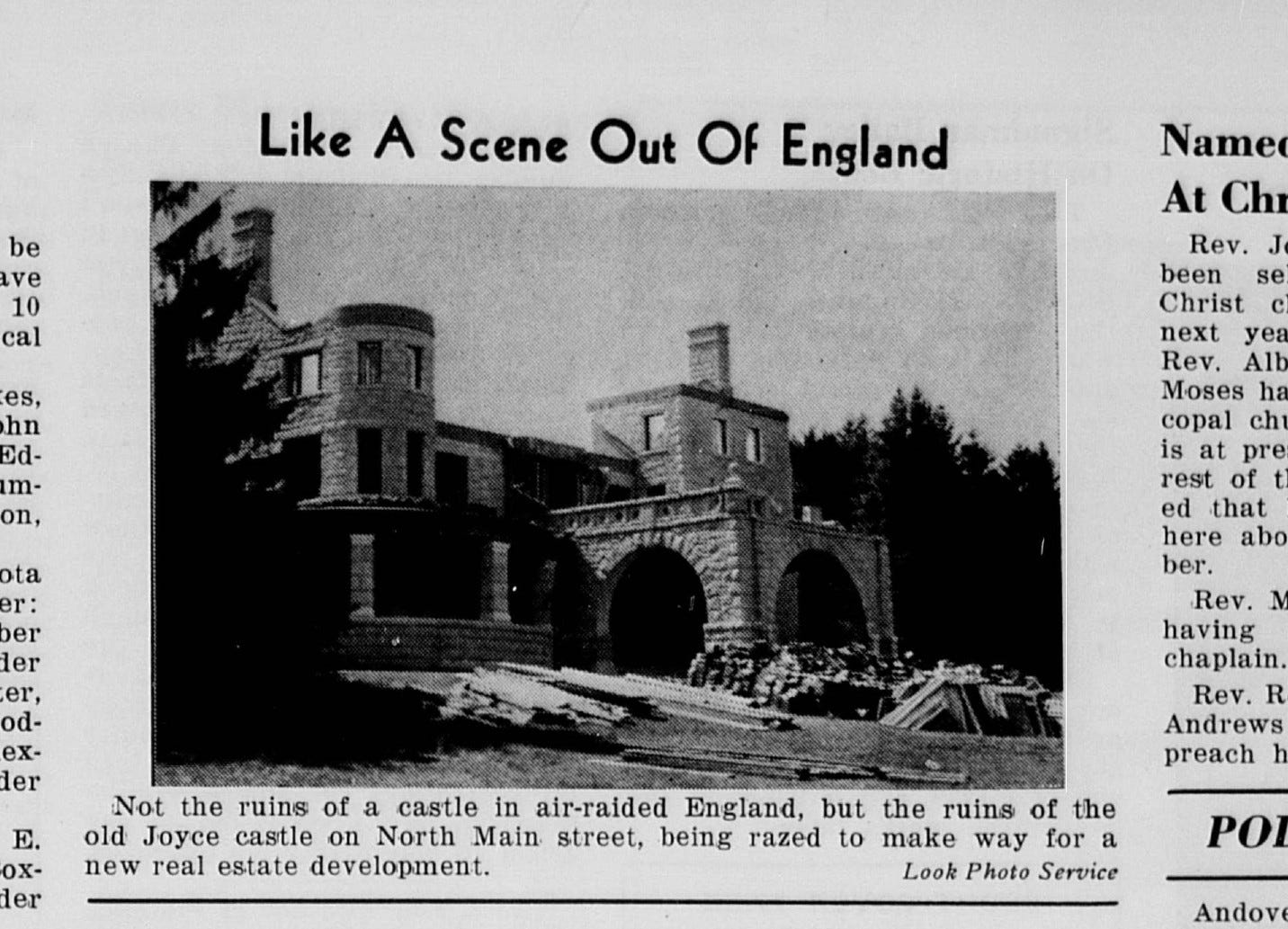
Charles H. Dufton, whose memories are documented alongside Renate’s, recalled that builders were anxious to reuse the granite blocks from the ruins of the castle. Chisels, sledges, sledge hammers, and drills were not strong enough to dislodge the granite. And nobody wanted to resort to dynamite. There may have been some doubt as to whether the blocks were theirs to take.
Long after the castle was demolished, Renate and her mother recognized pieces of the it in the homes that were built on the old grounds. The old boundary wall along North Main Street, the window from the dining room, and a pair of stone posts. Even the old motor car garage became a private home. It is nice to know that the castle lives on, albeit in a different form.
As it turns out, the Hoffacker family met the Sides family through their mutual friendship with John and Katharine Bolten. I learned about the Bolten family through the story of Katharine’s mother who survived the crash of the Hindenburg. The views from the gazebo must have been incredible. I would like to have seen them.
Please leave us a comment, and like and share History Buzz!
History Buzz is a reader-supported publication. To receive new posts and support our work, consider becoming a free or paid subscriber.
Further Reading
1929: The Graf Zeppelin becomes the first ship to sail around the world—by air
Andover Historic Preservation 248 North Main Street. Accessed April 4, 2026
https://preservation.mhl.org/248-north-main-street
ACHC Vertical Files, 248 North Main Street
Andover Townsman: (accessed online via Memorial Hall Library April 4, 2026)
Andover’s Big Building Year. July 19, 1912
Joyce Estate To Be Divided Into Thirty Lots. August 14, 1941
Boston Globe: (accessed via the Boston Public Library online databases)
Arrested With Decoy Package December 7, 1914
Hoffacker Acquires Former Joyce Home. June 21, 1936
Popular Science. 1929: The Graf Zeppelin becomes the first ship to sail around the world—by air Published August 29, 2024
Comments
Nothing yet. Say the first thing.
Sign in to join the conversation.