
Welcome or welcome back to History Buzz! If you’re a subscriber to the Buzz, thank you! If you’re new here, or you haven’t become a subscriber yet, hit that subscribe button to have History Buzz delivered directly to your inbox. If you can, please consider a paid subscription to support the research and writing that make History Buzz possible.
Today, we welcome back History Buzz contributor Chris Klein and the Andover Celebrates America 250 Committee.

Salem Poor’s independence day arrived on July 10, 1769. After two decades in slavery, the Andover resident purchased his freedom from John Poor III for 27 pounds—roughly a working man’s annual wages. How Salem Poor earned the money to buy his liberation is unclear—and the same fog of history blankets his service during the Battle of Bunker Hill, where he became one of the American Revolution’s first heroes.
As with most people enslaved in colonial America, the historical record about Salem Poor is scant. According to some accounts, he was brought to Andover as an infant in the 1740s after Lydia Abbot acquired him at a Salem slave market. He worked on the farm of John and Rebecca Poor in what was known as Shawshin Fields in present-day South Lawrence.
After buying his freedom, Poor wed Nancy Parker, herself formerly enslaved, in 1771. She was reportedly of mixed African American and Native American ancestry and had lived on Pine Island in the Merrimack River. A town meeting in 1774 voted against supporting Poor, his wife, and his children.
After the Revolutionary War began at Lexington and Concord, Poor enlisted as a private in Colonel James Frye’s regiment. Late on the afternoon of June 17, 1775, Poor and his fellow townsmen in Frye’s regiment found themselves in the epicenter of one of the most brutal clashes of the American Revolution.
After failing twice to storm the redoubt during the Battle of Bunker Hill, the British finally breached its walls on the third attempt. The battle devolved into primal combat. With their gunpowder depleted, the patriots relied on their swords, fists and blunt ends of their muskets in a desperate attempt to fend off the enemy. Amid the carnage, Poor assisted the wounded and covered retreating units. By some battle accounts, Poor shot dead British Lieutenant Colonel James Abercrombie, who mounted the redoubt walls yelling “The day is ours!” Abercrombie was the highest-ranking British officer to lose his life in the battle.
Complicating the tale are other reports that Abercrombie was mortally wounded by “friendly fire.” Plus, another formerly enslaved African American patriot with whom Poor is often conflated, Peter Salem, is often credited with killing Major John Pitcairn in a nearly identical fashion.
It may not be known precisely what Poor did at Bunker Hill—but it was clearly so extraordinary that on December 5, 1775, Colonel William Prescott and 13 regimental officers sent the following petition to the Massachusetts General Court:
“We declare that a negro man, called Salem Poor, of Col. Frye’s regiment, Capt. Ames’ company, in the late battle at Charlestown, behaved like an experienced officer, as well as an excellent soldier. To set forth particulars of his conduct would be tedious. We would beg leave to say, in the person of this said negro, centers a brave and gallant soldier. The reward due to so great and distinguished a character, we submit to the Congress.”
In a battle marked by numerous acts of courage, the singling out of one man—let alone one formerly enslaved—was remarkable.
Poor was not the only African American from Andover fighting at the Battle of Bunker Hill. Among the four Andover residents killed on June 17, 1775, was Philip Abbot, referred to in records as the “negro servant of Nathan Abbot.” Some historians believe the recognition of Poor’s bravery convinced George Washington to reverse his position and permit free Black soldiers in the Continental Army.
Although the colonial legislature denied the petition to reward him for his valor at Bunker Hill, Poor served at Saratoga, Monmouth, White Plains, and Valley Forge with the Continental Army before returning to Andover in 1780.
Poor did not live out the life of an American hero following the war. He married a second wife, Mary Twing, in 1780. The couple lived in Providence, Rhode Island, until they were ordered to leave, likely because they were unable to support themselves. Poor lived several weeks in a Boston almshouse in 1793 and was arrested six years later for a “breach of peace.” He married twice more before dying pauper in 1802. He was buried anonymously in Boston’s Copp’s Hill Burying Ground.
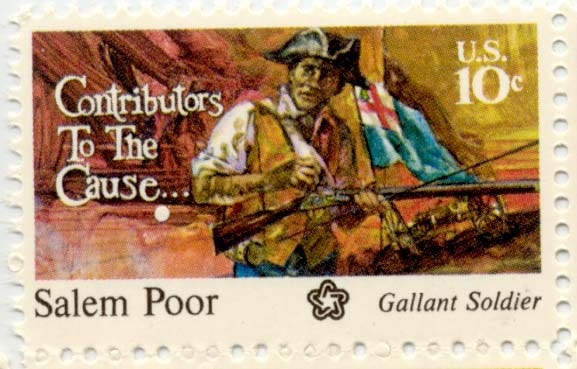
History, however, would not forget his actions at Bunker Hill. As the United States celebrated its bicentennial, the formerly enslaved Andover resident was honored on a 10-cent postage stamp with the tagline: “Salem Poor—Gallant Soldier.”
Thanks for reading. Be a part of the History Buzz community and leave a comment, like, or share this post.
History Buzz is a reader-supported publication. To receive new posts and support our work, consider becoming a free or paid subscriber.
References:
Bailey, Sarah Loring. Historical Sketches of Andover
Bell, J.L. “Peter Salem? Salem Poor? Who Killed Major John Pitcairn?” Journal of the American Revolution. https://allthingsliberty.com/2018/06/peter-salem-salem-poor-who-killed-major-john-pitcairn
Harris, Edward Mosley. Andover in The American Revolution
Mofford, Julia Haines. Andover, Massachusetts Historical Selections from Four Centuries
Philbrick, Nathaniel. Bunker Hill: A City, A Siege, A Revolution
Quintal, George. Patriots of Color ‘A Peculiar Beauty and Merit,’ African Americans and Native Americans at Battle Road & Bunker Hill
Comments
Nothing yet. Say the first thing.
Sign in to join the conversation.