
Welcome or welcome back to History Buzz! If you’re a subscriber to the Buzz, thank you! If you’re new here, or you haven’t become a subscriber yet, hit that subscribe button to have History Buzz delivered directly to your inbox. If you can, please consider a paid subscription to support the research and writing that make History Buzz possible.
In December 2025, we introduced History Center member-donors to an Andover story about the woman suffrage movement. Today on History Buzz we’re rolling out the first of a series of posts expanding on that story. But first, a shout out to “Andover Stories” writers Tom Adams, Gail Ralston, and Jennifer Scheer for their suffrage stories from 2010-2020, referenced throughout these posts.
Woman Suffrage
Full-suffrage for women has been an ember smoldering since America’s founding. Congress began to feel the pressure on the woman’s suffrage front in the 1860s. The looming thought was that the emancipation of women at the ballot box wasn’t a question of if, but one of when.1
In 1797 New Jersey made history by recognizing the right of women to vote. New Jersey women voted in large numbers until 1807, when the Assembly passed a law limiting suffrage to free white males. As the century progressed toward its conclusion, six states and territories would grant the vote to women. This wave of emancipation was pushed, pulled and otherwise cajoled by Woman’s Suffrage Movement.2
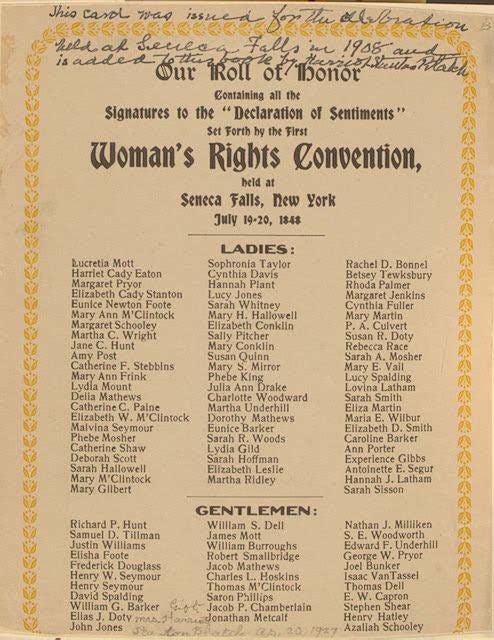
The organization evolved primarily from small groups that met regularly. Group leaders came in with valuable experience, some gleaned from the abolitionist movement, others from Civil War activities. Word of those meetings spread, interest grew and meeting attendance snowballed. The Seneca Falls Convention was the nation’s first dedicated to women’s rights. Emerging suffragist leaders Lucretia Mott and Elizabeth Cady Stanton were the primary organizers.3
Advertised as “a convention to discuss the social, civil, and religious conditions and rights of woman,” it was held in Seneca Falls, New York in July, 1848. It attracted 300 attendees including the former slave, abolitionist, and statesman Frederick Douglass. Seneca Falls was not the first organized large gathering of suffragists, but many historians cite it as the one that launched the suffrage movement.4
By the 1850s, women’s rights activists started meeting more regularly. They held their first national women’s rights convention in Worcester, Massachusetts in October, 1850. Among those suffragist luminaries present were former slave Sojourner Truth, a prominent leader and lecturer. 5
In 1869, the Andover Advertiser reported on a female suffrage convention in Hartford, CT where Henry Ward Beecher made an address.6 He said that,
“Every woman, as well as every man, has a right to develop to the full every power that God has given her. There is no virtuous thing that a man may do that a woman should not do if she is capable.”
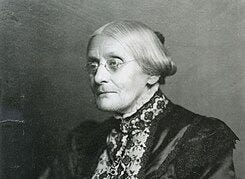
That same year, 1869, Susan B. Anthony established the first united national woman’s suffrage organization. Susan B. Anthony remained the very heart and soul of the movement. Once quoted as saying, “Men, their rights and nothing more. Women their rights and nothing less.” She was an incomparable organizer, lending relevance, inspiration and boundless energy for over half a century. She died in 1906.7
“Men, their rights and nothing more. Women their rights and nothing less.”
The first woman suffrage amendment was introduced in Congress in 1878. Over the next 40 years it was reintroduced to Congress regularly and failed repeatedly. The movement, however, kept pressing forward. The passion, persistence and leadership blossoming within the movement never diminished.8
The 19th Amendment to the United State Constitution was passed by Congress June 4, 1919, and ratified on August 18, 1920.
The right of citizens of the United States to vote shall not be denied or abridged by the United States or by any State on account of sex.
Congress shall have power to enforce this article by appropriate legislation.
Over the next few posts in this series, we’ll take a look at how the woman suffrage issue played out locally, in Andover, Massachusetts.
Thanks for reading!
~Elaine
If you’re a subscriber to the Buzz, thank you! If you’re new here, or you haven’t become a subscriber yet, hit that subscribe button to have History Buzz delivered directly to your inbox. If you can, please consider a paid subscription to support the research and writing that make History Buzz possible.
Tom Adams, “Andover Stories,” Andover Townsman
Jennifer Scheer, “Andover Stories,” Andover Townsman
Comments
Nothing yet. Say the first thing.
Sign in to join the conversation.