
Welcome or welcome back to History Buzz! If you’re a subscriber to the Buzz, thank you! If you’re new here, or you haven’t become a subscriber yet, hit that subscribe button to have History Buzz delivered directly to your inbox. If you can, please consider a paid subscription to support the research and writing that make History Buzz possible.
In December 2025, we introduced History Center member-donors to an Andover story about the woman suffrage movement. Today on History Buzz we’re rolling out the first of a series of posts expanding on that story. But first, a shout out to “Andover Stories” writers Tom Adams, Gail Ralston, and Jennifer Scheer for their suffrage stories from 2010-2020, referenced throughout these posts.
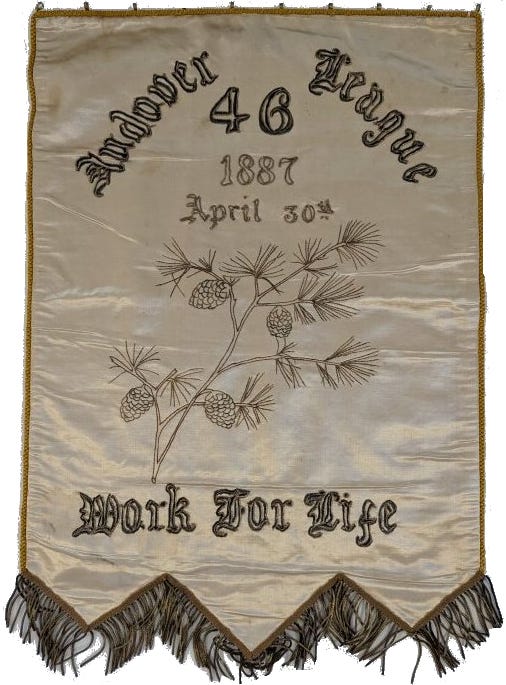
Andover’s first pro-suffrage group – the Andover Woman Suffrage League – was formed before 1887. Members of the group included men and women. The group supported the larger Boston Woman Suffrage League.
“The Andover Woman Suffrage League will have a table of fancy articles as well as useful things, at the Bazaar in Boston . . . (send items to) E.M. Sanborn, M. D., Green Street, Andover.” (Andover Townsman, 1887-11-04)
In 1892, the year of its founding, the November Club of Andover hosted Julia Ward Howe as a speaker, shortly after Howe spoke in Boston.
“At its last meeting, on April 14, the November Club received a visit . . . Mrs. Julia Ward Howe. She was one of the first to discover what a set of women banded together may accomplish . . .She spoke with a quiet humor, and yet with the strength of conviction, upon the vexed subject of women’s suffrage, and made even those who inclined to disapprove it feel if its devotees all possessed the sweet, womanly attractiveness and the dignified grace of this one, it would not be long before at least her own sex would be at one with her upon the subject.” (Andover Townsman 1889-11-14)
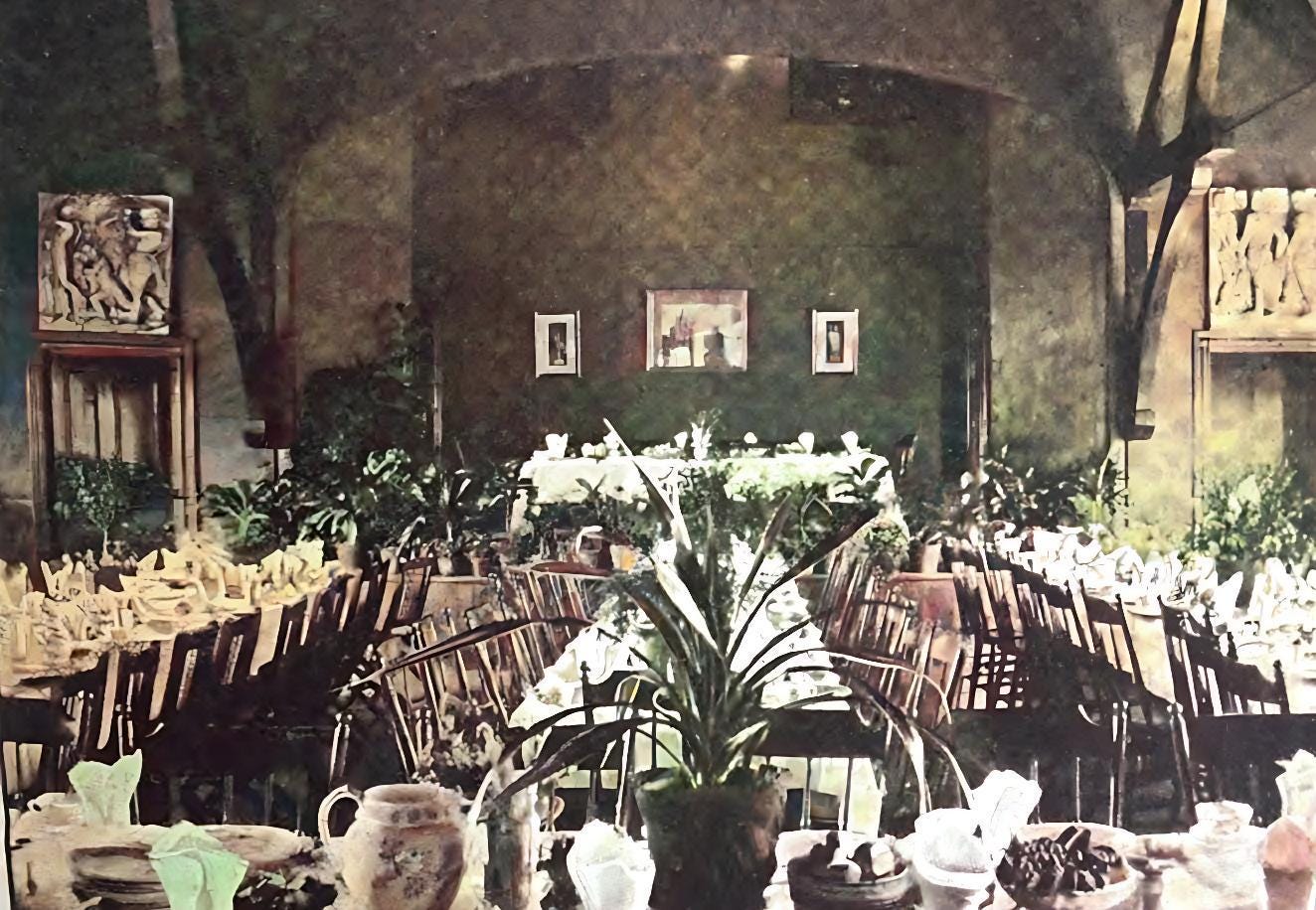
The Andover Anti-Suffrage League was also meeting around this time. The Andover Townsman announced one of their meetings in February 1905.
“There will be a meeting of the Andover branch of the Anti-Suffrage League at the home of Mrs. George W. W. Dove on Phillips Street on Friday afternoon, February 24th at 3:15 o’clock. Miss Porter and Mrs. George will speak.” (Andover Townsman, 1905-02-14)
The Andover Woman Suffrage League eventually became the Andover Equal Suffrage League around 1913.
In February 1913, the November Club hosted a debate on the subject of woman suffrage.
On the pro-suffrage side was Mrs. Susan Fitzgerald, secretary of the Massachusetts Political Equity Union.
Representing the anti-suffrage side was Dr. Ernest Birmbaum of the Massachusetts Association Opposed to the Further Extension of Suffrage to Women.
“The speakers were given several minutes in which to make their rebuttals and many interesting arguments developed. No very unanimous decision . . . was reached as to with which speaker the honors rested, and it was evident from the discussion following the debate that neither . . . succeeded in converting the ladies of the November Club into ardent suffragettes on the one hand, or positive detestators of that new departure, which, is it said is sure to come, on the other.” (Andover Townsman 1913-02-14)
In October 1913, the Andover Townsman ran a series, under the headings of “Why They Should” and “Why They Should Not,” featuring arguments on both sides of the suffrage debate.1
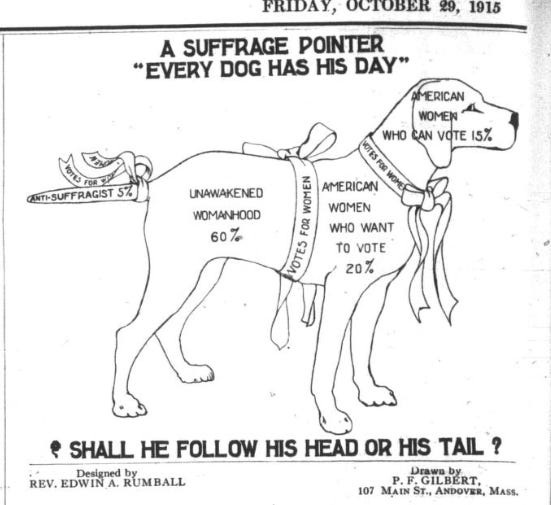
Why They Should
There were eight initial cases in favor of giving women the vote—and they were far-ranging in their scope. Some expanded on Beecher’s reasoning.
“It is in the line of Progress—a natural step in the process of Evolution.” And, “Woman Suffrage is no longer a mere theory. Women already have full suffrage in nine states and the territory of Alaska, and results show that they exercise the right in the main wisely and to the benefit of the community.”2
Other points hearken back to Revolutionary doctrines.
“In a democracy all persons not obviously disqualified should have a voice in the Government and sex constitutes logically no disqualification. Many arguments against Woman Suffrage resolve themselves into arguments against Democracy.”3
And more succinctly, “Many women are taxpayers and ‘Taxation without Representation is Tyranny.’”
The latter argument would become increasingly relevant just a few years later when the War Revenue Act of 1917 significantly lowered the income tax exemption to $1,000 per year (about $25,000 in today’s dollars). As a result, nearly half a million wage-earning women would be affected in addition to the 23,000 who had already been paying income tax under the existing law.4
There was another “pro” viewpoint that spoke to a common concern about granting women to right to vote: that it would take women out of the home and away from their primary role as mothers and homemakers.
“Women as home-makers and mothers need the ballot to ensure the best environment for their children.”5
It should be noted that feminism and women’s suffrage were two distinct movements at the time.
In fact, an article in the Townsman states,
“Being anti-suffrage by no means opposes one to far-reaching feministic conviction as to the individual development of woman. Some of the ablest workers for the cause of women that I have ever met in this country are anti-suffragists…On the other hand, being a suffragist by no means implies being a feminist. Being a suffragist may mean being only enough of a woman to keep up with only that part of the woman questions which concerns itself only with woman’s political enfranchisement.”6
Finally, the pro side maintained that giving women the right to vote was important7:
To protect individual rights: “Women in gainful occupations outside the home need the ballot for their own protection.”
To fully represent the citizenry: “Men and women being unlike the state needs the expression of their differing points of view.”
To better society overall: “All women need the development that comes with larger responsibility and a wider sphere of action; and whatever tends to develop the individual woman is ultimately for the good of the race.”
In our next post, we’ll look at local opposition to woman suffrage, as outlined in the Townsman article, “Why They Should Not.”
Thanks for reading!
~Elaine
If you’re a subscriber to the Buzz, thank you! If you’re new here, or you haven’t become a subscriber yet, hit that subscribe button to have History Buzz delivered directly to your inbox. If you can, please consider a paid subscription to support the research and writing that make History Buzz possible.
Jennifer Scheer, “Andover Stories,” Andover Townsman
Comments
Nothing yet. Say the first thing.
Sign in to join the conversation.