
Welcome or welcome back to History Buzz! If you’re a subscriber to the Buzz, thank you! If you’re new here, or you haven’t become a subscriber yet, hit that subscribe button to have History Buzz delivered directly to your inbox. If you can, please consider a paid subscription to support the research and writing that make History Buzz possible.
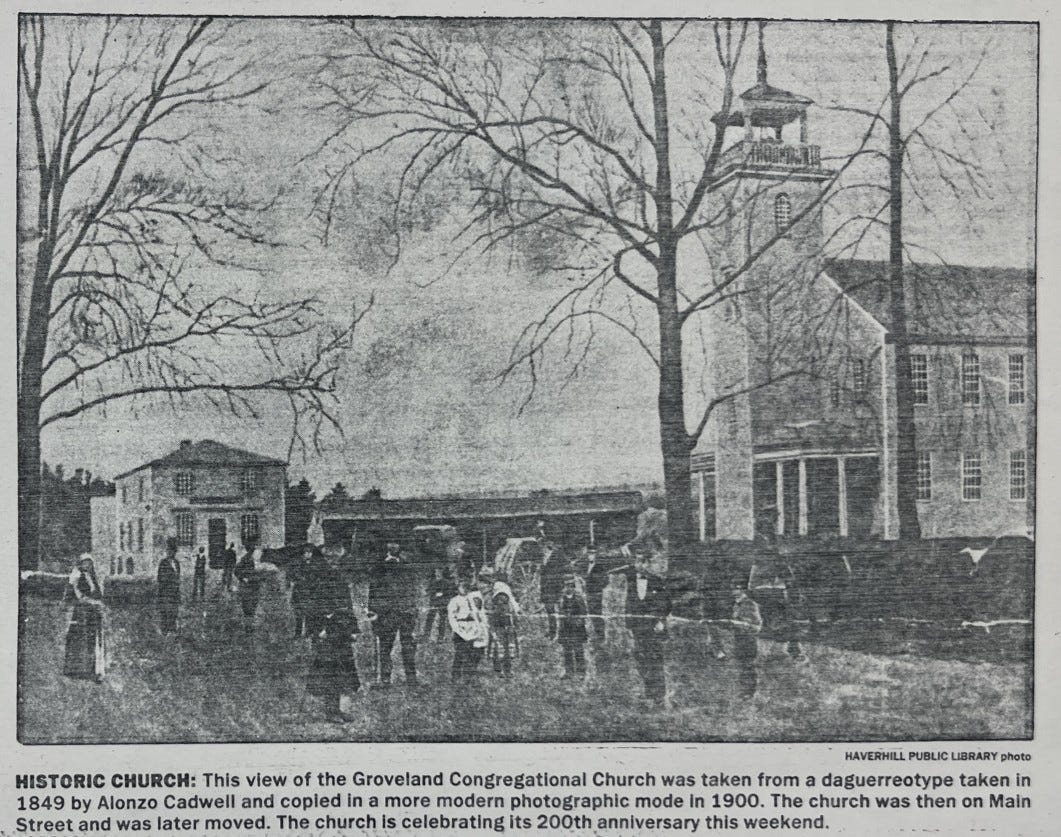
A few months ago, the History Center was contacted by a University of New Hampshire student named Mikayla Tilden who was working on an exhibit for the Congregational Church in present-day Groveland. She read the building contract for their current structure which dates to 1790. The building committee must have really liked Andover’s South Church because they wanted parts of their building to be ‘just like Andover’.
The History Center gave Mikayla digital copy of a daguerreotype of the 1788 iteration of South Church for the exhibit. I searched through the South Church records housed at ACHC to see what I could find about the 1788 structure. Who built it? What plans did they follow?
Of the three church buildings that I learned about in the making of this post, Groveland’s (formerly South Parish in Bradford’s) 1790 congregational church is the only one still standing. The South Church that we all know and love in Andover dates from 1861. North Parish’s current meetinghouse was built in 1836. I’ll explain more about North Parish’s connection later.
The building contract is dated the “sixth of April One Thousand Seven Hundred and Ninety” for the building of a “publick” house of worship for the South Parish in Bradford. The contract, like any eighteenth century legal document, is a chore to read. So I’ll cut to the chase.
“that shall be a porch in the front of said house which [?] the style and end-porch shall be nearly proportioned to the steeple and porches of the south meeting house in Andover... Said building shall be [?] with good [hewn?] stone, at least it shall be as well [?] as said Andover meeting house.”
The South Bradford congregation even wanted to emulate the windows in Andover’s South Parish structure. “There shall be the same number of windows in said house which there is in said Andover meeting house.” Furthermore, the windows and frames needed to be constructed in the same manner as Andover’s South Parish.
Even the desk and sound board inside South Bradford’s building had to emulate Andover. “There shall be a desk in said house with two seats before it and a sound board shall be built in the same form and manner of those in aforesaid Andover meeting house”. It has been said that imitation is the sincerest form of flattery.
Fortunately, the South Church Andover records housed at the History Center are indexed by a comprehensive finding aid. So I found the record book I was looking for very quickly. Paging through the book was an adventure. A generation or more of record keepers used the same book to track church business, life events of the parishioners, and whatever else. They’d run out of room and find the next blank page. At least there are notes all over the place to help the reader follow along.
The record book itself does not say much, giving a brief summary of all the meeting houses used by the church to that date.
I fared better looking in the Historical Manual of the South church which I first found in the history center’s research library. South Parish’s membership began deliberating and dithering over a new, third meeting house as early as September of 1771. Was it going to be on the east side or west side of the “Shawshin” River? In 1771, the west side of the river was favored. On April 14, 1772, the parish
voted to build a new meeting-house sufficient to accommodate the whole parish, and to set it on the eastwardly side of Shawshin River, as near the bridge called Holt’s bridge as a convenient place may be found, and to build said house in ten years from this time.
A dozen years elapsed, and said house still had not been built. Perhaps the Revolutionary War had something to do with it. But, as of 1784, the new meeting house was only going to be within six or 8 rods of the existing (second) meeting house. A committee chosen that year to plan the new meeting house did not meet in earnest until 1787. A deciding vote to accept the plans and proposals for the meeting house took place in December, 1787.
The plan was revised and completed by Hon. Samuel Phillips, Jr., Mr. Joshua Chandler, Mr. Nehemiah Abbot, Mr. Jonathan Cummings, Capt. Jonathan Abbot, Capt. Daniel Poor, Mr. Joseph Stevens, Jr., Mr. Joseph Holt, and Capt. Benjamin Ames.
South Parish’s third meeting house, 70 feet in length and 54 feet wide, held its first worship service on December 7, 1788. Seventeen years later. I think I know why the scrivener devoted only a few lines to something so momentous.
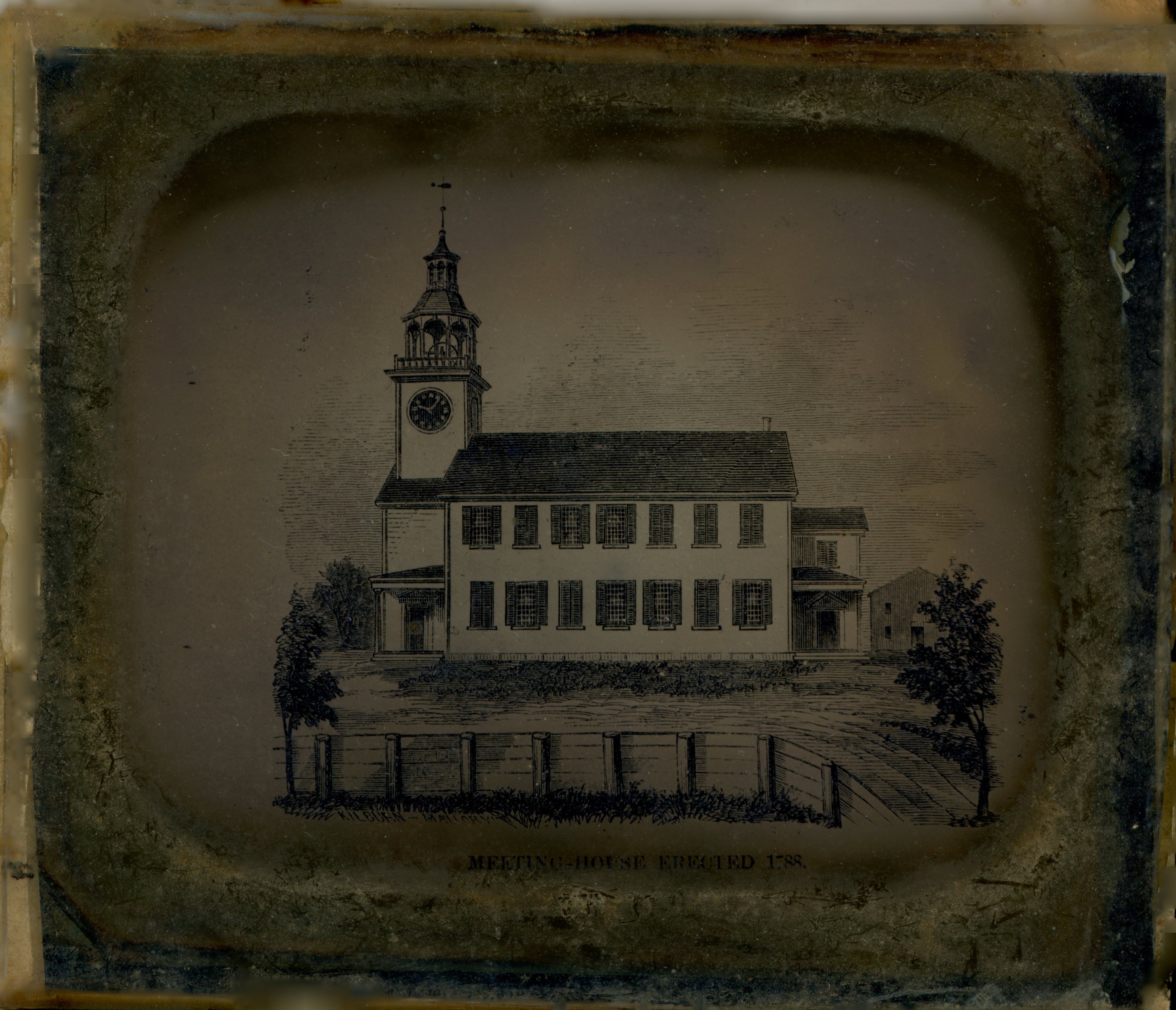
South Parish’s planning committee of the 1780s looked to the meetinghouse in North Parish for inspiration. In summary, South Bradford copied Andover’s South Parish which, in turn, took its cue from another parish in the same town.
The meetinghouse that started it all, North Parish’s fourth one, was finished in 1753. And the process seemed far more efficient than what happened in South Parish. The thrifty parishioners reused as much of the old structure as they could.
Neither meeting house in Andover came to a bad end. There was no fire, lightning strike, or other act of God that caused their destruction. As the population grew, more space was needed. Juliet Haynes Mofford wrote that the Puritans were constantly renovating and refurbishing meetinghouses to make them more stylish.
And yet, some North Parishioners felt that painting their new digs was an unnecessary luxury. It does not help repair the Puritans’ reputation for being humorless and dour.
Of all the articles and blogs I have written, this one was the second-most daunting. There are loads of stories of South Parish and South Church and both institutions loom large in Andover. Plenty of other people have been sharing that history. But I’m a resident of the now-defunct political entity of South Parish. Eventually, I’d be delving into South Church’s past.
If you’re a subscriber to the Buzz, thank you! If you’re new here, or you haven’t become a subscriber yet, hit that subscribe button to have History Buzz delivered directly to your inbox. If you can, please consider a paid subscription to support the research and writing that make History Buzz possible.
History Buzz is a reader-supported publication. To receive new posts and support our work, consider becoming a free or paid subscriber.
Further Reading:
Historical Manual of the South church in Andover, Mass. 1859. Available at area libraries but it seems like no copies can be taken home. It is also on the internet archive. https://archive.org/details/historicalmanua00massgoog
Juliet Haynes Mofford. The history of North Parish Church of North Andover, 1645-1974 : and firm thine ancient vow. (available at area libraries)
Bernard Trubowitz. The People in the Pews: The Sounding Board. Old North Church April 20, 2016 https://oldnorth.com/blog/the-sounding-board/ (accessed July 2, 2026)
Gail Ralston. The Town was the Church and the Church was the Town. Andover Stories February 27, 2020. https://andoverhistoryandculture.org/andover-stories-blog/the-town-was-the-church-and-the-church-was-the-town (accessed July 4, 2026)
Comments
Nothing yet. Say the first thing.
Sign in to join the conversation.