
Taken at the conceptual level, ‘courage’ in Shakespeare is essentially what it is in the major English writings of the preceding generation. For instance, Sir Thomas Elyot’s The Boke Named the Governour, first published in 1531, and Sir Thomas Hoby’s translation of Baldassare Castiglione’s Il Cortegiano, or The Book of the Courtier, which at first appeared in the original Italian in 1528, three years prior to Elyot’s Governour. Throughout Shakespeare’s dramatic writings the word ‘courage’ occurs some seventy times, ‘courageous’ ten times, ‘courageously’ twice. Those occasions in which though the word itself is not used but the principle or ethos of courage is manifestly present must be virtually beyond computation, at least with the luddite mechanisms employed by the electronically-challenged minority to which I belong.
In Shakespeare the word ‘courage’ occurs most thickly in the English Histories, after that come the major Tragedies, but the Comedies and late Romances are also represented. Indeed, to revert for a moment to the idea or ideal of courage, with or without the sanction of the word itself, I would suggest that it is an eminent distinction in the major Comedies and the Romances of Shakespeare, and is particularly associated with the patience and resourcefulness of women. Viola in Twelfth Night, Rosalind in As You Like It, Helena in All’s Well That Ends Well, Imogen in Cymbeline, Marina in Pericles - these are women of courage whose names spring immediately to mind.
In attributing qualities of courage, not only to young unmarried women, but also to matrons and the middle-ages (Hermione and Paulia in The Winter’s Tale, Queen Catherine in Henry VIII) Shakespeare gives his own impresa to a style of psychological and moral address already established and which he could have encountered - there is little or no direct evidence that he did - in Hoby’s translation of Castiglione. The first thing we notice when we collate Hoby’s version with Castiglione’s original text is that Hoby employs the word ‘courage’ to represent a variety of Italian words and phrases. At times it stands in place of the humanist key-word magnanimità, as when Hoby writes ‘stoutnesse of courage’. Magnanimità warrants an editorial footnote in my edition of the text, ‘Stoutnesse of courage; c.f. Magnanimity in the Aristotelian sense of the entire greatness of life’. Hoby employs the phrase ‘noble courage’ to translate magnanimità, he employs the phrase ‘verie courage’ to render la vera magnanimità and so on. The great protestant educator Sir John Cheke, who tutored the young Prince Edward, later Edward VI, provided a brief letter to go with the prefatory matter in Hoby’s Book of the Courtier. It is dated 16 July 1557 and is addressed ‘to his loving frind mayster Thomas Hoby’, and stands in the text where testimonies of commendation are generally placed. But the letter is as much mild reproach as it is praise. It is clear that Cheke would have preferred Hoby not to use words from other European languages, and to use instead, as he says, ‘our own tung shold be written cleane and pure, unmixt and unmangled by borrowing of other tunges.’
It is a happy irony that Shakespeare, who from Cheke’s purist stand-point, would be seen as one the arch adulterators of our tongue (‘the multitudinous seas incarnadine’), could also achieve his greatest effects with English written ‘cleane and pure’. Regarded from Cheke’s narrow angle of vision that distrusted any foreign words brought into English, the word ‘courage’ itself would have to be seen as borrowed from another ‘tung’, even though the primary senses had been established in England by the end of the fourteenth century. The OED cites ‘courage’ as a common Romanic word, answering to a latin type, coraticum, from cor (‘heart’). Its basic etymology is the heart as the ‘seat of feeling, thought, mind, spirit, disposition, nature’. The OED asks us to consider the sense of the phrase ‘to tell all one’s heart’ which is a parallel sense to ‘to speak one’s mind’. The modern sense, which is ‘that quality of mind which shows itself in facing danger without fear’, was established by the third quarter of the fourteenth century. To Hoby’s Castiglione translation the OED gives the first recorded citation of ‘courage’ as used as synecdoche or taking the part for the whole: ‘The prowesse of those divine courages’ meaning, in this sense, the prowess of those persons of divine courage.
At the heart of Castiglione’s ideal of the animo generoso stands the imperative of self-knowledge. In Hoby’s mid-sixteenth century English, ‘therfore a fond person,’ by which he means a fool, ‘can not be said to be stouthearted but verie courage in deede commeth of a propre advisement and a determined will so to doe’. Now this is the ‘verie courage’, I suggest, of Viola in Twelfth Night, of Rosalind in As You Like It, of Helena in All’s Well that Ends Well, of Imogen in Cymbeline, of Marina in Pericles, of Hermione and Paulina in the Winter’s Tale, and of Queen Catherine in Henry VIII. Courage without self-knowledge is obstinacy, as it is with Coriolanus in Shakespeare’s play of that name.
Now there are numerous forms of courage that Sir Thomas Elyot in The Boke Named the Governour qualifies by either a verb in the infinitive or an adjective preceding or following. Let me give you some examples, all taken from Elyot: ‘gentill courage’, ‘courage to studie’; ‘martiall courage’; ‘valyaunt courage’; ‘wanton courage’; ‘noble courage’; ‘courage inuincible’; ‘furye or rage whiche they calle courage’; ‘valiaunt and fierce courage’; ‘desperate courage’ ; ‘vertuous courage’; ‘courage and appetite’; ‘inuincable courage’; ‘excellent courage and vertue’; ‘the stubbourne courage of an obstinate seruaunt’; ‘vile courage’; ‘the courage of all men inclined to vertue’. Looking at Shakespeare’s plays in relation to that list, I would say that Hector in Troilus and Cressida represents ‘gentill courage’, and Troilus at the end of that same play manifests ‘desperate courage’, Richard III in his last scene, fighting to the death against his victorious opponent is ‘desperate courage’ also, Macbeth and Lady Macbeth, I suggest, represent what Elyot calls ‘vile courage’ (‘But screw your courage to the sticking-place, / And we’ll not fail’).
There are plays by Sheakespeare of which it is possible to say that he wrote this with such-and-such a volume on his desk. For the English history plays, one can say that it was Holinshed’s Chronicle, for Coriolanus and other of the Roman plays, one can say that it was Thomas North’s English translation of Plutarch. With the two works so far considered, Castiglione as translated by Hoby and Elyot’s The Book Named the Governour, I can make no such obvious and well-founded claim. I can say no more than that each of these two books modifies and enlarges the expository and debating language of their time, the language that Shakeapere directly inherited. Each is a book of polity, having to do with the training of princes, and their chief magistrates, who are the ‘governours’ of Elyot’s title. In his imaginative makeup Shakespeare was a populist and an elitist; he was a Christian stoic and an opportunist; and I deduce that the intellectual-elitist-opportunist energies of works such as Elyot’s Governour and Hoby’s Castigilione would have fed directly or indirectly into Shakespaere’s appetite for writing plays.
In the fourth book of The Courtier, in its English translation, we read ‘He that can commaunde, is always obeyed. And to commaunde is evermore the principal office of princis which notwithstandinge ought manye times also to see with their eyes and be present at the deede doynge.’ In short, a prince is right to delegate but needs to get his hands dirty from time to time. It takes only a small re-distribution of emphasis and you have Machiavelli’s Il Principe, though one adds that Castiglione does not make the same kind of recommendation to action as his Florentine contemporary. Castiglione test-word is magnanimità, Machiavelli’s is virtù. It is not that Castiglione scorns virtù but that he distrust the use of that word in certain political contexts.
Shakespeare’s political characterisations seem to inhabit a middle ground between magnanimità and virtù. The prince Hal of Henry IV parts I and II who becomes Henry V in Shakespaere’s brilliant, cold pageant play of that name, is a glittering instance of this. He undertakes war with France from a standpoint of manifest cynicism, following the deathbed precepts of his desperately cynical father:
Therefore, my Harry,
Be it thy course to busy giddy minds
With foreign quarrels…
Pre-empt domestic revolution and trouble by turning everybody’s attention to the kind of plunder they can get in a foreign war. And yet both before and after the battle of Agincourt he is portrayed by Shakespeare as a figure of magnanimity, as the animo generoso, in his exchanges of words with the common soldiers of his own army and in the marriage negotiations with his prospective in-laws, the royal family of defeated France.
Are we intended to draw up a trim ledger here, seeing how or if we can balance out virtù with or against magnanimità? I think not. Shakespeare’s strongest grasp of human creatures is revealed in the way his imagination seizes on the ambiguities in their individual natures or their circumstances. These are not terms which I would apply either to Castiglione or Machiavelli or Elyot. Castiglione and Machiavelli are ironists, by which I mean that they automatically assume the latent, inveterate nature of human fallibility in their presentations of ideal perfection. Of course, they work from opposite ends of the political spectrum; Castiglione purporting to think the best, and Machiavelli purporting to think the worst of human motives. Sir Thomas Elyot was a survivor in the court of Henry VIII, the protege of, successively, Cardinal Wolsey, Thomas Cromwell and Sir Thomas More. Wolsey died disgraced, Cromwell and More were beheaded, Elyot died in his bed. He must have been an ironist too.
In the closing pages of The Courtier, one of the participants in the conversazione celebrates love as:
‘Thou the most sweete bonde in the worlde, a meane between heavenlye and earthlye thynges, wyith a bountifull tempre bendest the high vertues to the government of the lower, and tourninge backe the mindes of mortall men to their beeginning, cooplest them with it’
Hoby’s translation introduces an unwitting ambiguity in one phrase - ‘bendest the high vertues to the government of the lower’. Hoby’s English, spiked on the syntactical ambiguity of the possessives of ‘to’ and ‘of’ might as well be saying that love causes the higher virtues to be governed by the baser motions. We all know this to be a fact of life. There are several passages in The Courtier that acknowledge that there is in our minds a variance between knowledge and greedy desire. We also know that Platonic reverence and awe can, with fatal ease, be diverted, debauched, into sensual love. But these acknowledgements do not change the fact that Hoby’s ‘bendest the high vertues to the government of the lower’ is an obtrusive accident of syntax.
In Othello, more terribly, more benightedly than in any other of Shakespeare’s plays we witness the high virtues bent by the agency of Iago to the government of - that is to be governed by - the lower, indeed the lowest, the basest instincts or appetites. One often hears characters such as Iago referred to as Machiavellian, but they are not so really. The men of devilish cunning and adamantine malign will, are types that the dramatists of Shakespeare’s day took more from the anti-Machiavellian propagandists, hostile parodist of Machiavelli, than from the man himself. Although Il Principe, first printed in Rome in 1532, with the sanction and favour of the Pope, remained publicly untranslated into English for more than a century (the first printed translation of Il Principe was in 1640 on the threshold of the English civil war), nonetheless it was being read in England by aristocrats such as Lord Morley and pre-eminent statesmen such as Thomas Cromwell very soon after it had appeared from the presses in Italy. Shakespeare’s Henry IV and Henry V and perhaps the Duke in Measure for Measure, negotiate more closely and coolly as students of the small Italian treatise.
Having said that, I acknowledge that Machiavelli did something to the concept of virtù in 1532, to differentiate it, even alienate it, from the resonances given to it by Castiglione four years earlier in 1528. In Castiglione virtù is one of the types of courage which can be interpreted as the will and capacity to hold fast to la virtù superna. If you detect a tautology here it is not I think accidental, because virtù for Castiglione is the capacity to act virtuously. It is virtue in action, acting with courage, having that ‘the courage of spirite whiche we seke to have in our Courtyer’, as Hoby renders it. In Machiavelli, and here I draw heavily on L A Burd’s splendid 1891 edition of Il Principe, the term is part of a collocation per fortuna o per virtù, which appears repeatedly in Machiavelli’s writings, not only in Il Principe, but in the Discorsi also. Burd observes that for Machiavelli ‘virtù corresponds in some degree to the French habileté: any man who by his abilities, tact, and dextrous management of men and things attains his end, is said to possess virtù; the character of the means he employs or the object he attains are indifferent’. In the Discorsi virtue in one place signifies the ability of the legislator, in another it is applied to the achievements of Hannibal, whom Machiavelli nonetheless describes as ‘empio’ (pitiless) and ‘crudele’ (cruel as a tyrant is cruel).
Among the Shakespearean characters who exemplify virtù in the sense of habileté, or tact and dextrous management, I would give a conspicuous palace to Vincentio, Duke of Vienna, in Measure for Measure, who, sickened by the city’s corruption, which in office he has failed to curb, pretends to leave on an urgent diplomatic mission, handing the reins of government to his sanctimonious deputy, Angelo. The Duke does not in fact leave the city but, disguised as friar, stays to keep an eye on governor and governed. His words in the close of Act I, Scene III, ‘hence we shall see, if power change purpose, what our seemers be’ anticipate his quasi-choric conclusion to Act III. Having rapidly discovered the attractions of lust, Angelo has decreed that unless Isabella has sex with him, her brother Claudio will be put to death (he intends to put him to death anyway). The Duke discovers Angelo’s intention and says at the end of chorus-like soliloquy
Craft against vice I must apply:
With Angelo to-night shall lie
His old betrothed but despised;
So disguise shall, by the disguised,
Pay with falsehood false exacting,
And perform an old contracting.
Duke Vincentio, that is to say, has encouraged a forlorn lady, whom Angelo had jilted, to take Isabella’s place in Angelo’s bed. Vincentio’s counter plot succeeds, not quite as Machiavelli prescribes, per fortuna o per virtù, but rather per fortuna e per virtù. Angelo is pardoned and marries the jilted lady; Claudio is saved; the Duke weds Isabella. The clue to this type of Shakespearean comedy is emblematical as I see it in the change of the Italian o to e, from the ‘or’ to the ‘and’. Commentators like to stress the Christian nature of this play, ‘judge not that thee be not judged; for with what judgement ye judge, ye shall be judged, and with what measure ye meet, it shall be measured unto you again’, Matthew 7:1 in the Geneva Bible version of 1560. Commentators also see it as a play about the nature of equity, which was on people’s minds then, partly because Catholic recusants and Calvinist separatists both appealed to it, seeking to mitigate the punitive inflexibility of the Church of England in the matter of obligatory church attendance. Those who appeal to the Sermon on the Mount, and those who appeal to the Court of the Star Chamber where equity suits were heard, unite in their conclusion that Measure for Measure shows a sense of dissatisfaction with its own dramatic mode, concentrated in its notoriously troublesome final scene, and a predominant harshness of tone, a savagery even, in its clowning. I have elsewhere committed thoughts to print on this perplexity, and I beg you to allow me to quote myself on it:
As with the Gospels, which it is allowed to resemble,
in Measure for Measure moral uplift
is not the issue. Scrupulosity, diffidence,
shrill spirituality, conviction, free expression,
come off as poorly as deceit or lust.
The ethical motiv is – so we may hazard –
opportunism, redemptive and redeemed,
case-hardened on case-law, casuistry’s
own redemption; the general temper
a caustic equity.
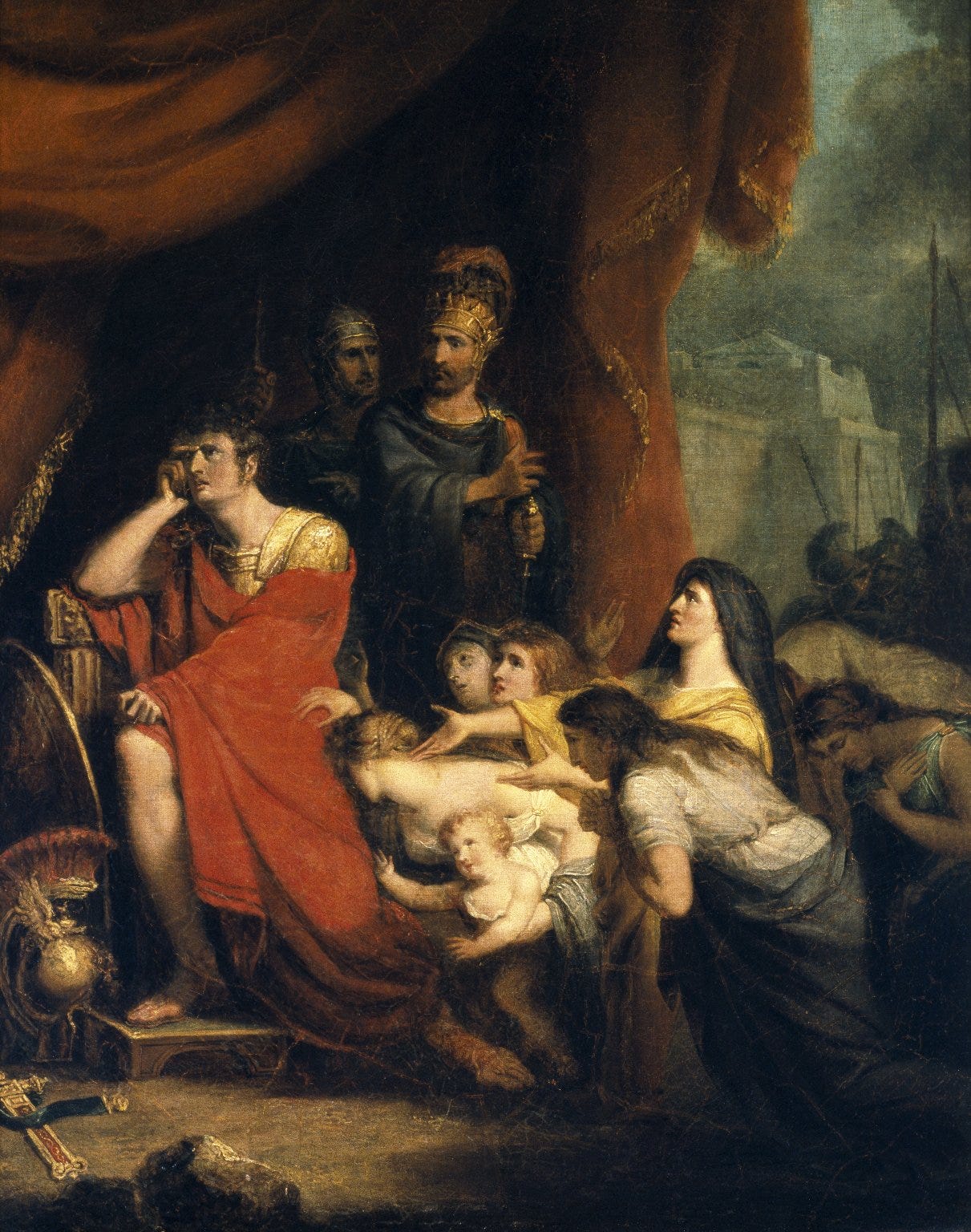
Another illustration of this theme, courage in Shakespeare, moves us on a few years from Measure for Measure in Shakespeare’s chronology of work, to 1608 and the writing and staging of that violently enigmatic, expansively cryptic study of misconceived, misguided, misanthropic, inordinate courage, The Tragedie of Coriolanus. There is no arguing against the facts of the matter: Coriolanus displays the unconquered prowess in arms that is Castiglione’s princely ideal. In fact, Sir Thomas Elyot cites Corilanus in Book 3, Chapter 17 of The Boke Named the Governour, simply as an exemplar of valiant acts and of a becoming modesty in victory. Elyot however truncates a fable which originates with Dionysius of Helicarnassus, with Livy and Plutarch. Now in all three of these authorities, Coriolanus’ early and triumphal prowess in arms is marred by a singular failure to understand himself, a failure that terminates in his becoming a traitor to his city, Rome, and to his own cult of courage and fortitude. As Sir Thomas Elyot notes in the heading and opening sentence to Book 3, Chapter 14, of The Governour, of magnanimity which may be named valiant courage:
MAGNANIMITIE is a vertue moche commendable, and also expedient to be in a gouernour, and is, as I haue sayd, a companyon of fortitude.
Note particularly that Elyot says ‘commendable and also expedient’. Coriolanus is prowess without magnamity, as Othello is magnamity without discretion. The major sense of that second term ‘expedient’ established by 1398 was ‘conducive to an advantage in general, or to a definite purpose, fit, proper or suitable to the circumstances of a case’. The OED does not recognise the depreciative sense ‘useful or politic as opposed to just or right’ any earlier than 1774. One enters a caveat here of course; the common thoughts and common practices which eventually bring about a shift of meaning probably - almost certainly - appear in human minds and motives for generations before official etymology catches up with them and confirms the shift. The gravitational pull of original sin ensures that a preferring of the useful or politic over the just and the right remains a staple of human conduct across the centuries. There is a persistent credibility gap, so to speak, between official descriptive language and human behaviour. Shakespeare’s contemporary, Francis Bacon, in a strikingly sober appraisal, commended Machiavelli for cogently and succinctly drawing attention to this gap between what men ought to do and what they do in fact.
This is the area in which I find Shakespeare most characteristically activates his imagination. The age in which he worked was rich in volumes of official descriptive language; the courtesy books, the books teaching the elements of rhetoric, the official histories such as Polydore Vergil’s Anglica Historia, More’s History of Richard III, Holinshed’s Chronicles and Grafton’s A Chronicle at large, and the Greek and Roman histories that were like oblique commentaries on English politics and politicking, or at least were read as such. Sir Thomas North’s Plutarch, Suetonius’ History of the Twelve Caesars translated by Philemon Holland in 1606. Shakespeare’s dramatic genius is to take the domain of maxim and axiom, of motto, emblem and moral fable, as they stand in relation to courage, and refract it through the medium of human behavioural heterogeneity. And one of my closing gestures, in a lecture entitled ‘Courage in Shakespeare’ would be to point to the linguistic prowess, the semantic magnanimity, the virtú with which genius in Shakespeare enacts itself in the arena of words and deeds.
I find myself having to return to a basic question regarding harmony or disharmony between intention and expectation in life and art. In a work in the high order of Coriolanus, for example, one senses the author’s imagination as a kind of fulcrum which enables him to get a purchase on two disparate kinds of massive, inert weight. There is the inertia of the story itself, the energy needed to simply get the action started and off the ground. The wretchedly familiar experience of writer’s block is intimately connected with this manner of purchase. The inert weight has got to be moved the first few inches, so to speak, and this can prove intolerably difficult. The other kind of inert mass is the expectation, or the taste, the demand for relevance and accessibility in whatever period the author is writing. The desire in our case to smear our disgusting empathy over one or other character instead of giving humble attention to the entirety of the play’s discourse. The voice of Shakespeare is the play in its entirety, the play itself.
What I say about the fulcrum and the inert mass is a metaphor that applies as well to King Lear, or The Tempest, or Troilus and Cressida or Timon of Athens or Richard II, as it does to Corilanus. Shakespeare never ceases to be aware of what is demanded of him both justly and unjustly. But Coriolanus stands a little apart from those writings in its unremitting concentration on the death struggle between actor and audience, between freedom and demand, between being and appearance of being. I feel that to some extent the tragic circumstances of the other great tragedies involve a metaphysics of the spirit. Indeed, Anthony and Cleopatra glories in this fact. The glory is in the language of the last Act. But Corilanus is without spirit as we are disposed to consider the human spirit in those other plays. It lacks the metaphysical dimension. I state that not as a complaint but as a fact. The integrity of the play is all the more vindicated by the discovery of a blank area where we expect to find a meaningful moral structure, and I would say in conclusion that Shakespeare’s courage as an author, as a handler of language and concept, is the courage of allowing those blank areas to exist even when the audience is demanding a meaningful moral structure.
No posts
Comments
Nothing yet. Say the first thing.
Sign in to join the conversation.