
A title like ‘War and Poetry’ is enough to reduce any prospective lecturer to paralysis. There was a period when I was trying to prepare this talk in which I seriously thought I would take fifty themes, and give to each theme one paragraph lasting one minute. I think you would have enjoyed this far more than the lecture you are going to hear. You would have been entertained. Consider the kind of theme I could have touched on: The Iliad as understood by twentieth century writers with particular reference to Simone Weil and the versions of Christopher Logue; Seventeenth century English approaches to The Aeneid, culminating in a discussion of the poetry and politics of Tony Harrison, who is indeed a very good classical scholar and who has written a very fine essay on seventeenth century English translations of Virgil; English poetic responses to the Thirty Years War, starting with John Donne’s ‘A Hymn to Christ at the Author’s Last Going into Germany’, going on through Fanshawe’s great Ode and finishing with Thomas Carew’s and the Caroline masques; Walt Whitman and Herman Melville as poets of the American Civil War; Thomas Hardy and A E Housmann as poets affected by the Boer War; Keith Douglas in relation to Isaac Rosenberg, whom he so greatly admired… why not poetry of the French Résistance 1940-1944?
As I say, I could have provided you with a lively fifty minutes with one paragraph given to fifty topics floated in that kind of way. I am afraid I have been very timid and settled for a kind of middle way, which is always a mistake. In politics people say one such stick to the middle way, but in lecturing I think it is fatal. And your worst fears will be realised by the time I have got to the end of the first page on my script which I now begin.
‘Since 1918 I have been deeply interested in Freudian psychoanalysis as being a possible corrective for my shell-shock, which had just returned, and I was thinking of putting myself under treatment.’
Robert Graves, Poetic Unreason (1925)
‘The late Dr. W. H. R. Rivers, in his Conflict and Dream, supports the main contentions of this book.’
Robert Graves, Poetic Unreason (1925)
W H R Rivers, the anthropologist and psychologist, as I am sure you know, had been on the staff of Craiglockhart military hospital where both Graves and Owen received treatment for post-traumatic stress disorder, as it is now called. I have to say that the clinical assistance that Rivers was able to offer Graves in the attempt to come to grips with his creative process has always seemed to me neither insightful nor helpful. What matters is that Graves conceived it to be so. Moreover, the fundamental premise in Graves’ approach, that poetry is in some way intimately involved in and expressive of psychic shock or mental conflict, is one that over the years has resulted in some significant poetry being written, not only by Graves. It is a position I am willing to explore in the sense that one may be said to be willing to explore or mine a stratum of possibility that might finally yield some distinct and positive result, positive in the sense of demonstrable not of ‘looking on the bright side of life’.
Graves developed the notion of shocked and conflicted feelings into one of semantic and syntactic tension, conflict and ambiguity in a once widely known analysis of a Shakespeare sonnet, a form of analysis which pre-dated William Empson’s Seven Types of Ambiguity (1930), a matter which Empson briefly acknowledged in that book. Here the issue becomes a little complicated; bear with me, as my American dentist used to say before starting on root canal work.
Empson’s acknowledgement was to a book of joint authorship, Laura Riding and Robert Graves’ A Survey of Modernist Poetry (1927), rather than Graves’ own On English Poetry: Being an Irregular Approach to the Psychology of this Art (1922), or to his Poetic Unreason (1925). The tortuous and at times acrimonious record of the business can be followed in pages 424-436 of Selected Letters of William Empson (2006).
Though Laura Riding brought extensive refinement and development into the initial perception, and in a real sense made it her own intellectual property, the property which like Schoenberg with his twelve-note system she most jealously guarded, the fact cannot be disputed that in 1922 in his book on English poetry some four years before he was aware of Riding or her work, Graves had written of John Webster’s line in the Duchess of Malfi ‘Cover my face; mine eyes dazzle; she died young’:
‘...that the word ‘dazzle’ does duty for two emotions at once, sun-dazzled awe at loveliness, tear-dazzled grief for early death’
And again you can find that (I say this for scruples sake) in the letters of William Empson, though in fairness to myself it is something that I read independently in Graves own book thirty or forty years ago.
The significance of this preliminary excursus to my main theme is, I trust, apparent. It is that, notwithstanding the three-personed contention about the matter, and notwithstanding later refinements of process by Laura Riding, a critical method of analysis overwhelmingly persuasive through the 1930s, 40s, 50s rawly originated in an ex-soldier-poet’s post-traumatic stress disorder, his clinical treatment, and his insight that there seems a profound connection between stress in the clinical sense, and denotative and connotative stress in poetic rendering and structuring.
But for a couple of qualifying factors supplied by the poet himself, I think Rivers’ ideas could have misled Graves into a path lacking exit, away from the desired result, which is an understanding of poetic process. What Rivers writes in his Conflict and Dream is:
‘I believe that only when poets and other artists have set to work to analyse the products of their artistry can we expect to understand the real mechanism of artistic production.’
Our reception of this idea, our sense of its creative applicability beyond the range of the therapeutic, depends on what we suppose Rivers to mean by ‘analyse’ and by ‘mechanism’ and by a slightly later phrase of his, ‘the immediate unelaborated product of the poet’s mind’. And further it depends on what we suppose Graves to mean when he writes in 1925, ‘poetry presupposes conflict in the poet’s mind of which this poem is the expression or the expression of its solution’. Now I sense that Rivers means by ‘real mechanism of artistic production’ the real individual psychosis, as opposed to broad cultural assumptions concerning the whole field of ‘tacit pledges’ with which Henry James engaged in his novels and prefaces. And it seems further that Rivers’ word ‘analyse’ means the application of Freudian psychoanalytical methods.
Rivers was concerned to take over into Graves post-war life as a poet and critic, the procedures he developed at Craiglockart while treating Graves and many other shell-shocked officers (it was an officers-only establishment). Had Graves kept strictly to Rivers’ field of exploration and reference, I believe that he would have found himself in a creative cul-de-sac. Fortunately, and still without assistance from Laura Riding (this was prior to 1926) he hit upon the notions of ‘nucleus’ and ‘embodiment’. In a key chapter of Poetic Unreason, the ‘secondary elaboration’, as it is called, he examines several drafts of one of his recent poems and draws from them the resumé of creative method:
‘The poet, I should say, became aware of a certain nucleus, a group of words embodying some phase of a conflict with which he was at the time concerned, and which suggested the outline of a poem’
This is still perilously poised. If all we are to perceive from analysis is a poem’s outline, I do not see any great benefit accruing to our understanding of how a poem comes to be itself. How the position shifts for Graves from theoretic-analytic nucleus to what is, in a broad sense, a semantic nucleus is revealed, or so it seems to me, on page 19 of that same book, Poetic Unreason. At this point Graves ridicules the emotive pre-conscription recruiting poster ‘Your King and County Needs you’ by recording that the slogan became ‘a trench joke for pulling corpses out of sand pits by their boots’. This observation is so precisely paralleled by a book that appeared five years later, Brophy and Patridge’s annotated anthology, Songs and Slang of the British Soldier 1914-1918, that I would find it extraordinary if I were told that these two authors were unacquainted with Graves’ book. On pages 193-4 of the first edition we find:
‘As time went on the soldier began to produce his own sayings, even as he produced his own songs, to help him through his cataclysmic days. In his first disillusionment, he turned and picked up some of the fine phrases which had stirred his heart into the patriotic desire to enlist. ‘Kitchener Wants You!’ became a method of telling a man he had been selected for some especially disgusting, arduous or dangerous duty. ‘Remember Belgium’ was heard with ironic and bitter intonations in the muddy wastes of the Ypres salient.’
Brophy and Partridge also assess the widespread use of obscenities by the fighting troops, in particular the word ‘fucking’ and related sexual obscenities. Their most telling observation - telling at least for the ideas I wish to develop - is on page 17 of the first edition:
‘It became so common that an effective way for the soldier to express emotion was to omit this word. Thus if a sergeant said ‘Get your fucking rifles!’ It was understood as a matter of routine. But if he said ‘Get your rifles!’ there was an immediate implication of urgency and danger.’
Now the passage, as I have just read it, does not stand thus in Brophy and Partridge’s book. The word ‘fucking’ does not appear anywhere in it, though ‘ —ing’ together with several sentences of leaden periphrasis, culminating in the statement ‘the adjectival form was the commonest, but the root word is a verb meaning to copulate’. The periphrastic way is also followed for a ‘female genital organ’ and ‘the filthiest in origin of all three words’ which of course, as you will have realised, is the word ‘bugger’.
I must not be sidetracked into discussing the tragi-comic processes attending the progress of Ulysses and Lady Chatterley’s Lover, roughly speak contemporaneous with Songs and Slang of the British Soldier, except to remark on the virtually impassable barriers that linguistic censorship imposed on Brophy and Partridge’s thesis. They wished to indicate the impact of the war, which they call ‘an experience so widespread and deep-sunk’, on the subsequent weighting and texturing of the English language, which they refer to as ‘probably the most imaginative and sensuously exact language of all, it is continually unfolding springs of metaphor within itself.’ Yet they cannot print the words that show the sensitive development of this language. I would even suggest that seen in the light of these remarks, what one can draw from Henry James’ pre-war Prefaces is likely to be of as much use to poets comprehension of stress as are the clinical writings of W H R Rivers, greatly though I esteem him.
I am not saying that we are better as a society for having been made legally entitled to use gross sexual obscenities without fear of prosecution. What we are bound by now, and here I admittedly become grossly contentious, is our living and amorphous power system of the kind that William Morris, speaking in 1883 in this university, called ‘Anarchical plutocracy’ against which force of degradation Yeats’ definition of the ‘Gyre’, or the definition of the ‘vortex’ as propounded by Henri Gaudier-Brzeska and Wyndham Lewis, could be called systematic attempts to convert negative into positive agglomerations.
In the conduct of this particular argument, that is my argument given now in this lecture, I propose citing a sentence from yet another lecture given originally in this university, by A C Bradley, during his tenure in the Chair of Poetry in the first decade of the twentieth century:
‘The essentially tragic fact is the self-division and intestinal warfare of the ethical substance, not so much the war of good with evil as the war of good with good’
If one were to attempt, and it would be I concede a somewhat fanciful exercise, a three-dimensional model of Bradley’s statement it would appear, according to my insistence, as an austerely incised granite block, not unlike certain installation inside Ian Hamilton Finlay’s famous garden, or not unlike certain types of war memorial. If one tried to find a three-dimensional representation of what William Morris means by ‘anarchical plutocracy’ even a gyre or a vortex would have too definite a shape, would seem, so to speak, too shapely. Bradley, it seems to me, sees the tragic fact as a fact, stony in its obduracy, shaped and morticed into a kind of mausoleum of the decencies, of which the key stone of the arch is a philosophical abstract from Hegel.
I must emphasise that I intend nothing detrimental in so describing it. In my own pattern of the symbolic verities, Bradley takes equal place with Yeats’ ‘gyres’ and with the ‘vortex’. I would describe in very similar terms David Jones’ magnificent dedication to In Parenthesis (1937), his book of oratory recounting the events of one day in the Battle of the Somme. A dedication which both reads, and appears on the page printed in same-size capitals, as if intended to be incised in stone. I do however sense that two distinct, though I would hope complementary, memory-systems are implied by placing in juxtaposition my own notion of the incised block (A C Bradley and David Jones) and the vortex (Lewis and Gaudier-Brzeska). With the first I would claim that we encounter memory as a relatively stable entity, a form of intrinsic value that remains static, a constancy. With the second, memory could be subject to distortion by forces of cultural gravity, wrenching, unstable. If the marmoreal dedication to In Parenthesis stands for the first, and I admit that I am playing fast and loose with your imaginative tolerance, the second is represented by sections of Wyndham Lewis’ sole volume of poetry One-Way Song (1933). The form of poetry that I might initially and rashly consider most necessary today, most likely to endure the frightful gravitational field of present chaos, might preserve the most telling features of both In Parenthesis and One-way Song, though it is possible that in suggesting this I over-estimate the effectiveness of both works.
Since we are discussing poetics directly, and financial degradation indirectly, I am able to say that in my view Bradley’s vision of internecine conflict still has great value. I cannot think that the struggle between rival aesthetics, unlike the war between rival ideologies, or as between residual democracy and rampant plutocracy, can ever be describable as anything other than the war of good with good. Admittedly my optimism, or afflicted meliorism, is put under considerable strain by W B Yeats’ editing of the Oxford Book of Modern Verse in 1935-6. This, as you know, is the volume from which Wilfred Owen was excluded by editorial fiat on the grounds that passive suffering is not a theme for poetry. In a letter to Dorothy Wellesley whom he believed or affected to believe a major poet, Yeats’ amplified his motive for the considerable animus he displayed:
‘When I excluded Wilfred Owen, whom I consider unworthy of the poets’ corner of a country newspaper, I did not know I was excluding a revered sandwich-board man of the revolution … However, if I had known it, I would have excluded him just the same. He is all blood, dirt and sucked sugar-stick (look at the selection in Faber’s anthology - he calls poets ‘bards,’ a girl a ‘maid,’ and talks about ‘Titanic war’). There is every excuse for him, but none for those who like him’
‘Revered sandwich-board man of the revolution’ in this particular context of Yeats’ moral mercator means someone who can be employed to advertise lefty pacifism. All in all for Yeats, and indeed the Yeats family, ‘revolution’ was a bad thing, to be kept distinct from such occurrences as ‘rebellion’ and ‘uprising’, which were by and large, although painful to be encouraged particularly when Irish, positive. Thus we have Elisabeth Corbett Yeats’ panache, her swagger of a colophon to the Cuala edition of Pound’s Certain Noble Plays of Japan (1916):
FINISHED ON THE TWENTIETH DAY OF JULY, IN THE YEAR OF THE SINN FEIN RISING, NINETEEN HUNDRED AND SIXTEEN
It certainly has style but my argument is tending to be suspicious of style. The distinction between words like ‘revolution’ and ‘rebellion’ as I see it, though you may say that I only see what I wish to see, is not entirely unrelated to the sliver of difference between ‘get your fucking rifles!’ which implies boredom and routine, and ‘get you rifles!’ which suggests an imminent encounter with terror and death. I am attempting to say that words are warps of signification, embodying passions, and that poems must effectively deal with these, as well as with the hostile passions that specifically target them.
Yeats thought historically in terms of ‘gyres’. As a literary critic he possessed as Gosse-like blockishness as his introduction to the Oxford anthology reveals passim:
‘I read Gerard Hopkins with great difficulty, I cannot keep my attention fixed for more than a few minutes; I suspect a bias born when I began to think’
Even so he is not wholly mistaken in what he says about Owen:
Only the stuttering rifles’ rapid rattle
Can patter out their hasty orisons.
This is an atrociously bad couple of lines, dire in its note of pert applicability. The very last thing that Owen needed to do at this point was onomatopoeia and alliteration. I cite Stravinsky’s catty remark about Benjamin Britten’s orchestration in War Requiem, his setting of words from Wilfred Owen and the latin mass for the dead: ‘‘The drums of Time’ sings the baritone and “boom, boom, boom” go the obedient timpani’. Stravinsky has a phrase for what Britten does here and elsewhere in that setting of Owen, ‘a bounteous presence of literalisms’. In providing his own presence of literalisms in these lines Owen gave certain hostages to ill-fortune as all attempts in poetry which intentionally or not seem placed to catch the lazy eye or lazy ear can be accused of doing.
Philosophically, Owen is perfect. He stands on the near-side of a rainbow-arch, the further side of which touches ground in Wordsworth’s ‘Michael’:
There is a comfort in the strength of love;
‘Twill make a thing endurable, which else
Would break the heart:—Old Michael found it so.
This grand sentiment is also the happy burden of those final letters from young Owen to his mother just prior to the attempt to launch an attack across the Sambre-Oise canal in early November 1918, in which attempt he died. His poems, notably ‘Insensibility’ and ‘Spring Offensive’, can indeed be seriously discussed on the same plane as Book XII, lines 250-277 of Wordsworth’s 1805 The Prelude, lines about the innate dignity and intelligence of the inarticulate and ill-educated, or as the grandly elegiac final chapter of George Eliot’s Middlemarch, part threnody for old mistakes, part aubade to the new dawn.
Why should technical hostages to fortune, as I call them, be of concern if the sentiment is agreeable to our contemporary sensibilities? To make some attempt at tackling that hypothetical question requires me to refer once more to Laura Riding and Robert Graves’ A Survey of Modernist Poetry (1928), one of the earliest, if not the earliest, critical discussions to give due weight to the achievement of Isaac Rosenberg. The point I take up is on page 188 where they challenge the idea of inevitable progress in the arts:
In this case, with modernist poetry seen and applauded as a part of the movement of civilization, the demands made upon it as such would become intensified. A world of plain readers hungering for up-to-date poetry would turn poetry into one of the gross industries’
To return upon A C Bradley’s ‘essentially tragic fact’, supposing poetry to have metamorphosed into one of the ‘gross industries’, the tragic fact remains, in a sense, self-division and intestinal warfare of the ethical substance, but only in a sense, one where ‘ethical substance’ does not describe a substance or even an essence as Bradley at least partly believes it does. We are contemplating not so much a riven block as a whirlwind. And if I, and here I become inexcusably vatic, take it to heart that Morris ‘anarchical plutocracy’ is a term adequate to the conditions of 1883 as Bishop Jeremy Taylor’s ‘publick dyscrasie’ was a term adequate to the cataclysmic events of mid-seventeenth century England, suppose I then try to envisage a poetry adequate not even to engage with, but merely to survive such conditions - what would that poetry resemble?
Since our subject is war, with and without the pity, I propose now to refer to a system of modern tank design, and what I trust is a sober and responsible fashion, draw from it certain salient features which appear to me to permit analogies to be drawn broadly with linguistics, narrowly with poetics. There is a defence system, it originated I believe with the Israeli Merkava, but is now ubiquitously employed, whereby the impact of an incoming projectile creates resistant pressures within the tank’s own fuel system, so that the fuel instead of igniting as it did in all World War Two tanks, especially the American Sherman, turns into a resistant medium pushing back at the projectile. Several of the phrases here I have taken from Patrick Wright’s book Tank: The Progress of a Monstrous War Machine (2000).
Some who are professionally concerned with poetics envisage the typical modernist poem as an armoured vehicle of the older world war two vintage protected externally by vulnerable obscurantism which can be broken to reveal what is left of the sensitive attitude. Others more radically argue that rhetorical armour should be done away with completely, that even the famous academic wit of the fifties Movement poets is too much now to have to tackle. What I suppose I am envisaging is the kind of poem which would integrate its sensibility, its fuel if you like, so completely with its formal eloquence, that there would be no hole in the middle, no secret driving place, no cubby hole in which the meaning squats waiting to be hauled out an imprisoned in a critical paraphrase or, as we say, analysis. The meaning could never be the remains. Whatever the attitude it would be entirely integrated in the texture.
If strange things happen where she is,
So that men say that graves open
And the dead walk, or that futurity
Becomes a womb and the unborn are shed,
Such portents are not to be wondered at,
Being tourbillions in Time made
By the strong pulling of her bladed mind
Through that ever-reluctant element.
That is a poem quoted in its entirety by Robert Graves. Its title is ‘On Portents’ and it is as near-as-dammit to being armoured all the way through. Ostensibly it is about sexual power, probably the power exerted by Laura Riding on Robert Graves. In reality it is like the majority, if not the totality, of fine poems about itself. The attitude is itself, it makes itself up as it goes along. I have seen no drafts, I am speaking of the impact it makes. If you showed me drafts it would make no difference to this assessment, how like Yeats I sound.
Being tourbillions in Time made
By the strong pulling of her bladed mind
Through that ever-reluctant element.
‘Tourbillion’ from the French tourbillon (OED: whirlwind; transferred sense - a whirling mass or system, a vortex, a whirl, an eddy, a whirlpool. The first recorded use in this sense is Steele in The Spectator number 472 ‘each of them, the fixed stars, is a sun moving on its axis in the centre of its own vortex or tourbillion’). Graves’ usage is noted in the OED entry as being of 1931. What Graves is using is the movement of and reaction to water of a marine turbine. As I have said, the attitude of Graves is not to be found dead in the seat of meaning after your critical laser-missile has obliterated the obstruction of metaphor. Graves’ attitude is the position of the poem, and the poem is simply itself.
Every poem that profoundly moves us simply by being its eloquent self is simultaneously the ‘strong pulling of the ‘bladed mind’ - imaginative technics - and that ‘ever reluctant element’ - experience as language. The poem is the tourbillon resulting from the interaction and this is just as true of a cavalier lyric, such as Lovelace’s ‘To Gratiana Dancing and Singing’, or Robert Burns’ ‘Ae fond kiss’, as it is of Yeats’ ‘The Second Coming’, where, as Jon Stallworthy was the first to show, the materia poetica was peculiarly reluctant to take the strong pulling of the bladed mind, the creative semantic intelligence:
And what rough beast, its hour come round at last,
Slouches towards Bethlehem to be born?
‘Slouches’ epitomises what I am attempting to describe. How could you possibly paraphrase its significance? Yet how could it be deemed anything other than absolutely right and on the spot. To adopt another phrase from Patrick Wright’s book on the tank, it makes the projectile of our critical impertinence commit suicide.
Now none of this will carry much weight with someone who cannot accept to some degree the proposition that those destructive forces for which Bishop Jeremy Taylor, at the time of the English civil war, coined the term ‘publick dyscrasy’ or for which William Morris in 1883 coined his phrase ‘anarchical plutocracy’, and in the knowledge of which Riding and Graves in 1927 envisaged the popularisation of up-to-date poetry as one of the ‘gross industries’. Unless you can accept that for me these represent a type of pervading damage condensed for arguments sake into a form of trope.
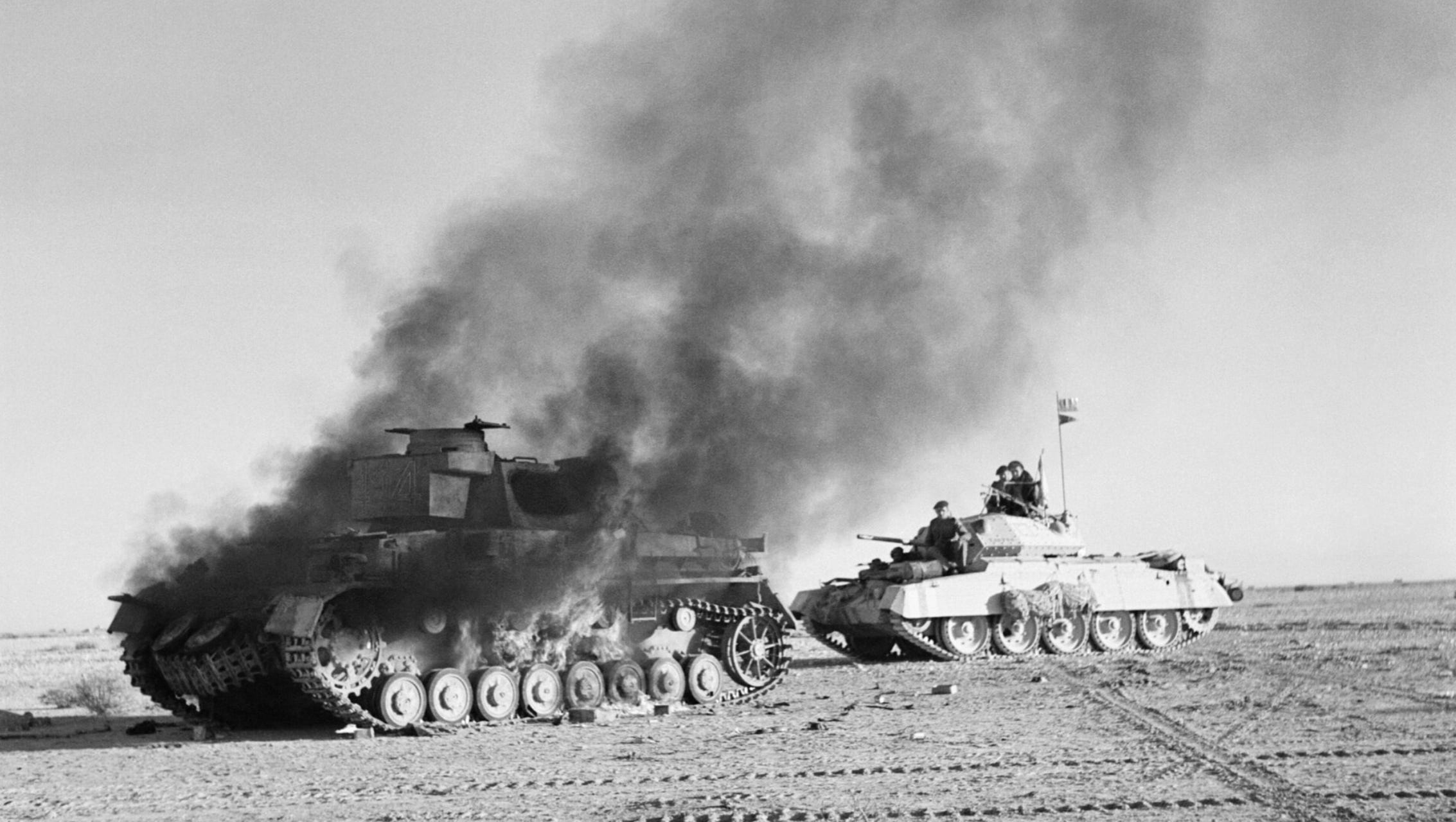
There may be some who find it chilling that I can discuss poetry in terms of tropes taken from a killing machine. Keith Douglas in his fine prose account of 1942 desert campaign of WWII Alamein to Zem Zem writes lyrically of the British tank of that period, the Crusader:
This tank is the best looking medium tank I ever saw. Whatever its shortcomings of performance, to see these tanks crossing country at speed was a thrill that seemed inexhaustible. Many times it encouraged us, and we were very proud of our Crusaders, though we often had cause to curse them.
Notice here that the poetics are pure aesthetics. I am not calling Douglas an aesthete, he was no more an aesthete than Rosenberg, whom he so admired and learnt from. But I am saying this announcement is pure aesthetics divorced from function. The Crusader is mechanically inefficient but it looks good.
The poetics of the poetic vehicle I envisage is embedded in its technical proficiency. I am trying to say something intrinsic to the nature of poetic survival. There is a battle behind the battle in this lecture and it is to do with the state of things that in some previous centuries was termed ‘The battle of the books’. I find myself increasingly wary of a form of poetics in which the poem becomes a mere conveyor of received opinion, sometimes in kit form, which can be unloaded and reassembled. I am troubled when certain words or phrases like Owen’s ‘pity’ become like canisters which when opened away from the poem release, I won’t say gas, but an atmosphere which it is recommended one breathes, in which by a dire oxymoron the ‘poetry is in the pity’ becomes the equivalent of ‘skegness is so bracing’.
I am not happy in saying this. I am embarrassed to speak formally about war poetry at all, sitting in comparative comfort with a glass of wine and a good dinner ahead of me, making capital out of a record of men mutilated, burned alive, driven mad. But I repeat, the poetry had better not be in the pity, or it will not survive as poetry. Perhaps it does not survive, perhaps even now it is only a concept, like contemporary international money.
I am omitting something that I was going to say about the origins of my ideas which I trace to what I think is Marshall McLuhan’s finest work, The Classical Trivium: The Place of Thomas Nashe in the Learning of his Time, which sat virtually unnoticed in the Cambridge University Library for about fifty years, where my wife found it twenty-five or thirty years ago, and brought it to my attention. It was belatedly put into print in 2005 by a small American press. I am leaping ahead to a later scholar’s synopsis of what McLuhan says about Thomas Nashe, the Elizabethan prose writer:
‘So effectively does Nashe’s writing convey a sense of the intractable materiality of words and the unpredictable nature of his own stylistic enterprise that we come to imagine him continually present, engaging, even as we read, with the animated unreliability of his own linguistic creation.’
Wyndham Lewis - Percy, not D B, the great Wyndham Lewis - I am sorry to say just does not get it. To him, Nashe is:
‘...a great prose-writer, one of the greatest as far as sheer execution is concerned, and in that over-ornate bustling field. Yet his emptiness has resulted in his work falling into neglect, which if you read him much, is not difficult to understand. His great appetite for words, their punning potentialities, along with a power of compressing them into pungent arabesques, is admirable enough to have made him more remembered than he is. But certainly some instinct in posterity turned it away from this too physical, too merely high-spirited and muscular, verbal performer. He tired it like a child with his empty energy, I suppose’.
Now a couple of Wyndham Lewis’ phrases - ‘as far as sheer execution is concerned’ and ‘a power of compressing them into pungent arabesques’ - shows how nearly he came to grasping that quality in Nashe which Lorna Hudson rightly calls ‘a sense of the intractable materiality of words. His failure matters because he is one of our greatest writers of the Great War’s aftermath, nonetheless with a frightful amount of energy running to waste in his writing. All his energy is in attack, he has no energy of defense, and is driven all too often to depict himself as if he were a self-caricature, a monstrous clown rather than a master of the world’s clownishness.
Where am I, and what am I about? I suppose I am about saying that a thoroughly Ramist period such as our own requires for its sanity a corps of anti-Ramist writers, of prose as well as poetry, for whom the intractable materiality of words, the unpredictable nature of their handling of the material of vision, is for them the ordinary measure of their day.
Now if I were linguistically component to assess the poetics of Velimir Khlebnikov (1885-1922) or Osip Mandelstam (1891-1938) or just possibly Paul Celan (1920-1970), I would have what I am tempted to call my Merkava poets, my poets armoured to resist the hostile thrust. Of course, the drawback of my position is that it cannot admit of translation. Undeterred by that discovery I proceed. I have already referred in passing to the pioneering attention paid by Riding and Graves to the radical achievement of Isaac Rosenberg, killed some months before Owen in the last year of the war. Riding and Graves say that he is one of the few poets who might have served as a fair challenge to sham modernism. A volume of his poems that appeared in 1922, edited by a well known poet of the day, Gordon Bottomley, and with an introductory memoir by Laurence Binyon. Riding and Graves rightly contend that it was the fashion of presentation that ensured Rosenberg’s continued obscurity. Binyon, a man of immense good will, treated the exercise as an act of necessary piety towards a young man of promise killed in his country’s service, and with allowances made for what Binyon calls ‘the immaturities of style and taste’. Riding and Graves term Bottomley and Binyon ‘safe poets’ with the innuendo that it is the recognised though tacit social function of safe poets to stifle the unsafe at birth, if necessary by heaping praises in such a way that all evidence of dangerous novelty is smothered by conventional pieties. Rosenberg had taken the trouble to write to Bottomley c. June 1916, two years before he was killed, six years before the appearance of the memorial volume:
‘People are always telling me that my work is promising – incomprehensible, but promising, and all that sort of thing, and my meekness subsides before their patronising knowingness.
It seems therefore a redoubled callousness subsequently to bury that work, along with its author, ‘bright-eyed thoroughly jewish in type’, as if the book as well as the man were in place in one of those beautifully tended imperial war grave commissioned plots in northern France and Flanders.
Rosenberg’s difficulty and challenge is that he absorbs our attack into the texture of his poetry, so that the poem itself, in addition to being its own eloquence, is also the record of our incomprehension. Take four lines from his verse play Moses, first published in 1916 as a pamphlet, at the poverty-stricken author’s expense. These days you find it offered for around $3000 and upwards by rare-book dealers. It took Rosenberg great effort to find the £2.10 necessary to print 100 copies.
The streaming vigours of his blood erupting
From his halt tongue are like an anger thrust
Out of a madman’s piteous craving for
A monstrous balked perfection.
What ‘monstrous balked perfection’ precisely? I do not know. What I do know, because the lines present the density of it, is that there is such a mental entity as ‘perfection’, like a tragic block, that it can be balked, frustrated, checked, thwarted, missed by error; that this failure is abnormal, outrageously wrong or absurd, that is to say, ‘monstrous’ (OED). The madman is either mad through his failure to find this perfect, his ‘halt tongue’, or else made to have desired it in the first place, ‘piteous craving’. The writing is at once impersonal, objective - it works with etymologies that can be looked up in the OED, as I have done - and intensely subjective, incomprehensible but promising and all that sort of thing. The utterance is uncompromisingly itself, at first sight intractable to synopsis, and yet open finally to verbal analysis and open, if not to us, then to the force-fields of cultural shift and change. Rosenberg is actually much closer to being the poet of The Prelude Book XII lines 250-77 than Owen is. Owen endeavours to speak on behalf of the inarticulate. Rosenberg comes thrusting up from amidst the body of inarticulacy itself, and, as if to recapitulate yet further, Rosenberg’s language is indeed the ethical substance, at war partly with itself, partly with us.
I do not have any great anxiety that what I have said may lead you to believe that poetry is best considered as a shamanistic practice. I do not regard it as the proper function of poetry to cast the runes or place spells on us. It is noticeable how at public readings insecure poets attempt to recite in an enticing, hypnotic manner, and I wish they would not. I do however concur with the late Martin Seymour Smith when he claims that ‘words are not the same as the things or qualities that they denote, while at the same time words are themselves things, the mysterious doubles of what they denote’. I would even add that Seymour Smith is less mysterious about the business than Eliot’s exposition of ‘the catalyst’ in ‘Tradition and the Individual Talent’. Seymour Smith’s insistence is manifestly demonstrable; Eliot’s is not. His ‘catalyst’ remains within the sphere of illuminating suggestions, whereas the four lines of Rosenberg that I read to you are self-evidently what is to be declared. The words yield meaning readily to examination, but it is a baffled meaning.
The radical discovery of the Great War was its bafflement by language as well as by the mathematics of mass killing. Much has been written in the past forty or fifty years regarding the total incomprehension that came between the front-fighters of all three main western front armies, and the headquarters staff and even more destructively families and home civics, town hall sentiments and the like. Right at the start, in August or September 1914, civilian and military assumptions had been more or less the same, though there were notable exceptions to this overview. Charles Sorley in his letters, Rosenberg in his letters, and Rupert Brooke, in a letter he wrote in his return from the abortive Antwerp expedition in late 1914, on which occasion he had been on the fringes of action. That letter should be read by all who, as it were, place him among those who had not seen action. Of course, nothing of this appears in Brooke’s begloried sonnets, the 1914 sequence written at about the same time as the letter. Sorely was in the main unable to work his prose intelligence into his poetry. He was killed in 1915, aged twenty. But by and large in August 1914 and for some time later, even perhaps up to the point of the Somme debacle of July 1916, everyone in Britain and the British Expeditionary Force (BEF) could describe what evil was, and even the intelligent Ford Maddox Heuffer, later Ford, in a book published in 1915, subscribed to the opinion: evil was Prussianism.
In his book When Blood is their Argument it is still possible for Heuffer, who went on write the magnificent war tetralogy of novels Parade’s End, to describe as an ‘indelible stain upon English civilisation, the fact that forty-five years earlier, in 1870, Thomas Carlyle had written a letter to The Times saying that he was glad that France had been defeated in the Franco Prussian war of that year’. A letter to The Times an indelible stain upon the English civilisation! By 1919 the year of the macabre victory parade through Paris, evil was something other than Prussianism, though what it was struck people then, as now, as something uneasy to come to grips with. It was something at once hyperactive and catatonic, amorphous yet capable of exerting particular pressure, individual people suffered it doubly both in themselves uniquely and as ciphers in a vast and indiscriminate mass.
It is of course a fact that a visual language capable of registering the dethronement of Bradleian monumental ethical reason, which was one of the many dis-related outcomes of 1914-18, existed immediately prior to the outbreak of that war. I cite Wyndham Lewis’ portfolio of vorticist drawings, Timon of Athens published in 1913, the unrecollected masterpiece, in a manner of speaking, of the twenties. I risk calling Wyndham Lewis the lost master-orator of the 1920s, not only because of Timon of Athens, nearly a decade old by 1920, but also because of the three prose tracts which grew out of his war experiences: The Art of Being Ruled (1926), The Lion and the Fox (1927) and Time and Western Man (1927) along with his single volume of poetry One-Way Song (1932). Listen to these four lines
I sabotage the sentence! With me is the naked word
I spike the verb - all parts of speech are pushed over on their backs.
I am the master of all that is half-uttered and imperfectly heard
Return with me where I am crying out with the gorilla and the bird!
I say lost master-orator because he lost his potentially quite considerable audience some time in the early thirties by a mixture of vanity, innocence and bad tactics. As I have already remarked, all his energy went into attack, he had no energy of defense except the fatal device of self-caricature. Rosenberg, had he not been killed in action in April 1918 would probably have been greater, more intelligent, with more energy of defense, which would allow him to open to circumstance in ways that Lewis could not permit himself to be open.
Lewis’ politics were of the right and so were the politics of David Jones, as were those of the author of Tarka the Otter (1927) and Salar the Salmon (1935). So stood the political sympathies of Saunders Lewis, that fierce champion of Welsh nationalism. All four were old front-fighters who had come to believe that their true kinship was with the French and German front-fighters, and that their natural enemies were to be found among the English, French and German general staff, and the civilian profiteers of all three nations.
We know how in any struggle between individuals or groups a great burden lifts when either side in that struggle by gesture or utterance admits some abstract excellence in the enemy whom it is their duty to oppose.
David Jones wrote that in a too little known essay, ‘Art in Relation to War’, written during the middle years of the Second World War 1942-3, revised 1946. It remained unpublished until 1978. An undated footnote in the published text records Jones’ chagrin that when Winston Churchill paid tribute to Erwin Rommel’s brilliant handling of the German Afrika Korps in the Libya-Tunisia campaign, Churchill’s gesture was resented by ignoble minds in this country. This essay takes up in broader terms the complex simplicity or simple complexities of the magnificent dedication to In Parenthesis which reads as if to be incised on stone, and can stand, even by itself, as one of the great utterances to come out of the Great War.
THIS WRITING IS FOR MY FRIENDS
IN MIND OF ALL COMMON & HIDDEN
MEN AND OF THE SECRET PRINCES
AND TO THE MEMORY OF THOSE
WITH ME IN THE COVERT AND IN
THE OPEN FROM THE BLACKWALL
THE BROADWAY THE CAUSEWAY
THE CUT THE FLATS THE LEVEL THE
ENVIRONS AND THOSE OTHERS
FROM TREATH FAWR AND LONG
MOUNTAIN THE HENDREF AND Y
HAFOD THE PENTRE PANDY AND Y
TAREN THE MAELORS THE BOUNDARY
WALLS AND NO. 4 WORKING
ESPECIALLY PTE R.A. LEWIS-GUNNER
FROM NEWPORT MONMOUTHSHIRE
KILLED IN ACTION IN THE BOE-
SINGHE SECTOR N.W. OF YPRES
SOME TIME IN THE WINTER 1916-17
AND TO THE BEARDED INFANTRY
WHO EXCHANGED THEIR LONG
LOAVES WITH US AT A SECTOR’S
BARRIER AND TO THE ENEMY
FRONT-FIGHTERS WHO SHARED OUR
PAINS AGAINST WHOM WE FOUND
OURSELVES BY MISADVENTURE
It does not harm the nobility of this incised stone, which in effect it is, if we remind ourselves that one of those enemy front-fighters who shared our pains was an NCO named Adolf Hitler who could have been killed in any one moment, in any one day, but was not, and whose conduct in action earned him the Iron Cross. And it was of course with just such association of politically disaffected German front-fighters, groups like the Freikorps, that the agitator Hitler first came to notice, in the early 1920s.
The specific density of Jones’ marmoreal dedication is itself greater than that of any one page of say, Auden’s The Orators: An English Study (1932), splendid though that work is. The Orators is the best we have next to In Parenthesis, next to Benjamin Britten’s early masterpiece Our Hunting Fathers (1936), set to a text by Auden, and in the absence to a complete ‘Coriolan’ by T S Eliot. I confess myself to be haunted by that failure of Eliot’s to complete that post-First-World-War work. If only he could have brought it up to as much as sixteen sections, that is not too much to ask, is it? Sixteenth sections to match Lewis’ portfolio of sixteen drawings! Timon of Athens and ‘Coriolan’, what a superb diptych might we be now celebrating, even as the smoke drifts north westwards from ruined Athens, to mingle with the smoke that drifts south east from ruined Iceland, to conjoin symbolically in a gyre, a tourbillion or vortex smack-over the flagrant Bundestag.
No posts
Comments
Nothing yet. Say the first thing.
Sign in to join the conversation.