
This short talk was composed for a symposium on Dietrich Bonhoeffer at Boston University, where Hill was the Professor of Literature and Religion at the time.
I want to begin by quoting from Bonhoeffer’s book Akt und Sein (1929) - ‘Act and Being’ - the dissertation which qualified him for the post of university lecturer:
Through the act of knowing the known comes into the power of the ‘I’; it can be ranged within the system of general knowledge [...] the goal of cognition is to close this system. Once it succeeds, the ‘I’ has become master of the world. For that reason alone revelation is inimical to the system for God is the master of the world…’1
In the light of that comment by Bonhoeffer I want to enter a word of warning about the film we saw this morning. Bonhoeffer did not die to the mellifluous sound of Lutheran chorales. He died alone and in ugliness. A film is an act of cognition. It is an attempt to ‘close the system’. Now the system of general knowledge through which the ‘I’ seeks mastery is at one level, you may say, as innocuous as it appears. It is an act in which all must engage if they aspire to grasp their place in the world. And yet, within the German political-ethical system, two years before the National Socialists were elected into power in 1933, the demonic ‘I’ was already exuding its virulent power. It is there in the title of Hitler’s book, Mein Kampf. And once this dimension of the cognitive ‘I’ is faced, it can be shown to be inevitable that the mind of the man who writes Akt und Sein will be inimical to, will be in eternal conflict with, the system developed by the mind of Mein Kampf.
It is important that we recognise at how early a stage in the development of Bonhoeffer’s thinking the ground of the opposition to Nazism, which would bring him to his death in 1945, was being laid. It is also important that we realise the special characteristic of his resistant mind and sensibility. He was born into the upper-professional class, to parents who could trace their descent from men who had suffered for their political principles. Dietrich’s paternal grandfather had been imprisoned in 1825 for expressing what had been called subversive liberal views. I stress Bonhoeffer’s impeccable hereditary liberal credentials in order to emphasise that he is in no sense a simple offspring of that tradition. In more ways than one, Dietrich Bonhoeffer’s sensibility was that of a radical conservative. That is, if it is a conservative characteristic to affirm the hierarchies. I would say that he believed in a natural aristocracy of the spirit; I can see no other way in which to read the section ‘The Sense of Quality’ in Letters and Papers from Prison, where he writes:
Unless we have the courage to fight for a revival of wholesome reserve between man and man, we shall perish in an anarchy of human values [...] In other times, it may have been the business of christianity to champion the equality of all men; its business today will be to defend passionately human dignity and reserve […] the cheap insinuation that our attitude is anti-social, we shall simply have to put up with; they are the invariable protests of the rabble against decency and order2
Now the German phrase ‘die Pöbelherrschaft’ means ‘mob-rule’ and it is possible to see how Bonhoeffer’s form of radical conservative self-discipline would take its stand against the hideous travesties of discipline inaugurated by the National Socialists. The conflict in which my limited comprehension understands Bonhoeffer to be engaged is that which takes place, at once eternally and presently, between the claims of the Absolute and the extortions of spiritual and political absolutism. In chapter 6 of his great work Ethics (1949), Bonhoeffer writes:
The origin of action which accords with reality is not the pseudo-Lutheran Christ who exists solely for the purpose of sanctioning the facts as they are, nor the Christ of radical enthusiasm whose function is to bless every revolution, but it is the incarnate God Jesus who has accepted man and who has loved, condemned and reconciled man and with him the world’3
Two observations seem to me to be necessary here. First, that the radical misappropriation of Bonhoeffer’s life and teaching by some British and American progressive theologians in the 1960s appears to be presciently understood in this passage from Ethics. Bonhoeffer’s phrase, which the English translation renders ‘the Christ of radical enthusiasm’, is ‘der radikal schwärmerische Christus’ which, though I am no Germanist (as will be obvious to you) strikes me as conveying more contempt than is indicated by the translation. We have to separate the Bonhoeffer legacy from the Bonhoeffer cult much of which, I would hazard, is no better than ‘romantische Schwärmerei’ dedicated, as Bonhoeffer would say, to ‘sanctioning the facts as they are’.
Sanctioning the facts as they are is not the same as facing the bitter fact. Bonhoeffer’s position at that time was a peculiar one. It was peculiar in the sense that not only was he estranged from the pseudo-Lutheran state organisation, the German Christians, he was also at odds, as the film showed us, with the strategic and tactical ambivalences of the Confessing Church. And there is also a sense in which for a relatively short period during spring of 1933, he was estranged from himself. This self-estrangement was made evident in two episodes which came virtually together in April 1933. In an article responding to the National Socialist boycott of Jewish businesses he stated with some vehemence
Here where Jew and German stand together under God’s word is the church. Here it is proven whether or not the Church is still the Church.4
In that same month of April 1933, the father of Dietrich’s Jewish brother-in-law, Gerhard Leibholz died. The family - Gerhard was married to Dietrich’s twin sister Sabine - asked Dietrich to conduct the funeral service, but he declined to do so, having accepted the advice of his ecclesiastical superior that to conduct a funeral service for a Jew would not, in the circumstances of April 1933, be prudent. I take this episode directly from Bethge, who also prints part of the stricken letter than Bonhoeffer sent his brother-in-law seven months later:
I am tormented by the thought… that I didn’t do as you asked me as a matter of course […] it preys on my mind… because it’s the kind of thing one can never make up for’5
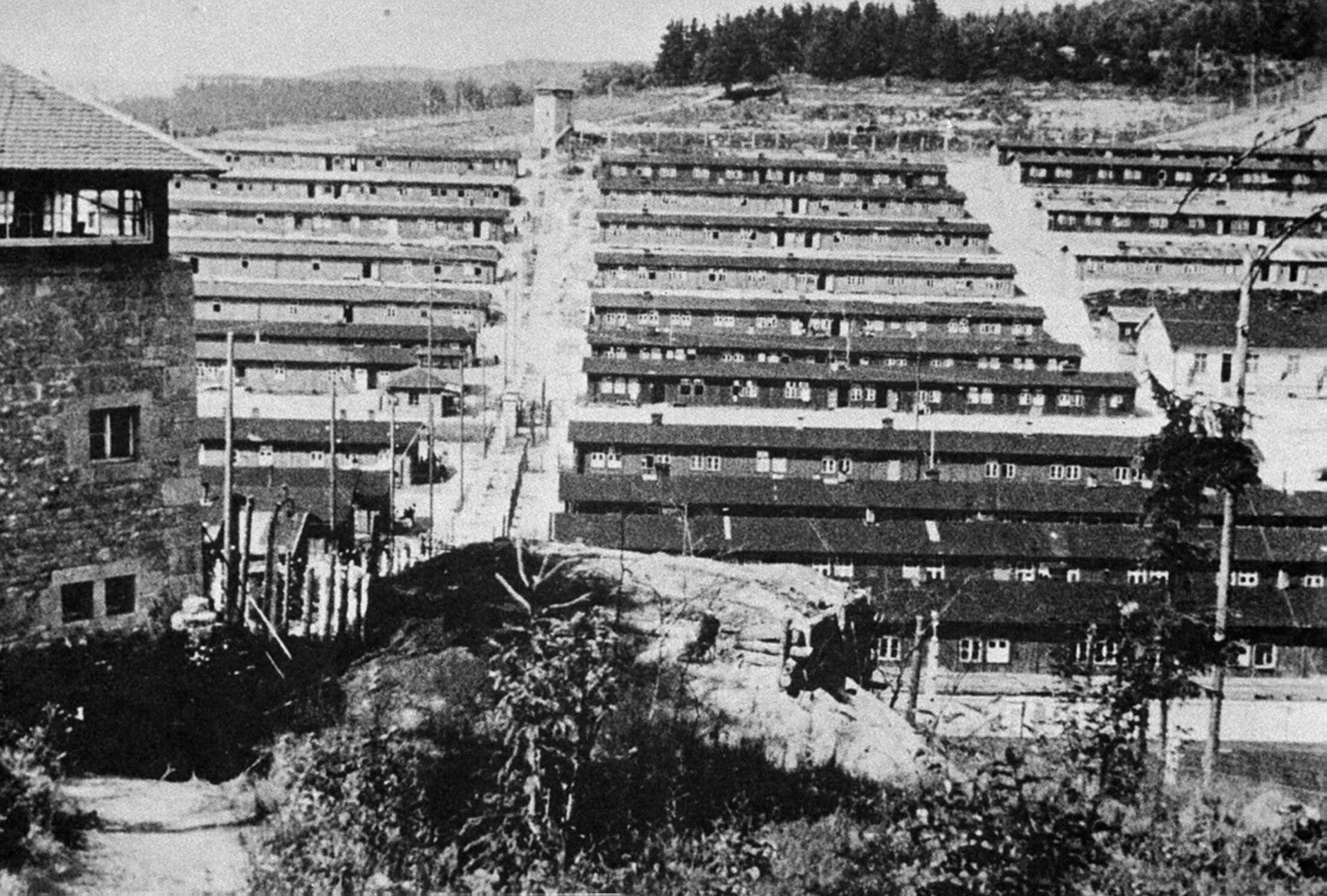
Now, I read the clarion call, the message writ large in letters of blood, on the posters which summoned us to this symposium. At the centre of the fire storm of the holocaust Dietrich Bonhoeffer confronted the evils of the Third Reich, and courageously opposed the godless face of Nazism. His theological and political resistance to and condemnation of anti-semitism cost him his life and established his place as a modern Christian martyr. I put this harangue alongside Bonhoeffer’s words of contrition in his letter to his Jewish brother-in-law - ‘I can’t think what made me behave as I did. How could I have been so much afraid at the time’. In these words I recognise not the poster-puppet of our state-of-the-game romantische Schwärmerei, but the active mind and spirit of the man who went to his death at Flossenbürg extermination camp twelve years later, ‘brave and composed’, in the words of a hostile witness, an SS camp doctor, who added, ‘I have hardly ever seen a man die so entirely submissive to the will of God’.
D Bonhoeffer, Act and Being, New York: Harper & Row (1961), p. 96
D Bonhoeffer, Letters and Papers from Prison, New York: Macmillan (1972), p. 12
D Bonhoeffer, Ethics, New York: Macmillan (1955), p. 199
D Bonhoeffer, No Rusty Swords, London: Colins (1965), p. 299
E Bethge, Dietrich Bonhoeffer: Man of Vision, Man of Courage, New York: Harper & Row (1970), p. 209
No posts
Comments
Nothing yet. Say the first thing.
Sign in to join the conversation.