
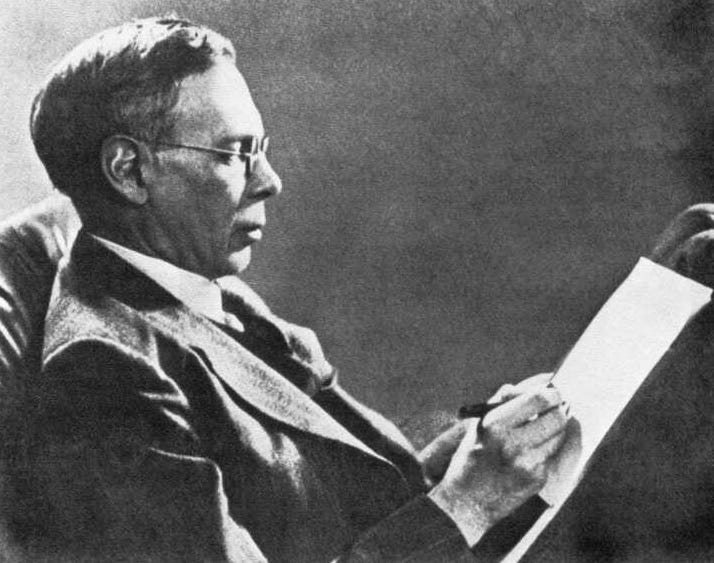
A few days after the end of the war in Europe, in May 1945, a death occurred at the Radcliffe Infirmary here in Oxford. The dead man’s name was Charles Williams; his mortal remains lie in St Cross Churchyard, a stone’s throw, you might say, from the English Faculty building. At the time of his death he was a few months short of his sixtieth birthday. Williams had arrived in Oxford very soon after the outbreak of war in September 1939, as a member of the London office of the Oxford University Press, which had been evacuated from its premises close to St Paul’s Cathedral, in the heart of the city. The five years he spent here were among the most rewarding of his somewhat straitened life. He was revered by C S Lewis, who introduced him to the Inklings, a blessing which I rather wish he had been spared. He was not a scholar of the calibre of Lewis or Tolkien, yet in my judgment he remains a more significant writer than either of them, and beyond question a more acute critic of contemporary literature than Lewis. Without a degree when he arrived, he was made an honorary MA, and gave memorable lectures for the depleted and foreshortened war-time English school. He had already edited Milton and Gerard Manley Hopkins for the OUP, now he excited the undergraduates with his lectures on ‘Chastity in the Ludlow Masque’ and they flocked to hear him. It amazes me now to realise that, when I came up in October 1950, Williams had been dead for a mere five years, scarcely more distant then, than I am now, from my inaugural lecture in this auditorium in December 2010. But at eighteen five years comprises a third to a quarter of one’s entire lifetime; at eighty-three it is a mere sixteenth.
This lecture is not about Williams, precisely, but his critical presence may be said to infuse it. Oxford University Press has on the stocks a critical biography of Williams by Grevel Lindop, which will supersede anything I have to say. The book by Williams which chiefly concerns me here is, I admit, the least satisfactory of his three major collections on English poetry. The best of them, The English Poetic Mind (1932), I would unhesitatingly recommend to current students of Shakespeare, Milton and Wordsworth, its eighty-three years notwithstanding. His other book, Poetry at Present (1930) is uneven, yet contains one of the most perceptive observations on the workings of poetry that he ever made.
Let us first enquire what flotsam, what detritus, the title phrase - ‘Poetry at Present’ - carried in its wake fifteen years short of a century ago. Williams then considered as contemporary the poetry of Thomas Hardy, Robert Bridges, A E Housman, Rudyard Kipling, W B Yeats, W H Davies, Walter de la Mare, G K Chesterton, John Masefield, Ralph Hodgson, Wilfrid Gibson, Lascelles Abercrombie, T S Eliot, Edith, Osbert and Sacherverall Stiwell, Robert Graves, Edmund Blunden. Williams’ book contains a chapter on each, though the Sitwell siblings have to share a single chapter. Some would say that is over generous but I would not agree. Every one of these eighteen names means something to me because I am an old and jealous lover of the art and an old and malign opponent of what I decide is cultural stupidity in high places. Ten of Williams’ poets ought to be instantly recognised and dated to within a couple of decades by any second or third year undergraduate member of the English Faculty who may be contemplating a baccalaureate dissertation on some aspect or aspects of twentieth century English poetry.
Who was Lascelles Abercrombie you may ask? Lascelles Abercrombie was prominent among contributors to Eddy Marsh’s immensely popular sequence of anthologies Georgian Poetry, which were annual productions around the time of the great war, to appear in which was considered a grand accolade by aspiring poets. Lascelles Abercrombie was revered by Isaac Rosenberg. Get hold of Vivien Noakes’ splendid scholarly edition, Isaac Rosenberg (which originated in doctoral research conducted under the supervision of John Stallworthy), turn immediately to the subject index in that book. ‘A’ for ‘Abercrombie’ — there he is, at the head of column one, with eighteen entries. Next consider the subdivision of these entries: ‘IR comments on LA’s work’ (five citations); ‘LA comments on IR’s work’ (four citations); ‘IR letters to LA’; ‘Marsh sends IR’s work to LA’ (six entries). In late July 1916, Pvt. I Rosenberg (address deleted by censor) wrote to an acquaintance, ‘Abercrombie’s ‘Hymn to Love’ is I think the great thing of modern times, and far above anything else of his I know’. Six months earlier Rosenberg had reported to a friend Abercrombie’s letter to him, in which the older man had said ‘what I like most in your songs is your ability to make the concealed poetic power in words come flashing out. Some of your phrases are remarkable; no one who writes poetry could help envying some of them.’ Abercrombie was no fool. He could sense weird excellence when he encountered it. And what a joy it must have been to the virtually unknown Rosenberg to receive such praise from so established a figure, whom he so devoutly admired. A century on and the name Lascelles Abercrombie is heard from time to time, albeit rarely, mentioned with respect, because he had spoken well of an obscure and penniless young jew from London’s East End, who ninety-seven years after his death is belatedly established as a major twentieth century figure.
In 1948, a working class boy at school in Worcestershire, who coincidentally bore my enviably distinguished name, already knew a few Rosenberg poems. But back then Rosenberg was a marginalised figure and I was odd enough to be caught reading poetry during half time in the stands at West Bromwich Albion. Characteristically, in the 1930s, F R Leavis’ periodical Scrutiny, dedicated to setting the critical cat among the cultural pigeons, praised him highly. It was however a major work of criticism, published in 1972, that really began the work of focusing Rosenberg and his poetry and poetic drama, and to affront our cultural short-sightedness with his manifest presence. I am referring of course to Jon Silkin’s Out of Battle: the Poetry of the Great War (1972), after forty-three years still by far the best critical account of British poetry of that time and, by intelligent implication and extrapolation, of the present time also because that, after all, is what the finest historical criticism does. It does not merely explain what poetry was in, say, the period of the Cromwellian Republic and Protectorate, it also tells you by inference and conference, what poetry is in 1958 or 1999 or 2015.
Too many with whom I have been professionally required to discuss poetry, in the course of the past sixty years, appear to believe that when we take up this topic we are encountering a simple narrative, and that it is our task, simply, to protract this narrative into further generations. What confronts us, in fact, is not a simple narrative but a vortex, part ‘force-field’, part force-field with its main drive broken, what I will call ‘impaction’. Now ‘vortex’ and ‘force-field’ are terms that I have employed in previous lectures. ‘Vortex’, a characteristic term of the modernist sculptor Henri Gaudier (1891-1915) also employed by Ezra Pound (1885-1972), Percy Wyndham Lewis (1882-1956), and W B Yeats (1865-1939), is a word of seventeenth century origin and twentieth century modification. Originally, it referred to a ‘supposed rotatory movement of cosmic matter round a centre or axis, regarded as accounting for the origin or phenomena of terrestrial and other systems, a body of such matter rapidly carried round in a continuous whirl’ (OED, 1989). On the modernist mutation of the word it needs to be said, the 1989 OED is at first sight useless. Do not look it up under ‘vortex’; look it up under ‘Vorticism’ and you will find there Pound’s crucial definition of vortex:
‘THE IMAGE IS NOT an idea. It is a radiant node or cluster; it is what I can, and must perforce, call a VORTEX from which, and through which, and into which ideas are constantly rushing. And from this necessity, came the name “Vorticism”.’
‘Force-field’ does not have an entry in my 1989 OED, though ‘force feed’ does. However, if we look up ‘field’ and index-finger it though to the bottom of column six, ‘sense 17a - Physics’ we find that ‘Fields of force’ is first revealed in a sentence dating from 1850, an entry in the diary of the great chemist and physicist Michael Faraday:
‘When the opposed bodies are on opposite sides of the axis magnetic, then the figured form would give fields of force in which the lines of magnetic power would vary’
I could recommend the whole of the 17a entry to any junior historian of modernist poetics. It reveals both the acumen and pathos of such a position. Acumen, because it shows how intelligent minds seek to make definable and debatable what is in fact no more than an intuition as to how language may be imagined to work. Pathos, because it demonstrates the desire of practitioners of an art to find a style of description which may persuade themselves and others that what we are in fact dealing with is not a disreputable art, but a dignified science. I should add here that, to the best of my recollection, my own discovery that the term had possibilities was owed not in this case to the OED, but to G E M Anscombe’s translation of Wittgenstein’s Philosophical Investigations (1953). The four pages (186, 186e, 187, 187e) of the 2001 edition of Philosophical Investigations have always seemed to possess a wonderful richness:
‘Es its eben nicht mit jenem ersten Urteil abgetan, denn es ist das Feld eines Wortes, was entscheidet’
That first judgement is not the end of the matter for it is the field of force of the word that is decisive.
You will have noticed, even so, that Wittgenstein’s German is simply ‘Feld eines Wortes’ and that the ‘field of force of a word’ is Anscombe’s translation.
Perhaps, since this is a valedictory lecture, I may be permitted the extravagance of suggesting that should any future undergraduate be so ill-advised as to wish to produce an essay on my critical tenets and practice, she must be aware that for me the concept of the linguistic force field has the twisted vitality of sacred scripture in the mind of a religious maniac. Whether the concept of the linguistic force field merits the importance which I attach to it is the crucial question to which the essayist will be obliged to respond; I cannot otherwise see how her discussion will avoid conveying an effect of conceptual inertia.
Now the term ‘inertia’ returns me to the figure of Charles William with whom I began and his book Poetry at Present (1930). It may seem to you, given my remarks about his inclusion of such figures as W H Davis and Wilfrid Gibson, and his exclusion of Owen, Rosenberg and, except for a passing mention, Edward Thomas, that I am about to indict him for gross negligence, but that is far from my intention. There are admirable things in the chapter on Abercrombie, such as this, for instance:
‘This poetry demands close reading and close thought, and such poetry cannot be lightly - or indeed at all - re-expressed in prose. Arnold’s claim that the loftiest function of poetry is the application of ideas to life, true as far as it goes, fails only to note that this application results in the creation of something with a new life of its own, and that the application of that life to ours is something profounder than the deduction of a moral or philosophical idea. It is the entering-in, through the senses and through the mind, of another existence’
The difference so far as it can be briefly critically indicated, between the language of Charles Willliams and the critical language of Ezra Pound or Percy Wyndham Lewis, is that even though he is pointing to the critical limitation of Arnold, his somewhat weighty mode of word choice and syntax strikes us as being within the Arnold tradition, whereas the critical idioms of Pound and Lewis do not. Even so, to put it somewhat sweepingly, their sources are as early-to-mid Victorian as his. But where they derive from Faraday and the electro-magneticists, he derives from the amalgamated precedents of literae humaniores. I said a little while back that Poetry at Present, while more erratic than The English Poetic Mind, nonetheless contains one of Williams’ most brilliant critical aperçus. It is part of a generalisation, and of course generalisations can be wild and unjust, but it is a generalisation concerning not all but a significant amount of poetry at present, if we understand that to mean the poetry of the 1930s:
‘These poets have as much of our ordinary working-day brains as the rest of us; their meditations are as subtle, their philosophies no less, but not more, surely based - they remark what we do and turn it into rhythm. But the faculty of compressing such meaning into a phrase is denied to them. We have to cover as much ground in their verse as in our own thoughts, and consequently we tire as soon’
When I read this brief passage, much too recently to benefit the bulk of own oeuvre (he says, ingratiatingly), I felt as one occasionally does, as though the sphere of my critical cognisance had spun more rapidly for an instant, and then settled back permanently on to a slightly different angle of axis. Let me become a little aggressive toward you on this topic, by the easy expedient of introducing the name of Larkin. Philip Larkin: The Complete Poems (2012) edited by Archie Burnett, contains fine poems and poems that are average, and poems that are even below average. His work is rated so highly across the literary board because a large consensus has been persuaded by critical opinion that certain mediocre poems are outstanding. The truly outstanding poems by Larkin may have gone largely unheeded, may even now be scarcely known. Here is a poem generally approved of by the lobbyists, but not in my judgment, a masterpiece of our time:
Once I am sure there’s nothing going on
I step inside, letting the door thud shut.
Another church: matting, seats, and stone,
And little books; sprawlings of flowers, cut
For Sunday, brownish now; some brass and stuff
Up at the holy end; the small neat organ;
And a tense, musty, unignorable silence,
Brewed God knows how long. Hatless, I take off
My cycle-clips in awkward reverence,
Move forward, run my hand around the font.
From where I stand, the roof looks almost new –
Cleaned, or restored? Someone would know: I don’t.
Mounting the lectern, I peruse a few
Hectoring large-scale verses, and pronounce
‘Here endeth’ much more loudly than I’d meant.
The echoes snigger briefly. Back at the door
I sign the book, donate an Irish sixpence,
Reflect the place was not worth stopping for.
Yet stop I did: in fact I often do,
And always end much at a loss like this,
Wondering what to look for; wondering, too,
When churches fall completely out of use
What we shall turn them into, if we shall keep
A few cathedrals chronically on show,
Their parchment, plate and pyx in locked cases,
And let the rest rent-free to rain and sheep.
Shall we avoid them as unlucky places?
Or, after dark, will dubious women come
To make their children touch a particular stone;
Pick simples for a cancer; or on some
Advised night see walking a dead one?
Power of some sort or other will go on
In games, in riddles, seemingly at random;
But superstition, like belief, must die,
And what remains when disbelief has gone?
Grass, weedy pavement, brambles, buttress, sky,
A shape less recognisable each week,
A purpose more obscure. I wonder who
Will be the last, the very last, to seek
This place for what it was; one of the crew
That tap and jot and know what rood-lofts were?
Some ruin-bibber, randy for antique,
Or Christmas-addict, counting on a whiff
Of gown-and-bands and organ-pipes and myrrh?
Or will he be my representative,
Bored, uninformed, knowing the ghostly silt
Dispersed, yet tending to this cross of ground
Through suburb scrub because it held unspilt
So long and equably what since is found
Only in separation – marriage, and birth,
And death, and thoughts of these – for which was built
This special shell? For, though I’ve no idea
What this accoutred frowsty barn is worth,
It pleases me to stand in silence here;
A serious house on serious earth it is,
In whose blent air all our compulsions meet,
Are recognised, and robed as destinies.
And that much never can be obsolete,
Since someone will forever be surprising
A hunger in himself to be more serious,
And gravitating with it to this ground,
Which, he once heard, was proper to grow wise in,
If only that so many dead lie round.
What is the poet attempting to express in this poem? (was that ever a real school examination question when I was young, or have I been conned into believing that it was?) As I remember them my own teachers at Bromsgrove County High School, Ann Leadhill, Ken Curtis, George Lloyd, were at once too passionate and too subtle to have imposed such a locution on us. And surely you agree that ‘attempting to express’ presumes that a poem is an act of blundering self-therapy rather than a subtle art, and no one in 2015 believes that. If you try a more sophisticated version of the question - e.g. what are the narrational and/or figurative parameters of this poem? - you may still be forcing the student into taking up a position she would rather avoid. If she is a potential first, she may decide to begin by challenging the terms of the question, though that requires nerve. Even I, by nature a timid, conformist lower second if ever there was one, gained my skin-of-the-teeth first in 1953 by telling a member of the viva committee that he was completely wrong about the last two stanzas of Keats’ ‘Ode to a Nightingale’, and demonstrating his error by effective off-the-cuff quotation. Tolkien, who chaired, was said to have observed, as the door closed behind me, ‘I rather like the cut of that young fellow’s jib’. It was not, of course, a congratulatory first; one of those went in 1953 to my exact contemporary John Burrow, distinguished father of the distinguished Colin Burrow, and latterly emeritus Winterstroke Professor of English at the University of Bristol.
Having given the essential period of notice to such necessary caveats, it may be allowable still under caution to ask what is it that Larkin is endeavouring to express, or convey or indicate or communicate in his poem ‘Church Going’. I will state the topic thus; others may put it more succinctly, more accurately, or more justly, but I will do what I can –
The narrator in the course of a cycle ride discovers an unfamiliar church and decides to enter. We observe him to be secular rather than devout. His feelings, having entered, are the familiarly elusive blend of awkwardness, interest, sympathy, and condescension, which he endeavours to analyse and assess to his and our satisfaction. Having spent some time looking at, and allowing his mind to speculate on, a variety of ecclesiastical objects, he leaves, so far as he and we are aware, he is now somewhat more sympathetic, and a trifle less condescending.
At a rough count I make that clumsy précis of mine 91 words. I make my word count for the whole poem 473 words. So 91 words of my not wholly successful précis against 473 words of narrative and philosophical rumination in Larkin’s own words. Is that ratio a gross discrepancy? Probably not. Try the same trick with one or more of the philosophical narratives among Hardy’s fair to middling Wessex poems (not the great poems), and you may get something like the same ratio. Play the same trick, you could add, to the fair-to-middling example of Wordsworth’s contributions to the first edition of Lyrical Ballads (1798), and you might extrapolate a similar kind of ratio.
You would have said, if you had met her,
’Twas a hard time for Goody Blake.
Her evenings then were dull and dead;
Sad case it was, as you may think,
For very cold to go to bed,
And then for cold not sleep a wink.
Or, in ‘Simon Lee, the Old Huntsman, with an incident in which he was concerned’:
“You’re overtasked, good Simon Lee,
Give me your tool,” to him I said;
And at the word right gladly he
Received my proffered aid.
I struck, and with a single blow
The tangled root I severed,
At which the poor old Man so long
And vainly had endeavoured.
The tears into his eyes were brought,
And thanks and praises seemed to run
So fast out of his heart, I thought
They never would have done.
—I’ve heard of hearts unkind, kind deeds
With coldness still returning;
Alas! the gratitude of men
Hath oftener left me mourning.
Once we have finished laughing ourselves egotistically naked over such lines as ‘give me your tool, to him I said,’ we may discover that the comingling of the narrative with the axiomatic in Lyrical Ballads is done with a sounder grasp of linguistic and metrical joinery than in ‘Church Going’, and further that the moral summation in the final stanzas of ‘Simon Lee’ is more self-effacingly profound than anything in Four Quartets, let alone ‘Church Going’ to which let us now return.
Or, after dark, will dubious women come
To make their children touch a particular stone;
Pick simples for a cancer; or on some
Advised night see walking a dead one?
Power of some sort or other will go on
In games, in riddles, seemingly at random;
But superstition, like belief, must die,
And what remains when disbelief has gone?
Grass, weedy pavement, brambles, buttress, sky
I hope that simply by reading this stanza I make it self-evident that ‘but superstition, like belief, must die’ is an inferior form of moralizing to ‘alas, the gratitude of man has oftener left me mourning’, though its tone is superior. Who are the dubious women? Are they what my nailer great-grandmother might have described as ‘no better than they ought to be?’ Let us consult the OED again. ‘Dubious’ sense 1 d. - of questionable or suspected character e.g. - ‘A Large bed covered with clothes of the most dubious black-brown hue’ (1860); ‘she had been absent from England, often in very dubious company (1884); ‘having got an evil odour by their dubious gains’ (1893). ‘Dubious’ sense 2 - subjectively doubtful, wavering or fluctuating in opinion, hesitating, inclined to doubt e.g. ‘She raised her eyebrows with a dubious expression’ (1865), ‘I followed them, dubious as to whether to ultimately interfere’ (1874)
I am glad that we looked those things up. Larkin in those four lines in ‘Church Going’ is using both senses of the word dubious simultaneously. That is to say he is poetically employing colloquial ambiguities. He is a university wit. The reasons why Larkin is not ever regarded, from the point of view of language skills, as a university wit, is due to a combination of causes and decisions, but how also are we to hear the line ‘a few cathedrals chronically on show’ almost the best single line of the poem? How are we to hear that line if not as an instance as what Eliot and after him Leavis instructed us to hear as examples in the line of wit? Turn to the OED again: ‘Chronically’ - in a chronic matter, inveterately. Turn to ‘Inveterately’ itself and you find ‘in a manner confirmed by long existence or practice, to a good degree firmly fixed or ingrained, virulently’, earliest citation 1645, Milton, Tetrachordon. And behind ‘Chronically’ is ‘Chronic’ - sense 1. ‘Of or relating to time, chronological’ (obsolete); sense 2a. ‘Of diseases etc, lasting a long time, long continued, lingering, inveterate, opposed to acute in cases of illness’; sense 3 - transferred sense ‘continuous constant, used colloquially as a vague expression of disapproval, bad, intense, severe, objectionable’
In Larkin’s ruminating a few cathedrals are chronically on show, because they belong, the majority of them, to ancient time, and because their deans and chapters are inveterate showers off of their treasures, and because those who are hostile to christianity deplore them as symptoms of a mental disease that has held the nation in thrall for too long, and so on, and so on. Or take ‘pick simples for a cancer’. This effective use of ‘simples’, alludes to beliefs and practices of late medieval and renaissance pharmacology. Note that we are dealing with a substantive, not an adjective - e.g. Sir Thomas Browne, ‘from the knowledge of simples, she had a receipt to make white hair black’ (1646), Augustus Jessop, The Coming of the Friars, ‘Cordials were kept by the lady of the house among her simples’ (1889).
We have here come into violent collision with a potential nexus of readers’ reactions that causes the exercise of debating poetry’s place and purpose in our culture to be so fraught with resentment and weariness. Many will object:
‘This is too much! In describing what you, Hill, obviously consider to be the functioning of approximately six lines of perfectly lucid verse, you have required us to hear proclaimed a plethora of entries from your precious 1989, second edition OED, in the elitist terms you generally reserve for this practice! What was it that John Keats wrote in one of his letters? ‘If poetry comes not as naturally as the leaves to a tree it had better not come at all.’ To you, Hill, a poem is not a poem unless virtually every other phrase has been placed on, then removed from, an etymological treadmill.’
Well, of course Keats was correct! What we must envisage is the first-rate poet to whom holding two or more senses of a word or phrase in exquisite balance is a natural reflex, not a punishment in a nineteenth century literary workhouse. And what we must also envisage is the first-rate reader, who possesses the ability to sense, with a kind of instantaneous reflex-activity of her mind, that she is reading a word or phrase in which two or more senses have a simultaneous valency. It is to my understanding a precise semantic equivalent to Pound’s ‘radiant node or cluster’ and that only a minority of poets or readers possess this type of instinctive reflex or verbal sensibility ought not to be a cause of anger or resentment among the majority of writers and readers at the present time. But it is a source of real resentment that poems should be written with an eye or ear to the expectation that some poets or readers will be able to sense these interrelations, in an instantaneous flash of vision, and take it as a perfectly ordinary thing. What I am in fact saying is that at the very root and heart of the debate over contemporary poetry are the profound and unreconciled and radical and drastic flaws and pressures of the society in which we live, a society in which for a whole complex of reasons ressentiment is the main energising force, and a great deal of this is I think expended on these quarrels between what I would call the high modernists and the post-modernists. I am of course not denying that it must feel marvellous to write in such a way that you can simultaneously play a common english phrase as you play a phrase by Mozart or Chopin; and to read in such a way that it is like hearing how a note struck in the bass clef seems to alter slightly the articulation of two successive notes in the treble clef, in a sonata or string-quartet. I will go further and suggest that the essential resonances of the English language must be maintained if only because an oligarchical plutocracy would wish them annulled. You may say the universities are here to defend us against such incursions, and encroachments and depletions; and I may answer that the universities have never been averse to the benefits of oligarchical plutocracy and now, perhaps more than ever, are part of it.
In 1955, D J Enright, poet and critic (as we ritualistically say), who circa 1939 had been a student of F R Leavis at Downing College, Cambridge, where (since this is my valedictory lecture) I will add that he had been a friend and contemporary of my sixth-form English teacher, Ken Curtis, about whom I have already spoken and to whom I dedicated my second book, brought out a volume with the title Poets of the 1950s: An Anthology of New English Verse. It was published in Tokyo by Kenkyusha Ltd. It is not that Enright has been obliged to take to the high seas in order to find a printer so insufficiently acquainted with English that these specimens of British lyrical ambition might escape censure and thereby attain desperately desired circulation. He, like numerous other british academics in the early post war decades, was himself teaching at a Japanese university, and this anthology was a means of introducing to an audience whose proficiency in English must have been very high the best our island could achieve by way of verse. The poets represented were Kinglsey Amis, Robert Conquest, Donald Davie, John Holloway, Elizabeth Jennings (there is now an ‘Elizabeth Jennings Way’ in north Oxford), Philip Larkin (printed, delightfully, as ‘Larkins’ on the dust jacket), John Wain and D J Enright. Each poet was required to provide a brief manifesto of two or three paragraphs to introduce his or her small selection. And if the anthology remains a significant footnote for literary historians it is because of the appearance, for the first time I believe, there in Larkin’s manifesto, of a now celebrated, pejorative coinage, ‘myth-kitty’:
As a guiding principle I believe that every poem must be its own sole freshly-created universe, and therefore have no belief in ‘tradition’ or a common myth-kitty or casual allusion in poems to other poems or poets, which last I find unpleasantly like the talk of literary understrappers letting you see they know the right people. A poet’s only guide is his own judgment; if that is defective his poetry will be defective, but he had still better judge for himself than listen to anyone else
You will be pleased to learn that I had to look up ‘understrappers’ who are ‘underlings, assistants, subordinate agents in common use from circa 1710’ (OED), though not where I came from. A ‘kitty’ in the sense in which Larkin is using the term in 1958 is the ‘money placed in the centre of a table in a gambling game, such as poker; by extension, earnings, liquid capital, a reserve fund, a sum of money made up of contributions by people involved in the common activity’ (OED). I looked for ‘myth-kitty’ in my twenty-volume set and could not find it, but that does not mean it is not there in the vast amount of print in the massif of that great and indispensable work.
The writing of poetry is a high-risk occupation, and gambling is a high-risk occupation, but it is bad logic to say that poetry-writing is therefore a form of social gambling. In poker you do not really want to get possession by chance and judgment of an ideal pattern of numerical values, and pretty shapes and bright colours. You want to wipe the expression of effortless and insufferable superiority from the face of another person. You desire to possess his wife, and his manservant, and his maidservant, and his ox and his ass. You aim to ruin him, just like in Poldark! In fact, I observe, parenthetically, there are remarkably few hostile reviews of contemporary poetry in what used to be known as the broad sheets or even in the little magazines. Maybe about one in a hundred reviews is hostile. But when the hundredth duly appears, its intention is palpable; not to correct, but to annihilate, to render the owner of the mine bankrupt. This kind of malpractice did not derive its motu cordus from fewer than a hundred words that appeared in English, albeit in a Japanese cultural context, exactly sixty years ago. The same human characteristics are discernable in previous centuries. But this is too large a topic to attempt in what remains of my lecture and of my transient local celebrity. In the 1960s and 70s the London publishing house Routledge & Keegan Paul ran a ‘Critical Heritage’ series, and it is to this, and similar publishing ventures, that I would direct you. There is huge relevance for us in the exhibition of the manners and styles with which our cultural predecessors were feted or dismissed to obloquy. But the most I can hope in any way to review now is the past sixty years, not the previous six hundred.
‘Church Going’ was published in The Spectator in London in the same year as the manifesto appeared from the press in Tokyo. I therefore find it oddly poignant when I encounter in Larkin’s poem such lines as these
Or, after dark, will dubious women come
To make their children touch a particular stone;
Or
Dispersed, yet tending to this cross of ground
Or
…marriage, and birth,
And death, and thoughts of these…
Or
And gravitating with it to this ground,
…They remind me of such other lines as these
In that open field
If you do not come too close, if you do not come too close,
On a summer midnight, you can hear the music
Of the weak pipe and the little drum
And see them dancing around the bonfire
The association of man and woman
In daunsinge, signifying matrimonie—
A dignified and commodiois sacrament.
Two and two, necessarye coniunction,
Holding eche other by the hand or the arm
Whiche betokeneth concorde.
Or that I should also be reminded in that passage, as Eliot surely intended us to be, of a Tudor imagery of public polity and spiritual governance that Eliot drew into his poem ‘East Coker’, with great deliberation from the writings of his collateral ancestor, Sir Thomas Elyot (c. 1490-1546), jurist, diplomat, lexicographer. If Larkin’s ‘Church Going’ were technically better than it is I would feel nothing but a pleasurable curiosity in treating the poems as imaginative equals and in working towards an attempt seriously to assess and evaluate Larkin’s position as a politically orientated poet, to some extent in line with, but to some extent in a skewed derivation from, two poets of an older generation as related and yet as distinct as Eliot and Auden.
I think the greatest weakness of Churchgoing is that so much of it is cast or pitched (here speaking of grammar and syntax) in the historic present. Did he derive this also from the ‘East Coker’ passage I just read? It may be possible successfully to pitch a prose narrative in this tense, the most recent example I can bring to mind is Hilary Mantel’s employment of it throughout the second volume Bring up the Bodies of her Thomas Cromwell trilogy. (You cannot say that over the five years I have not sweated blood to be topical!). A poem like ‘Church Going’ is itself historical argument from first to last, and it seems willfully to destroy by such means as this strange historical present a vital aspect of the dimension of thought, as well as of the dimension of time. The objection, interestingly enough, originates not with me, but with Larkin’s close friend Kinglsey Amis. Amis wrote to Larkin more than a year before the poem’s first appearance in print, with this and other objections, including criticism of the inverted word order in line 55 (‘a serious house on serious earth it is’), and an objection to the choice of the word ‘blent’ in line 66. To my mind there are further weaknesses to be found, e.g. ‘I wonder who will be the last, the very last to seek’ where the fifth, sixth and seventh words of line 39 seem to me to exist merely to provide the correct number of syllables in the pentameter line. But they carry an implication that the poet intends a profound existential distinction between ‘the last’ and ‘the very last’. In the early-to-mid 50s Neville Schute published a most depressing novel, about the last remnants of humanity enduring the consequences of all out nuclear war, some in Australia, some in an American submarine. It was later filmed. In my spasmodic reflex of irritation, and I am going to regret this – but as the yankee Admiral Farragut said, ‘Damn the torpedoes, full speed ahead!’ – that seems to me the only context in which an author might reiterate the existential emphasis between ‘the last’ and’ the very last’, and avoid appearing emotionally and stylistically inane.
Now the critic who most forcefully expresses the objections I am here trying to make is Charles Williams. The unanswerable objection to ‘Church Going’ ( I am prepared to pitch my claim so hyperbolically), a poem written some nine years after Williams’ death, is that passage from Poetry at Present which reads;
‘These poets have as much of our ordinary working-day brains as the rest of us; their meditations are as subtle, their philosophies no less, but not more, surely based - they remark what we do and turn it into rhythm. But the faculty of compressing such meaning into a phrase is denied to them. We have to cover as much ground in their verse as in our own thoughts, and consequently we tire as soon’
This statement, which I here claim as having, if it were known to more than a dozen people, a significance for the understanding of modern English language poetry comparable with that of Occam’s razor for medieval english and european philosophy, explains for me why certain of Larkin’s best known poems (I am trying to avoid the deplorable locution ‘best loved’) - ‘Church Going’, ‘The Whitsun Weddings’, ‘An Arundel Tomb’, ‘Lines on a Young Ladies Photograph Album’ - are finally less impressive than other of his poems, for example, ‘The Explosion’ (a magnificent poem), ‘Going’, ‘Water’, ‘Days’, ‘Solar’, which I am prepared to hazard are considerably less well known. But there remains something to be added. Those among you who were present at the first of the three lectures delivered in the final year of my tenure, given in the last week of Michaelmas 2014, may recall my saying that although Wilfred Owen’s oeuvre contained two, at least, of the greatest poems written in the twentieth century, his celebrated ‘Preface’ is deplorable, and that I wish it had been left unwritten, or that having been written it had then been lost.
‘Above all I am not concerned with Poetry. My subject is War, and the pity of War. The poetry is in the pity’
If you are really not concerned with poetry you have no business pressing it upon the public, or offering your ill-conceived and ill-expressed opinions about it. Some will say, ‘but he didn’t mean your admirable poetry, Dame Durden, he meant that awful fellow, Tennyson, that’s why he uses the capital ‘P’’. Of course, we forgive him for his pseudo-populist crassness. He was a fine poet and an immensely brave and gifted man, tormented by what he had witnessed, and he wanted his writings to work like affidavits, and testimonies and indictments, as in a court of law. The reason I remind you of what I said a few months ago is that there is something in Larkin, just as dire in its implications, although it is probably much less well known than the Owen. Larkin was in conversation with A N Wilson on BBC Radio 4, 29 March 1984, when he declared
‘You write down things that you think are absolutely peculiar to yourself, and nobody would be such a fool as to invoke them or suffer them, then you suddenly find people writing in from all over the place, saying that’s just what I felt, you know, man, thats it, and so on. I find this very, very gratifying indeed. And they are quite ordinary people. They are not people who write for the weeklies.’
Larkin died the year after this conversation took place, and almost certainly knew, during it, that he was a dying man. So it behoves one to tread carefully. If the letters were from readers who told him that his poems helped him to face death with a degree of stoical courage, well, what can one say? But to the best of my recollection, his impending demise was not public knowledge. If it is permitted to make some general technical-ethical comment that sets aside biographical implications, I would wish to say that if you find it very gratifying indeed when quite ordinary people, i.e. not reviewers, tell you that is just what I felt, I think you would be far better employed, you would be bringing far more delight to a far wider variety of audiences, you would be obtaining far greater job satisfaction, if you were to sign up to appear as a regular expert on The Antiques Roadshow. Except in a very specific sub-genre, known by such descriptive titles as ‘comic’ and ‘curious’ verse, I cannot see that poetry has any obligation to cheer people up, or even to depress them in the particular ways that they enjoy being depressed, which is what I suggest many found appealing in Larkin.
In one of these lectures, some time ago, I quoted a brief aperçu by the great contemporary choreographer Mark Morris:
I am not interested in self-expression, but in expresiveness
I would be entirely satisfied to have the fifteen hours of these lectures reduced to that one observation, which appeared in a Guardian interview. Oxymoronically, it is the Guardian which prints, at least once a week, full page advertisements of its own series of creative writing courses. Scarcely anything I have encountered in recent years more typifies the confusion of our time, than the conjunction within the same Guardian format, of Morris’s concentrated nine-word wisdom, and such advertising, whose entire raison d’être appears to, might be mistakenly assumed to, stem from the commercial incentive to profit from the desires of those who equate the power of language with the profitable afflatus of self-expression, with personal psycho-sexual potency, and/or commercial success. The origins of such advertisements are perhaps to be found in American quack medicine spreads of popular magazines in the 1870s and 80s; advertisements for electrical underwear to restore male potency. It is a malicious, but not wholly inaccurate, comparison.
What matter makes my spade for tears or mirth,
Letting down two clay pipes into the earth?
The one I smoked, the other a soldier
Of Blenheim, Ramillies, and Malplaquet
Perhaps. The dead man’s immortality
Lies represented lightly with my own,
A yard or two nearer the living air
Than bones of ancients who, amazed to see
Almighty God erect the mastodon,
Once laughed, or wept, in this same light of day.
A poem called ‘Digging’ by Edward Thomas, composed 21 July 1915. It has much in common with Larkin’s ‘Church Going’, and I cannot see that its ten lines exclude or overlook anything to do with our mortal, intellectual encounter with time that Larkin thought worthy of mention in his sixty-three lines. Thematically, the poems are concurrent; sense of self enhanced by physical and metaphysical contact with that which is not self. I am indebted to Edna Longely for her editorial collocation of this poem with Thomas’ biography of the Duke of Marlborough, published shortly before this poem’s composition. Thomas calls the panegyrics addressed to the Duke after Ramillies ‘verses of praise and flattery that never died, because they never lived’. It is, of course, a disappointment to me that Charles Williams omits Edward Thomas from Poetry at Present, while admitting the pleasing but inferior W H Davis, as he had omitted Rosenberg and admitted the towering genius of Lascelles Abercrombie, as it must have seemed at the time, and was in any case a view shared by Rosenberg. This does not negate my recognition that Williams can re-orientate in a couple of sentences the way in which we grasp how the poverty of certain highly praised poems is exposed in their narrative syntax. ‘We have to cover as much ground in their verse as in our own thoughts, and consequently we tire as soon’. I challenge you — read ‘Church Going’ in the light of Charles Williams’ words and still tell me that I am wrong. For eighty-five years that judgment has been available, bearing the imprimatur of one of our most revered academic presses, yet I would be astonished if, in all that time, even eighty-five persons had been aware of it.
The tragedy from my angle of vision is that some of you who have generously attended this series of fifteen lectures will suppose that one can challenge opinions, academic and journalistic, only by reference to Hillian force-fields and timely quotations from Ludwig Wittgenstein. In fact, Mark Morris says it in nine words. I am not interested in self-expression but in expressiveness. Charles Williams says it in twenty-one. Then again, I am not arguing against opinions in literature, so much as against vested interests which within our admittedly more restricted academic sphere, are no less virulent than those in banking or international aeronautical marketing.
And now in the immortal words of Charlie Brooker… ‘Go away’.
No posts
Comments
Nothing yet. Say the first thing.
Sign in to join the conversation.