
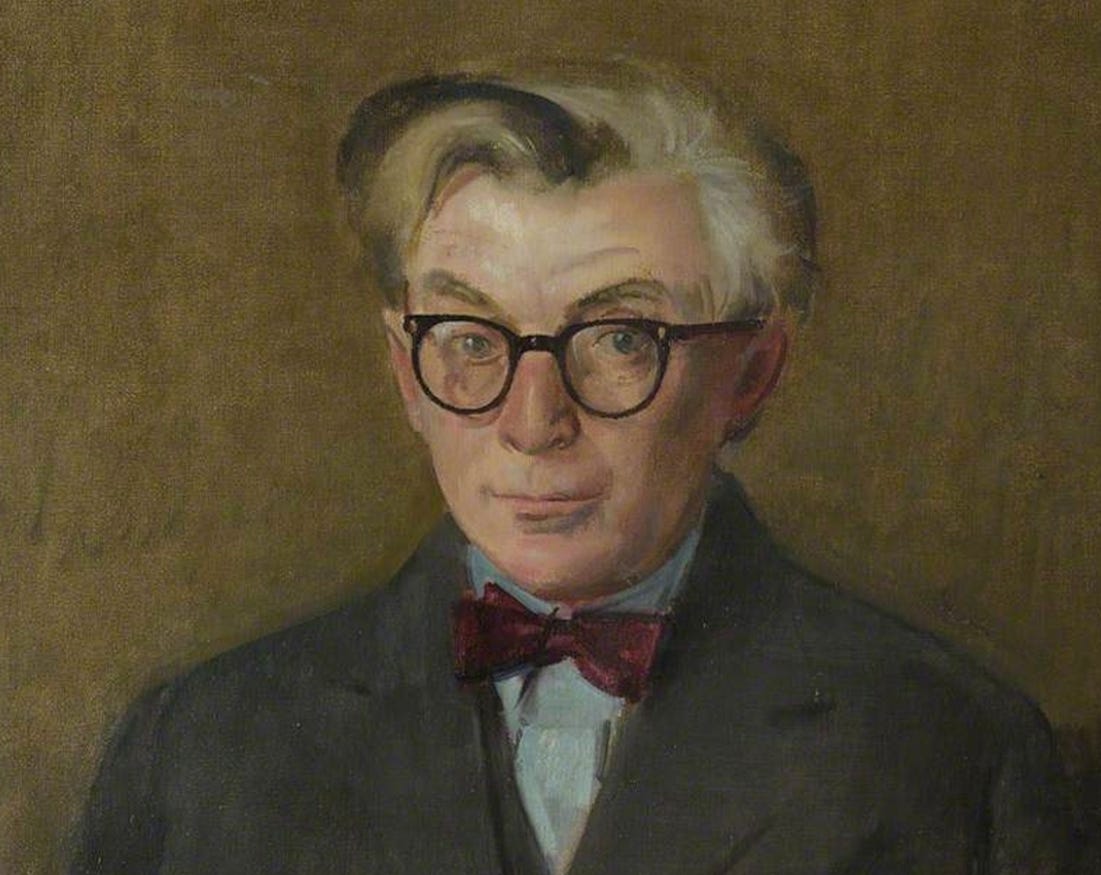
“Our assumptions do not matter if we are conscious that they are assumptions, but the most fallacious thing in the world is to organize our historical knowledge upon an assumption without realizing what we are doing.”
Herbert Butterfield, “The Whig Interpretation of History” (1931)
You’ve heard ideas like being “on the wrong side of history,” repeated by pundits and journalists all your life. But stop and think about it for a moment and you can’t help wondering where this strange idea came from. History takes sides?
This set of assumptions about “history” having a particular (progressive) will comes into public discourse constantly, especially in politics: “history will judge…” “the march of progress…” “you can’t turn back the clock…” “an idea whose time has come…”
Once you’ve learned to spot it you find it everywhere, in politics and social and cultural discourse. And in the study of art, perhaps more strongly and overtly than elsewhere.
If you’ve ever taken an art history course, you’ve seen this diagram.
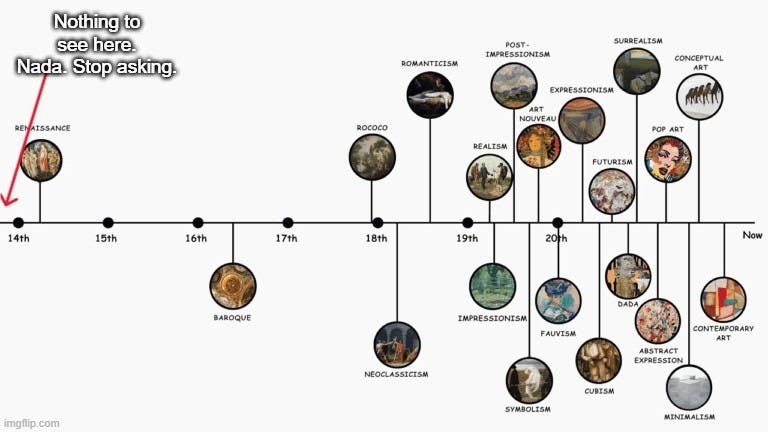
“Art,” properly understood, starts at the Renaissance, we are told, and marches smartly along its timeline: Baroque, Rococo, Romanticism, Realism, Impressionism, Post-Impressionism, Cubism, Expressionism, Fauvism, Postmodernism… each movement giving way to the next, like stations on a railway line.
Mostly without realising it, we’ve been taught a very specific way of thinking about the history of Western art. We know where “art” started, and where it went. We’re taught to draw a line backwards connecting the various movements that inevitably led us to where art is today. Artists who seemed in retrospect to have been moving along the line are routinely called “innovators,” “ambitious,” “avant garde,” etc. It’s often said of Giotto, for instance, that he “anticipated” later developments that didn’t exist for another century. And the flip side is obvious: those who weren’t going the right way, the direction willed by “history,” are “retrograde” “archaic,” and simply disappear from the story in a puff of historiographical irrelevance.

In today’s post for paid subscribers, we’re going to take a critical look at the idea that there is such a thing as a quasi-conscious entity called “History” that has some kind of specific will for the human race and its art. This idea was specifically identified and critiqued by an important and under-sung British historian, Herbert Butterfield in his seminal 1931 book, The Whig Interpretation of History. The “Whig” historiography is the habit of reading the past backwards from the present, turning what happened into what was supposed to happen. Once you know the ending, it’s remarkably easy to discover that the whole plot was leading there all along.
And once this habit gets into art history, the consequences are enormous: whole artistic traditions are judged according to whether they appear to be travelling towards the art that came after them, rather than according to what their makers actually intended them to be.
Become a member
The Sacred Images Project is a unique source of thought on sacred art, and a permanent reference library for its history, theology and practice.
Free subscribers receive regular public essays, news and updates.
Paid subscribers get the more substantial research: long-form essays on the history and theology of Christian art, extra materials below the paywalls with serious looks at ancient primary sources, close examinations of individual works and artists.
Subscriptions support the research and writing that keeps the whole project going.
Paid members receive:
Weekly subscriber-only essays and in-depth series
Full access to the Reading Rooms and growing archive
Downloadable resources, high-resolution images and other member extras
Membership in the Ars Sacra Association and future members’ benefits
Annual membership: $75, 30% off the monthly rate.
Comments
Nothing yet. Say the first thing.
Sign in to join the conversation.