
We live in what is being called a “post-truth” age, where definitions and meaning have become meaningless, or so we’re told. We’re just not supposed to mind very much what things are, in their nature, or bother our heads over the meaning of words or the objective value of things. I guess we’re expected to stop thinking entirely, and stop having any kind of spiritual needs, and mostly just open our mouths to receive whatever consumer items we’re fed by The Machine.
So, the question above, which was still a matter of interest and debate when I was in high school, seems to have simply been dropped from any public discourse. When anything can be “art” it means really nothing is art and no one in our elite institutions of art cares. Art itself has lost meaning, or been drained of it, by the official gatekeepers.
What have we got in “contemporary galleries” now, since we simply gave up defining and being interested in the meaning of things? A porcelain urinal. A rock. A dirty bed. A shark in a tank of formaldehyde. A tin of human excrement… It sinks from there…
What’s the point? The message? The point is that there is no point. And there’s certainly no message. In many cases there isn’t even an object.
So, what does the question, “What is art?” even mean in a cultural atmosphere like this that seems interested in nothing, finds meaning in nothing and offers nothing of meaning to anyone, that repudiates meaning? We have a cultural elite class devoted to meaninglessness, absurdity and nihilism. We pity them, and pray for them.
But these people are not us. We know there is meaning, and that art is important for helping define and express it; elites and institutions that have given up offering answers for meaning can simply be ignored, having made themselves irrelevant.
In fact, I think asking and thinking about the question is crucial for normal people to do right now, as the wider public continues to lose faith in the institutions purporting to be the preservers of our culture. But it needs to be revisited outside the context of our institutionalised postmodernist, deconstructionist meaninglessness.
Believing that art itself has meaning is an exercise in faith, an effort to recapture the concept of meaning itself. And it is a necessary starting point; or we might just as well go settle into our life of mindless consumption and distraction.
So, let’s see if we can put together some parameters, or even a few talking points, for an ongoing discussion about the big question above.

In todays post for all subscribers, we’re going to talk about a question that is surprisingly complex: What is “Art”? We’ll look at the Greek terms “techne” and “telos” to compare with our Postmodern Cartesian outlook of radical divorce from reality, craft and meaning.
Our elite institutions have told us for decades there’s no “meaning” to the term at all, so anything can be art. We respond that this means in effect, nothing is art. Postmodern anti-rationality has almost taken from us the ability to draw meaning from the art we make and see, so I thought a close examination of the term and the history of the idea would be timely.
Become a member
The Sacred Images Project is a unique source of thought on sacred art, and a permanent reference library for its history, theology and practice.
Free subscribers receive regular public essays, news and updates.
Paid subscribers get the more substantial research: long-form essays on the history and theology of Christian art, extra materials below the paywalls with serious looks at ancient primary sources, close examinations of individual works and artists.
Subscriptions support the research and writing that keeps the whole project going.
Paid members receive:
Weekly subscriber-only essays and in-depth series
Full access to the Reading Rooms and growing archive
Downloadable resources, high-resolution images and other member extras
Membership in the Ars Sacra Association and future members’ benefits
Annual membership: $75, 30% off the monthly rate.
The other way you can help support the work is by making a one-off donation or signing up for a patronage through my studio site, where you can choose for yourself the amount you contribute. Anyone contributing $9/month or more there will receive a complimentary paid monthly membership here. This helps me a lot because it is not subject to the 10% Substack fee.
Why is it important to think about right now? Obviously, the most pressing issue is “artificial intelligence” being used to create images and music. For the first time in history, it’s possible to have images that have no immediate connection to a human will, action or intelligence, and still less to any kind of craft or expertise with materials. It’s a sign of the strangeness of our times that we must now distinguish between the image and Art.
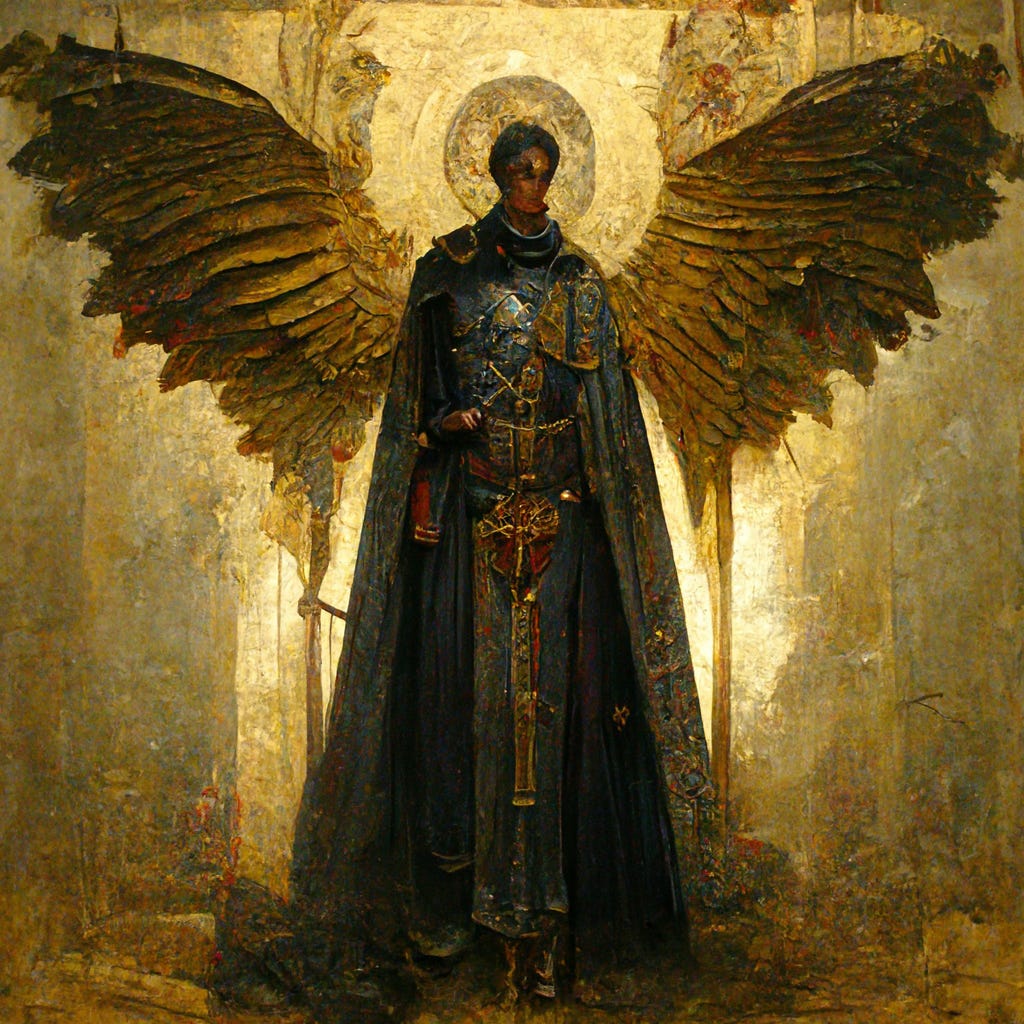
About a year ago a friend of mine told me about a new thing, an online toy he was messing around with. It looked interesting and I signed up for a month of free use during their beta test stage. Called MidJourney, it was an automatic image generator that used some kind of algorithmic, mathematical juju to create artificial images according to “prompts” - lines of descriptive text put by the user into a thing like a search window.
So, you open the page and there’s a little prompt window, and you type something like, “Guardian angel, Byzantium, impressionistic, dramatic lighting, large wings…” and click. It thinks about it for a minute or so, and out pops a group of simplified images. You can pick one you like and click “upgrade” and it will add details and make it look snazzier.

I played with it for a couple of weeks and used it as a prompt to my own visual imagination, saved a file of interesting images that I might use some time for paintings, then got bored and cancelled my subscription.
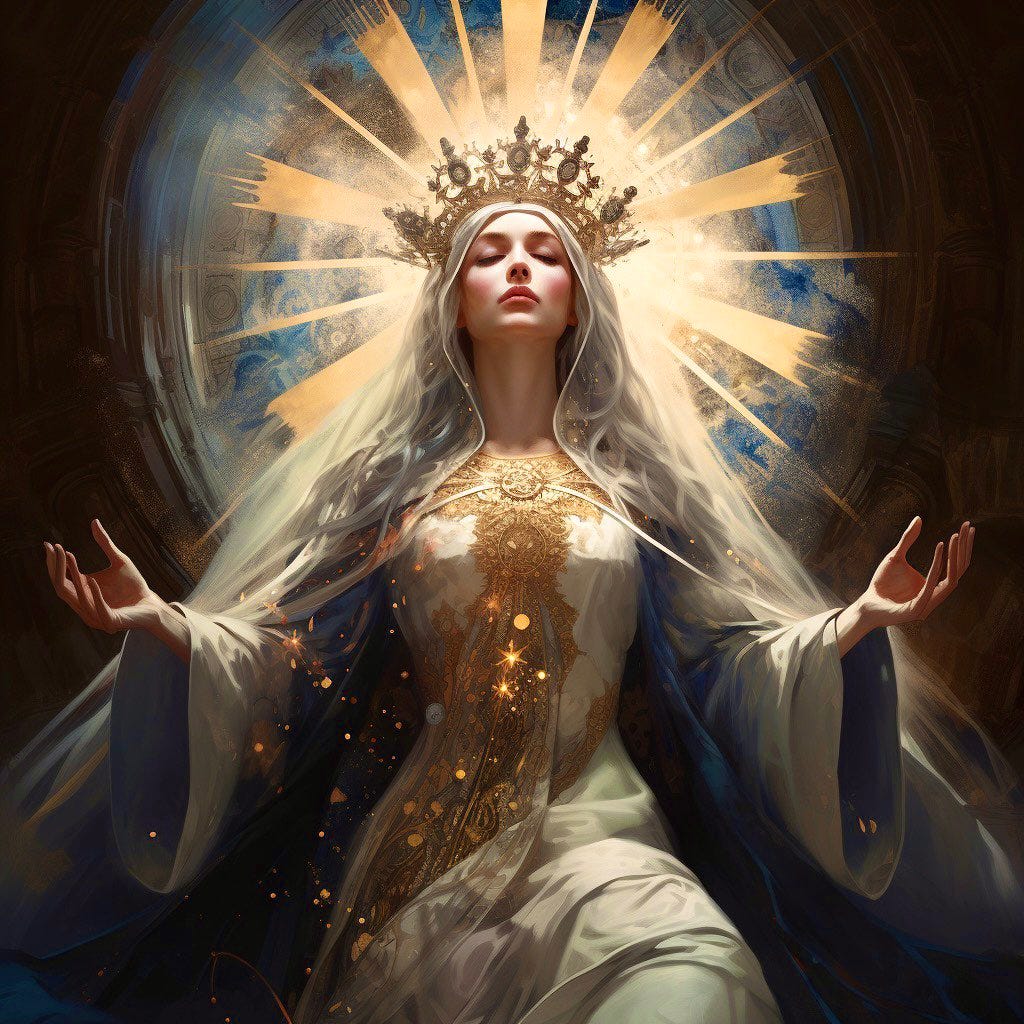
We’ve talked before about the differences between AI automatic images and art: “Mary, Queen of Heaven, or Varda, queen of the Valar?”
People who don’t really know what art is to begin with really especially don’t know how AI images are generated. They think it’s just some fancy new way for artists to create “digital art”. That is, a new kind of programme used by artists to electronically “paint” their work, manipulating a stylus or a mouse on an iPad or similar device.
But this is absolutely not the case. No human hand, eye or mind had anything to do with the creation of the image above. It was created in response to a verbal command typed into a thing like a search window. Automatically generated AI images are entirely created by a computer programme. They not only don’t involve a human artist, the program completely precludes any artistic involvement by a human.
I can’t count the number of times I’ve had fruitless arguments with people online presenting “art” created by an AI algorithm automatic image generator, and insisting that it’s really “by” a particular person. A lot of the time the person arguing is innocently unaware that there is no involvement of any “artist” - that is, the prompt writer - in the creation of the image. You might as well call the person ordering a pizza over the phone a pizza chef.
The fundamental difference between AI-generated images and human-created art, either using “digital media” or “traditional” physical media, lies in the distinction between human agency and the non-human, automatic processes of AI algorithms. In human-created digital art, the artist exercises creative control, he makes decisions guided by his intent, training, emotions, and personal experiences. Human agency is at the heart of this process, as the artist consciously directs composition, style and meaning.
No AI generated image can be any of those things. The AI programme doesn’t have agency, intention, experiences or training in any aspect of visual art - apart from the human-made images that have been used to “train” it. AI images are completely separate, divorced, from human agency. AI algorithms generate images based on patterns taken from vast visual datasets, without the involvement of intellect, human choice or creative decision-making.
It can’t do any of the things that go into creating visual art, even those using “digital media”; decisions about composition, colour, line, value, space, volume etc. It can’t have a grasp of or relationship with the subject or any kind of intentional message or purpose. Because all those require an intentional intellect which the machine doesn’t possess.

Something I’ve noticed a great deal in looking for online courses to take in iconography is that very, very few start with focus on the fundamentals: drawing in the iconographic modality. To create an icon freely, one that is uniquely your own, and to develop an authentically personal style, it is necessary to develop the foundational skill of drawing in the Byzantine style according to the canons, or “rules” of that style. In most cases, participants in a weekend “iconography” class will be given a photocopy of an existing icon and told to trace it.
But this teaches nothing.
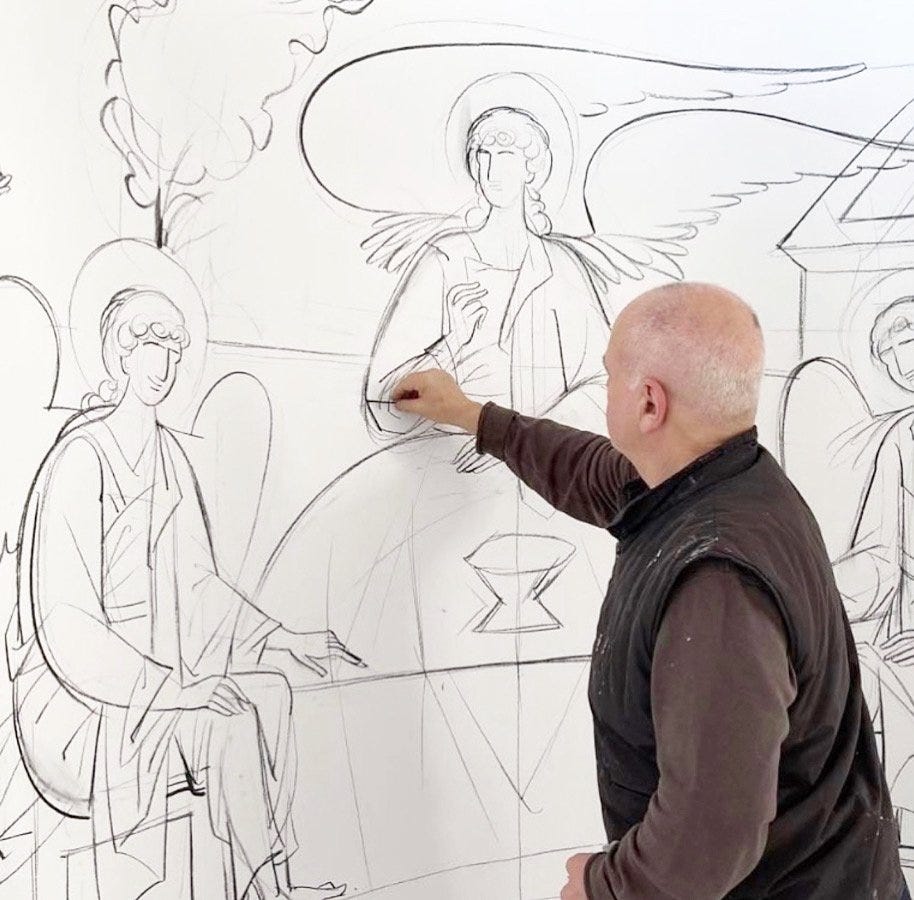
Everyone wants to skip drawing and get on to the exciting and satisfying painting stage, so they can have a finished piece to bring home and tell their friends they painted it. The teaching of drawing skills - the most fundamental skill in all visual art - is entirely lost in the west as a normal part of education, and with it the teaching of visual discernment.
The result is that in our culture, the visual intellect is atrophied, so we have no idea what art is supposed to look like. The idea that one trains seriously for many years to learn and develop these skills is simply lost. Real respect for a skilled practitioner has been replaced with a silly romantic idea that being a painter involves “talent” which is some sort of magical innate ability divinely granted to a lucky few1.
Craftsmanship, mastery of the use of materials and the development of the visual intelligence, is not just about mechanical execution. True mastery is about understanding the nuances of materials, tools and techniques, and how they can be manipulated to convey a particular emotion, story, or concept- in other words, meaning.
The rise of “conceptual art” has obviated the need for any development of skills. It certainly makes “making art” much easier if you can just place a rock on a plinth, and never have to bother to learn how to carve it into an image. No spending ten years apprenticing to a stone carver.
The average apprenticeship - just to gain mastery of materials and tools - in Renaissance Florence was 7 - 10 years. And that was when the real test began. Mastery of materials wasn’t enough to gain a painter a reputation for a nuanced understanding of subjects he would need to compete in the market of church and private commissions.
Techne is an ancient Greek term that refers to the art, skill, or craft involved in making something. Unlike episteme, which is knowledge for its own sake, techne is knowledge applied to produce something tangible, whether it be a painting, sculpture, or any other form of art. Techne is the essential relationship, the meeting point, between the artist’s technical skill and the creation of meaningful, impactful art. As George Kordis says in this video, his absolute mastery of Byzantine artistic styles and the materials that go into them is his artistic “mother tongue”.
Techne implies that creating art cannot be solely about inspiration or emotional expression. It has to involve a disciplined practice of skills that must be learned and perfected over time through sustained effort. An artist's techne is what enables him to execute ideas with precision and to communicate the intended message effectively.
The concept of techne also implies a connection between the artist and the tradition he is part of. We can’t imagine Leonardo da Vinci being separated from the styles and techniques of the High Renaissance in Florence. Throughout history, artistic techniques and methods have been passed down from one generation to the next, evolving and refining over time. By mastering techne, an artist aligns himself with his own purpose, with this tradition, becoming a part of it himself. In the end, techne owns the artist.
Techne, then, requires an artist to understand the principles behind their craft - how light interacts with form, how to create depth on a flat surface, or how different materials behave under various conditions, and how to use these considerations to say somethiung of meaning. This deep knowledge of craft and cultural meaning allows the artist to make informed decisions so the final work fulfils its intended purpose.
You hear all the time, as though it is as evident as a Euclidian axiom, “Well, as we all know, Art can’t be defined,” or “Art is entirely subjective; if someone says it’s art, it’s art.” But this is the Begging the Question fallacy. You are starting the discussion by assuming that which you must prove. Do we really “all know” that? Please demonstrate that art cannot be defined. Explain why.
If you do, I will probably find that you are assuming an entire worldview that I cannot accept, with rippling repercussions out to every aspect of life, a metaphysical black hole that sucks meaning out of everything. And that is the metaphysics of Void - the proposal that meaning is meaningless, that things cannot be defined, that reality itself is at best subjective. This is the essence of Modernity, in which we are all trapped in a kind of Cartesian hall of mirrors.
But to show me that something so fundamental to humanity as art Art cannot be defined, you have to show me that Void is true, which is an oxymoron, a self-refuting proposition. Void negates truth. Void presumes the internally contradictory proposal that it is true that nothing is true.
Void is the philosophy of negation and anti-meaning. It is the anti-idea that the grand shyster, the madman Marcel Duchamp promised in 19172 would free the art world from the tyranny of meaning. Here we are over a hundred years later watching the horror show of human beings using their own bodies as “meat Lego” to prove that craft - divorced from Telos, meaning, gives the human will its ultimate expressive power.
Telos: Greek. The ultimate purpose, end, or goal of a thing. In reference to visual art, telos describes the underlying purpose or intention that guides the creation and interpretation of a work of art. It is the reason why the artwork exists and what it seeks to achieve, whether that be to communicate a message, evoke an emotional response, express an idea, or fulfil a specific function within a cultural or religious context.
Seeking the Telos of a work looks beyond the mere image to consider what the artist intended to achieve and how the work fits into a broader narrative or tradition. In Byzantine art, the underlying meaning of the image is the person depicted. The meaning and purpose of an icon of St. Nicholas of Bari is St. Nicholas of Bari himself, the man and saint he was. The the Telos of the image of the Pantocrator is Christ the divine ruler.
Art conveys meaning, it has an inherent purpose, one that is built into its nature. This cannot be escaped, even if the proposed meaning is that there is no such thing as meaning.
A medieval or Renaissance figure like Cennino Cennini or Leonardo da Vinci would likely define “art” within a framework that combines skill, knowledge, and divine inspiration. To these men of the old world, “Art” was inseparable from craft and the ultimate purpose of an image. The idea of telos, that art had a higher purpose, was central to their understanding, as was the importance of techne, the mastery of craft and technique. Art - broadly defined as all the works of the hands of man - was seen as a noble pursuit that only started with innate talent but whose fulness could only be acheived through discipline and education, that is, a combination of intention and a deep understanding of the world.
Even if the given expression is building a staircase, Art is a disciplined craft grounded in technical skill and knowledge, with the ultimate purpose of reflecting divine truth, the ultimate Real.
I’m going to go out on a limb and propose a working definition for us now: “Art is the intentional human expression of ideas, emotions, or experiences, realised through the skilled application of craft (techne) and guided by a purpose (telos), to creating material works that demonstrate meaning and significance.”
Discuss.
People are sometimes shocked at the exasperated and annoyed reaction their well-intentioned admiration can receive from people who have spent many hard (and expensive) years toiling in classes learning the traditional skills. But the usual exclamation of, “Oh you’re so talented; I can’t draw a straight line,” really means the person imagines one is born with the ability to draw the way Harry Potter was born with his magic gene. Not only does it implicitly dismiss the labour that went into the study, it suggests there’s really nothing more to it than the luck of genetics. If you want to engage a skilled practitioner more fruitfully, try, “You seem to have had some serious training. Where did you study?”
The ideas about art that modern people accept without criticism - like “Art can’t be defined” - come from the early 20th century and were inserted into the art world deliberately. We talked about it in “Who killed art and why” back in September.
No posts
Comments
Nothing yet. Say the first thing.
Sign in to join the conversation.