
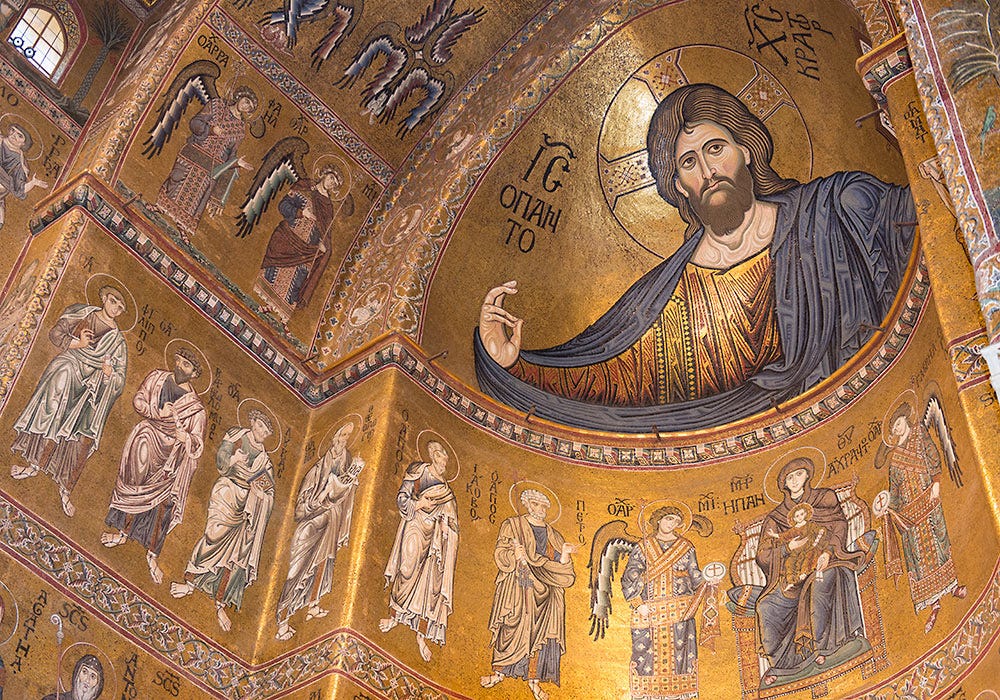
“Roger” isn’t the sort of name one usually associates with Sicily. But in the eleventh century something extraordinary happened in Southern Italy when two brothers of minor Norman nobility1 turned their ambitions and knightly energies toward reclaiming the island from its Islamic conquerors. It was a time when Normans were turning up all over Europe, and Sicily, though prosperous, was politically divided, presenting an irresistible prize.
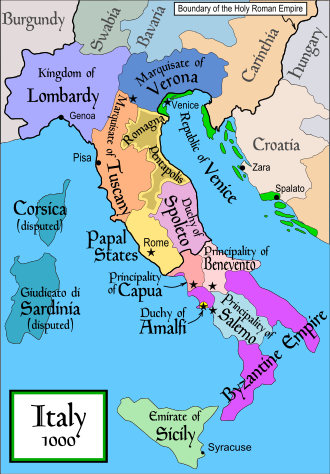
The history of the strategically critical region is extremely complex, but we can say that by the middle of the 11th century, Sicily had been under the rule of its Islamic conquerors for two centuries. Before the Muslim conquest began in 827, Sicily, a part of the Roman empire from its start, was essentially a Byzantine Greek Christian island, having been reclaimed from post-Roman, Ostrogoth rule by the illustrious Byzantine general Belisarius as part of his reconquest of lost Italian lands, in 535.
In 1061 two ambitious knights from Norman nobility, Robert Guiscard and his younger half brother, Roger de Hauteville, crossed the strait from Calabria and began what would come to be called the Norman conquest. They had an explicit mandate from the pope, who, in 1059 at Melfi had invested Robert Guiscard as Duke of Apulia and Calabria and, significantly, “by the grace of God and St. Peter, future Duke of Sicily” (futurus Siciliae dux). At this the brothers were magnificently successful, and by 1091, the town of Noto, near the southernmost tip of the island and the last major Muslim stronghold, fell to Roger and Islamic political rule in Sicily was over.
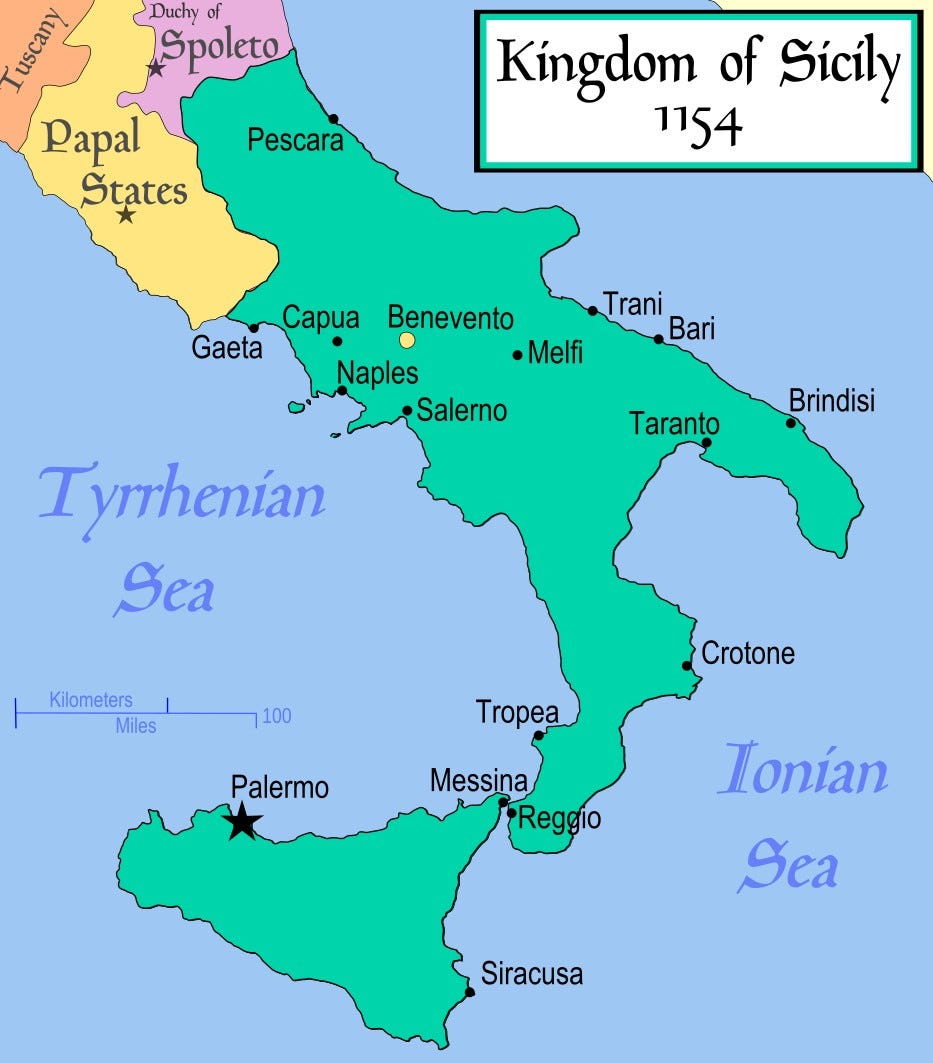
Roger’s kingdom, encompassing Sicily and most of southern Italy, would survive in various forms and under successive dynasties for more than seven centuries, until the unification of Italy in the nineteenth century.

In today’s post for all readers, we’re off to Norman Sicily for a little history and a look at the extraordinary Byzantine mosaics of Cefalù, Monreale and the Palatine Chapel.
Become a member
The Sacred Images Project is a unique source of thought on sacred art, and a permanent reference library for its history, theology and practice.
Free subscribers receive regular public essays, news and updates.
Paid subscribers get the more substantial research: long-form essays on the history and theology of Christian art, extra materials below the paywalls with serious looks at ancient primary sources, close examinations of individual works and artists.
Subscriptions support the research and writing that keeps the whole project going.
Paid members receive:
Weekly subscriber-only essays and in-depth series
Full access to the Reading Rooms and growing archive
Downloadable resources, high-resolution images and other member extras
Membership in the Ars Sacra Association and future members’ benefits
Annual membership: $75, 30% off the monthly rate.
Islamic rule in Sicily had created a unique society, a blend of Greek and Latin Christians and Muslims from around the Islamic world. Palermo became one of the great economic centres of the Mediterranean, famed for its markets, mosques, gardens and sophisticated water systems. Western Sicily, the side closest to North Africa, was the most thoroughly Arabised and Islamised part of the island, and eastern and northeastern areas retained much stronger Greek-speaking Christian and Byzantine cultural inheritance. Christian communities that remained on the island lived as dhimmis, permitted to practise Christianity subject to legal disabilities and taxation.
After the completion of the conquest, the cagey and diplomatically able Roger created a surprisingly balanced situation for all populations, preserving a remarkable degree of religious toleration for the time. But as a Latin Catholic Christian, whose success was crowned by papal approval, among his first tasks was the restoration of Latin dioceses and ecclesiastical structures. And as we saw in England after the conquest, Normans knew the power of sending a political message by building projects.
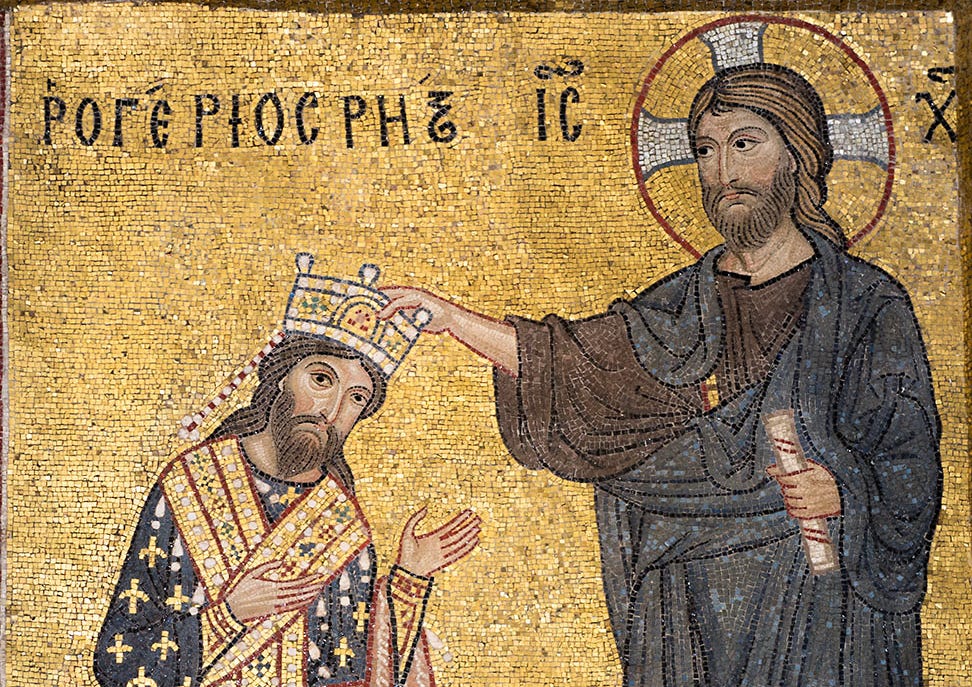
It was Roger’s son, Roger II, who turned this peculiar mixed inheritance into one of the most extraordinary artistic cultures of medieval Europe. The mosaic decorated apses of Sicily’s cathedrals still attract both tourists and serious scholarship today, nearly a thousand years later.
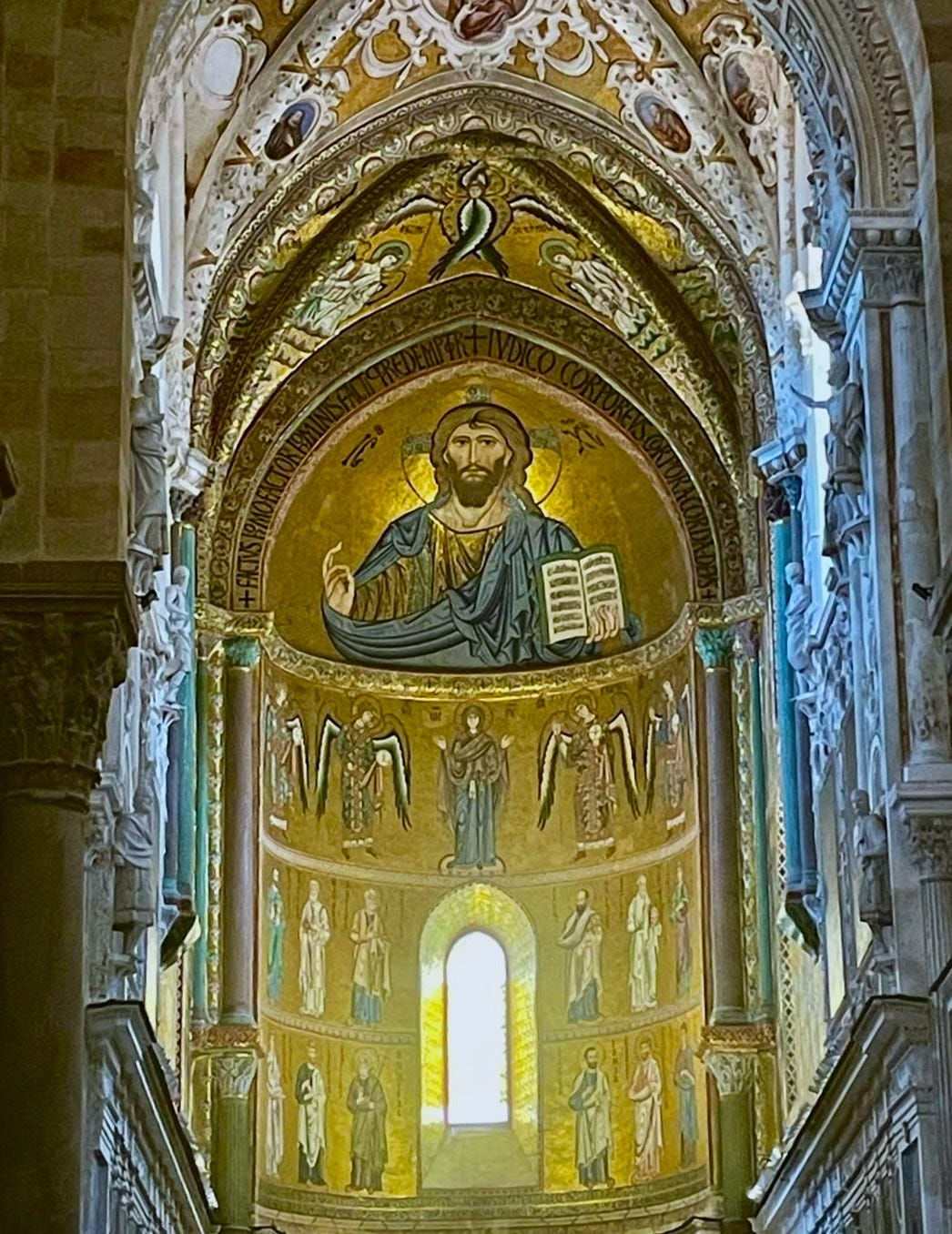
Modern scholars treat the story with “caution” of course, but according to tradition, in 1131, the year after he became king, Roger II2 was caught in a violent storm at sea while travelling from Salerno to Palermo. Fearing shipwreck, he vowed to Christ that if he reached land safely he would build a great church at the place where he came ashore3.
His ship safely reached the beach at Cefalù, and Roger kept his promise. The great Sicilian-Norman cathedral4 he founded there is dedicated to the Holy Saviour (Santissimo Salvatore), and boasts one of the most important Byzantine mosaics on the Italian peninsula, commissioned by Roger himself.
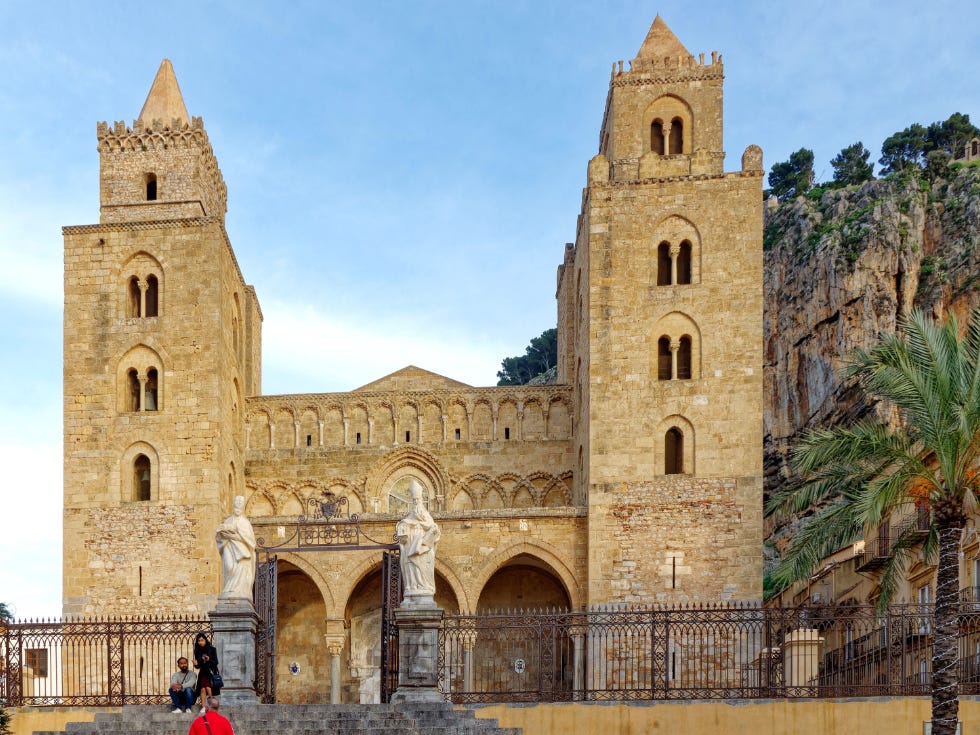
The cathedral had obvious political and dynastic purposes as its typically imposing Norman architecture attests. Roger had intended Cefalù as his burial church. He ordered two porphyry sarcophagi for it, a type of rare marble saturated with Roman and Byzantine imperial associations.
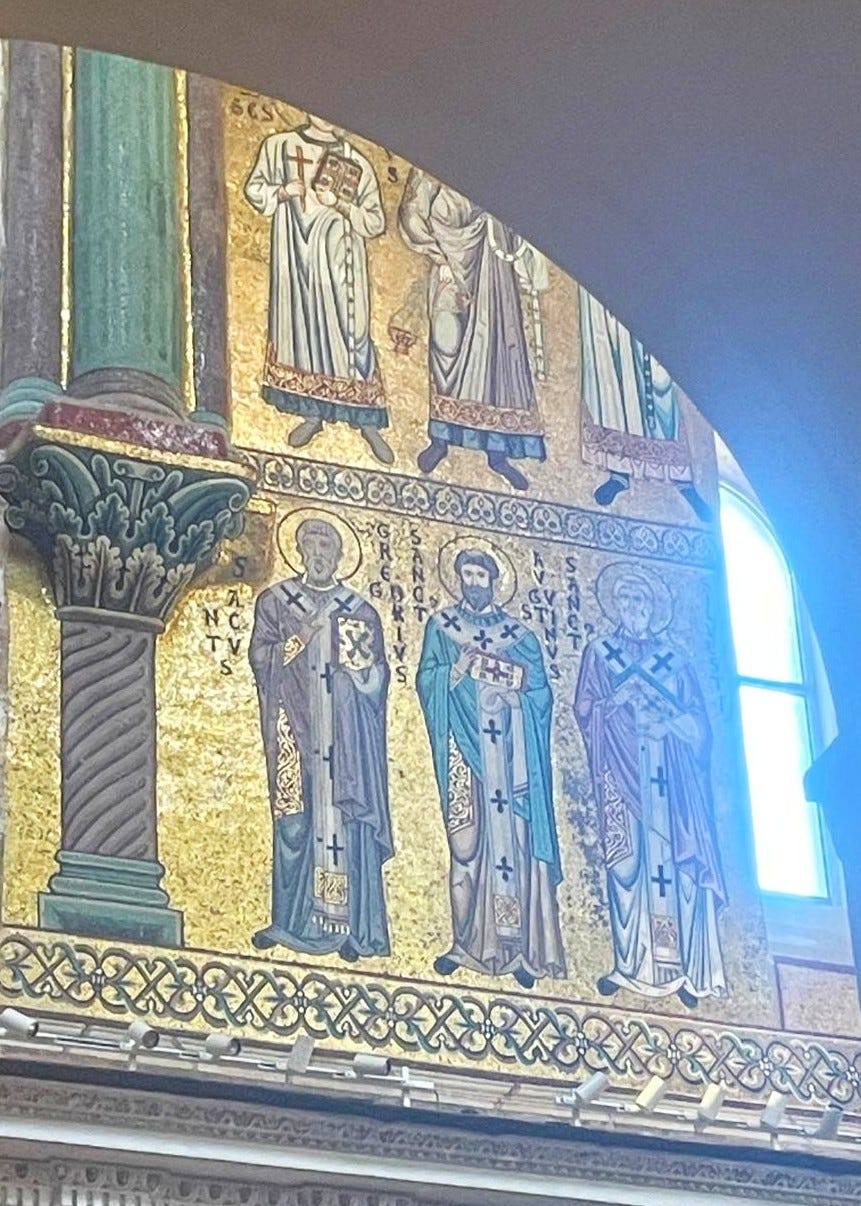
The mosaics are very safely dated to within Roger’s lifetime. An inscription gives 1148, so the programme was created within seventeen years of the cathedral’s foundation and six years before Roger’s death. They cannot be safely called Italo-Byzantine in style. Roger brought in Byzantine-trained mosaicists, probably from Constantinople, for the work.
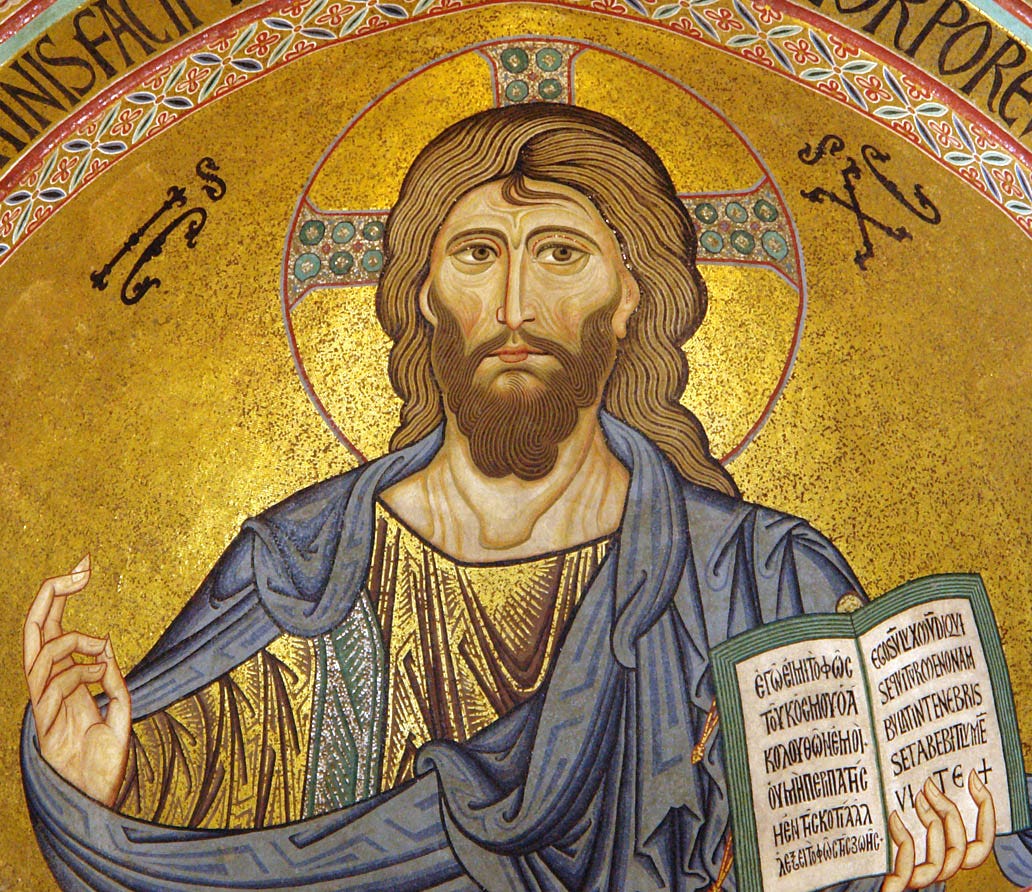
The colossal Pantocrator absolutely dominates the building with the curvature of the surface giving the appearance of embracing those in the sanctuary and nave.
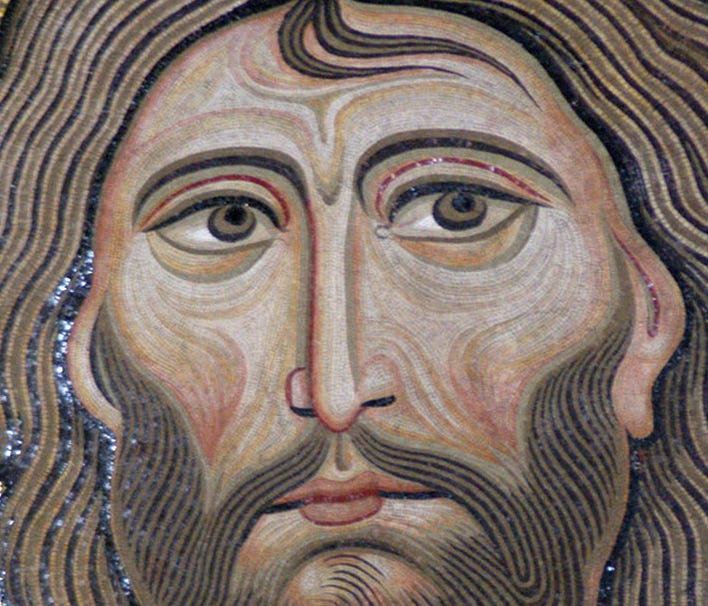
In the mature Byzantine tradition, the monumental mosaic was created as an integrated part of the architecture, rather than being merely a decorative addition.
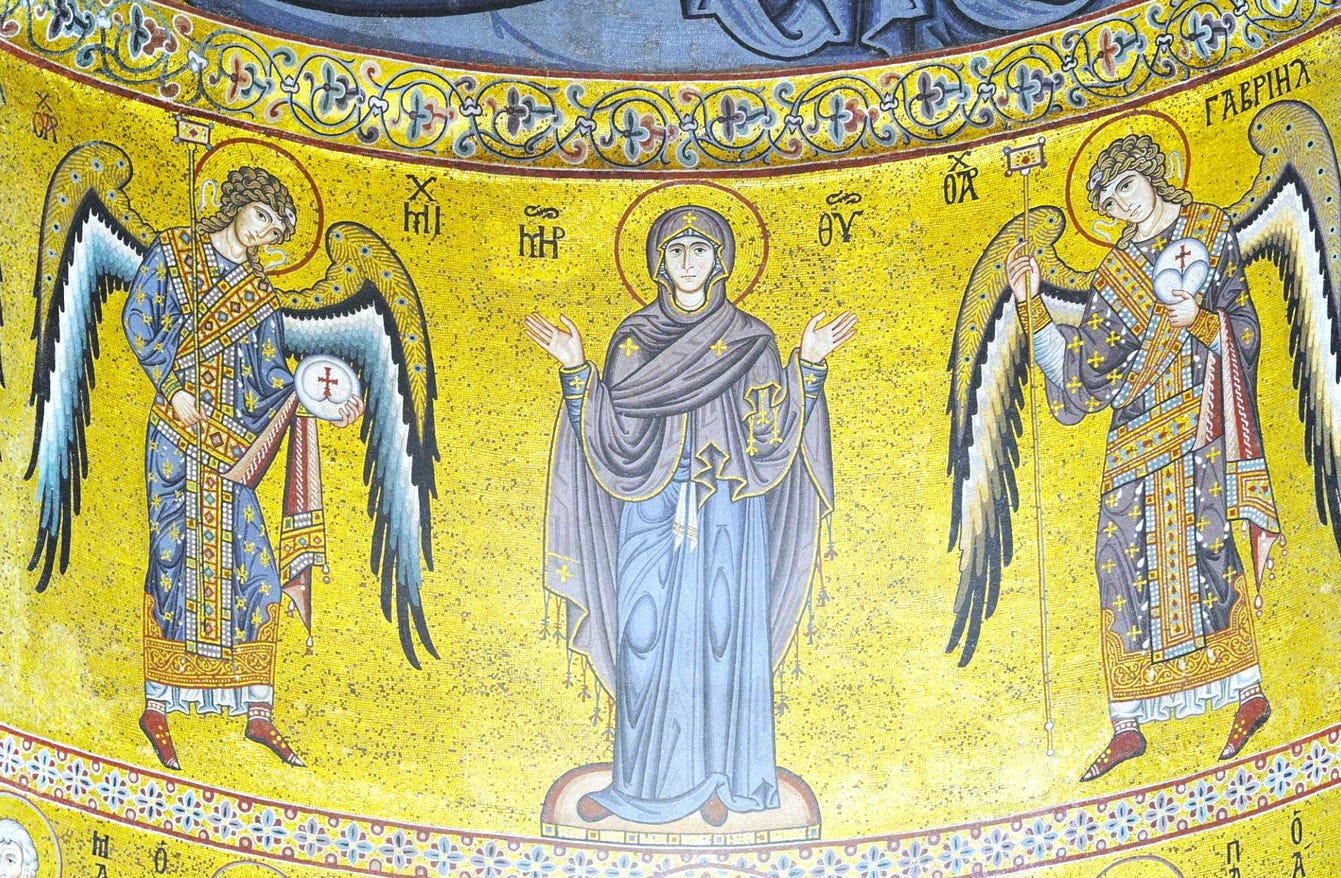
Particular classes of images are created for particular places. The architectural hierarchy of surfaces, with the apse, pendentives and walls divided into theologically derived registers, with the upper registers reserved for the Virgin and highest ranking angels and saints, told an entire cosmological story as one unified whole.
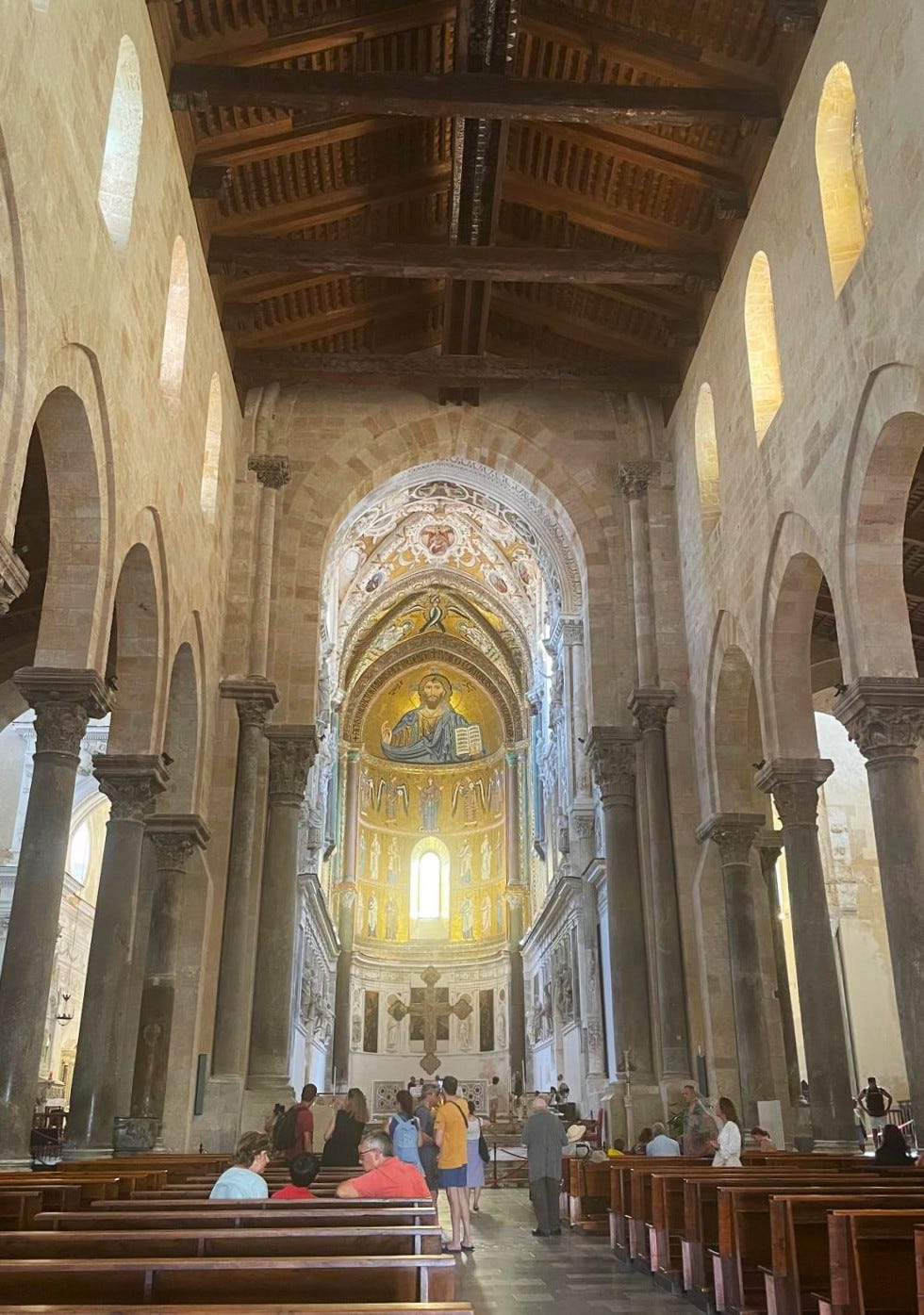
What makes Cefalù especially interesting is that the structure is not that of a typical Byzantine church. In keeping with Roger’s northern origins, it’s a large Latin Norman basilica with its typical European long nave and columns5. Roger’s Byzantine artists had to translate that established Byzantine system into a Western architectural form.
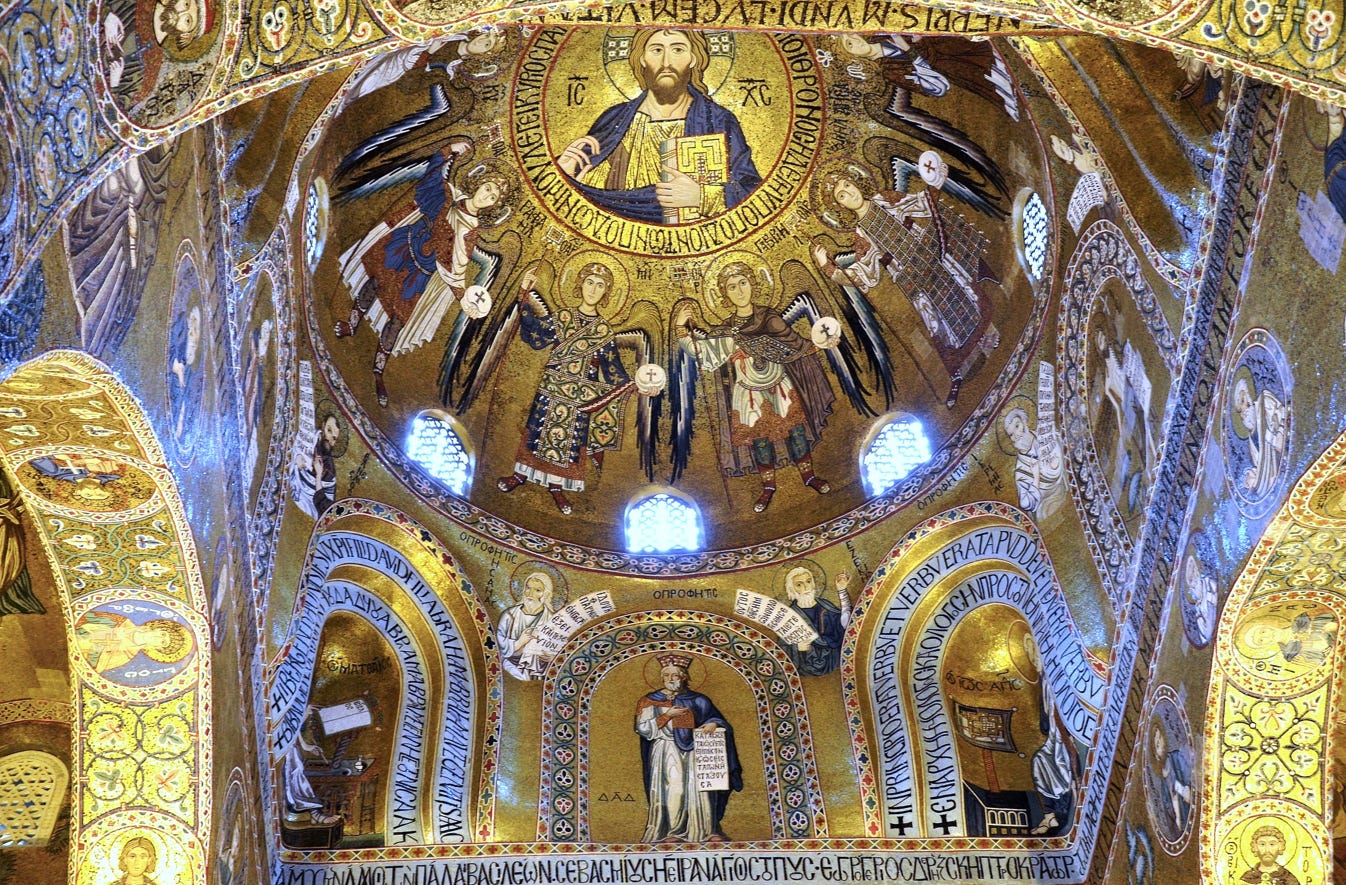
Commissioned by Roger II as the royal chapel of the Norman Palace in Palermo, the Palatine Chapel was started around 1130–1132, shortly after he became king, and was consecrated in 1140. Again, the building is constructed as a Latin basilica in the Norman style, with a long nave and columns, though this time the sanctuary is covered by a Byzantine-style dome, giving the eastern end a more Greek character.
Again, the apse is completely dominated by another monumental Pantocrator, and most of the church is covered in mosaic decorations, many more modern, but much of which date to the original foundation.
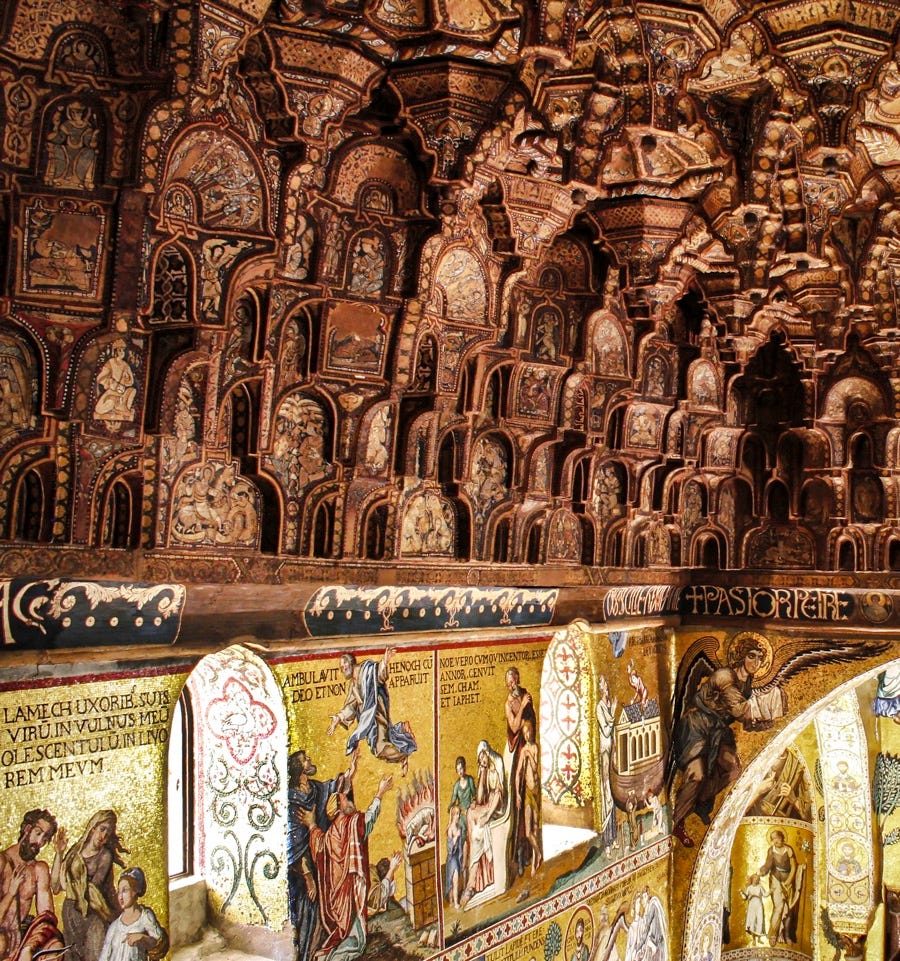
But what stands out as unusual in this case is the addition of a distinctly Islamic architectural feature, the wooden muqarnas ceiling, in which every section is a painted panel.
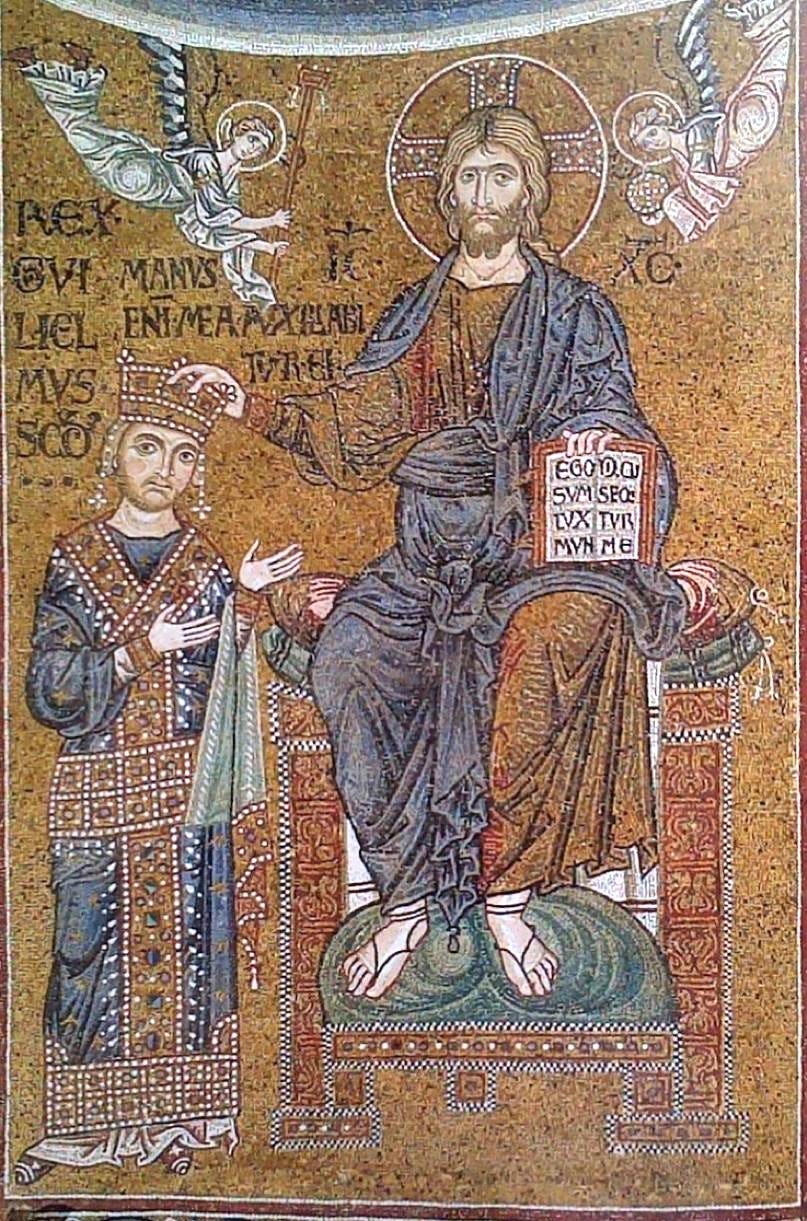
At the time of Roger II’s death, the Norman building project in Sicily was just getting going. Roger’s grandson William II carried on the family tradition, building the cathedral of Monreale near Palermo, and endowing it with even more magnificent mosaics and decorations. Begun in the 1170s, the programme covers almost the entire interior of the church, about 6,000 square metres.
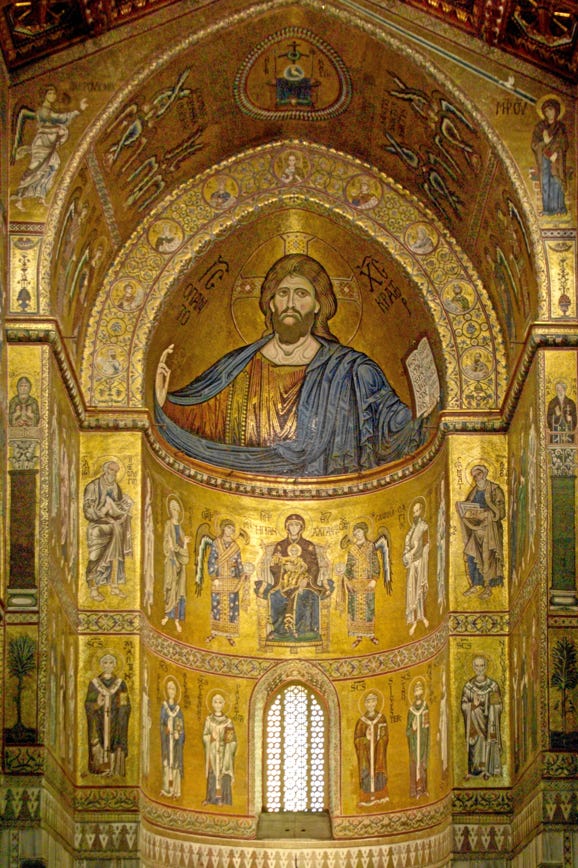
The enormous Pantocrator in the apse recalls Cefalù, but the Monreale programme covers the whole church, illustrating the entire history of salvation from Creation and the Old Testament through the life of Christ.
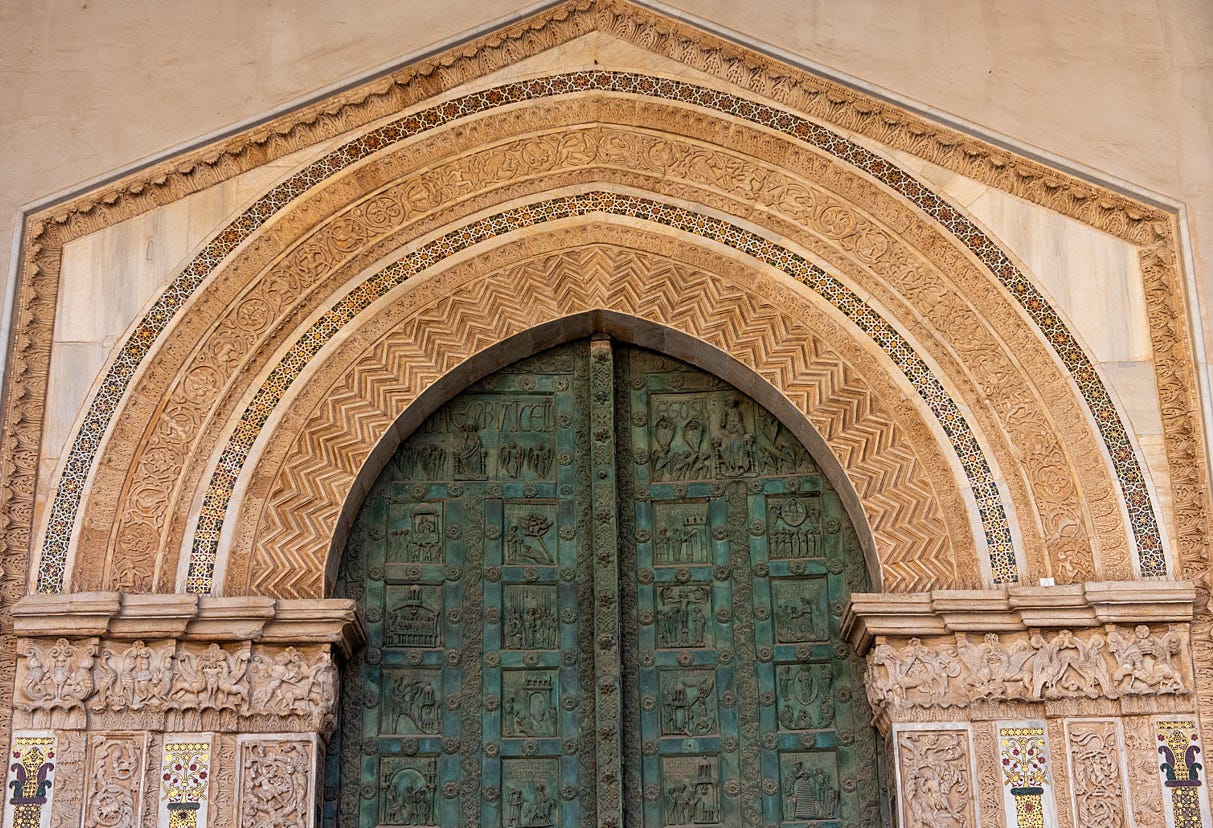
An extraordinary and riotous blend of Byzantine, Arabic/Islamic, classical Imperial and northern styles…
There really is no way to even begin to express the magnificence of these churches in a short post, but at least we’ve had a go at explaining why they are so important, and how they are connected to the larger story of Christian history in the Mediterranean.
As every YouTube video about Norman conquerors will remind us, they were the Christianised descendants of Vikings. They had been in Normandy for only about a century and a half when the de Hauteville boys turned up in southern Italy. By then they were thoroughly gallicised, French-speaking, Latin Christian and feudal, but had retained the extraordinary military and expansionist energy of their ancestors.
Roger II (1095–1154) inherited the County of Sicily in 1105 and subsequently acquired the Hauteville territories in southern Italy, becoming king of the Kingdom of Sicily- an extremely large territory that included much of mainland Italy, at Palermo in 1130.
The town of Cefalù is originally an ancient Greek settlement, dating at least to the 5th–4th centuries BC, called Kephaloídion (Κεφαλοίδιον), from kephalē, “head.” It most likely refers to the enormous rocca, or table-top mountain looming over the town.
Cefalù is one of those medieval cathedrals that took a very long time to complete. Building began rapidly under Roger II but continued for generations. It was finally consecrated in 1267.
Look carefully at the photos and you’ll see something surprising for the period: pointed arches! before “Gothic” has properly got going in northern France, incorporated by Roger’s Norman builders from existing Islamic architecture they found in Sicily.
No posts
Comments
Nothing yet. Say the first thing.
Sign in to join the conversation.