
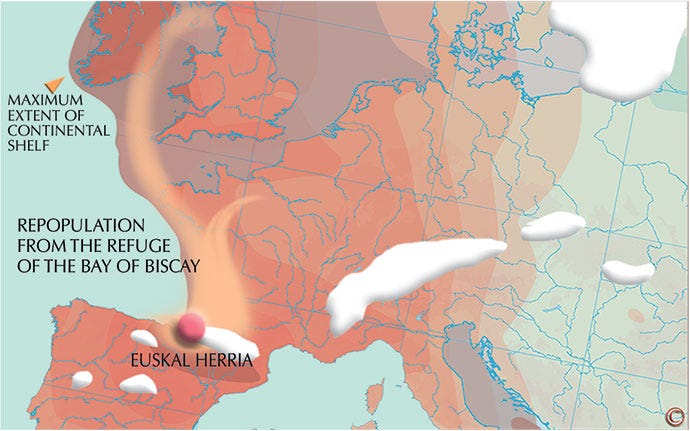
Modern Cumbrians are mostly descended from ancient hunter-gatherers who migrated north from Spain after the last ice age, the latest scientific evidence suggests.
Medics at the University of Complutense in Madrid took DNA samples from more than 5,600 people in 19 countries. The results strongly suggest that the inhabitants of the north-west corner of England are the descendants of prehistoric people who sailed up from Iberia.
But the proposition that thousands of families waited out the big freeze and then began paddling north in boats 10,000- 15,000 years ago to settle in the mountainous Cumbrian region might seem to be a rather amazing statement. It certainly does not fit with what has been taught in school history lessons for generations.
It would mean that the official story about the origins of Cumbrian people needs to be completely rewritten. Before explaining in full what the Iberian medics found in their huge investigation, let’s recap a little.
The traditional version of British history portrays the people of the so-called Celtic Fringe as a group that came, not from the south tens of thousands of years ago, but from Central Europe in around 400-500 BC. The conventional story goes that these people were rather poor, failed to unify militarily and were essentially massacred by allegedly stronger and better organised invaders from Northern Europe about 1,000 years later in 449 AD, in the famous Anglo-Saxon invasion.
Victorian historians were convinced the British were overwhelmingly Anglo-Saxon in origin. They assumed that virtually all the indigenous Celts must have been killed by the incomers. They decided a tiny minority of Celtic survivors, who were not killed, enslaved or expelled from Britain, were driven into infertile mountainous western areas like the Lake District and Wales. This allegedly tiny group of hapless refugees were allowed to scratch a living on unpromising land the Anglo-Saxons did not want.
For 200 years at least, the inhabitants of the western side of Britain were written off as essentially weak, marginal and unimportant. The term Celtic Fringe was invented to describe them in 1890 by the Tory Prime Minister Lord Salisbury as he called for a reduction in the number of MPs representing those areas.
Salisbury wrote: “The great defect of our present representation is that the Celtic edges of the country on both islands are represented enormously out of proportion to the rest of the Anglo-Saxon population.” The Anglo-Saxon invasion hypothesis was enthusiastically embraced by the British establishment because it confirmed some deep prejudices among the ruling class.
Firstly, it suggested that because the Celts were practically all exterminated, British veins now run with the undiluted blood of tough, no-nonsense Germanic tribes. This is supposed to explain why we had what it takes to build an Empire.
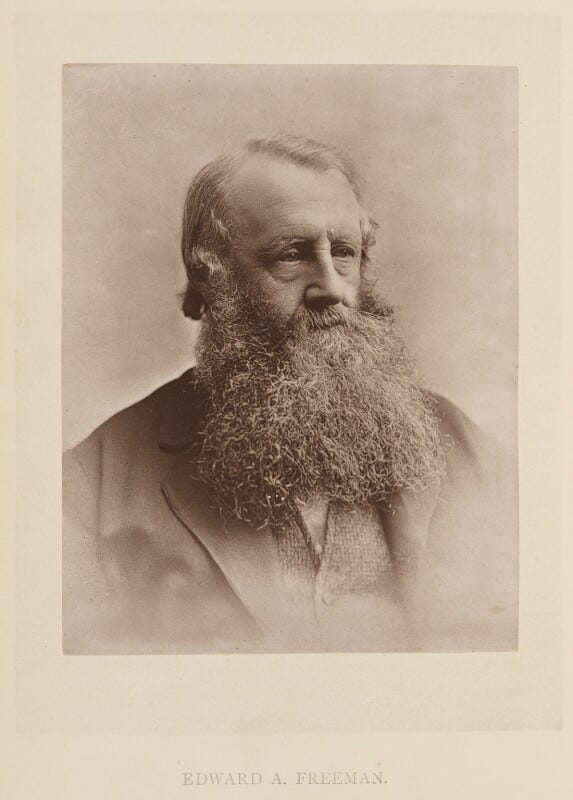
Possibly the most influential Victorian historian was Oxford University professor Edward Augustus Freeman. He rejoiced in the assumption that the British were really resilient Germans. He said people should “reverence” the Anglo-Saxon Chronicle, which purported to describe the Germanic invasion as the beginning of English history, “next after your Bibles and Homer (because it) tells us that the first Teutonic Kingdoms in Britain began in the year 449.”
The second reason the elite liked the invasion story was that it seemed to confirm Salisbury’s view that the people of the Celtic Fringe are inferior and less deserving of political power.
This tale envisages a heavily armed force of 200,000 Anglo-Saxon warriors wiping the landscape clean of Celts. It is still very influential among traditionalists, such as Dr David Starkey, presenter of Channel 4’s Monarchy programme. He described the alleged invasion as “ethnic cleansing at its most effective.”
But the entire invasion hypothesis has come under attack from a new generation of academics. They are led by Oxford Archaeology Professor Barry Cunliffe. This younger group points out that there is no archaeological evidence whatsoever for a single, major Anglo-Saxon invasion in 449AD, no battle sites, no mass graves and no sign of disruption to agriculture which is invariably seen when such events occur. They say the actual evidence that does exist suggests a slow migration of Germanic people into Britain over a period of three centuries, not an instantaneous invasion.
Cunliffe produced DNA research suggesting 68 per cent of Cumbrians are descendants of the original Celtic hunter-gatherers who arrived in Britain by sailing up the so-called Atlantic Facade after the ice age. This has been backed up by a separate 2015 survey conducted by the Wellcome Trust and Oxford University which found a distinctive Cumbrian genetic cluster overlaying the boundaries of the Dark Age Kingdom of Rheged as they believe they existed in 600 AD.
Cunliffe argues that, far from being driven west after some mythical slaughter, there is no archaeological or documentary evidence of a mass invasion by Anglo-Saxons and certainly no massacre.

The Cunliffe camp argues that, instead, the Cumbrian Celts migrated north from Spain, Portugal and Southern France after the ice age. They followed the relatively shallow waters of the continental shelf. They shared a culture and language with the people spread all along what he called the Atlantic Facade: the Irish, Welsh, Orkney Islanders, Bretons, Galicians, Basques, Portuguese, Cumbrians and the Cornish.
Cunliffe argues that these migrating Iberians used Celtic as a “lingua franca” rather as English is used as a medium of commerce today.
If true, this alternative thesis, which Cunliffe calls “Celtic from the West” would increase the importance of Celts in Britain’s history.
However, the traditionalists refuse to give up. One leading supporter of the invasion theory is the Professor of Archaeology at Leicester University, Simon James. He argues the most extreme case that the Celts “never existed” and that they were “invented” by an 18th Century linguist called Edward Lhuyd. He was the man who first identified that the people of Brittany, Cornwall, Ireland, Isle of Man, Scotland, Wales, and, until the 13th Century, Cumbria, spoke mutually comprehensible dialects of the Celtic language, a tongue rather like contemporary Welsh.
James strongly implied that the word Celt was a fiction invented for political reasons. It was a ploy to criticise the English suppression of regional identities, he said. We should simply stop using the term and the whole issue will vanish, he argued.
Even so, the latest DNA science has dealt a serious blow to the long-cherished Anglo-Saxon invasion idea.
A high-powered group of doctors based at the School of Medicine in the University of Complutense in Madrid, Spain, one of the oldest and most prestigious academic institutions in Europe, has produced one of the most comprehensive analyses of the genetic origins of Europeans ever conducted.
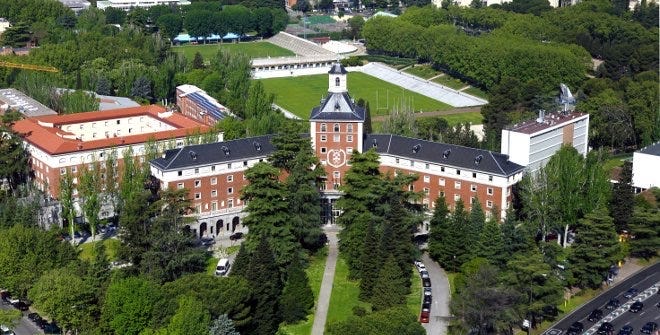
They decided to test whether the claims of Cunliffe and his allies stood up. It was an extremely large-scale investigation.
They took blood samples from 5,676 people in 19 countries. They came from a selection of Atlantic-facing countries as well as others such as from Japan, Switzerland, Austria in Central Europe and Finland to provide a clear comparison.
The analysis focused particularly on the frequency of the so-called R1b Y male chromosome.
HLA genes are used to match bone marrow recipients with their donors. So, they offer a very precise way of establishing someone’s genetic identity.
The doctors reported their findings in a paper entitled: “HLA Genes in Atlantic Celtic Populations: Are Celts Iberians?” It revealed the HLA readings were low in the non-Facade countries. But they “reached the maximum frequency in North Spain, Brittany, Wales, England, Scotland and Ireland.”
They add: “This suggests an ancestry relationship between populations inhabiting the Atlantic Europe facade.”
The report concluded: “The origin of the Celts is the Iberian Peninsula and not Central Europe.”
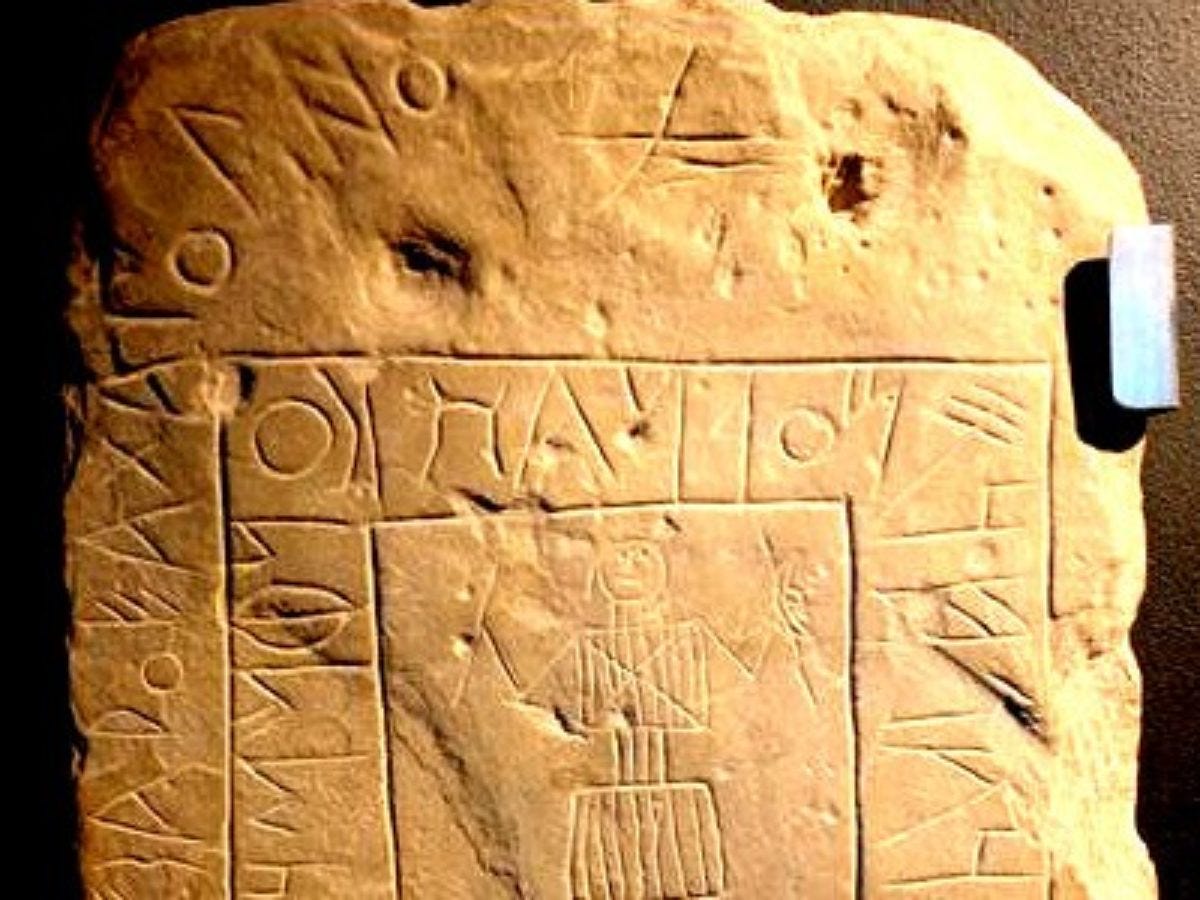
Now, this is very interesting because Linguist John Koch claims to have found potential proof of an Iberian origin for the Celts. He found rune-like inscriptions on around a hundred ancient stone tablets or stelae, mainly gravestones, in south western Portugal.
He believes they were written in the world’s earliest Celtic language, Tartessian, using the Phoenician alphabet.
The stelae date back to 900 BC - 200 years before the Hallstatt culture reached its peak in Austria. Hallstatt, according to the traditional view, is supposed to be the cultural centre of Celtdom.
One telling discovery is that the opening line on one Tartessian stelae mentions “Lugos”. This is the same Celtic god that Carlisle (Luguvalium) was dedicated to.
If confirmed, this is a remarkable link between Carlisle and the Portuguese port city of Tartessos 2,000 miles to the south. It is also adds strength to the Atlantic Facade thesis. If Koch is right, his findings mean Celtic culture and language was born in Iberia, spread to places like Cumbria and then to Central Europe, not the other way around.
A growing number of archaeologists believe the Koch discoveries indicate that Celtic was spoken in Iberia before it reached Britain and other parts of the facade before it ended up in the rest of Europe.
The Tartessian hypothesis is still controversial to some academics. Tatanya Mikhailova of the Institute of Linguistics at Russian Academy of Science, Moscow, is particularly sceptical, dismissing his interpretation as “biased” and “far-fetched”.
But Professor Alice Roberts, author of The Celts: Search for a Civilisation, is less sceptical. She believes the Tartessian evidence indicates the conventional story that the Celts invaded Britain from Central Europe: “isn’t just creaking; it’s broken.”
So, are the Cumbrians Spanish? It is beginning to look like they might be.
This is a piece is based on themes in a new book called Secrets of the Lost Kingdom. You can buy the book at The New Bookshop, Main Street, Cockermouth, at the Moon & Sixpence cafe in Cockermouth and Keswick, Bookends in Keswick and Carlisle, and Sam Read in Grasmere.
You can also order by post instantly here:
https://www.fletcherchristianbooks.com/product/secrets-of-the-lost-kingdom
No posts
Comments
Nothing yet. Say the first thing.
Sign in to join the conversation.