
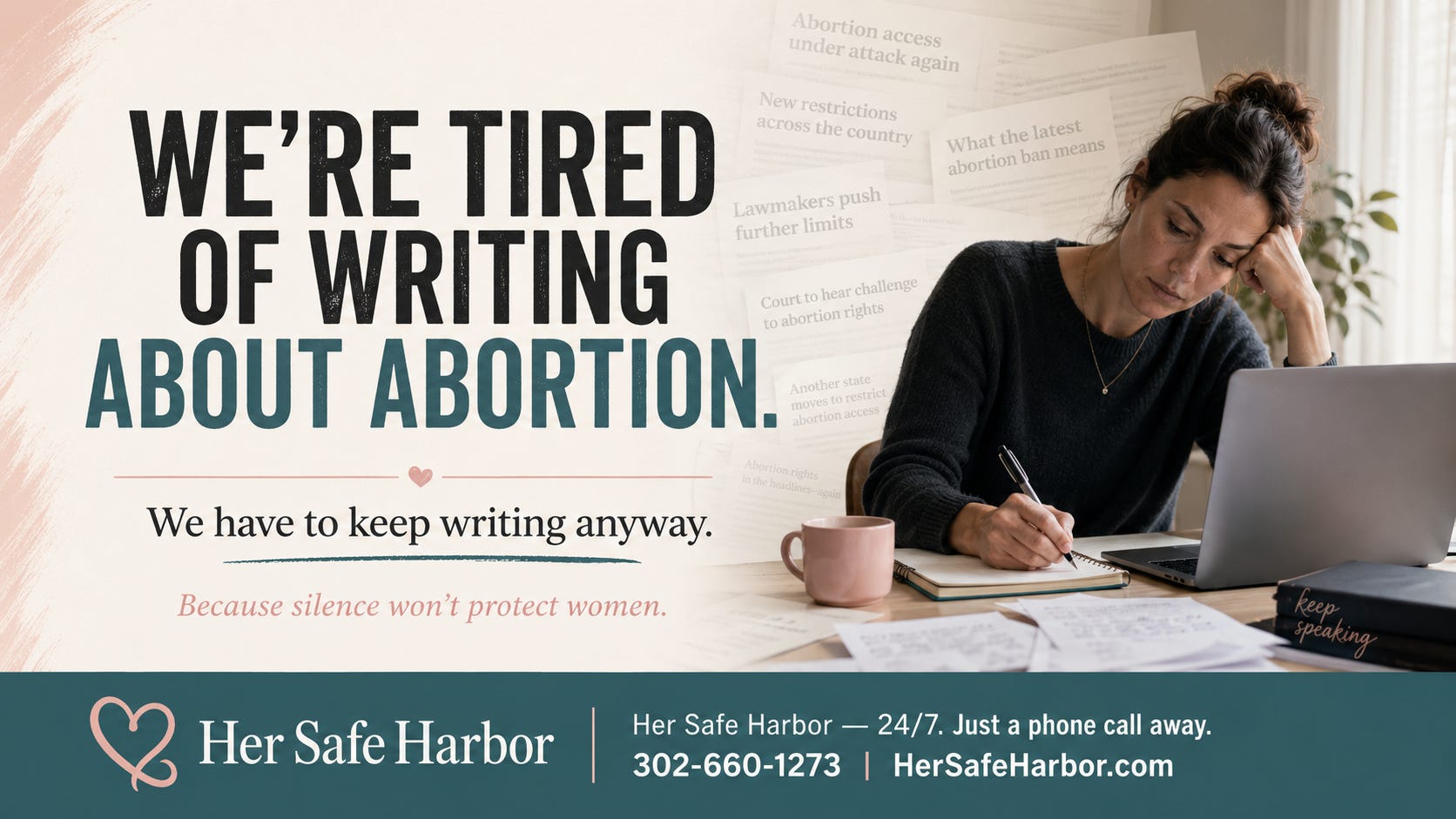
We are tired of writing about abortion.
We are tired of reading court filings that treat women’s bodies like disputed property. We are tired of tracking bills designed to punish doctors, frighten patients, censor websites, criminalize support, and turn ordinary healthcare into evidence of a crime.
We are tired of correcting the same lies.
No, abortion bans do not protect women.
No, medication abortion is not a public-health catastrophe.
No, telehealth care does not leave women abandoned.
No, politicians are not better qualified than patients and clinicians to make medical decisions.
No, forcing a woman to remain pregnant is not compassion simply because the law calls it “protection.”
We are tired of writing about women traveling hundreds of miles for care. We are tired of writing about doctors consulting attorneys while patients deteriorate. We are tired of writing about miscarriages becoming legal emergencies, medications being locked away during hemorrhages, and families being forced to leave their states after receiving devastating fetal diagnoses.
We are tired because none of this should require explanation.
And many readers are tired, too.
They have seen the headlines. They know abortion rights are under attack. They have watched the same arguments cycle through legislatures, courtrooms, campaign speeches, cable-news panels, and social-media feeds. Another ban. Another lawsuit. Another politician claiming that stripping women of bodily autonomy is an act of love.
Eventually, even the most committed person may feel tempted to look away.
That exhaustion is real. But we cannot surrender to it.
The constant flood of anti-abortion legislation is not merely a collection of isolated events. It creates a climate of permanent crisis.
One state proposes fetal personhood. Another targets abortion funds. Another threatens websites that publish information. Another tries to ban medication from being mailed. Another creates civil penalties for people who help. Another resurrects the Comstock Act. Another demands access to medical records. Another insists that an abortion ban is not really a ban, but a “minimum standard,” a “women’s safety law,” or a “protection for the unborn.”
The volume is overwhelming by design.
When every week brings another threat, people become numb. The public begins to treat each new restriction as background noise. News organizations move on. Readers stop clicking. Supporters stop sharing. Even advocates can begin to wonder whether writing one more article will make any difference.
That is precisely when silence becomes most useful to those taking rights away.
Authoritarian policies do not always arrive in one dramatic moment. Often, they advance through repetition, normalization, bureaucracy, euphemism, and fatigue. People become accustomed to what once would have shocked them.
A woman is denied emergency care, and it becomes another headline.
A doctor leaves a state, and it becomes another statistic.
A patient is forced to travel, and it becomes another story among thousands.
A law threatens people for sharing information, and the public is told it is merely a technical regulation.
The extraordinary slowly becomes ordinary.
Writing interrupts that process.
Abortion opponents understand the power of language. That is why abortion bans are so often packaged in soft, reassuring terms.
They call surveillance “safety.”
They call forced pregnancy “protection.”
They call criminalization “accountability.”
They call censorship “preventing trafficking.”
They call a national abortion ban a “minimum standard.”
They describe evidence-based medication as poison, emergency medical care as elective, and women seeking control over their own bodies as confused, coerced, reckless, or morally suspect.
When those descriptions go unanswered, they begin to shape public understanding.
Writing matters because someone must name what is actually happening.
A law that prevents a woman from ending a pregnancy is an abortion ban, regardless of its title.
A policy that forces a patient to travel hundreds of miles is not a minor inconvenience. It is a barrier to healthcare.
A rule that requires a woman to appear in person when telehealth is medically appropriate is not automatically a safety measure. It may be a political obstacle designed to delay or prevent care.
A threat against websites that publish accurate medical information is not consumer protection. It is censorship.
Clear language is not cosmetic. It is defensive infrastructure.
There is a comforting belief that evidence will eventually prevail on its own.
It will not.
Facts require people willing to explain them, defend them, repeat them, and place them in context. Misinformation has no obligation to be cautious, accurate, or consistent. It only has to be frightening enough to spread.
A fabricated claim can be written in a sentence. Correcting it may require several paragraphs, links to research, an explanation of medical terminology, and a reminder that association is not causation.
Propaganda is fast. Truth is labor-intensive.
That imbalance is exhausting, but it does not make the work optional.
When anti-abortion organizations claim that women are abandoned during telehealth abortions, someone must explain what provider-supported care actually looks like.
When activists claim that abortion medication is contaminating drinking water and causing everything from infertility to autism, someone must ask where the evidence is.
When politicians claim abortion bans protect patients, someone must document the delays, confusion, fear, and medical harm those laws create.
When advocates use rare or invented scenarios to justify restrictions affecting millions of women, someone must restore proportion and reality to the conversation.
We keep writing because repetition is not only a tool of propaganda. It is also how truth survives.
Public discussions about abortion often flatten women into symbols.
She becomes “the mother,” “the victim,” “the patient,” “the exception,” “the irresponsible woman,” or “the tragic case.” Her actual life disappears beneath whatever political lesson someone wants to extract from it.
Writing can restore the person.
The woman ending a pregnancy because she cannot safely carry it.
The mother protecting the children she already has.
The teenager who cannot tell her parents.
The patient receiving a fatal fetal diagnosis.
The woman whose abusive partner is monitoring her movements.
The person experiencing a miscarriage who needs the same medications politicians have spent years demonizing.
The nurse trying to follow a law no one can clearly explain.
The physician being told to wait until a patient is sick enough to justify treatment.
Stories make it more difficult to pretend that abortion policy is an abstract debate between competing slogans. These laws act on real bodies, inside real families, under real deadlines, with consequences that cannot always be reversed.
That is why personal testimony is so threatening to movements built on caricature.
A woman telling the truth about her abortion disrupts the fantasy that every abortion is a tragedy, every patient regrets her decision, and every restriction is benevolent.
Her life is not a talking point. Her relief is not propaganda. Her autonomy is not negotiable.
Not everyone can write an article, testify before a legislature, donate large sums, organize a protest, or provide abortion care.
But reading still matters.
Reading helps people recognize manipulated language before it becomes law. It helps them understand how a policy in one state may become a model for another. It helps them respond when relatives repeat misinformation. It helps voters distinguish between a candidate who says abortion should be “left to the states” and one who will actually protect access.
Reading also prevents isolation.
A woman living under a ban may feel as though the entire country has forgotten her. A provider working under threat may feel abandoned. An activist may wonder whether anyone is still listening.
Attention tells them they have not disappeared.
That attention must lead somewhere, of course. Awareness without action can become another form of consumption. We should not merely read about injustice, feel briefly horrified, and move on.
But action begins with understanding.
Refusing to surrender to exhaustion does not mean living in a permanent state of panic.
No one can absorb every headline, every lawsuit, every legislative hearing, every horrifying anecdote, and every bad-faith social-media post without becoming depleted.
There is a difference between staying engaged and allowing the news to consume you.
We can choose reliable sources rather than doomscrolling. We can step away temporarily without disappearing permanently. We can divide the work. One person may track legislation. Another may support patients. Another may write. Another may donate. Another may challenge misinformation in their community. Another may call lawmakers.
Rest is not surrender.
Taking a breath does not mean abandoning the cause.
The danger begins when temporary exhaustion becomes permanent disengagement—and when disengagement is mistaken for peace.
The issue has not disappeared merely because we stopped reading about it.
Women are still being denied care. Providers are still being threatened. Legislatures are still meeting. Courts are still deciding. Anti-abortion organizations are still writing model laws, funding campaigns, inventing new legal theories, and testing new ways to restrict medication, speech, travel, privacy, and medical practice.
They are not tired enough to stop.
We cannot be too tired to respond.
There is another reason to keep writing: memory.
Political movements often depend on public amnesia. They rewrite their own positions, deny their own goals, soften yesterday’s rhetoric, and insist that the consequences of their policies were unforeseeable.
The record matters.
It matters that people document what lawmakers promised before abortion bans passed—and what happened afterward.
It matters that we remember who claimed there would always be exceptions, who dismissed warnings from physicians, who insisted that no woman would be harmed, and who later blamed doctors for the confusion their laws created.
It matters that we preserve the stories of women who were denied treatment, forced to travel, prosecuted, investigated, endangered, or silenced.
Writing makes it harder to say, later, that no one knew.
We knew.
Patients told us. Doctors warned us. Legal experts explained it. Advocates documented it. Journalists reported it.
The harm was not an accident. It was predicted.
The goal is not simply to keep abortion in the news.
The goal is to make abortion legal, accessible, affordable, private, and genuinely available to the women who need it.
A right that exists only on paper is not enough.
Abortion is not meaningfully legal when the nearest clinic is hundreds of miles away. It is not accessible when a woman must take days off work, arrange childcare, pay for travel, meet medically unnecessary waiting periods, and risk criminal scrutiny. It is not private when digital records, location data, messages, and medical information may be used against her.
We are writing toward something concrete.
We are writing for laws that trust women.
We are writing for medical standards shaped by evidence rather than theology.
We are writing for providers who can treat patients without consulting a criminal-defense attorney.
We are writing for telehealth access, shield-law protections, medication by mail, privacy, affordability, and the freedom to make pregnancy decisions without government coercion.
We are writing because abortion must not merely remain possible for the wealthy, the well-connected, and those able to travel.
It must be legal and accessible for everyone.
Politicians pay attention to what voters discuss, share, donate to, organize around, and refuse to forget.
Silence communicates something, too.
It tells lawmakers that the public has moved on. It tells anti-abortion organizations that their strategy is working. It tells newsrooms that readers are no longer interested. It tells donors that the urgency has passed.
Our attention is not limitless, but it is powerful.
We can use it deliberately.
Read the article. Share the patient’s story. Correct the lie. Call the law what it is. Support the clinic. Donate to the abortion fund. Contact the legislator. Vote in the judicial election. Ask the candidate a specific question. Help someone travel. Protect someone’s privacy. Speak openly about abortion as healthcare.
No single act will restore abortion rights everywhere.
But rights are rarely restored by one heroic gesture. They are rebuilt through sustained pressure, repeated truth-telling, organized support, legal challenges, elections, direct care, and ordinary people refusing to accept injustice as normal.
We wish we did not have to write another article about abortion.
We wish women’s autonomy were not treated as a temporary privilege that must be defended in every election, every legislative session, and every courtroom.
We wish evidence were enough.
We wish compassion were enough.
We wish the consequences of abortion bans were so obvious that no one could deny them.
But wishing does not protect access.
Silence does not protect patients.
Exhaustion does not stop legislation.
So we will keep writing.
We will write when the language is manipulative. We will write when the science is distorted. We will write when women are blamed for the harm laws inflict on them. We will write when politicians insist that cruelty is compassion. We will write when another court case threatens access and when another state attempts to criminalize care.
We will also write about relief.
About the woman who received medication in time.
About the patient who spoke privately with a real provider.
About the mother who was able to choose what was right for her family.
About the people building networks of care despite extraordinary pressure.
About the fact that abortion is normal, common healthcare—and that women remain capable of making their own decisions even when politicians insist otherwise.
We are tired of writing about abortion.
But we are far more tired of watching women lose their rights.
And until abortion is legal, accessible, affordable, and protected, we cannot afford to stop.
Her Safe Harbor provides private, provider-guided reproductive healthcare to women across the country. No waiting rooms. No unnecessary barriers. Just care.
Her Safe Harbor — 24/7. Just a phone call away.
302-660-1273 | HerSafeHarbor.com
If you believe every woman deserves access to evidence-based reproductive healthcare, please consider sharing this article or supporting our work. Every donation helps us continue providing care, education, and support to women across the country.
Comments
Nothing yet. Say the first thing.
Sign in to join the conversation.