
By Her Safe Harbor
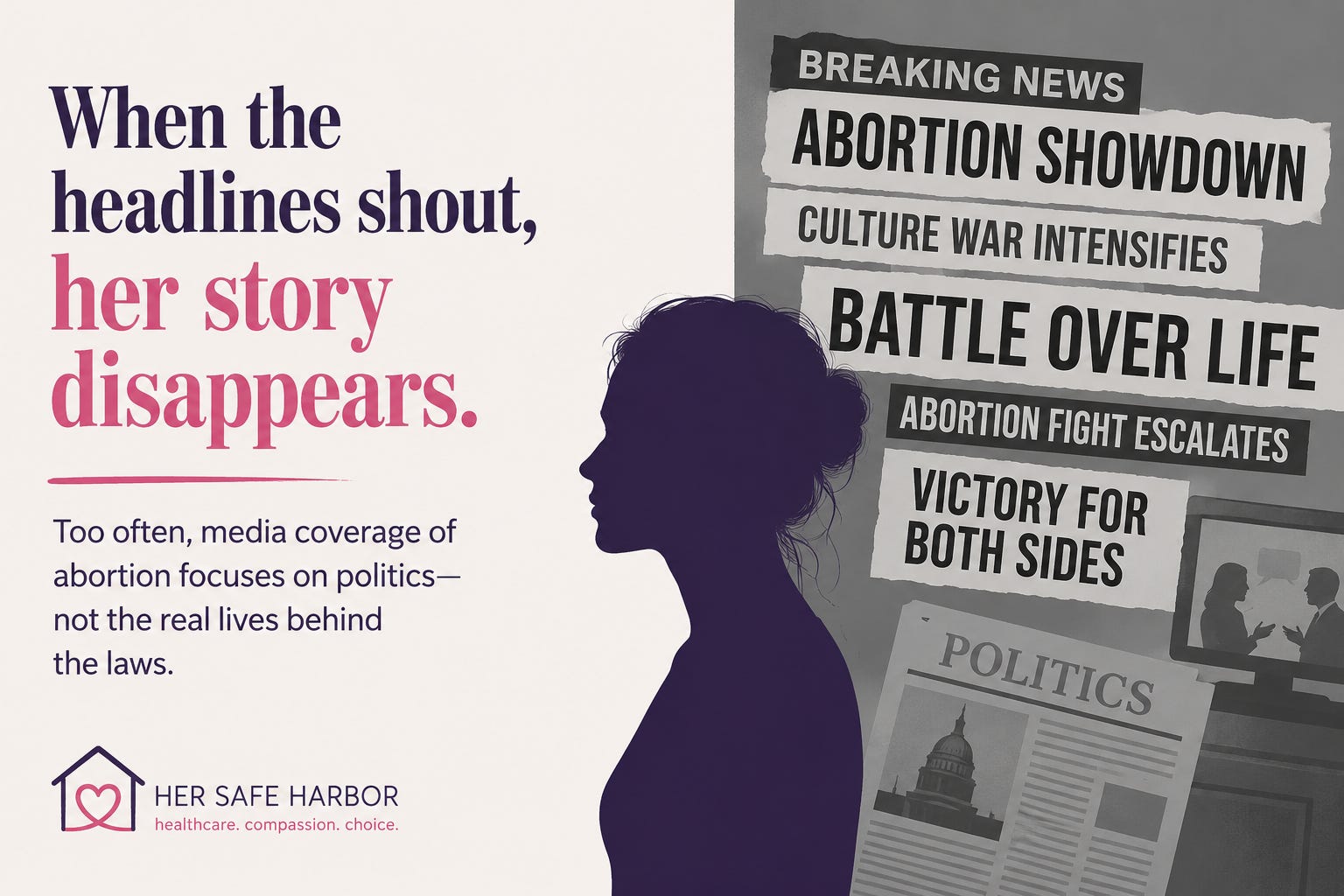
If you only followed abortion through the headlines, you might think the story is about politics.
Red states. Blue states. Supreme Court battles. Campaign ads. Court filings. Poll numbers.
The headlines scream.
The television panels argue.
Politicians dominate the conversation.
And somewhere beneath all of that noise, the actual patient disappears.
That is perhaps the greatest failure of abortion reporting today. Not that the media gets every fact wrong—but that it too often tells the wrong story.
Ironically, research has documented exactly this problem.
A landmark content analysis published in the Journal of Women’s Health examined abortion coverage in major American newspapers and found that abortion was overwhelmingly framed as a political issue rather than a healthcare issue. The experiences of women who actually had abortions appeared in only 4% of stories. Basic information about abortion’s safety, prevalence, or role in routine healthcare was largely absent. (PMC)
Think about that.
Ninety-six percent of stories discussing abortion did not meaningfully center the people actually living through it.
Instead, coverage centered politicians, legislation, court decisions, protests, and elections.
Imagine if heart disease were covered this way.
Imagine if every article about chemotherapy focused on congressional hearings instead of patients with cancer.
Imagine if diabetes coverage spent more time interviewing legislators than endocrinologists.
It would seem absurd.
Yet abortion receives that treatment every single day.
Modern journalism rewards outrage.
Clicks matter.
Engagement matters.
Conflict matters.
Complexity rarely survives the headline.
Instead we get phrases like:
“Abortion Showdown”
“Culture War Intensifies”
“Battle Over Life”
“Abortion Fight Escalates”
“Victory for Both Sides”
Those headlines generate attention.
They do not generate understanding.
Lost beneath them are the realities that never fit neatly into breaking news alerts:
A woman whose water breaks at 18 weeks.
A pregnancy complicated by severe preeclampsia.
A fetus with no chance of survival.
A mother trying to stay alive for the children she already has.
Those stories are medically complicated.
Human stories usually are.
Language shapes public understanding.
For decades, journalists have struggled with terminology because abortion opponents have intentionally introduced emotionally loaded language into public debate.
Many phrases now commonly heard in politics have no recognized medical meaning.
Examples include:
“Partial-birth abortion”
“Chemical abortion”
“Abortion until birth”
“Elective abortion” used without context
“Late-term abortion”
Several of these terms were deliberately created for political messaging rather than clinical accuracy.
Recognizing this, both the Associated Press and NPR have updated editorial guidance encouraging journalists to use medically precise terminology rather than advocacy language. For example, they recommend “medication abortion” instead of “chemical abortion,” discourage “late-term abortion” because it has no accepted medical definition, and generally favor descriptive language over political branding. (New Hampshire Public Radio)
This is not political correctness.
It is journalism.
Medicine depends upon precise language.
Journalism should too.
Many stories report:
“The state enacted an abortion ban.”
Technically true.
Practically meaningless.
What kind of ban?
Six weeks?
Twelve weeks?
Total?
With rape exceptions?
Without them?
Medical emergency exceptions?
How are physicians interpreting those exceptions?
Can doctors intervene before sepsis?
Must patients be actively dying?
Can medication abortion still be prescribed?
Is miscarriage care affected?
Can physicians discuss out-of-state care?
Can hospitals transfer patients?
Those details determine whether women receive treatment.
Yet they are frequently reduced to a single phrase:
“Abortion ban.”
The public is left believing all bans are essentially alike.
They are not.
News coverage often follows this pattern:
Governor signs bill.
Protests occur.
Lawsuit filed.
Court blocks law.
Appeal follows.
End of story.
But for women, that is where the story actually starts.
After Dobbs, women have:
Driven hundreds of miles for care.
Delayed treatment while physicians consulted hospital lawyers.
Been forced to carry pregnancies with fatal fetal diagnoses.
Experienced dangerous delays in miscarriage treatment.
Traveled across multiple states while bleeding.
Continued pregnancies despite serious threats to their health because physicians feared prosecution.
These are not hypothetical consequences.
They are the downstream effects of policy.
Unfortunately, downstream effects rarely make the front page.
Journalists understandably want fairness.
But fairness is not achieved by presenting unequal evidence as though it were equally supported.
If ninety-eight climate scientists agree on climate change and two disagree, giving each side equal time creates a false impression of scientific uncertainty.
Healthcare reporting should work the same way.
When a claim lacks credible medical evidence, it should not receive the same weight as decades of peer-reviewed research simply because someone made the claim.
For example, recent assertions that medication abortion is contaminating drinking water and causing infertility have received media attention despite a lack of evidence supporting those conclusions. Repeating such claims without explaining the scientific consensus can leave readers believing there is genuine medical controversy where there is little or none.
Journalism should report claims.
It should also report whether those claims are supported by evidence.
Those are different responsibilities.
Perhaps the most overlooked problem is what happens after abortion disappears from the headline.
Most abortion stories never mention:
maternal morbidity
delayed miscarriage care
obstetric workforce shortages
rural hospital closures
physician recruitment
maternal mortality
emergency department delays
travel burdens
financial hardship
childcare challenges
domestic violence
reproductive coercion
Yet these are often the consequences women actually experience.
The abortion itself may last hours.
The effects of abortion policy can last years.
One study found that personal experiences with abortion appeared in only four percent of newspaper coverage. (PMC)
Four percent.
That means the overwhelming majority of abortion reporting tells readers about laws instead of lives.
Women become numbers.
States become maps.
Court cases become entertainment.
Real people disappear.
Imagine an article that begins like this:
A 32-year-old mother of two arrived at an emergency department after her water broke at 18 weeks. Physicians knew the pregnancy could not survive. They also knew intervening too early might expose them to criminal prosecution. Hospital lawyers were consulted before treatment began.
That story teaches readers something.
Not about political parties.
About healthcare.
About law.
About medicine.
About fear.
About how legislation reaches an emergency room.
That is the story too often missing.
Abortion is not merely an election issue.
It is not simply a Supreme Court issue.
It is not only a moral issue.
It is healthcare.
Healthcare is messy.
Healthcare is nuanced.
Healthcare resists simple headlines.
Journalists have an extraordinarily difficult job, particularly when covering an issue as emotionally charged as abortion. Many reporters strive to be accurate, thoughtful, and fair. But the incentives of modern media—speed, conflict, clicks, and political framing—often overshadow the slower, more complex work of explaining how abortion laws function in real life.
The question isn’t whether abortion should be reported.
It absolutely should.
The question is whether we’re reporting the right story.
Because until we start telling the stories of women navigating impossible medical decisions, frightened physicians practicing under legal uncertainty, and families living with the consequences long after the cameras leave, we are not really reporting on abortion at all.
We’re simply reporting on the politics surrounding it.
And women deserve better journalism than that.
If you believe every woman deserves access to evidence-based reproductive healthcare, please consider sharing this article or supporting our work. Every donation helps us continue providing care, education, and support to women across the country.
Her Safe Harbor provides confidential, evidence-based reproductive healthcare to women in all 50 states. We believe healthcare decisions belong between a woman and her medical provider—not politicians, headlines, or television pundits.
24/7. Just a phone call away.
302-660-1273
HerSafeHarbor.com
Comments
Nothing yet. Say the first thing.
Sign in to join the conversation.