
It was a crisp winter morning (by equatorial standards, at least) and we had just beaten the sun to the pavement. My girls were bundled like little burritos in the pram in front of me, while I propelled them forward on our morning jog. As we rounded a bend in the path, I saw a couple of older women chatting up ahead. One of them loosely held a leash that drooped across most of the concrete strip, terminating in a little white poodle that pompously looked my way as we rapidly approached.
The path before us was almost entirely blocked by this little white prince of a dog and his superfluous leash. To save derailing my cargo at speed, I carefully hugged the leftmost side of the path, zooming past the poodle and his owner, feeling perhaps a tiny bit disgruntled at her lack of motion to rein in her dog. But within two paces the feeling was gone.
And then I heard an indignant yell resound from behind me, “HEY!! YOU ALMOST RAN OVER MY DOG!” (The capitalisation is entirely warranted, believe me. And those aren’t the seven rarest words.)
I almost didn’t realise the woman was speaking (nay, yelling) at me for a moment, I was so confused by the accusation. When I realised that I was indeed the target of her ire, I felt a surge of righteous indignation. (Is there really any other kind?) I whipped my head around and said a different set of seven words (with perhaps a bit of capitalisation of my own), “Your Dog Was Blocking The Entire Path!” And then I continued on jogging, leaving her to stand there, boring a reproachful hole in my back.
My retort had clearly not convinced the woman of my (perceived) moral high ground and I had this irrational desire to right the (perceived) wrong in her mind.
When it comes to anger, perception is everything.
She perceived me to be in the wrong. I perceived her perception to be wrong. And we were both left to part ways, never to see each other again, each with an angry little splinter in the other’s mind.
The entire exchange was perhaps all of ten seconds, but it threatened to eat up magnitudes more time with its continual replay in the theatre of my mind as I jogged the rest of the way home. And once upon a time it would have.
Every time the memory surfaced, I would have seen the scene in my mind clear as the new day around us. It would have felt almost… good… to replay my defence against her accusation. Yet at the same time, I would have been filled with this simmering itch that only justice could scratch. Over time, the memory would have faded, but not been forgotten.
But as fate would have it, I had been researching this very topic mere days before the encounter and I knew the “trick.” By the time I returned home ten minutes later, the woman was a distant memory. My day wasn’t ruined. Nor was my morning. Or even my jog. In fact, I would have forgotten all about her had I not now immortalised her in this little prelude.
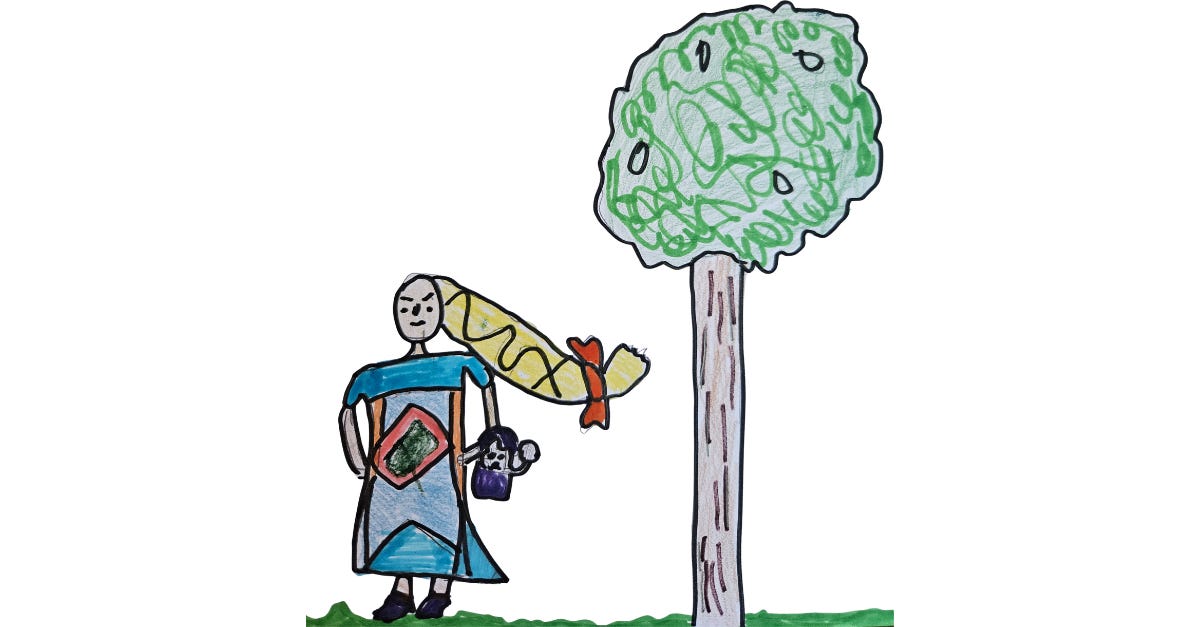
Anger is a curious contradiction of an emotion. It is like a craving with no reward to consume, like fear with the magnetic pole of action flipped from avoidance to approach.
Anger shares a similar chemical substrate with fear — central noradrenaline (and even dopamine) surges in the brain and adrenaline in the body — that mobilises us to act.1 When the immediate goal is safety, it’s this fear cocktail that often carries us away from the threat. But when safety is (at least somewhat) assured, it’s anger we feel that carries us towards the threat.
If the woman had been a six-foot-five brawny muscular man covered in tattoos (out walking his demure little poodle at 6am on a weekday morning) who yelled those same capitalised words at me, I am quite certain I wouldn’t have responded the same way. In fact, I suspect my two little burritos would have felt the pram speed up considerably as I hot-footed it out of there.2
But the interesting part is that, the further away I would have gotten (and the more my immediate safety was assured), the more my fear would have given way to anger. The replays would have still surfaced, and with them the urge to simulate alternate realities where I did stand up for myself.
Approach-driven motivation is usually associated with rewards, but it is also shared by anger. In many ways, a surge of anger is not unlike a strong craving to move towards a reward — in one case to consume or do something pleasurable, and in the other to achieve the delicious reward of justice. And as any human being on this planet can attest, not following a craving doesn’t feel good, it feels aversive. The only way to remedy that aversive state is to get that reward.
But that’s the problem. “Justice” is a far more difficult reward to obtain than a chocolate bar.
We’ve all felt the frustration of a stubbed toe or a traffic jam, but these aren’t situations that require justice. There is no perceived wrong to be righted. We feel the initial flare of mobilisation (a small surge in neurochemicals) and then once the situation passes, that feeling usually fades.
By the time you get to work, any traffic jam is long forgotten. It certainly doesn’t rear its figurative head within your literal mind periodically throughout the day. There is no splinter.
But, if instead of a traffic jam on the way to work, say someone had given you a long horn when you tried to respectfully merge into traffic, speeding up to cut you off and flipping you the bird while they did it. You can bet your morning coffee that such an event would embed itself within your mind like a nagging sliver of wood — a background itch that would remain there for the rest of the day (if not longer).
Anger — the instantly mobilising and subsequently ruminative kind — requires an agent, another human being that has wronged us (or something we value) in some way.3
When there is no agent (like the stubbed toe) the situation resolves with its own passing. The open loop of frustration is closed naturally by time.
But when there is an agent, the open loop of anger can only be closed by justice — by the wrongdoer admitting fault or by their punishment.
The middle finger in traffic was attached to a human who had broken a common road courtesy, triggering a sudden heated craving to right the wrong — to get that wrong-doer to admit fault. But obtaining such a “reward” in live traffic is impossible (there’s no such thing as an apology horn, and if there were I suspect it would get very little use). So the anger loop remains open as you pull into your carpark at work. And as you sit down at your desk. And as you order your morning coffee. Every resurfacing of the memory triggers another echo of anger and you spend your morning simmering in the fumes of the event. (“Stewing” indeed.)
My hairbreadth jog past the woman and her poodle triggered an open loop of anger in her mind, and she tried to right that perceived wrong by throwing a verbal accusation at me. That opened its own loop of anger within my mind and I tried to right that perceived wrong by yelling it back at her.
When you spell out the futility of an angry volley like that, it’s no wonder we humans constantly run into trouble with other humans.
Justice is the most elusive reward of all. Either the situation doesn’t afford the opportunity (like the traffic jam) or the far more common case: the person in the (perceived) wrong doesn’t admit fault with sufficient sincerity.
The rarest string of seven words a human being could possibly utter are,
“You’re right. I was wrong. I’m sorry.”
Yet it is precisely those seven words that are needed to close a loop of anger.
When you have a sudden craving for chocolate and you satisfy that craving, you strengthen it for next time. The more times you do this, the more your brain pulls in all the different contexts as future triggers for the craving.
It’s the same with anger. But when those seven words won’t come, our brain will just as happily settle for punishment instead.4 Delivering the punishment can feel rewarding all by itself, so much so that we’ll even pay for the privilege.5
And just like with a chocolate craving, you don’t even need to get this “reward” to strengthen those craving pathways — you simply need to pursue it.
It isn’t only justice that reinforces anger, the pursuit of justice does as well. The act of confronting the agent. Or thinking about confronting the agent. Or replaying the confrontation. Whenever you act under the influence of anger, your brain is pulling in that context and storing it as future predictors of anger.
Acting in anger makes the craving to act in anger worse. And it makes the number of triggers grow. That’s one (very good) reason not to act in anger. Here’s another: your brain on anger is an entirely different version of you. And not one you want at the helm.
When we’re in a state of anger, a few different cognitive biases kick in. We’re less able to judge the objective cost of a situation — if fear makes us risk-averse, anger makes us risk-inclined. 6Acting in anger always seems like a really good idea… when angry. Hand in hand with this propensity to act first and ask questions later is a shift in cognitive processing. Rather than considering the nuance of the situation, we reason from fast and cheap stereotypes.7 And to top it all off, we simply feel a greater sense of certainty about any decision or action we take while under the influence of anger.8
It’s as if we have swallowed an elixir of confidence. No wonder it can sometimes feel good to feel angry.
This elixir would have been a powerful dominance-asserting tool in our ancestral arsenal, but we now live in a world that has grown to accommodate morality, justice and courtesy. (Or at least, it purports to.)
Acting in anger is rarely a sound strategy in modern times. At best, we’re left volleying anger like a hot potato (like my encounter with the poodle woman). At worst, we’re left injured or in jail. Rarely does acting in anger ever lead to those seven words that we crave most.
There is a rather wide misconception that anger is some reservoir of energy that needs to be discharged somehow in order to move on. And rather than discharging it at a person, a more evolved alternative is to redirect it into a more “positive” outlet. “You feel angry? Go hit a punching bag for an hour.” On its face, this does seem like sound advice.
But remember what anger is: a chemically enhanced brain and body, mobilised to act, craving action. This surge in noradrenaline lowers the threshold for plasticity.9 Your brain is essentially in “edit mode,” ready to reinforce whatever behaviour follows. When that behaviour is aggressive action, your brain learns that aggressive action is the default response for anger.10 With each repetition, the wiring becomes a little more automatic, and the list of triggers grows a little longer.
Every instance you act in anger makes you a more angry person.11
So what do you do? Not act? Let all injustices pass you by? Of course not! The key is to act, just not under the influence of anger. Let the elixir wear off and then reassess the situation.
Anger requires two things to keep its fire burning: mobilisation (the chemically enhanced state of arousal) and mental fixation (on the wrong-doer). Most people go for mobilisation as the lever to shift their irate state. And while this is indeed a sound strategy, the mental fixation component is a far greater lever.
Mobilisation doesn’t always lead to mental fixation. But mental fixation can very quickly lead to mobilisation.
Merely thinking about a past wrongdoing can reinstate a chemical echo of the original event, triggering that insatiable craving to act.12 To relieve this aversive state, you then continue to think about acting or simulate different scenarios where you did act or could act (otherwise known as ruminating). And because this mental stewing temporarily relieves the aversive state, and feels rewarding in and of itself, the ruminative behaviour gets heavily reinforced.
Just how every instance of physically acting in anger makes you more prone to act in anger in future, every instance of angry rumination makes you more prone to angrily ruminate in future.13 It is a vicious positive feedback loop that becomes more difficult to exit the more times it is cycled.
The prescription is simple: redirect attention while mobilised, help the body settle and only then determine whether the action you wanted to take (while under the elixir’s influence) would indeed bring about those seven words. Or if it would have simply scratched the angry itch created by that splinter.
If there is action to be taken while with a level head, take it. If there isn’t, don’t. Then meet any replay with the same strategy: acknowledge and redirect attention.
My primitive brain took the poodle woman’s accusation as evidence that she considered herself (nay, her dog) of higher status than me. And my primitive brain urged me to act to right that status imbalance. Should I have yelled back at her? Perhaps not. I may have let the primitive part of me win the first round, high on the fast-acting elixir of anger. But I won every round against it from then on. Each time the memory resurfaced on my jog home, I knew what was happening and redirected my attention to the present moment. Five times in total, each one spaced further apart than the last.
The anger had nothing to stick to.
I don’t know if the woman still carries a small splinter in her mind about the “rude” lady with the pram full of burritos.
Neither of us will hear those seven words, but somewhere on the jog home I stopped needing them.
If you'd like help catching anger before you act on it, or breaking the replay loop afterwards, I work with people to build custom protocols that help weaken these patterns over time. They're delivered through the HIYB app, and you can register your interest below.
Apply for your rewiring protocol here
References for this essay, and for the wider series, are available as a collection in the Research Library, specifically:
The old assumption was that unpleasant emotions make you want to avoid the thing causing them. But we later discovered that anger is negatively valenced yet approach-motivated (Carver & Harmon-Jones 2009).
Anger’s approach signature only appears when acting is possible (or deemed safe… ish) (Harmon-Jones et al. 2003).
More insidiously, anger can even arise as a mask for shame, which is something we’ll explore more deeply in a future essay.
Retaliating against a provocateur recruits the brain’s reward circuitry. People who show more activation retaliate more (Chester & DeWall 2016).
In a rather hilarious 2004 study, participants played a trust game where one player defects and the wronged player can punish them for it. These wronged players paid for the privilege of financially punishing the defector (even though it cost them their own earnings as well). And their reward centre lit up like a Christmas tree while they did so (De Quervain et al. 2004). (The greater the brightness, the more they were willing to pay.)
Angry people have been shown to judge risks optimistically and take more of them, while fearful people do the opposite (Lerner & Keltner 2001).
Angry participants leaned on stereotypes and on who was speaking rather than on what was said. Sad participants, equally unhappy, did not (Bodenhausen et al. 1994).
Anger carries an unusual sense of certainty that other negative emotions lack (Tiedens & Linton 2001).
Dopamine and noradrenaline both lower the plasticity threshold of the brain. Noradrenaline's impact is longer than dopamine's because it clears more slowly and acts through receptors that shift the brain's overall state rather than marking a single event. One upside to this is that a heated moment is theoretically a moment your brain is unusually willing to learn from (Sara 2009, Berridge & Waterhouse 2003).
There was a large 600-people-strong study that basically involved insulting each and every one of them and then being put into three groups: one told to punch a punching bag with the insulter in mind, another told to punch it while thinking about getting fit and the third were left to sit and twiddle their thumbs. Sitting quietly came out best on both anger and aggression. The bag-as-insulter group scored the worst (Bushman 2002). A later meta-review found that breathing, meditation and yoga (all activities that increase parasympathetic dominance) all reduced anger. Boxing, running and cycling (all activities that increase sympathetic dominance) didn’t (Kjærvik & Bushman 2024).
There is no study to prove this statement. (Such a study would require tracking people at least a decade into their acting on anger and measuring what they became.) But we do know that retaliation activates reward circuitry, venting doesn’t reduce anger (and can often increase it) and behaviours that deliver reward get repeated. It seems a reasonable extrapolation to say then that a person who continues to act in anger will become a more angry person.
Blood pressure stays elevated in people who keep thinking about an earlier provocation, and returns to baseline in those who don't (Glynn et al. 2002).
Replaying a provocation does indeed reinstate the physiological state and keep the grievance front of mind (Denson 2013). Worse, this rumination can colour subsequent (neutral) exchanges (Bushman et al. 2005).
No posts
Comments
Nothing yet. Say the first thing.
Sign in to join the conversation.