
About 100 years ago, a charming1 fellow with a great big white moustache and beard made an accidental discovery that shaped the course of psychology and neuroscience.
You might have heard of his name, especially in reference to man’s best friend: dear Pavlov and his dogs.
Originally studying the digestive process of canines, Pavlov noticed how some dogs appeared to salivate at the mere sound of footsteps of those who bore treats. Switching to this far more fascinating (and less barbarically implemented) study, Pavlov went on to formalise the very first experiments demonstrating classical conditioning.
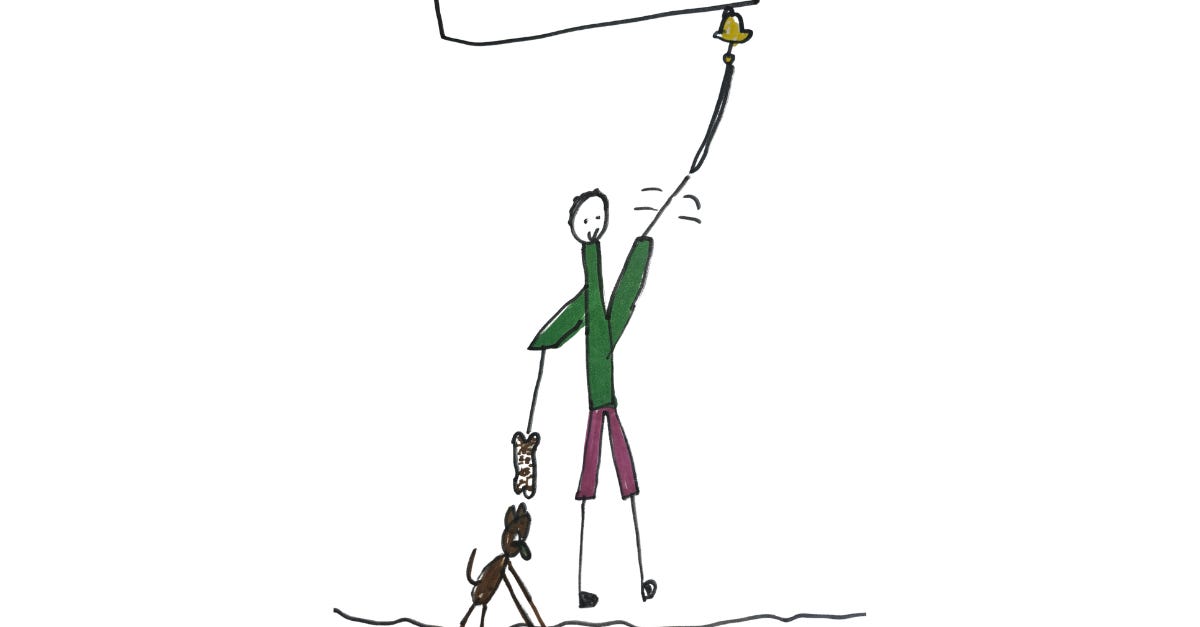
At first, Pavlov paired a ringing bell2 with the delivery of a treat, which his little furballs greedily devoured. After many repetitions, the mere sound of the tinkling bell triggered an excited and drool-laced response in his dogs.
What Pavlov didn’t know at the time — because it would take another 90 or so years to discover — was that deep within the striatum of each little drooling canine was a dopamine spike driving that anticipation (and drool). At first, the spike would have occurred at delivery of the treat. Then, with repetition, the spike would have shifted back to the earliest cue: the infamous bell.
When we hear our phone chime and feel the urge to check it, that’s a shifted spike deep within our own striatum, triggered by a different bell.
When we’re waiting in line and feel the itch to take out our phone, that’s another anticipatory spike.
When we see our phone on the table and wonder if anyone has messaged, that’s yet another spike.
We are all Pavlov’s dog, salivating over a slab of glass.
But unlike Pavlov’s canine companions, there isn’t just one bell. We’ve been trained to mentally salivate — to feel compelled to pull out our phone — at the sight, sound, feel, or even thought of our phone.
What most don’t realise is that we humans are capable of ringing the bell ourselves. We can choose how or when or what conditions us.
We can be both Pavlov and his dog.
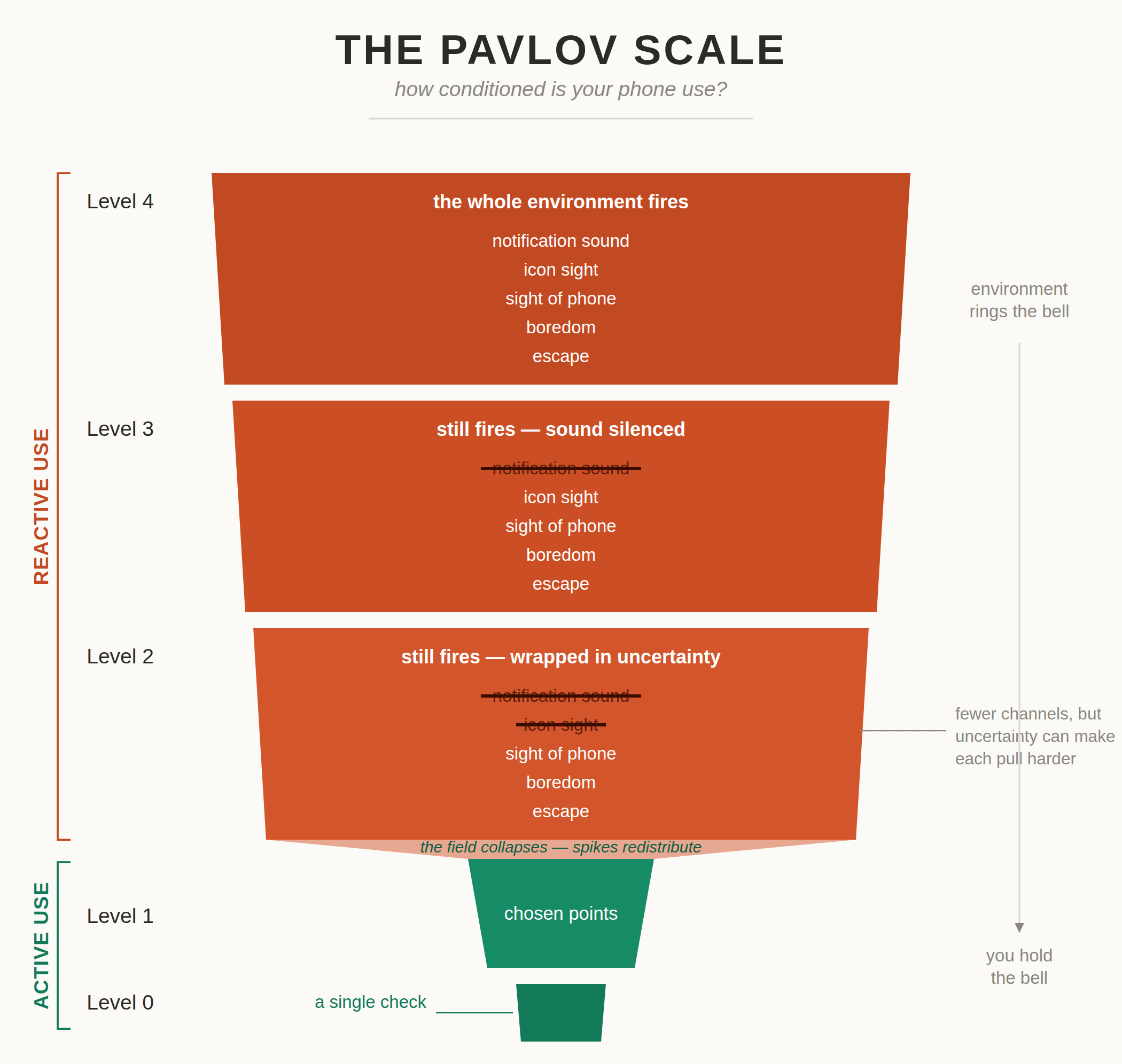
On the Pavlovian conditioning scale below, I suspect most people are at a Level 2, 3 or 4 when it comes to their phones. They are no better than Pavlov’s dogs, swiping instead of salivating, hundreds of times a day. It is a rare person indeed who has taken control of the bell — who has reduced their level of phone conditioning to 1, or even 0.
Where do you sit?
What this looks like: Phone on general, notifications on, unlimited scroll time
When you see someone out in the wild pull out their phone in direct response to the sound of a notification, that is a Level 4 Pavlovian response.
At this level, when you hear a notification bell, you feel instantly compelled to check who or what it could be. Then, once you’ve unlocked your phone and satisfied your compulsive curiosity, you often find yourself losing tens of minutes (if not hours) to the time sink that is the infinite scroll.
Every time that bell sounds, a burst of dopamine surges within your limbic striatum. This “spike” is your brain predicting the imminent possibility of a high value reward and supplying you with the motivation (nay, compulsion) to go get it. When you oblige, the neuroplasticity effects of that same spike wires in the behavioural policy of “hear bell, check phone.” Next time, the spike will hit harder. With every ring of the bell, you become more bound to the device.3
And once the notification that draws someone to the device has been checked, people at this level rarely put down their phone.
The very act of holding it and having checked notifications are the triggers for yet another spike — this time, one that compels you to start scrolling. Before you know it, you’re thumbing through your chosen social media platform, unable to stop. This subjects your brain to a low-grade load of limbic dopamine as spike after anticipatory spike pulls you further down the screen.
Level 4 is not a great place to be. It is peak Pavlovian conditioning.
What this looks like: Phone on silent, notifications on, no scroll limits
Thankfully, people are getting a little wiser to the harmful effects of the notification and choosing to keep their phone on silent. But, in many ways, this is just as bad. Every time you glance at your screen, all the little colourful icons still beckon to you with their own promise of novelty, connection and self-importance.
The dopamine spike that compels you to check your phone is now triggered by the sight (not the sound) of these icons. You may have silenced the literal bell, but it still rings clearly in your mind. When you answer it with a swiping unlock, you wire the compulsion to check your phone in deeper still.
Again, once you’re in, the scroll-triggering spike hits and you’re opening social media apps before you even realise what you’re doing. If you’ve unlocked and started scrolling when bored, between tasks, or when you simply want to escape to oblivion for a little while, all of these different contexts begin to carry predictive weight as well. The scroll-check spike spreads further upstream, like a dark kind of magic seeping into your surroundings — a magic that compels you to draw out your phone and start swiping.
The well-worn act of swiping to unlock is a cue itself that also predicts scrolling with near perfect certainty. This well-worn path has been trodden so frequently that the spike of dopamine often shifts deeper, from conscious motivation to below-awareness automation. Unlocking your phone no longer compulsively pulls you to scroll. It triggers a habitual swipe-up reflex as ingrained as the knee jerk.4
This is why you can have a benign need to check something on your phone (like a calendar appointment or use the stopwatch) and find yourself scrolling away minutes later, the original task long forgotten. The scroll-spike-at-unlock is too powerful.
If the sound of a notification triggers a check-phone spike and the sight of a notification triggers a check-phone spike, one might reasonably conclude that the solution is to then simply turn notifications off.
One might be wrong.
What this looks like: Phone on silent, notifications off, no scroll limits
Uncertainty is a dopamine amplifier. When a cue-triggered spike is wrapped in uncertainty, the compulsive pull it elicits is astronomically larger. (This is the secret to slot machines and hot-and-cold love interests.)
Back in Level 4, when a notification sounded, the bell may have given you a hint of the type of reward on the other side, but the uncertainty of its contents still amplified the check-phone spike.
In Level 3, a similar level of uncertainty would have been present in the sight of the icons awaiting your checking. But because you turned off the alert, every moment you weren’t looking at your home screen carried even greater uncertainty — you didn’t know if a new notification had come through! And that uncertainty can often make the compulsion to check feel even greater.
In Level 2, where you turn off notifications altogether, you wrap the phone itself with thick layers of crackling uncertainty, supercharging any environmental spike with that power. It’s no longer “What is on the other side of that notification?” but instead “Are there any notifications at all?”
If the number of phone cues within your environment is high enough, the bell could quite possibly ring in your mind more than it would if you had left your phone on general. Your inner “phone noise” can become louder than your phone!
This means Levels 2 and 3 only lessen the conditioning if you’re checking your phone for notifications less than the frequency of actual incoming notifications. And for many people, that’s not the case, making these levels actually worse for their dopamine system than Level 4.
And as always, once you’re through and checking, the scroll-spike hits and you’re suddenly deep in the bowels of social media, passively consuming before you realise it.
What this looks like: Phone on silent, planned notification check times, planned scroll times
Level 1 is the first point where you take the bell into your own hands and condition yourself.
There are two “rewards” that lie within your phone: notifications and social media feeds. Every environmental cue — sight, sound, thought, feeling, boredom, task transitions, bathroom breaks etc. — that triggers the urge to pull out your phone is often powered by the simultaneous weight of these two rewards.
In Levels 2 to 4, so many external and internal cues hold all of that power — they ring your mental bell and you immediately start salivating. But in Level 1, you decide which cues should have that power. You decide (in advance) when you will check notifications, and when you will scroll social media. And you do not waver.
When you make this decision (and crucially, when you stick to it for long enough), the size of the dopamine spike triggered by all those environmental cues starts to slowly reduce as your brain learns that those things aren’t reliable predictors of checking or scrolling. This predictive weight redistributes to the times of your choosing. It’s almost as if the dark dopamine magic triggered by everything around you is siphoned onto those carefully chosen points in your day.
At Level 1, boredom becomes boredom again, without the phone itch. You can finally go to the bathroom without feeling like you need to take your digital appendage with you. And if you leave your phone at home by accident, for once you don’t feel like a part of you is missing.
In fact, if you stick to this, many people often reach a point where they actually don’t want to use their phone until the designated time has arrived. It is a beautiful demonstration of the power of dopamine redistribution.
What this looks like: Phone on silent, planned notification checks, no social media whatsoever
Now we’re getting to the good stuff. If you’re still reading, you may not be satisfied with just holding the bell. You may be tired of your mind filling with saliva. (There’s a metaphor for limbic dopamine I never thought I would type.)
Level 1 may have curtailed the temporal uncertainty of when you will check, but the uncertainty of what you will find when you check still lingers, amplified by the prospect of social validation. On top of this, the flickering stream of endless short-form content (and the low-grade load of limbic dopamine that comes with it) still beckons.
To truly transcend the world of limbic dopamine, you need to ask yourself one question:
“What information do I really need to know that will affect my present actions?”
Do you need to know how many people have liked a post? No, certainly not every day. “Likes” are a noisy and lagging metric. Cut.
Do you need to know how many followers or subscribers you have? No, certainly not every day. They are another noisy and lagging metric. Cut.
Are you really learning anything while you mindlessly scroll through reels and aphorisms? No, not when attention is fragmented to the level of seconds. Cut.
When it comes down to it, your phone should be a tool that you use only to serve the most fundamental of human needs: genuine, human-to-human connection.
Which means once you strip away the binds of limbic dopamine, all you really need your phone for is this: a message from someone whom you love, respect or could help.
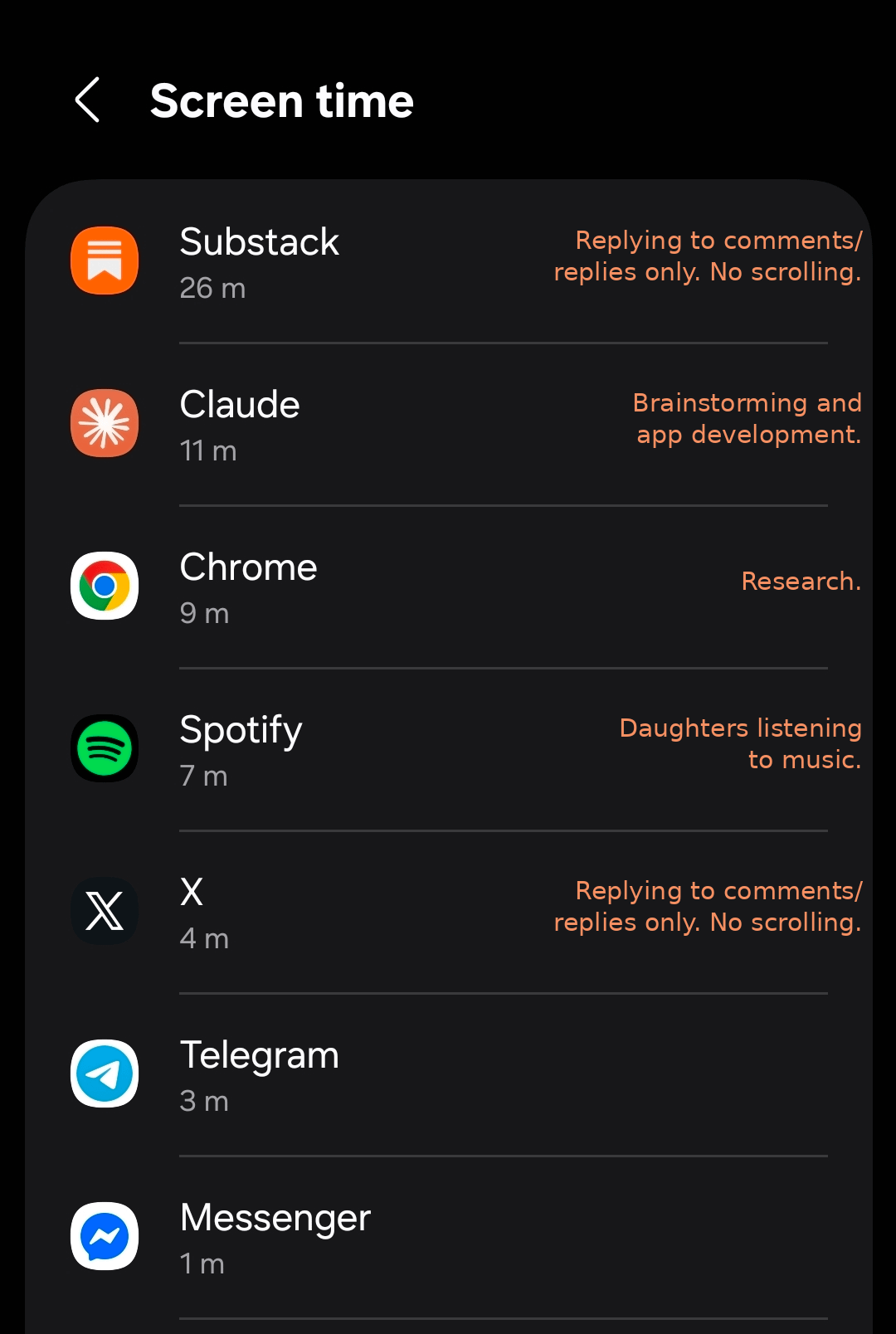
This is exactly what my phone has become for me and why my daily use totals less than one hour (including playing music for my daughters when we go for our morning walk). I check private messages and replies on X/Substack at two defined times every day, and these times have absorbed all the predictive power from my surroundings. The only other things I use my phone for outside these times are research, brainstorming and app development — basically, if an idea strikes while away from my laptop.
I do not scroll social media.5 And the craziest part of all is this: I have no urge to scroll social media. Once upon a time, boredom, waiting and even just plopping down onto the couch all triggered a compulsive itch to pull out my phone and start scrolling. I was at least a Pavlov Level 3. Now, there is nothing. At Level 0, my scroll-spikes have all disappeared. And the check-spikes have been contained.
When my husband read this draft (not too long after the meta-awareness essay), he said that I sounded like an “enlightened monk atop a mountain, looking down on all the pleb phone users.” While he paints a rather vivid picture, that is most assuredly not the case, nor what I am trying to achieve with this piece! I know what it is to feel ruled by your phone and the constant itch to check… the constant compulsion to scroll. But those feelings are run by dopamine, and your dopamine can be reprogrammed.
Such is the power of holding your own bell.
When Steve Jobs walked on stage and held the world’s first smartphone aloft in the air, he was a modern Pavlov, holding the bell up high for all to see.
It’s taken nearly 20 years for us to come full circle and realise the only way to reclaim our dopamine is to turn the smartphone back into a dumb one.
You should get to decide when the bell rings.
Or whether it should ring at all.
I've written about my own dopamine reprogramming experiment to neutralise the pull of my phone here, but the protocol has come a very long way since then. It's now something I build with people personally, using the HIYB app.
First, you develop awareness around your own phone habit, then I design a custom protocol to rewire your dopamine system so you're free of the compulsion. The app helps you implement your custom protocol and shows your progress, so the rewiring becomes tangible — you see exactly how far you've come, and how far you've got to Level 1. Or 0! (Level 0 isn't the goal for everyone and most people's ideal is Level 1 — notifications and a planned scroll or two, on your terms, at times you choose. Wherever your ideal usage sits, there's a way to get you there.)
References for this essay, and for the wider series, are available as a collection in the Research Library, specifically:
“Charming” might be a bit of a stretch, especially if you are fond of dogs. Ivan Pavlov used to perform barbaric surgeries on dogs, cutting holes at strategic points in a dog’s stomach to measure digestive progress. Fortunately, his pivot to studying conditioned responses required far less cutting.
The infamous bell is most famously associated with the story of Pavlov, but in actual fact, he reportedly preferred a more reliable cue like a metronome or buzzer. I’m continuing with the bell in this story because it just has a much better ring to it. (I’m sorry.)
I use the dopaminergic/reinforcement-learning layer in my explanations and in particular here because I find that many of us (myself included) discover a sense of agency when looking a few levels of abstraction below pure psychology. This "neuroscience level" of understanding makes it easier to recognise behaviour in the moment (and I suspect, ironically, that it recruits more cortical control). It is a model (a useful, scientifically sourced one) of complex human behaviour inferred from more narrow and discrete studies and certainly not the complete causal story of every phone check. I’ll expand on why this deeper framing helps, and where its limits are, in a later essay.
When an action still serves a represented goal (you reach for your phone in order to get some specific reward), dopamine maintains a presence in the ventral striatum as a predictor of that reward, triggering the motivational impulse to go and get it. But when a motor action has been repeated so often, and with such consistency (like swiping across to unlock, then up to scroll), control over it shifts ‘deeper’ into the dorsal striatum, where dopamine sustains the action as an automatic habit, run off independent of whatever reward first trained it.
There is a way to scroll and engage with social media whilst protecting your brain, and I’ve written about that here. Many people need to do so as part of their work and that is absolutely fine! But the timing and duration should be on your terms, and not The Platform’s. That’s what Level 1 is all about.
No posts
Comments
Nothing yet. Say the first thing.
Sign in to join the conversation.