
For half of my life, I have been driven by the wrong reasons. (Literally, 50% of my years on this planet. I sat down and did the maths.)
See all that red down there in the coloured stripe that is my life to date? That’s me striving and achieving and winning, driven by the fuel of extrinsic motivation, always with one eye on what came next.
See all the green? That’s when the balance of my motivation was intrinsic — discovering, learning and creating, for the simple joy of discovering, learning and creating. (Also literally: I created two magnificent little humans in that last green block down there.)
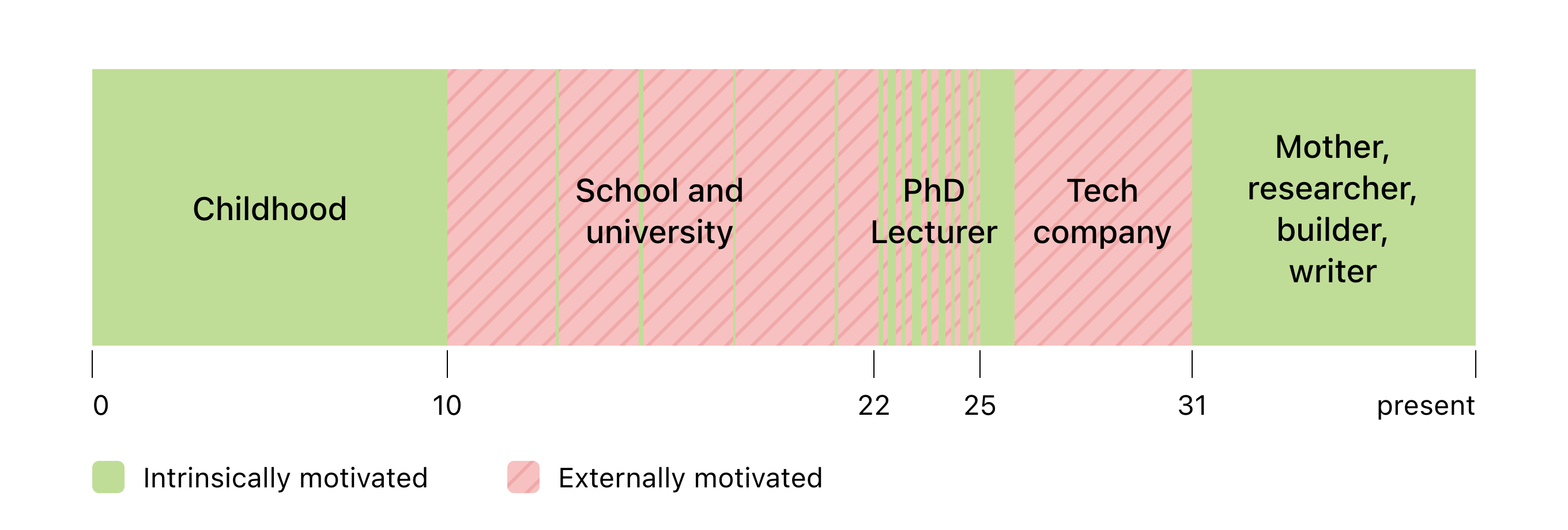
In which colours do you think I was happiest?
Extrinsic motivation is a volatile source of fuel because it is tied to your environment and your interactions with it. But intrinsic motivation is a constant and renewable energy source that flows freely from within. (As long as you don’t start grading it.1) Both kinds of motivation can propel you to achieve great things but only one leaves you feeling truly fulfilled.
We are all born configured in an intrinsically motivated state. You need only observe the pure joy in a little child’s face when they discover that the square block fits in the square hole, or that sunlight and rain make a rainbow, or that sandcastles are just as fun to demolish as they are to build.
As children, we drew because we loved drawing. We played because we loved playing. And we ran because we loved to run.
But as we grew older, people around us started grading those actions. Or handing out awards for them. Or ranking us against others using symbolic ribbons of blue, green and red. Slowly, grade by grade, the balance of our motivation began to shift from intrinsic towards extrinsic, and all the awards at the finish line began to cannibalise the joy of the process itself.
At our core, we’re all fuelled by dopamine. Whenever this potent neurochemical surges within our striatum, we feel a rush of motivation, the embodiment of pure potential energy. Dopamine alone feels like coiled momentum, a restless rush to move forwards. It only feels “good” when that forward momentum is triggered by something that has actually happened — a favourable surprise experienced not anticipated.2
There are three ways this rush is triggered, and they relate directly to whether the motivation we feel leads to fulfilment or emptiness.
Your brain is constantly refining its models of the world and your own interactions within it. When the outcome of your actions exceeds its predictions, a dopamine spike fires, marking the moment as significant and making you want to keep doing whatever led to that positive surprise. This is you essentially triggering your own dopamine — the renewable fuel of intrinsic motivation.
Phrases like “tie the reward to the effort” or “embrace the discomfort” often spill from the lips of people who strive for this ideal, as if intrinsic motivation is something to be hacked.
But they’ve got it all wrong. Intrinsic motivation is the natural byproduct of a brain being challenged. It isn’t something to be found, but something that emerges when you place your brain in a state where it can learn.
“Effort” is the discomfort of not being able to do something perfectly. It sets the baseline against which you can surprise yourself, and thus trigger that motivation spike (the “reward”). But if the activity is effort-less, there can be no surprise, which means there can be no motivational reward! Effort is the necessary and fertile ground out of which the reward sprouts.
This is what it means to find joy inside the process. You’re continually challenging yourself and then surprising yourself when your effort suddenly punches through the ceiling of your prior abilities.
This kind of motivation is self-sustainable, endlessly renewable, and ensures you will never lose your love of learning because it is wiring in a love of learning. It’s the fuel that fires the flames of creativity, passion and purpose.
Extrinsic motivation is a far more common type of fuel that drives most successful people in today’s yardstick-measuring modern world. Rather than the value coming from the surprise of your own actions exceeding expectations, the value comes from the outside world. Praise, awards, metrics, prizes and financial reward all belong in this category.
This type of motivation does have a place, don’t get me wrong. It can serve as a valuable kind of “bootstrapping” motivation in the early days of learning, which are often fraught with disappointment at reality coming up well short of expectations. But it only works if it is delivered as closely as possible to the effort.
My daughter is a perfect illustration of this. She recently started learning how to tie her shoelaces. And let me tell you, a six-year-old’s tolerance for frustration is frighteningly low. Shoes were thrown. Tears were shed. But with a few strategic, “That’s amazing, you almost had it!” and “You are doing so well to stick with this!” from myself and her father, she felt some extrinsic motivation and it fuelled her to keep trying. Within two days, she had it.
This scaffolding isn’t just specific to children. In my own recent foray into learning the guitar, I won’t deny how good it felt when my husband sometimes poked his head around the corner and said, “Wow! That’s actually sounding really good!”3 A little sprinkling of external motivation to supplement my own internal supply only served to spur me on further.4
As long as your dopamine is being triggered more by your actions measured against your own expectations (rather than the expectations of others), your motivation stays predominantly intrinsic and your joy stays protected.
It’s when the rewards are externally delivered outside the process — away from the effort, at the finish line — that the joy starts leeching out.
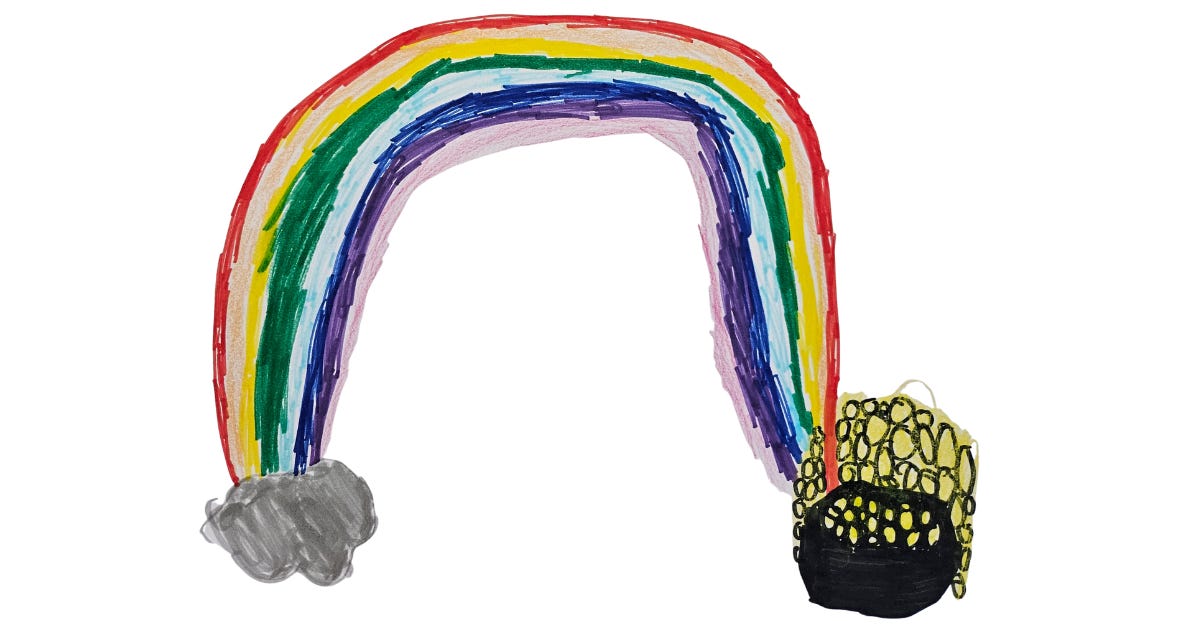
There is a type of motivation that essentially cannibalises any dopamine found within the process: the pot of gold at the end of the rainbow of effort. When the awards at the finish line are so great, the dopamine triggered by their “surprise” begins to shift upstream, to cues within the process itself. These feel like anticipatory bursts of energy — glimpses of a finish line — rather than motivation produced by the effort itself.
As a quick thought experiment, consider two writers, one who writes because they simply love writing and the other who writes for external validation. (Feel free to swap out “writer” for any other agent noun of your choosing. Runner, painter, baker, developer, builder… any “do-er” obeys the laws of motivation, because motivation itself is the catalyst for do-ing.)
The intrinsically motivated writer generates the bulk of their motivation dopamine from within the process itself, whether it be from the click of an insight or the delicious retrieval of a perfect word or the satisfaction at distilling a particular point. Every spike of dopamine they trigger just reinforces their love of writing, keeping reward and effort naturally coupled. Their attention stays anchored in the present, because it’s the present moment that contains the surprise.
The extrinsically motivated writer generates their motivation dopamine from anticipation of the applause that will come. Their attention is constantly pulled to the future because that is where the rewarding surprise now lies. Instead of being propelled by a fuel manufactured from their own effort, it’s a tether to the outside world, pulling them (and their attention) to the finish line.
This can be a dangerous form of propulsion for two reasons: it can overshadow the intrinsic joy that might have otherwise been found inside the process, and it makes for a fleeting victory. People driven by this kind of motivation often experience an immense letdown upon achieving the great thing they set out to achieve, because all that anticipatory dopamine has priced in the value of the eventual reward.
When applause that you’ve been anticipating for weeks finally arrives, there is little surprise to be felt, and therefore no spike to propel you onwards. The tether simply falls slack. (Worse, if the applause isn’t at the expected decibels, a dopamine dip can occur, wiring in demotivation.)
This lacklustre feeling at the point of achievement can make you feel momentarily bereft and it’s only once you set your sights on a new goal that a new tether anchors and tows you onwards.
A purely extrinsically motivated individual lacks fulfilment — but certainly not motivation — before the finish line and can’t find either one immediately afterwards. They only feel “satisfied” while they are in motion and looking at that ever-shifting pot of gold.
They miss the beauty of the entire rainbow.
In the beginning, nature bestowed me with intrinsic motivation — as a child, curiosity was my fuel. Then the modern world slowly stole it by grading me on my effort. External validation became my fuel and I spent my secondary and tertiary education driven by the lure of a plus after every metaphorical (and literal) A.
It was only during moments of peak agency — when I was given the latitude to explore what I wanted — that sporadic moments of intrinsic motivation returned.
During my PhD, I would often wake in that liminal state of consciousness so characteristic of the witching hour, a solution to my current problem lying on a platter within my mind.5 When I started volunteering to help with research at a tech company simply because the work was so fascinating, the intrinsic motivation also returned. (Are you seeing a pattern here? When financial compensation — a common external motivator — is removed, curiosity can more easily shine through.) But as my role shifted to a remunerated one (with output watched by hawklike investors) that intrinsic motivation was slowly cannibalised once more.
I came full circle when I had my first daughter and nature once more granted me the gift of intrinsic motivation. There is nothing more joyful (or effortfully rewarding!) than raising a tiny little person new to this world. Seeing my daughter discover her own curiosity helped me excavate long-buried parts of my own, like splitting a geode open to find the crystals within. (That same daughter is currently obsessed with gemstones and wants to be a “Gem Scientist” when she grows up.6)
In reality, motivation is usually a combination of self-generated, external and anticipatory dopamine: joy in the process, gentle encouragement from the sidelines, and an end goal. The more you skew the balance towards the first by generating motivation inside the process, the more joy you keep. But it requires constant vigilance in a world that keeps trying to point you at the pot of gold.
Tomorrow, I’ll be running the annual colour rush with my Gem Scientist daughter. It’s a race with no winner, where people toss colours at you as you sail by, ending the day a rainbow.
Your own rainbow is still there, perhaps buried a little. You just have to take your eyes off the pot of gold long enough to see it.
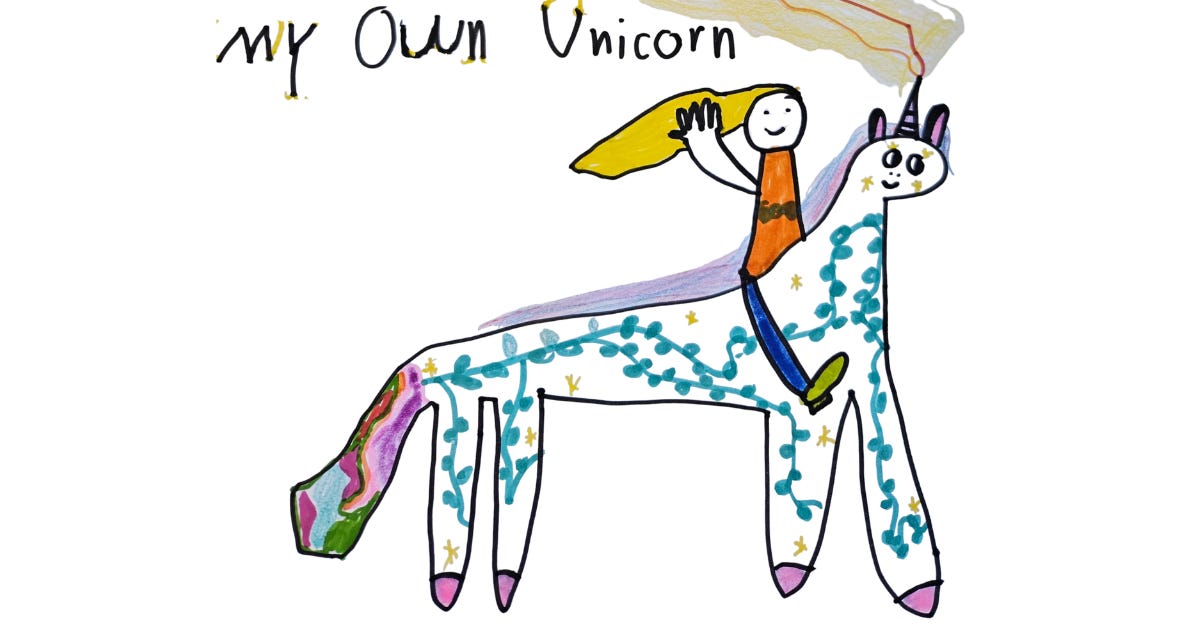
A while ago, someone posed the question to me, “Would you still write if nobody read your work?” And I did ponder this. But, at the end of the day, I write to help, not to receive compensation (which is one of the reasons why these essays are all free). And I write to understand, but not so that I can receive praise for that understanding. So… yes, I would still write. (I just wouldn’t put quite so much care into formatting.)
So I would like to put a similar question to you: Do you see the pot of gold or the rainbow?
References for this essay, and for the wider series, are available as a collection in the Research Library, specifically Dopamine, Reward Prediction, and Learning.
A now-famous Stanford study from 1973 gave preschoolers a reward for drawing, where some were promised it in advance and some were surprised with it afterwards. Only the children who’d been anticipating it lost interest in drawing later. (The surprised ones were unaffected.) It’s not the reward that steals the joy, but the anticipation of it (Lepper et al. 1973, Deci et al. 1999).
“Liking” (opioid) and “wanting” (dopamine) systems are separable.
The “actually” there shows how I had exceeded his own expectations as well as my own.
I knew it had worked when I started looking forward to guitar practice. “Looking forward” to something is dopamine’s domain and is a sign that the motivation spike has shifted further upstream, right where you want it: before the task.
I would then have to get out of bed and test it right away, much to my husband’s frustration.
The (intrinsic) force is strong in this one. And may it ever remain that way.
No posts
Comments
Nothing yet. Say the first thing.
Sign in to join the conversation.