
Book Muse: The House on the Cerulean Sea by T.J. Klune
As ICE officers invade Chicago, rounding up children in the middle of the night to zip-tie them together and lead them into the streets, I wasn’t sure I was up to reading T.J. Kune’s The House on the Cerulean Sea. The idea of opening up a young adult fantasy novel about children who are “different” being forcibly removed from their families and placed in orphanages seemed just a little too close to reality to me.
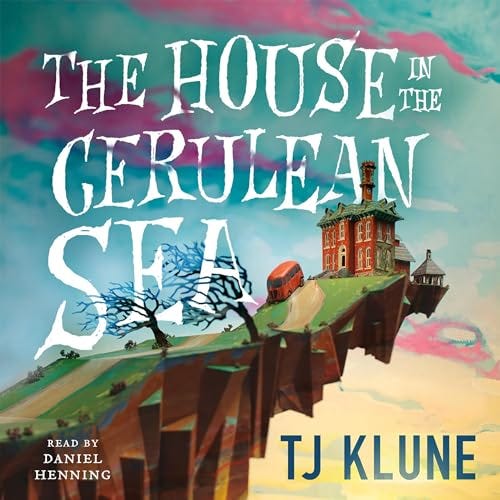
But I read the book anyway. And I am glad I did. The House on the Cerulean Sea features loveable and quirky characters, shadowy antagonists which suffer defeat in utterly satisfying ways, and a heartwarming and happy ending.
Without giving too much away, here’s the basic premise: in some unknown time in the not-so-distant future, children are born with magical or non-human qualities. Because of these perceived defects, these children are placed by the government into corporate orphanages – a misnomer at best, since, as one character notes, “Do you see anyone looking to adopt these children?”
Our main character, Linus, is an orphanage inspector, hired by the corporation to visit various homes to ensure the children are well-taken care of: fed, loved, and educated. If they are, he fills out a report. If they are not, he fills out a report. Linus is the quintessential pencil-pusher – he never asks if these reports result in any action. Because of his remarkable ability to follow rules without question, along with his lonely existence outside of his job, he is sent by the corporation to report on The House on the Cerulean Sea, a home for “special orphans.”
This kicks off the plot. We meet the orphans themselves, a delightful mix of, well, children, along with their caretaker, Arthur. What ensues, as you might guess, is the effect these orphans have on Linus over his month-long stay, which makes Linus see the children, and himself, in a different light.
And in typical Klune fashion, there is a budding romance between Arthur and Linus, which creates a charming subplot.
Klune, an American, said he based this story on the “sixties scoop” in Canada, when the Canadian government mandated that all indigenous children be removed from their families in the late 1950’s through the 1980’s. Over 20,000 children were be placed in orphanages to be adopted by white families (reminiscent of the actions taken by the US government forcing native children in America to enroll in “Indian boarding schools” in the 1870’s through the 1930’s).
Klune has received some criticism for this. Some argue that by treating a horrific historic event as a fantasy – particularly one that has a happy ending—he trivializes the trauma of the indigenous people. While this may be true, it’s also true that we are people who ignore our history unless it’s presented in palatable forms, like fiction. Consider Otsuka’s The Budda in the Attic, Zusak’s The Book Thief, Hannah’s The Women, or a slew of other fictions based on actual events. The House on the Cerulean Sea is clearly billed as a fantasy and a YA novel, not a historical fiction. So, no. I don’t buy this argument.
But if I haven’t convinced you yet, here’s why you should read this book. It is hopeful. It posits that even the most stubborn and intransigent of us can change, if we are given the opportunity to interact with people different than ourselves: different backgrounds, different abilities, different appearances, different ways of seeing the world. And once we have changed, we cannot change back.
This is the same lesson that I’ve learned over the past few days from Chicago. As I watch white adults walk home children of color from the local schools, neighbors standing up to ICE agents in the streets, and people marching down Michigan Avenue, I see many of us taking seriously our role as human beings to see one another and to protect one another. Because this is what makes us human.
So thanks, T.J. Klune and the city of Chicago. You both tell a great story.
Quotes:
“It is better to be kind than right.”
- T.J. Klune, The House on the Cerulean Sea
“When something is broken, you can put it back together. It may not fit quite the same, or work like it did before, but that doesn’t mean it’s no longer useful.”
- T.J. Klune, The House on the Cerulean Sea
Notes:
Ancillary Review of Books: https://ancillaryreviewofbooks.org/2021/04/22/the-kids-are-alright-review-of-the-house-in-the-cerulean-sea-by-tj-klune/
Good Reads: https://www.goodreads.com/book/show/45047384-the-house-in-the-cerulean-sea
No posts
Comments
Nothing yet. Say the first thing.
Sign in to join the conversation.