
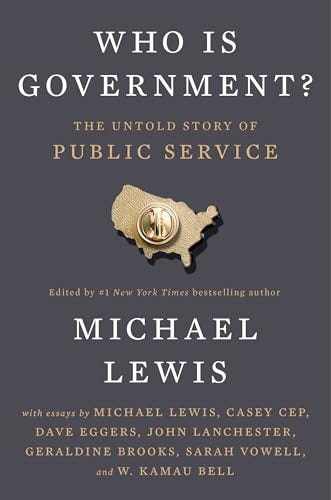
After the 43-day government shutdown this fall (the longest in American history), I thought I’d share Who Is Government?: The Untold Story of Public Service, a collection of essays edited by Michael Lewis. It’s about government jobs. I know, it sounds boring. It’s not. Seven rock-star writers give us profiles of a few selected government employees doing work you’ve never heard of: the scientist who made mines safer, the IRS agent who uncovered a child pornography ring, the person who works to make all 13 billion records in the National Archives available to anyone anywhere in the country—and more. Originally published as a series of articles in The Washington Post, Lewis curated this collection to showcase obscure yet essential government jobs through talking with the actual folks that do this work. And their work is fascinating.
Oh, and the writers of this collection? They’re like a dream list for any contemporary reader. There’s the editor, Michael Lewis, whose nonfiction includes The Big Short and Moneyball; Geraldine Brooks, the amazing fiction writer of Horse and People of the Book; David Eggers, founder of 826 Valencia and author of multiple fiction books, including What is the What and Zeitoun; Sarah Vowell, a contributing editor for “This American Life,” known for her comedy books like Assassination Vacation and The Partly Cloudy Patriot, and John Lancaster, writer of one of my favorite dystopian fables, The Wall. And others too. If you get the audio version of the book, each writer reads their own essays, which is much fun (although I’ll admit, Brooks’ reading voice leaves something to be desired.)
My personal favorites are the chapters by John Lancaster and Casey Cep. “The Numbers” by Landcaster is about the U.S. Bureau of Labor Statistics, which explains how this department collects its data (so much data!). This essay is chock-full of measurements, percentages, and details that this organization collects, including the median size of bedbugs, the number of deaths by falls, and the average price of cheese. But all this data has a purpose: for example, if you can determine the age of people most likely at risk for falls (typically the elderly), then you can put together theories on how to prevent these kinds of accidents. If you know the price of cheese, you can begin to calculate the Consumer Price Index to determine how the cost of food is changing over time. And if you know the typical size of a bedbug? Well, I guess, then, you know that too.
Cep’s essay, “The Sentinel,” profiles Ronald E. Walters, who runs the National Cemetery Administration. He is the person who makes sure all our national cemeteries are clean, accessible, and prioritize veterans’ burials. In this highly politicized climate and calls to the to privatize everything, include the National Cemeteries, Walters says plainly, “There’s no Republican or Democratic way to bury a veteran.” So true.
Not every essay hits it out of the park. For example, the chapter “The Rookie,” by W. Kamu Bell features an interview with Olivia Rynberg-Going, a new paralegal at the U.S. Department of Justice. This essay is rather weak (and surprisingly, for a comedian, not funny), but it does provide a voice not just to the veteran employees of the government, but those who are choosing to begin this work.
Who is Government Anyway? is such a timely book. Even before DOGE started dismantling our federal government, people have always been skeptical of government workers. What do these people do all day? This book offers a glimpse, albeit a curated one, into some of their professional lives. What’s more, most of the folks profiled in these essays could get other, better paying jobs elsewhere. And they certainly aren’t famous for their work (think about being at a dinner party, introducing yourself as someone who works in the Bureau of Labor Statistics, and watching people’s faces go blank). But they do the work anyway—because they believe it matters. Many contemporary readers tend to gravitate towards stories of famous people, often rife with enough sex and scandal to make the tale interesting. Who is Government Anyway? is a different kind of book: it showcases quiet, good people who see their job as a higher calling. Imagine if we were able to see more profiles like these – showcasing ways to live and work with integrity in this country.
What else I’ve read this month:
· This is the Night our House Will Catch on Fire by Nick Flynn
· The Wilderness by Angela Flourney
· The Riddle Song and Other Rememberings by Rebecca McCalnahan
· I Hope This Finds You Well by Kate Baer
· Good Talk: A Memoir in Conversations by Mira Jacob
Shot me a message or note if you’d like to talk about any of these books – I’d love to hear what you think!
And next month? My “Top Ten Reads for 2025.” Stay tuned. (And please, don’t pay me — just become a free subscriber!
No posts
Comments
Nothing yet. Say the first thing.
Sign in to join the conversation.