
I started writing this Substack to understand the truth of our situation. After Mark died, I didn’t want to be told how to do grief, but I did want to be understood. I wanted to tell others what it felt like to be in it and really feel it. Because not having Mark there to talk about it all was the most unimaginably painful part of losing him.
I didn’t write for anyone else; it was an attempt at being selfish. Then friends and family started telling me that it helped them. They sent messages like, “Oh god, you made me cry at work again. Why do I open your Substack at my desk?”
Being nominated by WAY (Widowed And Young) for the 2026 Helen Bailey Award means that the honesty I’ve been trying to hold onto inside myself has found its way to others. WAY nominated me for, “moving, powerful and rare insights” in my writing about grief. I’m grateful and humbled to have been recognised for a writer’s award. Never would I have imagined that anyone would be interested in what I had to say. Although I suspect Mark would have seen it coming, and that he’d be delighted.
Then, a few months ago, WAY asked me to contribute to their quarterly newsletter. After reading a post I’d written on resilience, they asked me if I’d like to write a point of view on anticipatory grief to share with other members. I was delighted to be given the opportunity. I was also surprised that I’d reached such a visible point, without noticing. And I was more than a bit daunted. I realised it would be the first time anyone other than me had published something I’d written. It was also quite exciting. I decided they knew more about what people wanted to read than I did, so I proceeded to turn my inner reflections into something readable. The image below is the article, they published last week, and what follows is an edit of what I submitted to them.
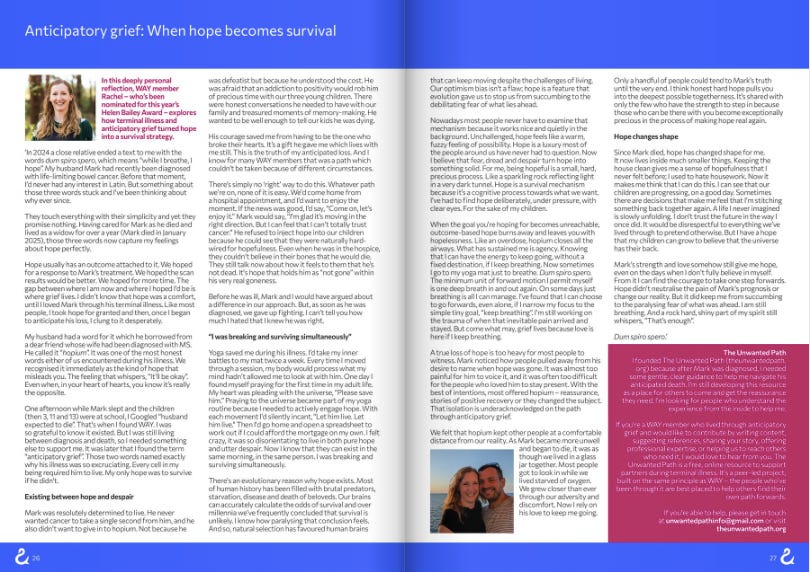
In 2024 a close relative ended a text to me with the words dum spiro spero. While I breathe, I hope. My husband Mark had recently been diagnosed with life-limiting bowel cancer. Before that moment, I’d never had any interest in the dead language; I loathed my Latin teacher at school. But something about those three words stuck and I’ve been thinking about why ever since.
They touch everything with their simplicity and yet they promise nothing. Having cared for Mark as he died and now living as a widow, those three words capture my feelings about hope perfectly.
Hope usually has an outcome attached to it. We hoped for a response to the treatment. We hoped the scan results would be better. We hoped for more time. The gap between where I am now and where I hoped I’d be is where grief lives. I didn’t know that hope was a comfort, until I loved Mark through his terminal illness. Like most people, I took hope for granted and then, once I began to anticipate his loss, I clung to it desperately.
My husband had a word for it which he borrowed from a dear friend whose wife had been diagnosed with MS. He called it hopium. It was one of the most honest words either of us encountered during his illness. We recognised it immediately as the kind of hope which misleads you. The feeling that whispers, “It’ll be okay.” Even when, in your heart of hearts, you know it’s really the opposite.
One afternoon while Mark slept and the children were at school, I Googled “husband expected to die”. That’s when I found WAY. I was so grateful to know it existed. But I was still living between diagnosis and death, so I needed something else to support me. It was later that I found the term “anticipatory grief”. Those two words named exactly why his illness was so excruciating. Every cell in my being required him to live. My only hope was to survive if he didn’t.
Mark was resolutely determined to live. He never wanted cancer to take a single second from him, and he also didn’t want to give in to hopium. Not because he was defeatist but because he understood the cost. He was afraid that an addiction to positivity would rob him of precious time with our three young children. There were honest conversations he needed to have with our family and treasured moments of memory-making. He wanted to be well enough to tell our kids he was dying.
His courage saved me from having to be the one who broke their hearts. It’s a gift he gave me which lives with me still. This is the truth of my anticipated loss. And I know for many people who lose their loved one that is a path which can’t be taken.
There’s simply no right way to do this. Whatever path death forces us onto, none of it is easy. We’d come home from a hospital appointment and I’d want to enjoy the moment. If the news was good or at least the results showed no progress I’d say, “Come on, let’s enjoy it. The oncologist told us it’s okay.” Mark would say, “I’m glad it’s moving in the right direction. But I can feel that I can’t totally trust cancer.” He refused to inject hope into our children because he could see that they were naturally hard-wired for hopefulness. Even when he was in the hospice, they couldn’t believe in their bones that he would die. They still talk now about how it seems to feel that he’s, “not gone”. It’s hope which holds him alive in his very real goneness.
Before he was ill, Mark and I would have argued about a difference in our approach. But, as soon as he was diagnosed, we gave up fighting. I can’t tell you how much I hated that I knew he was right.
Yoga saved me during his illness. I’d take my inner battles to my mat twice a week. Every time I moved through a session, my body would process what my mind hadn’t allowed me to look at with him. One day I found myself praying for the first time in my adult life. I was in flow and came back to myself to find that I was genuinely praying. My heart was pleading with the universe, “Please save him.” Praying to the universe became part of my yoga routine because I needed to actively engage hope. With each movement I’d silently incant, “Let him live. Let him live.” Then I’d go home and open a spreadsheet to work out if I could afford the mortgage on my own. I felt crazy, it was so disorientating to live in both pure hope and utter despair. Now I know that they can exist in the same morning, in the same person. I was breaking and surviving simultaneously.
It was so hard to live with I researched hope’s origins; I thought understanding its evolutionary origins may help me to conquer it. Remembering that most of the humans in history have faced brutal predators, starvation, disease and death of their beloveds did actually help me a little bit. Our brains can accurately calculate the odds of survival, and therefore over millennia we’ve quite rightly concluded that continuation of what we love is finite. I know how paralysing that conclusion feels, in real terms. And so, natural selection has curated human brains which can keep moving despite the ordeal of living. Our optimism bias is structural; it isn’t a flaw. Hope is a feature which stops people succumbing to the debilitating fear of what lies ahead.
Nowadays most of us never have to examine that mechanism because it works nice and quietly in the background. Unchallenged, hope feels like a warm, fuzzy feeling of possibility. Hope is a luxury most of the people around me and my family have never had to question. Now I believe that fear, dread and despair turn hope into something solid. For me, being hopeful is a small, hard, precious process. Like finding a sparkling rock reflecting light, glinting from within a deeply dark place. Hope is a survival mechanism because it’s a cognitive process towards what we want. I’ve had to find hope deliberately, under pressure, with clear eyes. For the sake of my children.
When the goal you’re hoping for becomes unreachable, outcome-based hope burns away and leaves you with hopelessness. Like an overdose, hopium closes all the airways. What has sustained me is agency. Knowing that I can find the energy to keep going, without a fixed destination, if I keep breathing is crucial. It’s everything to me on some days. I’ve found that I can choose to go forwards, even alone. Dum spiro spero.
Nowadays I sometimes go to my yoga mat just to breathe. I still go twice a week to move. But the minimum unit of forward motion I permit myself is one deep breath in and out again. I’m still working on the trauma of when the inevitable pain arrived and stayed. He died and there was nothing I could do to save him. That hurts me still. And come what may, grief will live because love is here.
That kind of love turns hope into grief, it has a weight which is felt long before the loss is real. Hope floats. Grief sinks. It’s a submergence so frightening that most people can’t bear to be near it. Mark noticed how people pulled away from his desire to name when hope was gone. It was almost too painful for him to voice, and it was often too difficult for the people who loved him to stay present for it. Despite the best of intentions, most of the people around him offered hopium – reassurance, stories of positive recovery, or they changed the subject. He didn’t blame them, he wouldn’t have been thinking about it either, if he had the choice. That isolation is under-acknowledged on the path through anticipatory grief.
We felt that hopium kept other people at a comfortable distance from our reality. As Mark became more unwell and began to die, it was as though we lived in a glass jar together, most people got to look in while we lived starved of oxygen. We grew closer than ever through our adversity and discomfort. Now I rely on his love to keep me going.
Only a handful of people could tend to Mark’s truth until the very end. I think honest, hard hope pulls you into the deepest possible togetherness. It’s shared only with the very few who have the strength to step into it, and those who can be there with you become exceptionally precious in the process of making hope real.
Since Mark died hope has changed shape for me. It now lives inside much smaller things. Keeping the house clean gives me a sense of hopefulness that I never felt before. I used to hate housework, now it makes me think that, “I can do this”. On a good day, I can see that our children are progressing. It’s not a continuous belief, but it glints at me in difficulty. Sometimes life-level decisions are overwhelming, and then I see that I’m holding something together, long enough for it to heal again. A life I never imagined is slowly unfolding. I don’t trust the future in the way I once did. It would be disrespectful to everything we’ve lived through to pretend otherwise. But I have a hope that my children can grow to believe that the universe has their back.
Mark’s strength and love somehow still gives me hope, even on the days when I don’t fully believe in myself. From his loving faith in me I can find the courage to take one step forwards. Hope didn’t neutralise the pain of Mark’s prognosis or change our reality. But it did keep me from succumbing to the paralysing fear of what was ahead. I am still breathing. And a rock hard, shiny part of my spirit still whispers, “That’s enough”.
Dum spiro spero.
Comments
Nothing yet. Say the first thing.
Sign in to join the conversation.