
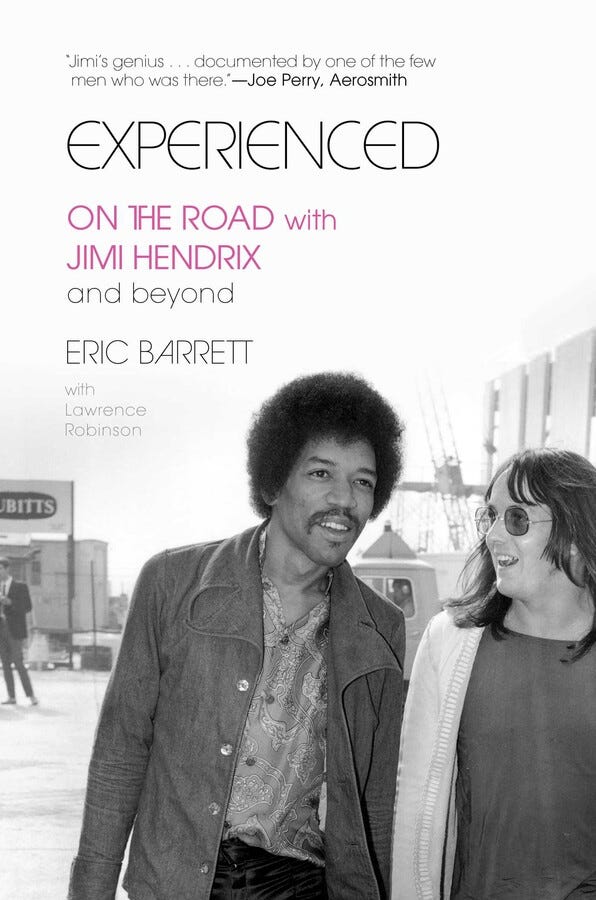
One of the more intriguing Hendrix-related news items in recent memory was the announcement earlier this year that Eric Barrett, Jimi’s former road manager, was publishing a memoir, titled Experienced: On the Road with Jimi Hendrix and Beyond. Likely known only to the most serious researchers and fans, Eric was witness to most of the major events in Jimi’s career from 1968 onwards. For nearly 60 years, he kept his memories and thoughts from those times private. I was fortunate to receive an advance copy of the highly-anticipated book, which will be published on August 4 by Diversion Books.
The promotional blurb sets some pretty high expectations:
Experienced is Barrett’s long-awaited, unflinching memoir: the definitive inside account of Hendrix as friend, bandleader, and phenomenon. It strips away the mythology to reveal the man in all his musical wizardry and human contradictions. It reveals Hendrix as volatile, generous, insecure, incandescently creative, and always in pursuit of the next sound. . . . [It] is not just another rock memoir but a once-in-a-lifetime backstage history of music’s most transformative years, told through the prism of Barrett’s ride on Hendrix’s feedback-fueled rise and tragic fall.
Thankfully, I’m pleased to report that the book delivers. It’s a fresh and authentic narrative from Eric’s perspective as a fairly ordinary guy from Glasgow suddenly thrust into the epicenter of rock history, first with Jimi and then with the music icons of the decades that followed, looking back at an extraordinary career.
Words like “insider” and “confidant” are loosely thrown around when it comes to Hendrix-related memoirs. The truth is, despite the unusually large and ever-present crowd of hangers-on, Jimi Hendrix’s inner circle was quite small. Eric Barrett, however, was one of the very few people brought into “the family,” as he calls it. Though often neglected by Hendrix biographers—the most popular book doesn’t even mention him—Eric’s bona fides were never really in doubt. He can be spotted in photos and film ranging from the Royal Albert Hall (holding on for dear life to the back of Jimi’s Marshalls) to Woodstock (see below) to accompanying Jimi on his final cross-Atlantic flight in August 1970 (tastefully chosen for the book’s cover, both smiling).
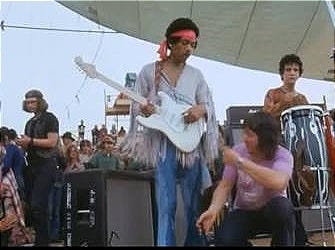
It’s evident that Eric was not just a roadie or guitar tech in the modern sense, but, in many ways, Jimi’s right hand (or should it be left hand?) both onstage and offstage, a self-described “fixer.” His credentials are established naturally through the many, many new stories and other nuggets that Eric shares over the course of the book. A few of my personal favorites:
He was one of only two people that Jimi allowed to handle his guitars. (The other was Eric’s boss, Gerry Stickells, who tragically passed away in 2019.) This privilege also came with the unenviable responsibility of stopping everyone else around Jimi, no matter who they were, from touching them.
He regularly accompanied Jimi on his late night visits to the clubs in New York, London or LA, where the shy and self-conscious Jimi had Eric ask the musicians if they’d let Jimi jam with them.
When Jimi spotted someone from the stage that he wanted to “meet,” he signaled to Eric, who was tasked with finding them and getting them backstage.
As you’d expect, the book is packed with rockstar road stories—many being told for the first time—that will likely become instant classics and retold for decades to come. I found myself stopping on nearly every page to jot a note to myself, usually with at least one exclamation point. We get a new, first-hand perspective of the Experience’s harrowing escape from a mob of fans, police, and tear gas from the Denver Pop Festival in June 1969 in the back of a box truck, with Eric behind the wheel. We learn how Eric was somehow able to get Jimi’s equipment to the Woodstock stage in August 1969, despite the miles of closed roads in every direction packed with abandoned cars. And, of course, we hear about the unique “employment benefits” that came with being the roadie to the biggest rock star in the world, including Eric’s hilarious, but obviously futile, attempts to compete with Jimi over women.
But those hoping for stunning revelations of deep, dark secrets or earth-shattering scandals will be disappointed. In my view, this is a relief. I haven’t paid much attention to the mainstream press coverage of the book, but I would be highly surprised to see the kind of sensationalist, tabloid-style headlines that usually accompany rock memoirs. You won’t be told that Jimi was murdered as part of a vaguely explained grand conspiracy involving the mafia, the CIA, and his management, for example. Nor will you be told that Jimi was a junkie or an out-of-control freak. It’s clear—from both the book itself and its promotion—that Eric isn’t looking to sell books at any cost. Rather, this is an honest and authentic account of an incredible history with which very few, if any, other authors can compete.
We get an inside look at not only musical genius, but the person behind it. It captures Jimi’s unique sense of humor and extraordinary lightheartedness, qualities that weren’t part of Jimi’s public image, but are consistently attested to by those closest to him. I was reminded of a line Jimi gave in his final recorded interview: “When things get too heavy, just call me helium, the lightest gas known to man.” [Google tells me that hydrogen is actually lighter than helium. Jimi was not a chemist, nor am I.] When I first heard that, I found it a little hard to believe, but, after reading Eric’s book, I don’t doubt it.
This really isn’t a book about Jimi Hendrix, though. It’s about Eric’s wild ride through rock history, beginning with Jimi but continuing alongside the superstars that came later— Bowie in the Seventies, Madonna in the Eighties, to name just two. The book’s structure is a little unusual. Though Eric’s time with Jimi provides the narrative thrust, it’s interspersed with flashforwards to Eric’s later career that echo his past, like his ongoing challenge to keep the artist out of jail. After telling us about Mitch Mitchell and Noel Redding’s habit of carrying bags “stuffed to the brim with drugs” on international flights, Eric tells us about Bowie’s (and his own) predilection for cocaine mid-show and Eric’s global rolodex of dependable drug dealers in the Seventies. The flashforwards also effectively highlight just how different rock tours during Jimi’s time were from not just today, but even just a few years later. No choreographed light shows. Minimal security or concern for safety. And, as crazy as it sounds, handing out-of-tune guitars onstage.
That Eric’s stories about figures like Bowie, Madonna, Billy Idol, Aerosmith, and others serve as mere side notes to Jimi is a remarkable testament to the unique place that Jimi occupies in musical and cultural history. Often under-appreciated, Eric illustrates this nicely in the book’s introduction, with a wonderful anecdote that captures the spirit of the book and is worth quoting at length:
It was Jimi’s name that opened all the other doors for me. It wasn’t something I ever tried to exploit, but having his name on my resume always carried a huge amount of weight. It somehow made me cool by association. No matter what I did afterward, or who I worked for, I’d be forever known as “Jimi Hendrix’s roadie.”
When I was managing tours for Lenny Kravitz, he was very close friends with Denzel Washington. The first time Lenny introduced me, he said, “This is my tour manager, Eric.” Denzel nodded. Nothing more. Polite enough but obviously not keen to engage. Then Lenny added, “He used to be Jimi Hendrix’s roadie.”
Instantly, Denzel’s entire demeanor changed. He pushed me in the chest and exclaimed, “Get the hell out of here!” He then vigorously shook my hand and asked me a ton of questions about Jimi. He couldn’t have been more effusive. Suddenly, I’d become cool enough for a movie star to get all excited about.
That’s what Jimi’s name could do.
The book will be released publicly on August 4. If you’ve read this far, it should be obvious that you should pick up a copy. Order it from your local bookstore or, if you must, on Amazon. And drop a comment once you’ve had a chance to read it!
No posts
Comments
Nothing yet. Say the first thing.
Sign in to join the conversation.