
This is the second in my three-part series for Heaven Research presenting a summary and analysis of the pending litigation in the UK brought in the interests of Noel Redding and Mitch Mitchell’s heirs that seeks to restore their rights in the music of the Jimi Hendrix Experience.
In Part One, I summarized the basics of the case and the long and twisted history of the Experience’s business dealings—from the original, rotten deal that Jimi, Mitch, and Noel signed in October 1966 with Mike Jeffrey and Chas Chandler, to lawsuits and settlements by Mitch and Noel in the 1970s, to Experience Hendrix LLC’s consolidation of rights in the 1990s. In this Part Two, I break down the core claims brought by the Redding and Mitchell estates, who assert that both men died destitute in the early 2000s, including the facts, the complex legal issues, and the arguments presented by both the Claimants and Sony UK. Let’s dive in.
Noel and Mitch assert two distinct types of rights under English law in relation to the Experience’s studio albums: first, a joint copyright (with Jimi) in the sound recordings themselves; and second, a type of “performers’ right” created by English law in 1996 and 2003 and applied retroactively. The second type of right is the real heart of the case and is what is keeping the industry on edge.
The Claimants do not have an easy task, given the agreements that Noel and Mitch signed during their lifetimes. To be successful under either claim, they need to clear a number of tall legal hurdles. I will walk through each of the claims separately, although many of the issues overlap.
Noel and Mitch argue that they (along with Jimi) were the original joint owners of the sound recording copyrights for each of the three Experience studio albums—Are You Experienced (1967), Axis: Bold As Love (1967), and Electric Ladyland (1968)—and that they continue to hold those copyrights today.
At the outset, it’s important to clarify what this actually means. In both English and US law, when a song is written and recorded, there are two different copyrights created. There is a copyright in the composition, which is the song itself (e.g., the lyrics, the musical structure, the melody, etc.). This comes into play with cover records, transcriptions or tablature, and claims that an artist “ripped off” another. There is also a separate copyright in the actual recording itself (i.e., the masters), which comes into play with record releases, allowing a song to be used in a movie, TV show or ad, and, most importantly, streaming.
Noel and Mitch are arguing that they are joint owners of the latter right, the copyright in the sound recordings, not the former. They face three main legal hurdles.
Under English law, the original owner of the sound recording copyright is the “maker” of the recording. The first question for the Court to answer is who was the maker of the three albums, the band or the producers? The answer is murkier than it may seem at first glance.
The maker is not necessarily the person who played the notes, wrote the songs, or made other creative musical decisions. Rather, it is generally the person who commissioned the recordings, by paying for the studio time, equipment, and the physical tapes and by organizing the session. It is an entrepreneurial right based on capital investment, not creative performance. (This is a critical difference from US copyright law, which protects “authors,” focusing on artistic creativity, not capital.) Typically, the maker is the record label or the producer.
Noel and Mitch argue that “The Jimi Hendrix Experience” was a partnership—in which the band verbally agreed to a 50/25/25 split among Jimi, Noel, and Mitch—that was the maker of the three studio albums. Sony UK, on the other hand, argues that Mike Jeffrey and Chas Chandler were the makers. Both sides rely on the wording in the original recording agreement in October 1966 (covered in Part One), and what little records were created and preserved by various managers, accountants, and lawyers.
Noel and Mitch’s argument is based on their factual claim that the band was ultimately responsible for paying recording costs. They cite a few pieces of evidence to support this, most notably:
The October 1966 Recording Agreement, which expressly allowed Jeffrey/Chandler to deduct their recording costs from the band’s royalties;
Hendrix/Warner Bros Artists Agreement, dated June 24, 1968 between Jimi and Warner Bros., in which Jimi agreed to pay recording expenses and that any of Warner’s expenses would be deducted from his royalties;
Accounting Records, including records from 1969 and 1970 showing specific payments for recording costs incurred by Noel Redding at Sound Center Inc. and Electric Lady Studios and records from Jimi’s lawyer, created after his death, detailing deductions that were charged to Jimi for recording sessions; and
Noel’s Autobiography, in which he wrote about recording expenses being charged to the band.
Sony UK disputes this, arguing that Jeffrey/Chandler paid the recording costs and took the financial risk associated with the recording, citing:
The October 1966 Recording Agreement, which specifically required Jeffrey/Chandler to pay all costs incurred in making the recordings and to procure the premises and equipment to make them; and
A De Lane Lea Studios Invoice, dated November 30, 1966, addressed to Jeffrey/Chandler, charging them for a recording session with Jimi on November 28, 1966.
It’s important to note that Sony UK was unsuccessful in dismissing these claims at an earlier stage of the litigation, with a court finding that there was a genuine factual dispute that required a trial to resolve.
In my view, Sony UK has the better argument here, both legally and factually. The Recording Agreement, the validity of which is uncontested, clearly required Jeffrey/Chandler to front the recording costs. While the agreement also allowed them to recoup their expenses by deducting from the band’s royalties, as Sony UK points out, that would only be possible if the records became successful. Had the record not sold, it appears that Jeffrey/Chandler would have been on the hook. If the intent of the law is to grant rights to the person who made the capital investment and took on financial risk, it makes sense for Jeffrey/Chandler to be the rights holders. There is also factual support for this, including the De Lane Lea invoice charging them for at least one of the recording sessions for Are You Experienced.
Although not introduced by Sony UK, there is also substantial evidence of Chas Chandler’s personal investment in the Jimi Hendrix Experience, with numerous interviews and other accounts of Chas selling his prized bass guitars to pay for the band’s equipment, the recording sessions and promotional events. For example, as Jas Obrecht writes in his 2018 book, Stone Free: Jimi Hendrix in London, September 1966 - June 1967:
Upon their return to England, Chas Chandler set about arranging their first studio recording. Then and now, people typically assume that headlining musicians are financially well-off. But for Chandler and many others who’d “made it big” during the first wave of the British Invasion, this was untrue. Though the Animals had chart-topping hits, American tours, and high-profile TV appearances, Chandler had little to show for it, other than a few nice instruments. . . . And now Chandler, already covering the lion’s share of Jimi’s living and equipment expenses, had to come up with the funds for studio sessions. Time was of the essence.
John McDermott gives a lot more detail in his essential guide, Jimi Hendrix: Sessions. For example:
To make their recorded debut, Chandler booked time at London’s DeLane Lea Recording Studios. . . . Limited cash reserves forced Chandler to complete much of the necessary preproduction at his London flat. . . . With little money available for experimentation, recording “Stone Free” was decidedly less complicated than “Hey Joe.” “‘Stone Free’ was recorded and mixed in one day,’ Chandler explains with pride. ‘I couldn’t afford to have the band learn the song in the studio, so I booked a rehearsal at the Averbach House beforehand. Prior to that, we had rehearsed in nightclubs.
The other evidence cited by Noel and Mitch isn’t very compelling. The Warner Bros agreement, for example, was signed in June 1968—after the three studio albums were recorded. It was also signed only by Jimi and, as far as I can tell, contained no evidence that Noel and Mitch were bound or affected by it. Similarly, the accounting records also appear to have concerned recordings after Electric Ladyland, referring to costs that Noel incurred at Sound Center (a recording studio in LA) and at Electric Lady (Jimi’s studio in New York that did not open until 1970). These recording sessions appear to have occurred after Noel had already left the Experience in June 1969 and were likely related to his other musical projects.
Given the dearth of records, the question of who paid for the Experience’s recording sessions is probably unknowable. Personally, I suspect the truth is somewhere in the middle. While I don’t doubt that Mike Jeffrey found ways to charge Jimi, Mitch and Noel for their recording expenses, it’s also certainly true that Chandler (and possibly Jeffrey) invested in the band and arranged the studio time and other logistics of recording, at least at the outset. I also would not be surprised to learn that Jimi was charged recording expenses that were not charged to Mitch and Noel, as suggested by the Warner Bros agreement. (As I’ll discuss in Part Three, I suspect this arrangement changed over time, and that Electric Ladyland might be a different case, though the parties don’t explore this.)
Even if Mitch and Noel can successfully argue that they paid for the recording sessions and were therefore the “makers,” they would still need to convince the Court that they held onto them. Here, the precise language of the October 1966 recording agreement is critical.
Sony UK argues that, even if Jimi, Mitch, and Noel were the original holders of the sound recording copyrights, they sold those rights to Jeffrey/Chandler in the October 1966 agreement. The point to this provision in particular:

That looks as clear as it can be, doesn’t it? Not so, say the Claimants.
Despite this seemingly unambiguous language, there are other provisions in the agreement that suggest that Jeffrey/Chandler’s copyrights were not absolute and were limited by time. The agreement was limited to a seven-year term, with Jeffrey/Chandler having the unilateral right to extend it by another five years. At the end of the agreement, Jeffrey/Chandler would have a further five-year “sell-off period” during which they could sell any stocks of records that had been manufactured. At the end of the sell-off period, they were required to either destroy them or return them, at the option of Jimi, Mitch, and Noel:
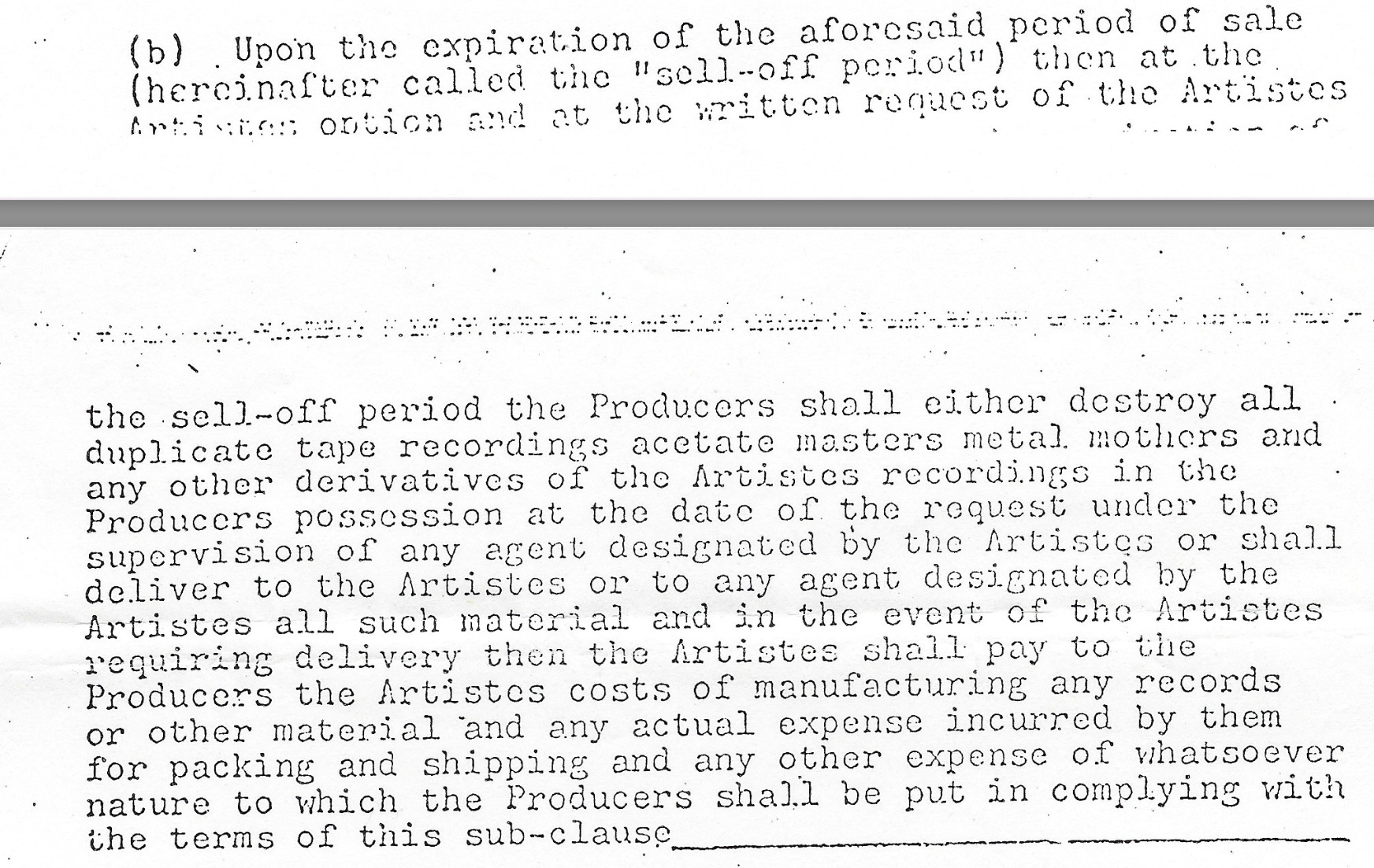
Noel and Mitch argue that this arrangement would only make sense if they retained the copyrights. If Jeffrey/Chandler owned the copyrights, why would they be required to destroy or return tapes to the band?
The apparent conflict between these provisions is certainly odd. On one hand, the agreement doesn’t seem to allow Jeffrey/Chandler to sell the Experience’s records after the sell-off period ends, and it required them to either destroy tapes or return them to the band. On the other hand, the “copyrights” provision is unambiguous, and it appears that, even though they were required to return or destroy copies, Jeffrey/Chandler could retain the masters. In the end, it seems to me that Sony UK likely has the better argument here.
Needless to say, however, there is simply no way that Jimi, Mitch, or Noel contemplated this at the time. I wouldn’t be surprised if Jeffrey/Chandler failed to consider it either. This only further supports my opinion that the agreement should be held unenforceable.
Even if the Claimants beat the odds on the first two hurdles, they still need to clear this last one, which is the most difficult. As discussed in Part One, both Mitch and Noel brought claims against the Hendrix estate in the early 1970s, shortly after Jimi’s death, and they both settled those cases by releasing their claims in exchange for lump sum payments. To be successful, the Claimants need to argue that their releases did not extend to the present sound recordings copyrights dispute.
The releases that Mitch and Noel signed were very broad. Noel’s release, signed on April 22, 1973—which hilariously referred to the name of the band as “Are You Experienced”—stated:
1. I hereby release the Estate of JIMI HENDRIX, deceased, “ARE YOU EXPERIENCED”, a corporation, the stock of which is owned by the Estate of JIMI HENDRIX, deceased, Warner Brothers Records, and any and all other record companies throughout the world with whom JIMI HENDRIX in his lifetime, or the Estate of JIMI HENDRIX, deceased, have entered into contracts or agreements for the distribution and sale of recordings of JIMI HENDRIX on which I performed, from any and all liability or responsibility to me to account for any royalties or compensation to me in connection with said recordings. I further covenant not to sue any such record companies for compensation arising out of the distribution of such recordings. By this release I acknowledge full settlement of any compensation which I may claim in connection with earnings on said recordings in the past, as well as any earnings which might result in the future, both in the United States and throughout the rest of the world.
. . . .
2. This release goes to any recordings which may be released or mastered in the future as well as those already in release and goes to world-wide rights.
Notably, however, the release contained an exception, tacked on at the end:
*Nothing contained herein shall in any way be deemed a waiver of or with prejudice to my claim and/or claims against Yameta Corporation, a Bahamian Corporation, or its successors in interest, assignees or its officers and directors.
Mitch’s release, signed on September 30, 1974, contains similarly broad language:
1. I hereby release the ESTATE OF JIMI HENDRIX, deceased, its successors and/or assigns, Are You Experienced, Ltd., its successors and/or assigns and any and all record companies or other entities with whom said JIMI HENDRIX, his Estate, or their successors or assigns may have contracted in the past, or may contract in the future (excepting those reservations which are specifically set forth in paragraph 6 below) for the distribution and sale of records embodying performances of JIMI HENDRIX on which I performed, including any soundtrack recordings from any and all liability or responsibility to account to me for or pay royalties or other compensation to me in connection with any such recordings. Further, I covenant, promise and agree not to sue the ESTATE OF JIMI HENDRIX, its successors and/or assigns, Are You Experienced Ltd., its successors and/or assigns nor any such entities or record companies for compensation arising out of the distribution of any recordings made pursuant to such contracts or agreements.
2. By this release, I acknowledge full settlement of any compensation which I may have claimed, now claim or in the future may claim in connection with earnings on said recordings in the past, as well as any earnings which might result in the future from the sale of such recordings.
As referenced in Paragraph 1, Mitch also carved out certain parties from his release. His list of carve-outs goes further than Noel’s:
6. Specifically excepted, reserved and excluded from this release and covenant not to sue are whatever claims and rights, if any, I, JOHN GRAHAM MITCHELL, may now have against the following: Warner Bros. Pictures with respect to my appearance in a certain motion picture entitled “JIMI HENDRIX[”], Barclay Records, Track Records, EMBER RECORDS, YAMETA COMPANY LTD., WARNER BROS. RECORDS solely with respect to production services, MICHAEL JEFFREY and the ESTATE OF MICHAEL JEFFREY, CHAS. CHANDLER, MICHAEL JEFFREY AND CHAS. CHANDLER doing business in any form (whether corporate, joint venture, partnership or otherwise).
This type of language, which, unlike the original October 1966 recording agreement, Mitch and Noel signed after consulting with their own lawyers, is very difficult to escape. The Claimants try to do so in a few ways, including by arguing that the release was backward-looking and did not extend to future royalties and by arguing that the releases and their corresponding discontinuances of the litigations were ineffective under New York law. They also argue that, because digital streaming was unanticipated at the time, it could not be within the scope of the agreements. They also argue that the “Yameta” exception is a critical one that applies here.
At bottom, it is very difficult to see a way in which a court would find that, notwithstanding the clarity of the language in the releases, corporations representing the interests of Noel and Mitch’s heirs could assert copyright claims more than 50 years later, particularly given that they both could have asserted the same claims during their lifetimes.
The sound recordings copyright claim, however, is only the appetizer in the litigation. The main course—what has the industry on edge—is the second claim, which seeks to establish Noel and Mitch’s “Performers’ Property Rights” (or “PPR”) in the Experience’s records. What sets this claim apart is that PPR did not exist in 1966, when they signed the original recording agreement. Nor did they exist in the 1970s, when they signed the releases.
At the outset, a bit of legal context is necessary. In 1988, the British Parliament passed a new law, the Copyright, Designs and Patents Act 1988 (“CDPA”), which established various rights that songwriters and performers have in music they create, including “performers’ rights,” to which every performer on a record is entitled. These were new rights, distinct from traditional copyright, and the government expanded them at least twice, first in 1996 and then in 2003. Those regulations established four types of PPR: (i) the right to reproduce recordings; (ii) the right to distribute recordings; (iii) the right to rent recordings; and (iv) the right to make recordings available to the public.
The law requires the consent of every performer on a record to any of the four things above, including making the recordings available on digital streaming services. A person who, for example, makes a song available on Spotify or Apple Music in the UK without the consent of every person performing on the record, is infringing those rights. What’s more, the law applied retroactively—meaning that it applied to recordings before the law went into place. There are, however, at least two critical limitations: first, as a property right, a performer can sell or transfer his or her PPR to others, which is now standard practice in new recording agreements; and second, certain exceptions and protections were put into place to protect acts and agreements that happened before the law went into place.
The heart of the Redding/Mitchell litigation is whether and to what extent those limitations apply to the agreements that Noel and Mitch signed before the law was enacted. Broadly speaking, there are three separate questions before the court, with very little, if any, precedent that the court can use for guidance.
As discussed earlier, the rights that Jimi, Mitch, and Noel granted to Jeffrey/Chandler when they signed the October 1966 recording agreement were seemingly all encompassing. It included not only copyright, but also “[t]he sole and exclusive right” to distribute the records “by any method now known or hereafter to be known” and to “permit the public performance” of the records “by broadcasting . . . or by any other means now known or hereafter to be known.” The Claimants argue that, notwithstanding the breadth of these provisions, Mitch and Noel did not give valid consent to rights and technology that did not exist and could not have been contemplated.
In my view, while the argument about uncontemplated technology seems weak given the specific language in the agreement, Mitch and Noel’s position that their consent could not extend to legal rights that had not yet existed is a very strong one. For all its breadth, the 1966 recording agreement said nothing about legal rights that could be created in the future. Indeed, I doubt such an agreement could even be enforceable. The agreement concerns rights that existed at the time it was signed, such as the various copyrights. It seems to me that since the purpose of the law was to retroactively confer new rights, it would make little sense to conclude that the rights were waived before they were created. This would also be consistent with the “transitional provisions,” discussed below, which offer protection for pre-commencement actions.
The next question is distinct, but similar. Sony UK argues that, even if the 1966 recording agreement didn’t extend to these new rights, the releases that Mitch and Noel signed in the 1970s to resolve their litigations against the Hendrix estate included potential future claims related to new rights.
The legal analysis here is a bit different from Q1, as it concerns a release of future claims and a covenant not to sue, both of which are treated differently under New York law (which governs the releases) than under English law. A major point of contention in the litigation is over how New York law applies to these releases, with each side presenting an expert to support their position.
Now, this is where it gets most interesting.
To counterbalance the extraordinary retroactive application of the new rights, the law offered protections to record companies and others that distributed records under agreements that were made before the law was enacted, which the parties refer to as the “Transitional Provisions.” This makes sense, as it would be unfair to hold a person responsible for infringing a right that didn’t exist at the time. The far more challenging question is whether these Transitional Provisions cover acts that occurred after the law was put into place. In other words, are record labels like Sony UK required to go back to the performers for new consents? Or can they safely rely on agreements they reached before the rights were created?
Here is the critical language from the Transitional Provisions of the CDPA, § 180(3) (emphasis added):
The rights conferred by this Part apply in relation to performances taking place before the commencement of this Part; but no act done before commencement, or in pursuance of arrangements made before commencement, shall be regarded as infringing those rights.
What does this mean? If Sony UK puts “Purple Haze” on Apple Music or Spotify in 2026, are they doing so in pursuance of an “arrangement[]” made before 1989? No court has ever answered this question before. (In a prior litigation between Experience Hendrix and Purple Haze Records, an English court explicitly left this question open, and, at an earlier stage of this litigation, the Court found that a full trial was needed on this point.)
Sony UK argues that the purpose of this provision was to broadly protect pre-existing contracts, a position that the industry has generally assumed to be the case since the law was enacted. The Claimants, however, argue that the protection was intended to be transitional and should be construed far more narrowly—a position that finds strong support from some legal commentators, including the leading treatise on this area of the law. Those commentators suggest that the protection covers only copies of the recordings in existence at the time the law was enacted, not the creation of new copies or contracts in the future.
This is a compelling argument, and it appears to be consistent with the text of the law. As Sony UK points out, however, for decades, the industry has been operating differently, and if this position were to be adopted, it would shake the industry to its core. In close calls, courts are generally reluctant to impose such changes.
That will do it for Part Two. In Part Three, I’ll discuss some other issues in the case that might be overlooked, but could be determinative — unless the Court issues its decision before I can finish it….
Thanks for reading.
No posts
Comments
Nothing yet. Say the first thing.
Sign in to join the conversation.