
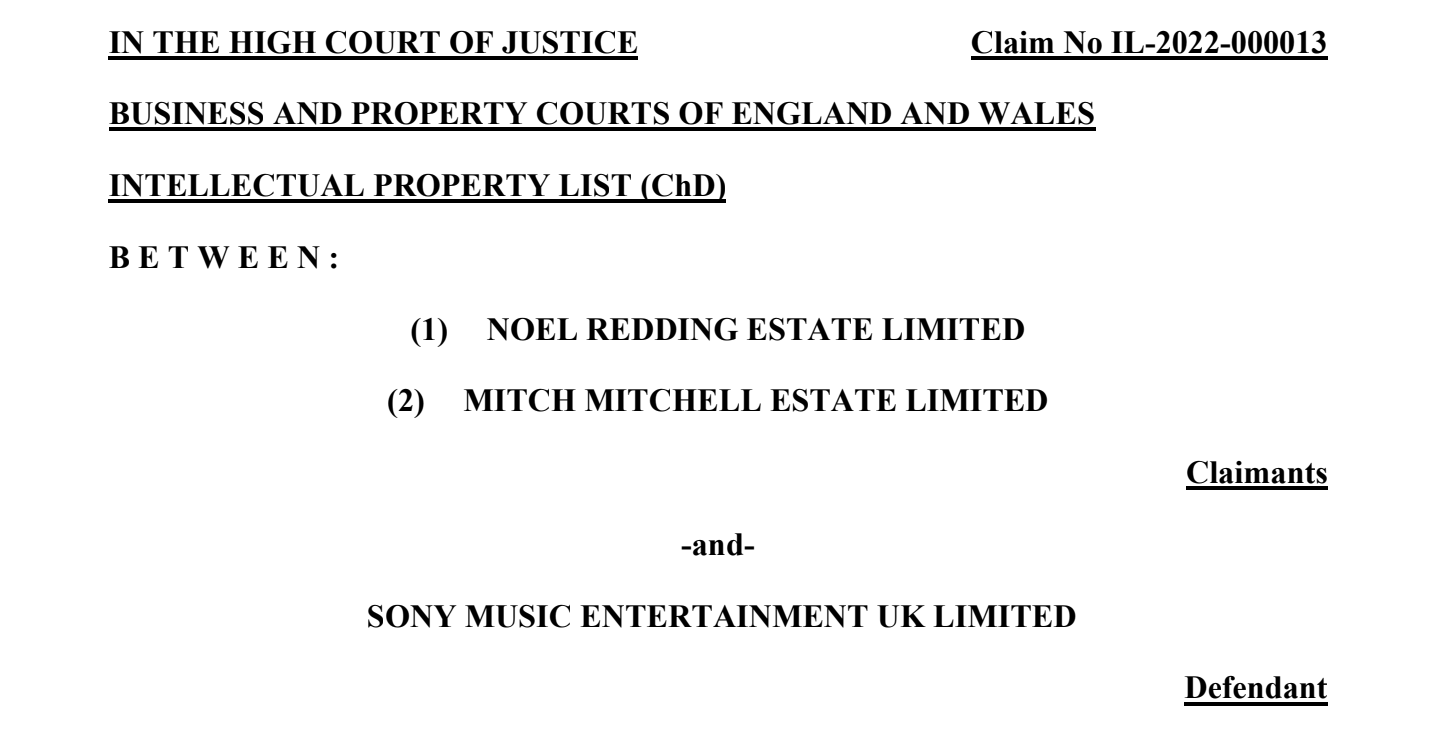
As many readers may be aware, there has been a major legal storm brewing in England over the rights of the heirs to Noel Redding and Mitch Mitchell to the recorded music of the Jimi Hendrix Experience.
The case is nearing its climax, with a post-trial decision by the Court expected within the next week or two. The decision will affect not only the future of the Experience’s music, but the music industry as a whole, potentially shaking it to its core. While there has been significant coverage of the litigation in the mainstream press, unsurprisingly, those reports provide very little detail or explanation regarding the nature of the claims, the legal and factual issues, and the potential impact, all of which are quite complex and nuanced.
Heaven Research is stepping in to fill that gap with a three-part series presenting an in-depth summary and analysis of the litigation, based on my review of the court papers and evidentiary record, and some external research. In this Part One, I’ll cover the basics and the long and winding history of the case. In Part Two, I’ll break down the two key claims brought by the Redding and Mitchell estates, including the facts, legal issues, and the arguments presented by both sides. And in Part Three, I’ll address some overlooked legal issues that could prove significant and discuss the broader implications of the case.
Let’s start with two basic questions: who are the parties, and what is this all about?
Needless to say, none of the members of the Jimi Hendrix Experience are parties to the case, having passed away long ago: Noel in 2003; Mitch in 2008; and, of course, Jimi in 1970.
The Claimants are two English legal entities, Noel Redding Estate Ltd and Mitch Mitchell Estate Ltd, which are owned by the same person, a businessman named Edward Adams and are jointly represented by counsel. It’s important to note that these are not literally the “estates” of Noel and Mitch. Rather, they are business entities that have received certain rights from their heirs, who have submitted supporting witness statements. (In Noel’s case, the sister of his long-time partner at the time of his death. In Mitch’s case, his daughter.) Adams has a notable history, having previously owned the now-defunct Purple Haze Records, which released some interesting Hendrix albums in the early 2000s before Experience Hendrix put a stop to it. It appears that the business purpose of these entities owned by Adams is to pursue this litigation. Nevertheless, for ease of reference, I will refer to the Claimants as “Noel” and “Mitch.”
The sole defendant is Sony Music Entertainment UK Limited, which distributes and “makes available” via streaming all of Hendrix’s music, including the Experience records, in the UK, under the terms of a license from Experience Hendrix LLC, the owner of the rights. Curiously, Experience Hendrix is not a party to the litigation. This appears to have been a strategic choice by the Claimants that, as I’ll discuss in Part III, may have a significant effect on the outcome of the case. Nor are Sony’s parent company or US company parties either. The case is strictly limited to the UK.
Noel and Mitch are seeking a judgment that they hold two different types of rights in the Experience’s studio albums: first, a joint copyright (with Jimi) in the sound recordings themselves; and second, a type of “performers’ right,” a relatively new right under UK law requiring performers on a record to “consent” to another person’s exploitation of a record containing their performance, which applies retroactively.
While there is a significant money damages component for Sony UK’s alleged infringement of those rights, due to the applicable six-year statute of limitations, at most, any damages would be limited to infringement that occurred less than six years before they commenced litigation. The heart of the case is forward-looking: it’s about Sony UK’s ability to continue to offer the Experience catalog on streaming services in the UK and to issue re-releases of the Experience’s records.
It’s also important to be clear on what this case is not about. Notwithstanding their importance, the claims are actually quite limited in scope in several key respects:
The claims are limited to the three Experience studio albums released during Jimi’s lifetime, Are You Experienced, Axis: Bold As Love, and Electric Ladyland. At least on its face, the case isn’t concerned with any other recordings featuring Noel and Mitch, such as posthumously released studio albums (e.g., BBC Sessions), studio outtakes (e.g., the Axis and Electric Ladyland outtakes included in recent box sets), and live recordings (e.g., Monterey, Hollywood Bowl, Miami Pop, Royal Albert Hall). Nor does it concern any of Mitch’s significant post-Experience work with Jimi. (More thoughts on this later.)
As noted above, the case is strictly limited to the UK. It is not concerned with releases and streaming of the Experience’s records in the US, EU, or any other jurisdiction.
This case also isn’t about whether Noel and Mitch were screwed out of money or otherwise taken advantage of by the Experience’s management or by record labels, whether in terms of record sales or tour income. While that undoubtedly happened, Noel and Mitch pursued several litigations to redress those wrongs during their lifetimes, and it isn’t a part of this case.
Subscribers to Heaven Research probably don’t need a history lesson on the Jimi Hendrix Experience. Nevertheless, the history of legal events is critical to understanding the current litigation.
On October 11, 1966, shortly after forming the Experience in London, Jimi, Mitch and Noel signed a recording agreement with their management, Mike Jeffrey and Bryan “Chas” Chandler. It’s one of the most critical documents in the case.
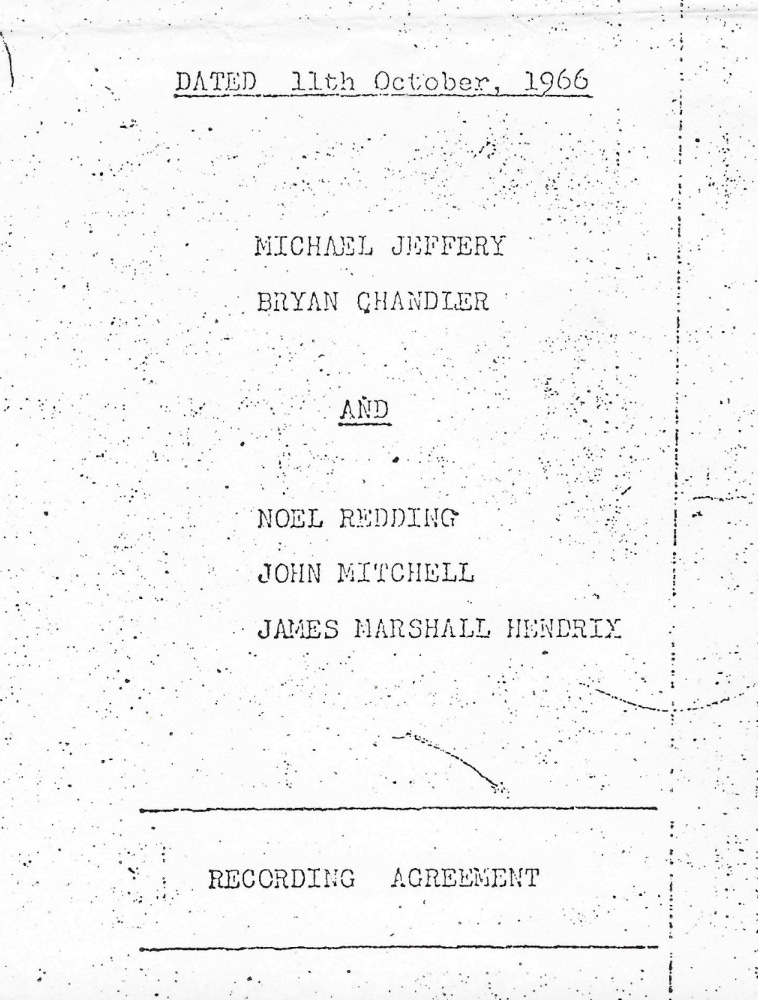
By all accounts, it’s highly unlikely that Jimi, Mitch or Noel even read this contract or understood what they were signing, and they certainly didn’t get legal advice. It was a truly awful deal. They agreed to exclusively record for Jeffrey/Chandler for 7 years (i.e., until October 1973). Jeffrey/Chandler appear to have received basically the full spectrum of legal rights, such as:
“[C]opyright in any arrangements or transcriptions of musical works” made by the band for the purpose of the recordings
“The copyright throughout the world in all sound recordings of performances of musical works” by the band
“The sole and exclusive rights to manufacture[,] sell[,] lease[,] assign[,] licence[,] distribute or otherwise use or dispose” of the recordings “by any method now known or hereafter to be known made therefrom at such prices and under such labels and trade names as the Producers shall think fit”
The right to continue to sell records for 5 years after the termination of the agreement, after which they must either destroy or return the recordings
And, in perhaps the most outrageous provision, Jimi, Mitch, and Noel granted Jeffrey and Chandler Power of Attorney to sign any contracts on their behalf “relating to[,] in connection with[,] or arising out of the subject matter of this Agreement[,] namely recording in all its forms.” This meant that Jeffrey and Chandler—their counterparties in the agreement, with a direct and obvious conflict of interest—had complete control over the band’s music and identity. They could, for example, sign agreements with record labels that paid themselves mightily, to the detriment of the Experience. They could settle legal claims against the band on unfavorable terms. They could even unilaterally amend the recording agreement itself! (I should note that, as a legal matter, as a result of the POA, Jeffrey and Chandler owed fiduciary duties to Jimi, Mitch, and Noel that would likely be violated in those scenarios. In practice, however, the band would have had to sue them to enforce this, for which there was little to no legal precedent at the time.)
In exchange for all of this, Jimi, Mitch, and Noel received a commission of a paltry 2.5% of record sales—not to each of them, but to be split among them! (The 2.5% commission was to be raised to 5% from October 1968 onwards.) As if this wasn’t bad enough, inexplicably, they were only entitled to commissions on 90% of sales. Moreover, Jeffrey/Chandler could deduct their recording expenses from the band’s commissions, and could also charge them if any of them arrived more than 15 minutes late to a recording session. Who knows whether Jimi, Mitch or Noel actually received even that.
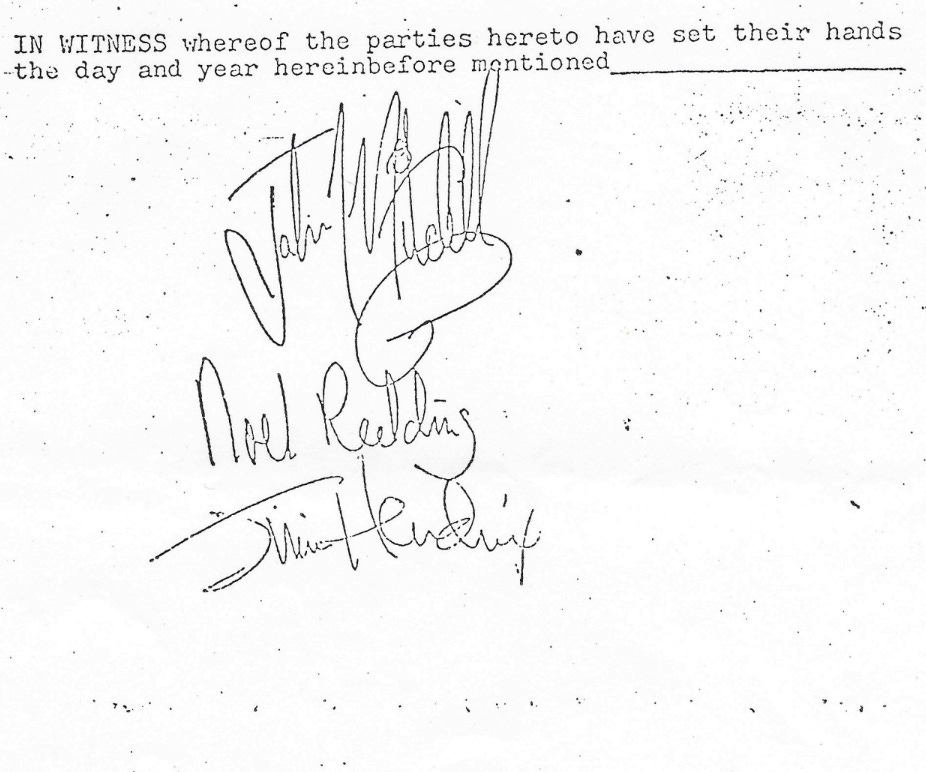
In my view, this agreement was both procedurally and substantively unconscionable, and, had it been presented to a court, I would expect the court to find it unenforceable. Nevertheless, those issues don’t appear to be before the court in the pending litigation, and the parties are stuck with it.
Jimi’s unexpected and tragic death in September 1970 (without a will) threw things into chaos, with seemingly everyone trying to get a piece of the money and the legal rights. The death of Mike Jeffrey in March 1973 in a bizarre mid-air collision over France further complicated matters.
Both Noel and Mitch sued the Hendrix estate in New York to recover unpaid royalties. They ultimately settled for lump sums: Noel received $100,000 in 1973 (worth about $730,000 today), and Mitch received $247,500 in 1974 (worth about $1.6 million today). The terms of these settlements are the other critical issue in the current litigation.
Despite these payouts, the Claimants argue both men died in relative poverty, excluded from the massive revenues Jimi’s successors later enjoyed. Both Mitch’s daughter and Noel’s heir submitted witness statements to this effect that are heartbreaking to read. Mitch’s daughter, for example, states that Mitch lived in small flats and houses that had no heat or plumbing and that he had no assets whatsoever when he died in 2008. Noel’s autobiography also covers his post-Experience financial troubles at great length.
An entire book could (and should) be written about the very long, twisted, and opaque path of Jimi’s rights and Jeffrey/Chandler’s rights, culminating in Experience Hendrix’s consolidated ownership in the 1990s. This path has only limited relevance to the current litigation, however, so I’ll only briefly summarize the key events:
In 1969, Chas Chandler transferred all of his interests related to the Experience to Mike Jeffrey, formally exiting his role in the Experience. Jimi signed a letter consenting to this transfer and affirming Mike Jeffrey as his sole manager. Noel signed a letter “re-confirming” his consent in 1970 (after the band had broken up), likely because his purported original consent didn’t happen or wasn’t recorded. Curiously, there isn’t a written consent from Mitch.
In September 1970, Jimi died intestate (without a will), leaving his father, Al, as the sole heir. Jimi’s rights weren’t formally vested into Al until 1977.
In 1973, Jeffrey died, and in 1981, the Jeffrey Estate sold all of Jeffrey’s Hendrix-related rights to a company (PMSA) that had an agreement with Al Hendrix. Later, PMSA transferred the rights to yet another company (Interlit).
Finally, in 1995, Al Hendrix reached a comprehensive settlement with all of these entities and numerous other entities and individuals (including Alan Douglas) who claimed to have Hendrix-related rights, under which all of the rights were transferred to a new company set up by Al, Experience Hendrix LLC.
There’s obviously a lot more to this story, including the role of Yameta Company, a mysterious Bahamian corporation engaged in business with Mike Jeffrey and Chas Chandler, but let’s leave that for another day.
This brings us to today. The UK litigation itself has a somewhat interesting history. After the Redding and Mitchell estates threatened to sue, Experience Hendrix rushed into court in the US, seeking a declaration from the US District Court for the Southern District of New York (the federal court sitting in Manhattan) that Mitch and Noel’s 1970s releases foreclosed the claims. The court rejected this, concluding that the UK litigation should proceed first.
The case went through several rounds in the UK, including an appeal and some shifts in the parties’ positions, and ultimately went to trial in December 2025. The parties, Experience Hendrix, and the record industry as a whole now wait for the trial court’s decision, which is expected at any time.
That’s enough for Part One. Stay tuned for Part Two, which should be published within the next week, which will dive deep into the fascinating legal issues before court, and the parties’ competing arguments. To make sure you don’t miss out, be sure to subscribe above. It’s free!
Thanks for reading.
No posts
Comments
Nothing yet. Say the first thing.
Sign in to join the conversation.