
Dear Readers,
Welcome to the latest edition of the HealthVC newsletter.
HealthVC is the go-to newsletter for founders, LPs, and emerging managers who want to master fundraising, build institutional-grade data rooms, and understand how investors actually make decisions.
Founders often assume an investor’s decision is only about the company.
If the investor passes, the founder thinks the market was not compelling enough, the traction was not strong enough, the team was not ready, the deck was not clear, the valuation was too high, or the risk was too difficult to underwrite.
Sometimes that is true.
But sometimes the company met the right investor at the wrong moment in the investor’s own fund cycle.
This is one of the least understood parts of fundraising. Founders spend most of their time thinking about their own timing. How much runway is left? When does the round need to close? What milestone comes next? How quickly can the investor move? What does the company need to prove before the next financing?
All of that matters. But investors also have timing constraints.
A venture fund is not a permanent pool of flexible capital that behaves the same way every year. A fund has its own lifecycle. It raises capital from LPs, begins deploying, builds a portfolio, manages reserves, supports existing companies, prepares for future funds, and eventually slows down new investment activity. Where a fund sits in that cycle has a direct impact on how it behaves.
A fund early in deployment may be actively looking for new investments. It may have fresh capital, open portfolio construction, and a mandate to build exposure. A fund later in its investment period may be more selective. It may have limited room for new companies, more capital reserved for follow-ons, and less appetite to take new risk. A fund near the end of its cycle may like a company but be unable or unwilling to lead because the timing does not fit.
From the founder’s perspective, this can feel confusing. The investor likes the company, understands the sector, has invested in similar businesses, asks thoughtful questions, and seems like a perfect fit. Then they pass, delay, or stay vague.
The founder assumes the company was rejected.
But the answer may be simpler.
The fund may not have enough new investment capacity. The partner may not have enough remaining allocation. The fund may be focused on supporting existing portfolio companies. The investment period may be ending. The fund may be waiting for a new vehicle. The team may be fundraising from LPs and unable to move with conviction. The fund may still have capital, but not the right kind of capital for a new lead investment.
That is the fund cycle problem.
A good company can meet the right fund at the wrong time.
A fund’s behaviour changes as the fund matures.
At the beginning of a fund, investors usually need to deploy. They are building the portfolio, looking for the right companies, shaping the fund’s exposure, and deciding which themes they want to own. They may be more open to new conversations because the fund has room. They may have more flexibility to lead, set terms, and take ownership of a new investment.
This does not mean they will invest easily. Good funds are still selective. But the fund has a reason to look for new opportunities because its job at that stage is to build the portfolio.
In the middle of the fund, behaviour becomes more selective. The fund may already have several companies in the portfolio. The partners are thinking about diversification, concentration, ownership, reserves, and which gaps remain. They may still be making new investments, but they are more aware of what each new company does to the overall portfolio.
By the later stage of the fund, the situation changes again. The fund may have already made most of its planned new investments. The remaining capital may be reserved for follow-ons. The partners may need to support existing winners rather than add new risk. Even if they like a company, they may not be able to give it the same attention, cheque size, or follow-on support they could have given two years earlier.
This is why two meetings with the same fund can produce very different outcomes depending on timing.
The same company might have been highly relevant when the fund was early in deployment, but much harder to fit when the fund is mostly allocated.
Founders often do not see this because the fund’s website does not usually say, “We only have room for two more new investments,” or “Most of our remaining capital is reserved for existing portfolio companies,” or “We like this sector, but we are nearly done deploying this vehicle.”
So the founder reads the pass as a company problem.
Sometimes it is really a fund timing problem.
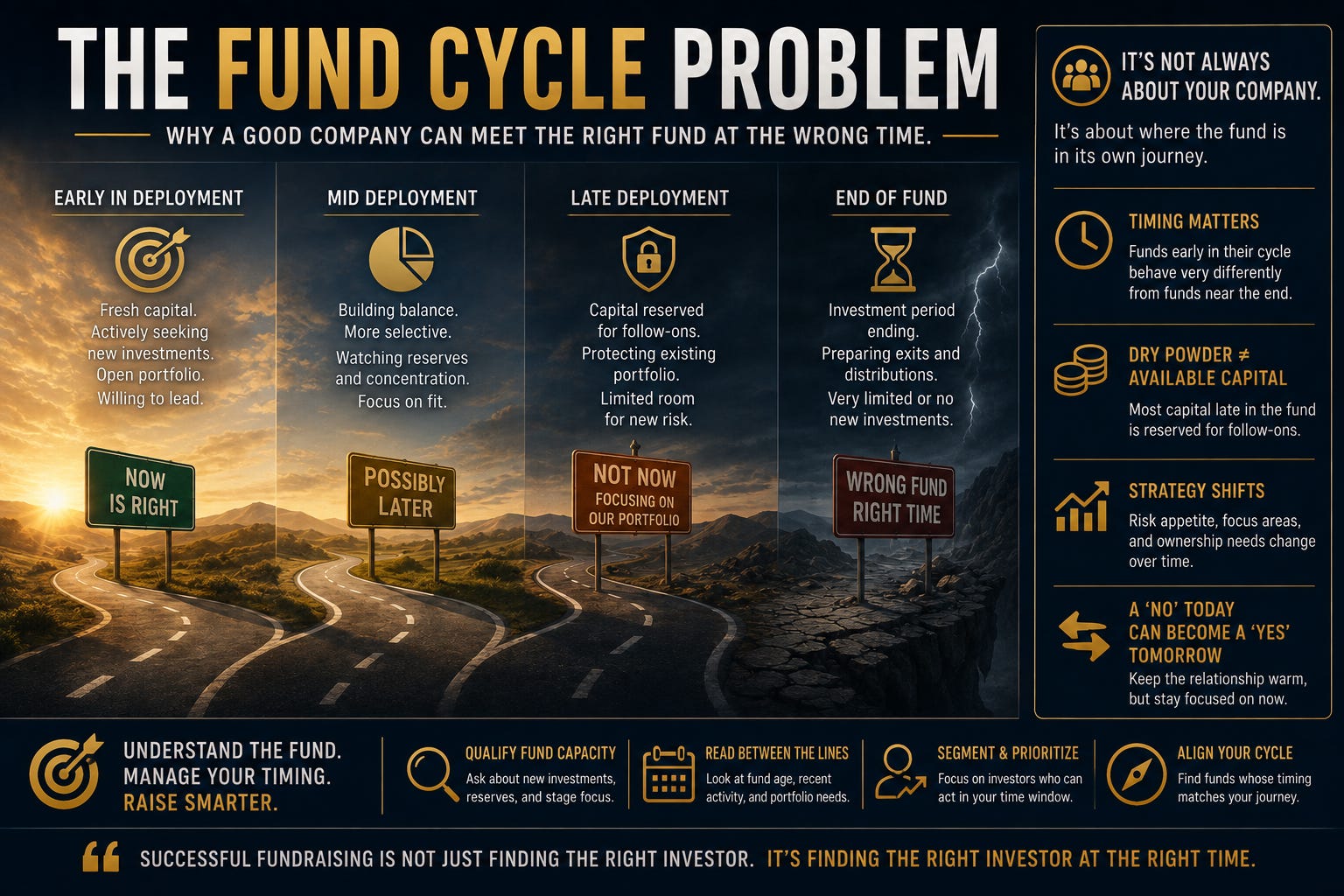
Founders often hear that there is a lot of dry powder in venture capital and assume that investors must be able to invest.
But dry powder is not the same as available capital for your round.
A fund may have undeployed capital, but much of that capital may be reserved for existing portfolio companies. It may be committed to follow-on rounds, bridges, insider extensions, or future support for companies the fund already owns. The fund may also have portfolio construction rules that limit how much can go into new companies at a certain point in the cycle.
This matters because founders sometimes misread investor capacity. A fund can appear active, well-capitalised, and relevant, but still have limited ability to lead new investments. The capital exists, but it may already have a job.
This is especially important in health and life sciences, where follow-on needs can be significant. A company may require several rounds before major value inflection. Investors know this. A fund that leads a health investment has to think not only about the first cheque, but about the future capital the company may need. If the fund does not have enough reserve capacity, leading may be difficult even if the opportunity is attractive.
Founders often ask, “Does this investor have money?”
The better question is, “Does this investor have the right money, at the right moment, for this type of investment?”
That distinction matters.
Capital that exists but is reserved for existing companies will not help a new founder close a round. A fund that is active but late in deployment may be more focused on protecting current ownership than adding new positions. A partner who likes the company may still struggle to secure internal support if the fund’s remaining capacity is limited.
This is why fund timing can quietly shape investor behaviour.
A fund early in its lifecycle is usually trying to create new positions. The partners are building the portfolio and deciding which companies will represent the fund’s core themes. They are looking for ownership, category exposure, and long-term upside.
A fund later in its lifecycle is often trying to protect existing positions. The partners are thinking about which portfolio companies deserve more capital, which companies need support, which winners require reserves, and which exposures are already large enough.
This changes how they evaluate new opportunities.
An early fund may ask, “Could this become one of the important companies in our portfolio?”
A late fund may ask, “Do we have enough room, time, and reserve capacity to make this new investment worth it?”
Those are different questions.
The company may be the same, but the investor’s internal context is different. That context can decide whether the conversation moves forward.
Founders often underestimate this because investors rarely explain it directly. They may simply say the company is too early, too late, too broad, too capital-intensive, or not quite right for the current fund. Sometimes that feedback is accurate. Sometimes it is a polite way of saying the fund’s own timing does not support the investment.
This is not dishonesty. It is often easier for investors to give company-facing feedback than to explain fund construction dynamics. But founders need to understand what may be happening underneath.
If a fund is late in its cycle, a founder should not assume that positive engagement means real investment capacity. The investor may enjoy the conversation, want to track the company, and genuinely believe it could be interesting later. But they may not be in a position to lead now.
Another fund timing issue appears when the investor is raising their next fund.
When a venture firm is fundraising from LPs, its behaviour can change. The team may still meet companies, but internal attention may be divided. Partners may be spending significant time with LPs, portfolio performance, fund narrative, references, and closing commitments for the next vehicle. The firm may be careful about making new investments while the next fund is not fully raised.
This can create confusing signals for founders.
The investor may take the meeting because the company fits the thesis. They may want to maintain market visibility. They may want to track opportunities for the next fund. They may ask detailed questions because they are genuinely interested. But if the firm is between funds or uncertain about the timing of its next close, it may not be able to move quickly.
Founders can mistake this for investor hesitation about the company. In reality, the investor may be managing its own financing process.
This matters because fundraising is a timing game on both sides. The founder is raising from investors. The investors may also be raising from LPs. If those two timelines do not align, the company can fall into a gap.
A fund may say, “This is very interesting, but we would like to stay close.” That can mean many things. It may mean the company needs more proof. It may mean the investor is not convinced. It may also mean the fund is not ready to deploy from the next vehicle yet.
The founder needs to qualify this carefully. Otherwise, they may spend months nurturing an investor who is not currently capable of making the decision they need.
Where a fund sits in its cycle can also affect its risk appetite.
Early in a fund, investors may be more willing to take bold new positions because they are building the portfolio. They may be looking for companies that can define the fund. They may have time to support a business through early uncertainty and follow it into later rounds.
Later in a fund, the same investor may become more cautious. They may already have enough exposure to a sector. They may have learned from portfolio challenges. They may need new investments to show faster progress. They may prefer companies that are closer to clear milestones because there is less time left in the fund’s lifecycle to support long uncertainty.
This is especially relevant in health. A company with a long development path may be attractive to a fund with fresh capital and patience. The same company may be much harder for a late-cycle fund to underwrite if the value inflection is too far away.
The investor may still believe in the market. They may still like the founder. They may still respect the science, product, or opportunity. But the timing of value creation may not fit the timing of the fund.
Founders should understand that investor risk appetite is not fixed. It is shaped by mandate, portfolio construction, performance, LP expectations, partner priorities, and fund timing.
A pass does not always mean the investor thinks the company is weak.
It may mean the company does not fit what that fund needs now.
Every fund has a portfolio construction model, even if founders rarely see it.
The fund may plan to make a certain number of investments. It may target a specific cheque size. It may require a minimum ownership level. It may reserve a certain percentage for follow-ons. It may limit exposure to certain sectors, geographies, stages, or risk types. It may want a balance between platform, therapeutics, diagnostics, digital health, medtech, infrastructure, or services.
Once the fund has already made several investments, each new opportunity is evaluated against what is left.
This means a company may be rejected not because it is bad, but because the portfolio already has similar exposure. The fund may already have a company in the same category. It may have reached its internal limit for a type of risk. It may not want another long-development asset. It may not want more exposure to a specific geography. It may not want to create conflict with an existing portfolio company.
Founders often experience this as vague investor feedback.
The investor says, “We like it, but it is not quite a fit.” The founder wants to know what is wrong. Sometimes nothing is wrong in the way the founder thinks. The fund simply cannot or does not want to add that exposure at that point in the fund.
This is why researching fund fit matters, but even good research has limits. A fund’s public thesis may remain the same while its internal portfolio needs change. The website may say they invest in your sector, but the current fund may no longer need another company like yours.
The fund’s stated thesis tells you what they like.
The fund cycle tells you what they can still do.
Founders often judge investor seriousness by speed. That can be useful, but speed also depends on fund timing.
A fund early in deployment and actively looking for new investments may move quickly when it sees a company that fits. A fund with limited remaining capacity may take longer because every new investment needs more internal justification. A fund raising its next vehicle may slow down because attention is divided. A fund with many portfolio issues may delay new investments because existing companies require capital and time.
The founder may read this as lack of conviction, and sometimes that is correct. But sometimes the delay is structural.
That does not mean founders should tolerate endless ambiguity. They should not. A slow investor is still a problem if the company needs to close. But founders should understand why the delay may be happening so they can manage the process more intelligently.
If a fund is not in a position to move now, the founder should not build the round around them. They may be useful later. They may be worth keeping warm. They may be relevant for the next fund or the next round. But they should not be treated as near-term capital unless there is a clear path to decision.
Fundraising discipline means knowing the difference between an investor who is slow because they are working through diligence and an investor who is slow because they are not able to act.
The outcome for the founder may look similar.
The strategy should be different.
One of the most important lessons for founders is that not every no is a judgment on company quality.
A good company can meet a good fund at the wrong time. The fund may have invested in similar companies before. The partner may understand the market. The conversation may be strong. The feedback may be thoughtful. The fit may look obvious from the outside.
But the fund may be too late in deployment. It may have no room left for new leads. It may be saving capital for existing portfolio companies. It may be between funds. It may have already made its bet in the category. It may require a different risk profile for the remaining investments in the fund.
This is frustrating because the founder cannot fix it with a better deck.
That does not mean the founder should ignore feedback. Every investor conversation can create useful learning. But founders need to separate company feedback from fund timing. If they treat every pass as proof that the company is not good enough, they may overcorrect. They may change the story unnecessarily, lower confidence, or chase the wrong signals.
A founder might hear ten different versions of “not now.” Some of those may mean the company needs more proof. Some may mean the round is not structured correctly. Some may mean the investor is not convinced. Some may simply mean the fund cannot act now.
The skill is learning to tell the difference.
A fund that cannot invest now may still become valuable later.
If the investor genuinely understands the company and the reason for passing is timing, not conviction, the relationship may be worth maintaining. The fund may invest from its next vehicle. The partner may introduce other investors. The investor may become relevant at the next round. They may provide useful feedback, market insight, or customer connections. They may become a reference point when the company reaches a stronger milestone.
But founders need to be careful. Keeping investors warm is useful only when the relationship has a clear purpose. It should not become a substitute for finding investors who can act now.
A founder should know which investors are current-round prospects, which are future-round prospects, which are useful advisors, and which are simply polite observers. Those categories matter because they determine where the founder should spend time.
The fund cycle problem does not mean founders should become cynical. It means they should become more precise.
If a fund says, “This is interesting, but the timing is difficult for us,” the founder can ask what that means. Are they still making new investments from the current fund? Are they leading new rounds? Are they reserving mostly for existing companies? Are they raising a new fund? When would they realistically be able to invest? What milestone would make the company relevant for them later?
These questions help the founder understand whether the relationship is worth nurturing or whether it is simply not actionable.
The deeper question is how founders can avoid spending months with investors who like the company but are not in a position to invest.
Comments
Nothing yet. Say the first thing.
Sign in to join the conversation.