
Dear Readers,
Welcome to the latest edition of the HealthVC newsletter.
HealthVC is the go-to newsletter for founders, LPs, and emerging managers who want to master fundraising, build institutional-grade data rooms, and understand how investors actually make decisions.
Founders usually think about the round in front of them.
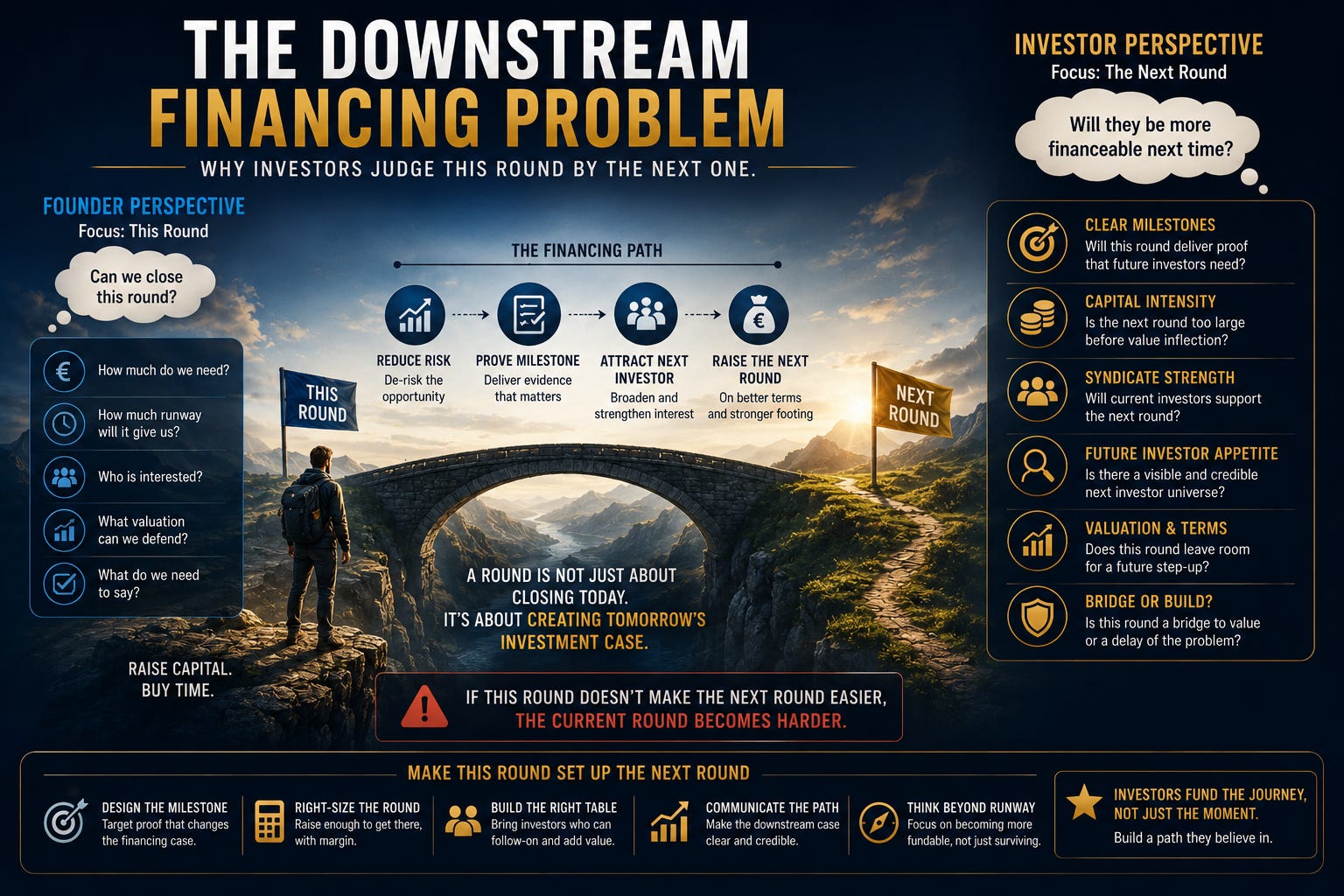
Can we close this financing? How much do we need? Who can lead? What valuation can we defend? How much runway will it give us? Which investors are interested? What do we need to say in the deck? How do we create urgency before the cash runs out?
That is understandable. When a company is raising, the current round feels like the whole game. The founder needs capital to keep building, reach the next milestone, hire the next person, fund the next study, enter the next market, or survive the next phase of uncertainty.
But investors are not only asking whether this round can close.
They are asking whether the next round can happen.
This is one of the most important differences between how founders experience fundraising and how investors underwrite it. A founder sees the current financing as the urgent problem. An investor sees the current financing as one step in a longer financing path. They are trying to understand not only whether the company is worth backing today, but whether the company will become more financeable after this capital is spent.
That is the downstream financing problem.
It appears when a company can raise some money now, but the next round looks difficult. The milestone is unclear. The capital required is too high. The current syndicate may not be able to support the company again. Future investor appetite may be limited. The valuation may not leave room for the next financing. The round may extend runway, but not change the company’s risk profile enough to attract the next set of investors.
From the founder’s perspective, the round may look like progress.
From the investor’s perspective, it may look like a bridge to another problem.
This matters because venture investors do not want to finance a company into a dead end. They want to believe the capital they provide will move the company to a stronger position. A stronger evidence package. A clearer commercial story. A more credible regulatory path. A better syndicate. A more attractive next round. A company that new investors will want to finance.
If this round does not make the next round easier, the current round becomes harder to lead.
A financing round is not just a cash event. It is part of a sequence.
Investors know that most early health companies will need more than one round of capital. Digital health companies may need time to prove adoption, sales repeatability, and customer retention. Medtech companies may need clinical evidence, regulatory progress, manufacturing readiness, and market access. Diagnostics companies may need analytical validation, clinical validation, reimbursement logic, and commercial proof. Therapeutics companies may need preclinical data, IND-enabling work, clinical trials, and strategic interest.
The investor is not only asking, “Can this company use our capital well?”
They are also asking, “What will this company look like when it needs to raise again?”
That question changes the analysis. A company may be interesting today, but if the next financing requires a large amount of capital before enough risk has been reduced, the investor may hesitate. A company may have a good product, but if the current round does not create a milestone that future investors care about, the round becomes less attractive. A company may have a strong founder, but if the syndicate cannot support the next phase, the financing risk increases.
This is not pessimism. It is venture underwriting.
Investors know that every round has to create the conditions for the next decision. The current round should not only buy time. It should buy progress that matters. It should move the company from one level of uncertainty to a better one.
If the company cannot explain how this capital improves downstream financeability, investors may worry that they are funding motion rather than value creation.
Founders often say the round gives them eighteen months of runway.
That may be true, but runway alone is not enough.
Investors want to know what happens during those eighteen months. What will be proven? What risk will be reduced? What milestone will be reached? What will the company be able to say at the next financing that it cannot say today? Who will care about that proof point? Why will the next investor believe the company is worth more?
A round that gives runway but does not create a stronger financing position is fragile. It postpones the problem instead of solving it.
This is one of the most common mistakes founders make. They explain how the money will be spent, but not how the spend changes the company. They describe hiring, product development, pilots, clinical work, regulatory preparation, sales activity, market expansion, and operations. Those may all be necessary, but the investor is trying to understand the financing consequence.
Will these activities make the company more fundable?
That is the real question.
A founder might say, “We are raising €3 million to fund the next eighteen months.” A stronger version is, “We are raising €3 million to reach a milestone that should allow the company to raise a Series A from specialist investors because we will have completed the evidence package, converted two pilots into paid contracts, and shown that the first customer segment can adopt the product repeatably.”
The second version is not just a budget. It is a financing path.
Investors need that path because they are judging this round by what it makes possible next.
One of the questions investors quietly ask is: who funds this company next?
This does not mean the founder needs signed interest from future investors. It means the founder should understand the likely next investor universe. Which funds would care if this milestone is reached? What stage do they invest at? What evidence do they require? What cheque size and ownership do they target? Would they see this as a venture-scale opportunity? Would they understand the risk profile? Would the current round make the company more attractive to them?
If the next investor is not visible, the current investor may become nervous.
This is especially important when a company sits between categories. A health company may be too clinical for generalist SaaS investors, but too commercial for life sciences investors. Too capital-intensive for seed funds, but too early for growth funds. Too strategic for financial investors, but not mature enough for corporates. Too platform-like for single-asset investors, but not yet broad enough for platform investors.
These category gaps create downstream financing risk.
The founder may believe the company is attractive to many investor types. But if none of those investors clearly own the next stage, the current round becomes harder. Investors do not want to discover later that the company has no natural buyer for the next financing.
The strongest founders understand the next investor before they need them. They know which funds are likely to care, what those funds need to see, and how the current round is designed to create that evidence.
That does not guarantee the next round.
But it makes the current round more credible.
A milestone is not just something the company achieves.
A real financing milestone changes how the company can be underwritten.
This distinction matters. Many founders list milestones that sound productive but do not necessarily change investor conviction. Launching a new website, hiring a commercial lead, attending conferences, adding features, signing exploratory partnerships, or running early pilots may all be useful, but they may not be enough to change the next financing decision.
Investors want milestones that reduce a specific risk.
If the main risk is clinical, the milestone should make the evidence stronger. If the main risk is commercial, the milestone should show that buyers will pay. If the main risk is regulatory, the milestone should clarify the pathway. If the main risk is adoption, the milestone should show that implementation works. If the main risk is platform credibility, the milestone should prove that the platform can produce repeatable outputs. If the main risk is financing, the milestone should make future investors more likely to lead.
This is where founders often become too vague. They say, “This round gets us to traction,” or “This round gets us to the next stage,” or “This round gives us enough runway to scale.” Investors need more precision.
What exactly changes?
The next round becomes easier when the company can say something stronger and more specific than before. We did not just build more product. We proved the first buyer will pay. We did not just run a pilot. We converted the pilot into a contract. We did not just generate data. We generated the data future investors told us they needed. We did not just expand the pipeline. We showed a repeatable pattern in one customer segment.
A milestone that does not change the financing case may still be progress.
But it may not be enough progress for venture capital.
Health companies often require more capital than founders expect.
That does not automatically make them bad investments. Many valuable health companies are capital-intensive. Clinical development, regulatory work, evidence generation, manufacturing, reimbursement, market access, and enterprise sales all require capital. Investors understand this.
The issue is whether the capital intensity matches the value inflection.
If a company needs a lot of money before it can reach a meaningful proof point, the current round becomes harder. If the next round will need to be much larger but the milestone is not strong enough to attract larger funds, the financing path becomes fragile. If the company requires repeated bridge rounds just to survive, investors may worry that capital will be used to keep the company alive rather than move it to a new level of value.
This is why investors look ahead.
They want to know how much capital the company will need over time, not only how much it needs now. They want to understand whether each round gets the company to a stronger position or simply creates another financing need. They want to know whether the company can attract the type of capital required for its ambition.
A founder may think the current round is small and therefore easier. But if the company will need a very large follow-on before major proof, the small round may not solve enough. In some cases, raising too little can be as dangerous as raising too much because the company reaches the next fundraising conversation without enough progress.
The right round size is not only about dilution.
It is about reaching a fundable next point.
Founders often think valuation is mainly about the current negotiation.
Investors think about valuation downstream.
If the valuation is too high today, the company may struggle to raise the next round at a meaningful step-up. That creates risk for everyone. Future investors may hesitate because the company has not grown into the prior price. Existing investors may resist a flat or down round. The founder may lose flexibility. The company may spend time defending valuation instead of building conviction around progress.
This does not mean founders should accept unfairly low valuations. Valuation matters. Dilution matters. Founder ownership matters. But valuation has to fit the financing path.
A good valuation is not only the highest price a founder can get. It is a price that allows the company to raise the next round if it executes well.
This is especially important in health because value creation may not happen in neat software-style increments. A company may need to reach a clinical, regulatory, commercial, or strategic milestone before a real step-up is justified. If the current valuation already prices in future proof that has not yet been created, the next round becomes harder.
Investors know this. They may like the company but worry that the price creates downstream financing risk. They may pass not because they dislike the opportunity, but because they cannot see how the next round clears.
Founders should understand that valuation is not just a scoreboard.
It is part of the financing architecture.
The next round is not only shaped by the company’s progress. It is shaped by the behaviour of the current syndicate.
Investors want to know who will support the company if the next round takes longer. Who has reserves? Who can follow on? Who has credibility with future investors? Who can help bridge if needed? Who understands the sector? Who will remain engaged if progress is slower than expected?
A weak syndicate increases downstream financing risk. Passive investors may not help when the company needs support. Small cheque investors may lack follow-on capacity. Strategics may have narrow incentives. Existing investors who do not participate in the next round may create signalling concerns. A cap table without a credible lead may make future investors wonder who truly owns the financing risk.
This does not mean every company needs a perfect syndicate. Very few early companies have one. But the founder needs to understand how the current syndicate affects the next financing.
If the existing investors cannot support the company again, the next round has to rely entirely on new money. That may be possible, but it raises the bar. New investors will ask why insiders are not participating. They will want to know whether that is because of fund capacity, strategy, timing, ownership, or loss of conviction.
A strong syndicate does not guarantee the next round.
But a weak syndicate can make the next round harder before the founder even enters the market.
Bridge rounds are common. They are not automatically bad. Many companies use bridge capital to reach a milestone, extend runway, close a strategic discussion, complete a study, or prepare for a stronger round. In difficult markets, bridges can be rational and necessary.
But investors distinguish between a bridge to value and a bridge to delay.
A bridge to value has a clear purpose. It gets the company to a defined milestone that changes the financing case. A bridge to delay simply buys more time without making the company meaningfully more fundable. The first can be attractive. The second creates concern.
Downstream financing risk increases when a company appears to be moving from bridge to bridge without changing its risk profile. Investors may worry that the company is becoming dependent on insider support, temporary extensions, and survival capital rather than reaching milestones that attract new money.
Founders need to be honest about this. If the company is raising a bridge, the question is not only how much runway it creates. The question is what decision the bridge unlocks. Does it get the company to data? A contract? A regulatory milestone? A strategic term sheet? A lead investor process? A financing event with stronger evidence?
If the answer is unclear, investors may see the bridge as a sign that the company is not yet on a fundable path.
A bridge should lead somewhere.
Founders sometimes assume that if they make progress, future investors will appear.
Progress helps, but it is not enough. The company needs to make the kind of progress that future investors care about. That depends on the investor universe, market conditions, sector appetite, stage expectations, capital intensity, and the type of risk being reduced.
A seed investor may care about different evidence than a Series A investor. A generalist fund may care about different metrics than a specialist healthcare fund. A pharma strategic may care about different proof than a financial VC. A growth investor may care about revenue quality, retention, margins, and repeatability. A life sciences investor may care about data quality, translational logic, IP, regulatory pathway, and clinical relevance.
If the founder does not know what the next investor needs, they may spend the current round proving the wrong things.
This is one of the biggest downstream financing mistakes. The company works hard. The team executes. The founder reaches the milestone they promised. But when they enter the next round, investors say the proof is not the right proof.
That is painful because the mistake happened earlier.
Founders need to reverse-engineer the next round. What will the next investor need to believe? What proof will matter? What objections will they have? What will they compare the company against? What will make them lead?
This does not mean building the company only for investors. It means understanding that financing is part of the company’s path. If the company will need more capital, the current round must be designed with the next financing decision in mind.
Some rounds solve today’s cash problem but create tomorrow’s financing problem.
A round can be too small to reach a meaningful milestone. It can be too expensive to allow a future step-up. It can bring in investors who cannot support the company later. It can create rights or preferences that complicate future financing. It can extend runway without resolving the main risk. It can produce enough progress for updates, but not enough progress for a new lead.
This is why investors judge the current round so carefully.
They are not only deciding whether the company deserves money. They are deciding whether this financing structure helps or hurts the company’s future.
A founder under pressure may accept capital on terms that seem manageable because the immediate need is urgent. Sometimes that is necessary. Survival matters. But founders should understand the tradeoff. Not every round makes the company stronger. Some rounds keep the company alive while making the next round more difficult.
The best financing rounds do more than extend runway. They improve the company’s position. They create a credible milestone. They strengthen the syndicate. They preserve future flexibility. They make the next investor easier to identify. They allow a future price that makes sense if the company executes.
That is what investors want to see.
P.S. Want to Stay Informed? Subscribe to HealthVC Pro, The Operating System for Founders & Emerging Managers
Stop guessing. Start executing.
HealthVC Pro gives founders, GPs, and LPs direct access to the most actionable tools in European venture capital today:
💥 A live, filterable database of 3,400+ investors, by stage, region, thesis, and type
📬 Proven outreach scripts to secure meetings with LPs, co-investors, and angels
📊 Real-world pitch decks, frameworks, and fundraising playbooks that actually work
🔍 Monthly updates to investor data, not some dusty PDF or scraped list
💬 Founding Members get async feedback on decks and messaging
Whether you’re raising your first round or deploying your third fund, this is your tactical edge.
Subscribe now and operate like a pro.
Don’t forget to check out the HealthVC on YouTube and The Terminology of Venture Capital on Amazon.
The deeper question founders should ask is not, “Can we close this round?” It is, “Will this round make the company more financeable next time?”
Comments
Nothing yet. Say the first thing.
Sign in to join the conversation.