
Dear Readers,
Welcome to the latest edition of the HealthVC newsletter.
HealthVC is the go-to newsletter for founders, LPs, and emerging managers who want to master fundraising, build institutional-grade data rooms, and understand how investors actually make decisions.
Most founders think fundraising is mainly about getting money into the company.
That is understandable. When the runway is tightening, the team is waiting, the product needs to move, the trial needs funding, the commercial plan needs support, and the next milestone depends on capital, the obvious goal is to close the round. Money in the bank feels like the win.
But investors are not only looking at how much capital a company raises.
They are looking at who is around the table.
This is one of the most underappreciated parts of fundraising. Founders often think of the syndicate as a list of names, cheques, and logos. Investors see something more complex. They see signals. They see future support. They see governance risk. They see follow-on capacity. They see alignment or misalignment. They see whether the company has attracted serious believers or convenient capital. They see whether the cap table makes the next round easier or harder.
That is the syndicate quality problem.
A company can raise money and still build a weak syndicate. It can fill the round with passive investors who will not help, small cheques that create complexity, strategic investors with misaligned incentives, angels with no follow-on capacity, funds that cannot support future rounds, or investors who like the company but are not willing to take real ownership of it.
From the founder’s perspective, this may still look like progress. The round closed. The company has more runway. The deck can say the company is backed by investors. The founder can move on from fundraising and get back to building.
But from the next investor’s perspective, the syndicate becomes part of the diligence.
Who led the last round? Did existing investors participate? Who has reserves? Who can support the company if the market slows? Are the investors aligned on strategy? Are there names on the cap table that create signalling risk? Is there anyone credible enough to help anchor the next financing? Does the syndicate make the company easier to believe, or does it create more questions?
Founders often underestimate this because the consequences do not appear immediately. A weak syndicate may not hurt on the day the round closes. It may hurt twelve months later, when the company needs the next round and new investors start reading the cap table.
That is when founders discover that not all capital behaves the same way.
A financing round is not only about raising capital. It is also about designing the ownership structure that will sit around the company during the next phase of risk.
That ownership structure matters.
In a strong syndicate, the investors understand the company, believe in the milestone, know their role, support the founder, have enough credibility to help with future financing, and behave in a way that strengthens the company. They do not all need to be large funds. They do not all need to be famous names. But they should have a reason to be there beyond writing a cheque.
In a weak syndicate, the opposite happens. Investors come in without a clear role. Some are passive. Some are misaligned. Some do not understand the sector. Some have no ability to follow on. Some bring complexity without value. Some create signalling problems because they are present on the cap table but absent when it matters.
The founder may not feel this at first because the money still arrives. But the syndicate starts shaping the company’s future almost immediately. It affects governance. It affects introductions. It affects investor updates. It affects the next fundraising process. It affects how new investors interpret the company’s momentum.
This is why syndicate design is part of company building.
A founder should not ask only, “Can this investor write a cheque?” They should also ask, “What does this investor do to the company after the cheque clears?”
That question changes everything.
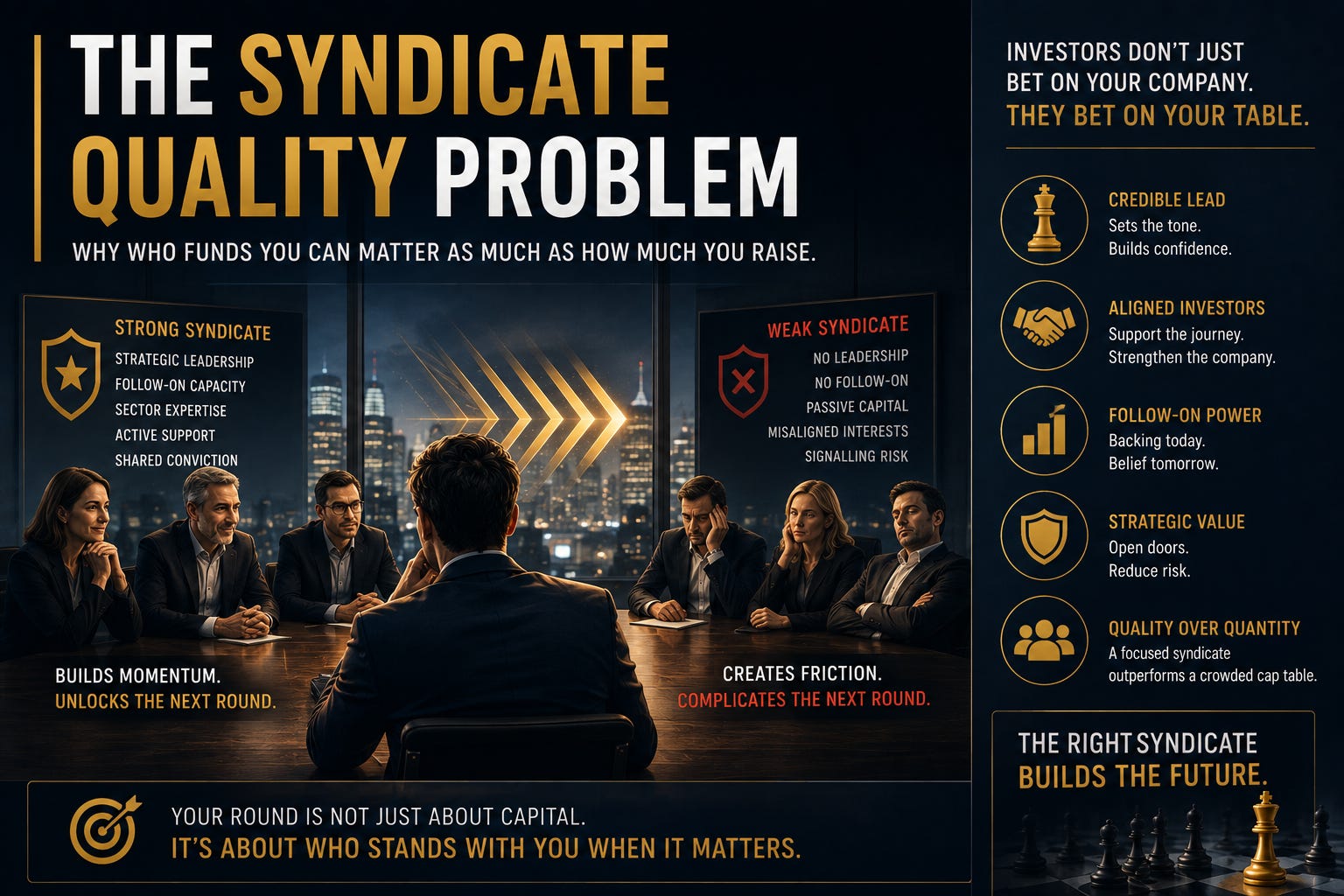
When a company raises the next round, new investors look backward before they look forward.
They look at who funded the company before. They look at whether the previous lead is credible. They look at whether insiders are participating. They look at whether the syndicate has the ability to support the company. They look at whether the cap table is clean or complicated. They look at whether previous investors are enthusiastic or quiet.
This is not because investors are lazy. It is because prior investor behaviour contains information.
If strong investors backed the company and continue to support it, that can help. It suggests that people who already know the company still believe. If existing investors are silent, absent, or unwilling to participate, that creates questions. It does not automatically kill the round, but it forces the founder to explain why.
New investors know insiders have more information than outsiders. If the people closest to the company are not supporting the next round, the new investor wants to understand whether that is because of fund limitations, portfolio construction, timing, internal policy, or loss of conviction.
These are very different explanations.
A good founder can explain the situation clearly. A weak explanation creates doubt. “They are supportive but not investing” may be true, but it is not enough. Why are they not investing? Do they lack reserves? Are they at the end of their fund? Are they overexposed? Did they change strategy? Did they lose conviction? Were they never meaningful investors in the first place?
The answer matters because the next investor is trying to understand not only the company, but the behaviour of the capital already around it.
Not all passive investors are bad. Some angels, family offices, and small funds write helpful early cheques and do not need to be deeply involved. Passive capital can be valuable, especially when the company is early and needs flexibility.
The problem is when the syndicate is mostly passive.
A company with many passive investors may have money but little support. Nobody is helping shape the next round. Nobody is preparing the founder for diligence. Nobody is using their network meaningfully. Nobody is helping recruit. Nobody is providing market intelligence. Nobody is willing to bridge. Nobody is willing to defend the company when things become harder.
This becomes dangerous in health because the path is rarely smooth. Timelines shift. Evidence takes longer. Customers move slowly. Regulatory questions appear. Commercial proof is harder than expected. The next round may require more education, more credibility, and more strategic support than the founder anticipated.
Passive capital does not solve those problems.
A weak syndicate can leave the founder alone at exactly the moment the company needs experienced help. The founder may have investors, but not partners. They may have names on the cap table, but no one willing to make the next financing easier.
That matters to new investors because they are not only evaluating the company’s progress. They are evaluating the support system around the company.
A company with passive capital can still succeed, but the founder needs to understand the gap. If the current syndicate will not help with the next round, the founder has to build that support elsewhere.
Strategic investors can be powerful. In health, they can bring credibility, market access, technical insight, commercial channels, clinical relationships, regulatory understanding, and potential exit relevance. A respected strategic investor can make a company easier to understand and more attractive to other investors.
But strategic capital can also create complications.
New investors will ask why the strategic investor invested. Is the relationship commercial, financial, defensive, exploratory, or option-driven? Does the strategic have rights that could limit future partnerships or acquisitions? Does their presence make other potential partners nervous? Are they helping the company, or simply watching it? Are they aligned with the founder’s long-term financing strategy?
This is especially important when a strategic investor comes in too early or with rights that narrow the company’s future. A corporate cheque can look impressive in the announcement, but if it creates perceived exclusivity, information rights concerns, commercial dependency, or exit complications, it may make the next round harder.
The issue is not strategic capital itself. The issue is strategic fit.
Founders should ask what the strategic investor changes. Does it reduce real risk? Does it open distribution? Does it support evidence generation? Does it create commercial access? Does it improve credibility with future investors? Or does it only create a logo for the deck?
Investors can usually tell the difference.
Founders often fill rounds with many smaller cheques because it feels easier than finding larger conviction. This can work, but it can also create problems.
A crowded cap table with many small investors can make governance more complicated. It can make communication harder. It can create unclear expectations. It can make the next round more difficult if there is no obvious investor with enough ownership or conviction to support the company meaningfully.
This does not mean founders should avoid angels or small cheques entirely. Some small investors can be highly valuable. A specialist angel with deep sector expertise, a founder-operator who can open doors, a clinician with real market influence, or a family office with strategic patience can be worth far more than their cheque size.
The issue is whether the cheque has a purpose.
If the company brings in many small investors without a clear reason, the cap table can become crowded without becoming stronger. Investors may ask why those people are there. They may wonder whether the founder lacked access to larger, higher-conviction capital. They may worry that the round was assembled through convenience rather than strategy.
Again, the point is not that every investor needs to be famous or large. The point is that the syndicate should make sense.
A good syndicate has logic. A weak syndicate is just a collection of money.
The lead investor usually carries the strongest signal. A credible lead can set terms, anchor conviction, organise the round, and give other investors confidence. But the rest of the syndicate still matters.
A strong lead surrounded by useful co-investors can create a powerful financing base. The company may have one investor with ownership and governance responsibility, plus others who bring customer access, technical expertise, geographic reach, strategic relationships, or future financing support.
A strong lead surrounded by weak or misaligned investors may still create friction. The lead may have to manage more complexity. Future investors may still question parts of the cap table. The founder may still be dealing with too many voices, too little support, or conflicting incentives.
A weak lead with many passive followers is even more difficult. The founder may have closed a round, but no one has truly taken ownership of the company’s financing path. When the next round comes, there may be no investor with enough conviction, reserves, or credibility to help.
This is why founders should think of the syndicate as a system. Each investor plays a role. Some provide leadership. Some provide expertise. Some provide access. Some provide follow-on capacity. Some provide strategic relevance. Some provide credibility. Some should probably not be there.
The best founders are intentional about this. They do not treat all money as equal because they understand that the syndicate becomes part of the company’s story.
The real cost of a weak syndicate often appears at the next financing.
A new investor may like the company, but pause when they see that existing investors are not participating. They may worry if the previous round was filled with investors who cannot follow on. They may question why there is no credible institutional investor already involved. They may become concerned if the cap table includes strategic rights that complicate future exits. They may hesitate if the company has too many small investors and no clear governance structure.
These questions do not always lead to a pass, but they add friction.
Fundraising is already difficult. Anything that adds uncertainty makes the process harder. A poor syndicate can force the founder to spend time explaining the cap table instead of building conviction around the company.
In some cases, the syndicate can create signalling risk. If a well-known investor is on the cap table but not participating, new investors may wonder why. If insiders are quiet, new investors may worry. If previous investors were never truly committed, the founder may have to prove that the current round is different.
This is why founders should think about the next round when constructing this one.
The question is not only, “Will this cheque help us close today?” The better question is, “Will this investor make the company easier or harder to finance tomorrow?”
In health and life sciences, syndicate quality matters because the company may need more than money.
It may need sector expertise. It may need patient capital. It may need investors who understand long timelines, evidence generation, regulatory pathways, clinical development, reimbursement, market access, enterprise sales, pharma partnerships, or strategic exits. It may need investors who can help the company survive periods when progress is real but slow.
A generalist investor may be helpful, but if they do not understand the sector’s timelines, they may become impatient. A small investor may be supportive, but if they cannot follow on, they may not help when the company needs bridge capital. A strategic investor may be useful, but if their incentives are too narrow, they may complicate broader market access. A passive investor may be easy to work with, but they may not provide enough support when the company faces a difficult financing environment.
Health companies often require a syndicate that understands the path.
That does not mean every investor must be a health specialist. Some companies benefit from a mix of specialist and generalist capital. But the founder needs to understand what the company’s risk profile requires. A diagnostic company, a digital health company, a medtech company, a biotech platform, and a healthcare AI company may each need different syndicate strengths.
The right syndicate should make the company more resilient, not just better funded.
The deeper question is not whether a founder can raise money. It is whether the founder can build a syndicate that strengthens the company’s future financing position.
Comments
Nothing yet. Say the first thing.
Sign in to join the conversation.