
Dear Readers,
Welcome to the latest edition of the HealthVC newsletter.
HealthVC is the go-to newsletter for founders, LPs, and emerging managers who want to master fundraising, build institutional-grade data rooms, and understand how investors actually make decisions.
Most founders think the main negotiation in a financing round is valuation.
That is understandable. Valuation is visible. It affects dilution. It becomes a signal in the market. It appears in the term sheet. It shapes how founders feel about the company’s progress, ambition, and bargaining power. A higher valuation can feel like validation. A lower valuation can feel like weakness.
But investors are not only thinking about valuation.
They are also thinking about ownership.
This is one of the most misunderstood parts of fundraising. Founders often ask, “What valuation can we raise at?” Investors often ask a different question: “Can we build enough ownership for this investment to matter?”
Those are not the same question.
A fund may like the company, believe in the founder, understand the market, and still struggle to lead if the round structure does not allow it to reach a meaningful ownership position. The round may be too small. The valuation may be too high. The dilution may be too low. The company may need so much future capital that the investor worries about being diluted later. The cap table may already be crowded. The lead allocation may not be large enough for the fund’s model.
From the founder’s perspective, this can feel strange. If an investor likes the company, why does ownership matter so much? Why would a fund pass because they cannot own enough? Why does a cheque size need to match a percentage? Why does a valuation that feels attractive to the founder create hesitation for the investor?
The answer is portfolio construction.
Venture funds are not only picking good companies. They are building portfolios. They need each investment to have the potential to return enough capital to matter for the fund. If a fund owns too little of a company, even a strong outcome may not move the fund’s overall returns. That changes how investors think about round size, valuation, dilution, reserves, follow-on capacity, and whether they can lead.
That is the ownership problem.
Founders often think valuation is the main number. Investors are also calculating whether the round allows them to own enough of the upside.
A venture fund is judged by returns to its LPs. That means each investment has to be considered in relation to the size of the fund, the cheque written, the ownership acquired, the likely dilution over time, and the possible exit outcome.
A small angel can write a small cheque and be happy with a small ownership stake because their personal return threshold may be different. A micro fund may be able to make smaller ownership work because the fund size is smaller. A large institutional fund may need a much larger ownership position because the outcome has to matter at the fund level.
This is why different investors behave differently in the same round.
A €250,000 cheque may be meaningful for one investor and irrelevant for another. A 2 percent ownership position may be attractive for one fund and impossible for another. A €3 million round may be large enough for one investor to lead, but too small for a larger fund to build the ownership they need. A valuation that seems reasonable to the founder may leave the lead investor with too little of the company for the risk they are taking.
Founders often interpret this as a lack of conviction. Sometimes it is. But sometimes it is simply fund math.
The investor may believe the company could become valuable, but if they cannot own enough at entry, and if future dilution will reduce that position further, the investment may not fit their model. The company can be good and still not work for that fund.
This is especially important when founders speak to funds of different sizes. A small specialist fund, a large multi-stage fund, a family office, a corporate venture arm, an angel syndicate, and a seed fund may all look like “investors,” but they do not all need the same ownership. They do not all think about the same cheque size. They do not all have the same return requirements.
Fundraising gets easier when founders understand which ownership logic applies to the investor in front of them.
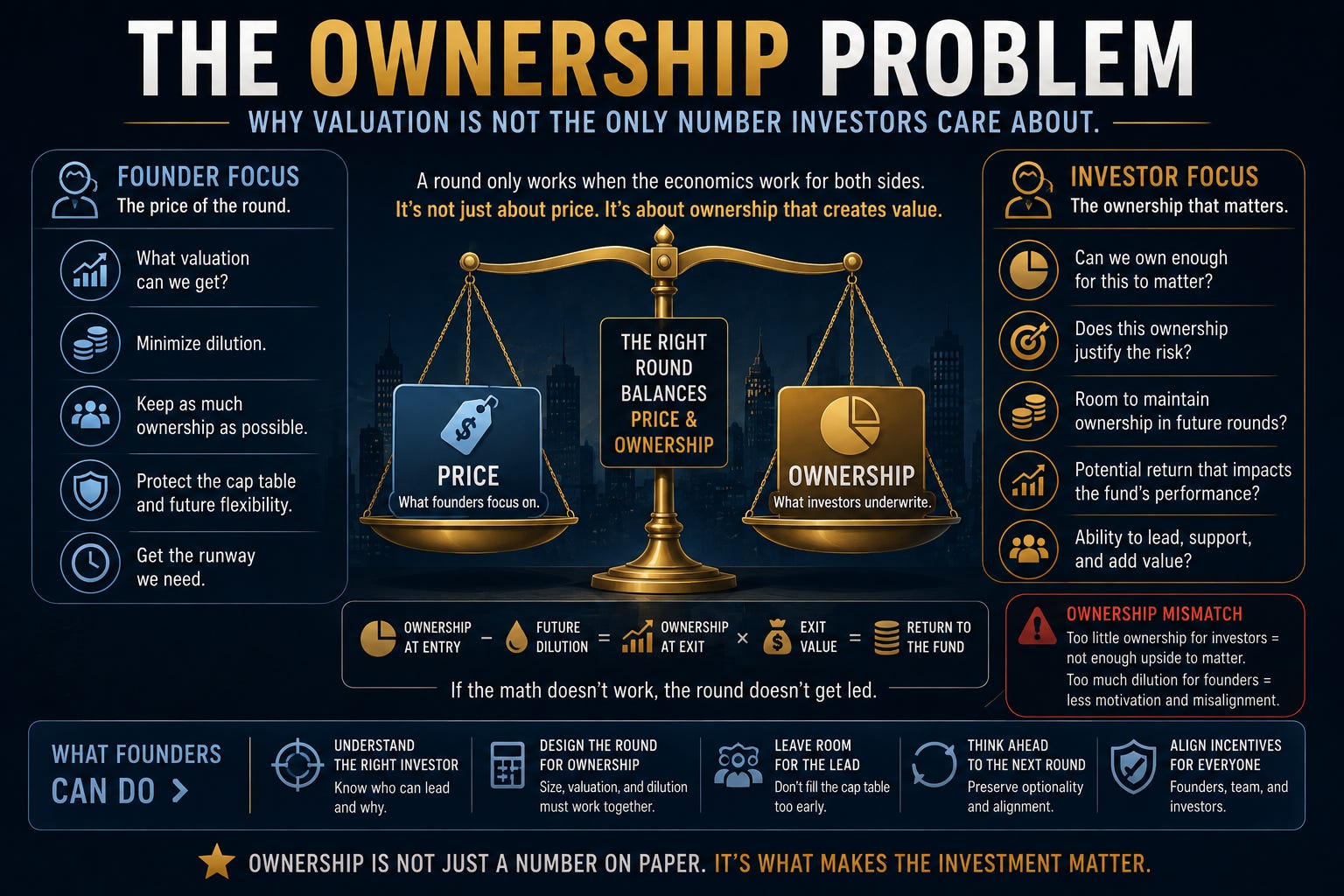
Valuation is not separate from ownership. It directly affects how much of the company an investor can buy with a given cheque.
If a fund wants to invest €2 million and the pre-money valuation is €8 million, that investment buys a meaningful position. If the same fund wants to invest €2 million and the pre-money valuation is €30 million, the ownership is much smaller. The company may still be attractive, but the investor’s economics have changed.
This is why a high valuation can create friction even when investors like the company.
Founders often see a higher valuation as less dilution and therefore a better deal. Investors may see the same valuation as reducing their ability to build ownership, increasing the future step-up required, and making the risk reward less compelling. The issue is not only whether the company is “worth” the price today. It is whether the ownership available at that price can produce the return the investor needs.
This does not mean founders should always accept lower valuations. Valuation matters. Founder dilution matters. Team ownership matters. Future option pools matter. A round that is priced too low can be painful and may create its own problems.
But valuation has to work for both sides of the table.
If the price is too high for a lead investor to reach its ownership target, the round may become harder to lead. If the lead cannot own enough, they may prefer to follow, wait for the next round, or pass entirely. The founder may still find capital, but the structure may not attract the investor they actually need.
This is one reason rounds can stall even when the company has interest.
The valuation may be founder-friendly, but not leadable.
Founders often decide how much to raise based on runway.
They calculate the budget, team needs, product plan, clinical work, regulatory preparation, commercial activity, and operating costs. Then they decide the round size. That is a reasonable starting point, but it is not the whole financing design.
The round size also determines how much ownership is available to investors.
If the round is too small, a lead investor may not be able to invest enough to reach its target ownership. If the founder wants to raise €1 million, but the right lead fund usually writes €2 million to €4 million initial cheques, the fund may not fit the round. If the founder tries to keep dilution extremely low, they may reduce the space available for the investor who would otherwise lead.
This creates a difficult tradeoff.
Founders want enough capital to reach the next milestone, but they also want to manage dilution. Investors want enough ownership to justify the work, risk, and future support. A strong round structure has to balance both.
This is why a founder should not think about round size only as cash need. They should also think about what kind of investor the round is designed to attract. If the company needs a lead investor, the round must be large enough and structured enough for that lead to own a meaningful position. If the company only needs a small extension, the investor universe may be different. If the company needs specialist institutional capital, the ownership available has to match that capital.
The question is not only, “How much do we need?”
It is, “What round structure allows the right investor to say yes?”
Founders often try to minimise dilution as much as possible. That instinct makes sense. Ownership is important. Founders should not give away unnecessary equity. A company that over-dilutes early can create long-term problems for the founder, team, and future investors.
But too little dilution can also create problems.
If a founder wants to raise a meaningful amount of capital while giving up very little ownership, the implied valuation may become too high for the stage. That can make the round harder to lead. It can also make the next round harder because the company must grow into the valuation before future investors can justify a step-up.
In venture, dilution is not only a cost. It is also how investors buy enough upside to make the risk worthwhile.
If the investor is taking early risk, doing deep diligence, helping build the syndicate, supporting the next round, and putting their reputation behind the company, they usually need enough ownership to justify that role. A founder who wants a lead investor but offers only follower-level ownership may create a mismatch.
This does not mean founders should accept excessive dilution. The goal is not to give investors as much as they want. The goal is to understand the ownership range that makes the round attractive, fair, and financeable.
A good round leaves founders motivated, employees properly incentivised, and investors meaningfully aligned.
That balance matters more than maximising valuation at all costs.
Many funds have ownership targets. They may want to own 5 percent, 10 percent, 15 percent, or more at entry, depending on stage, fund size, strategy, and whether they lead. Some funds are comfortable with smaller positions if they have a clear path to increase ownership later. Others need to build meaningful ownership immediately.
Founders rarely ask about this early enough.
They may spend weeks with an investor before discovering that the fund needs a larger allocation than the round can support. Or they may push for a valuation that makes the investor’s ownership target impossible. Or they may fill the round with smaller cheques before realising there is no room left for a lead.
This is why ownership should be part of fundraising qualification.
A founder should understand whether an investor leads or follows, what cheque size they typically write, what ownership they target, whether they require a board seat, whether they reserve for follow-ons, and whether they need room to increase ownership over time. These questions are not just technical. They determine whether the investor can realistically fit the round.
If the founder avoids this conversation, they may mistake interest for alignment.
An investor can like the company, but if the ownership does not work, the round may not work for them. That does not mean the company is bad. It means the financing structure and investor model are mismatched.
Investors do not only think about the ownership they get today. They think about what that ownership may become after future rounds.
This is especially important in health because companies often need multiple financings before reaching major value inflection. A medtech company may need more capital for clinical studies, regulatory clearance, manufacturing, and commercial launch. A diagnostics company may need validation, reimbursement work, and market access. A therapeutics company may need several rounds before clinical proof. A digital health company may need capital to prove repeatable sales and retention.
If an investor buys 8 percent today, they may not own 8 percent later. Future rounds will dilute them unless they follow on. The investor has to decide whether they have the reserves, conviction, and fund capacity to maintain or increase ownership over time.
This affects whether they are willing to lead now.
If the company is highly capital-intensive and the investor cannot support future rounds, they may worry that their ownership will shrink too much before the outcome. If the current round is priced too high, they may worry they are starting with too little ownership at too much risk. If the next round is likely to require a large institutional lead, they may worry about being diluted heavily unless they can participate.
This is why ownership is connected to downstream financing.
The investor is not only buying a slice of the company today. They are buying a position in a financing journey. They need to believe that position can remain meaningful enough to justify the investment.
Founders who understand this can have more sophisticated conversations. They can explain not only the current dilution, but how future rounds may work, what milestones will justify them, and how existing investors can remain aligned.
Pro rata rights are often treated as a technical term, but they matter because they allow investors to maintain ownership in future rounds.
For investors, pro rata can be valuable. If the company performs well, the investor wants the right to keep investing and protect their ownership. Without that right, they may be diluted by future investors even if they want to continue supporting the company.
For founders, pro rata rights can also create trade-offs. Granting too many rights too broadly can make future rounds more complicated. If many small investors have rights, the company may have less flexibility when a future lead wants allocation. If strategic investors have rights, future investors may ask how those rights affect the financing or exit path. If existing investors have strong rights but no real ability to follow on, the rights may create administrative complexity without meaningful support.
The issue is not whether pro rata is good or bad. The issue is whether the rights match the role of the investor.
A lead investor with meaningful ownership and follow-on capacity may reasonably expect pro rata rights. A small passive investor may not need the same rights. A strategic investor may require careful thought. Founders should understand that allocation rights shape future financing flexibility.
Ownership is not only about the percentage on the cap table today.
It is about who has the ability to protect, increase, or complicate ownership tomorrow.
Leading a round is expensive in time, reputation, and internal effort.
A lead investor has to do deeper diligence, negotiate terms, build conviction, organise the syndicate, and often take a board role or governance responsibility. They are not simply adding capital. They are taking ownership of the financing process.
Because of that, a lead usually needs ownership that matches the responsibility.
If the lead can only own a small position, they may not be able to justify the work. They may like the company, but prefer to follow. They may tell the founder they are interested, but ask who else is leading. They may wait for a larger round. They may decide the company is attractive but not a fit for their model.
This is frustrating for founders because it can feel like investors are asking for too much. Sometimes they are. But often, they are simply applying their fund economics.
A lead investor needs the possibility of a return that matters. If the company succeeds and the fund owns too little, the outcome may not justify the risk. If the fund cannot get enough ownership now and expects to be diluted later, the investment may not make sense.
This is why ownership can decide whether a round has a lead.
Founders who want a strong lead need to create a round where a strong lead can participate meaningfully. Otherwise, they may end up with many followers and no investor willing to take responsibility.
Founders sometimes hear investors talk about ownership and assume they are talking about control.
That is not always the case.
Most venture investors do not want to run the company. They want enough ownership for the investment to matter economically. They want alignment. They want governance appropriate to the stage. They want information rights, participation rights, and the ability to support the company over time. That is different from wanting to control the business.
Of course, founders should be thoughtful about governance, rights, board composition, vetoes, and investor behaviour. Not every investor is the right partner. Ownership terms matter. Control terms matter. The founder should understand what they are agreeing to.
But it is important not to confuse ownership economics with control ambition.
A fund may ask for 10 percent or 15 percent ownership because that is how its model works, not because it wants to dominate the company. A lead may ask for a board seat because governance and support come with the role, not because it wants to micromanage. A fund may ask for pro rata because it wants to maintain exposure to a company it believes in, not because it wants to block future financing.
Good founders understand the difference. They negotiate carefully, but they also understand why ownership matters to investors.
That makes the conversation more productive.
Future investors will look at the ownership structure too.
They will ask whether founders still own enough to be motivated. They will ask whether the employee option pool is sufficient. They will ask whether early investors own too much or too little. They will ask whether the cap table is clean. They will ask whether there are small shareholders, rights, or strategic investors that could complicate a future round. They will ask whether existing investors have enough ownership and conviction to support the company.
A company can become harder to finance if the ownership structure is already strained.
If founders have been over-diluted too early, future investors may worry about motivation. If no investor owns enough to care, future investors may worry about lack of support. If too many small investors have rights, future investors may worry about complexity. If a strategic investor owns a meaningful stake with special rights, future investors may worry about conflicts.
This is why ownership design matters from the beginning.
Every round changes the future cap table. Every cap table becomes part of future diligence. The ownership decisions a founder makes today can either create flexibility later or remove it.
The strongest founders do not treat ownership as a one-round negotiation.
They treat it as financing architecture.
The deeper question founders should ask is not only, “What valuation can we get?” It is, “What ownership structure makes this round leadable, financeable, and healthy for the next stage?”
Comments
Nothing yet. Say the first thing.
Sign in to join the conversation.