
Dear Readers,
Welcome to the latest edition of the HealthVC newsletter.
HealthVC is the go-to newsletter for founders, LPs, and emerging managers who want to master fundraising, build institutional-grade data rooms, and understand how investors actually make decisions.
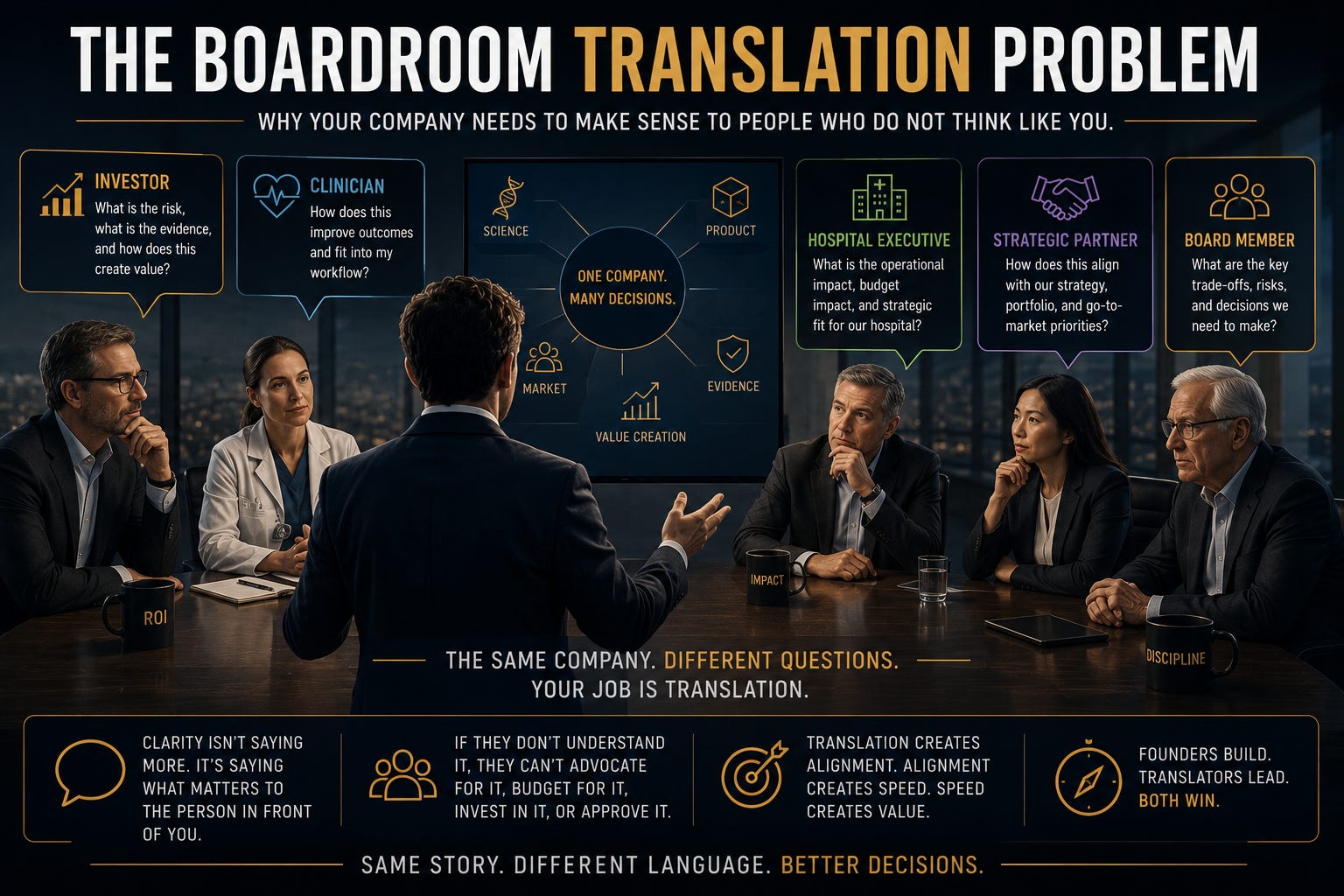
One of the most underestimated skills in fundraising is translation. Not translation between languages, but translation between decision-makers. Founders often explain the company in the language they are most comfortable with. Scientific founders explain the science. Clinical founders explain the patient need. Product founders explain the features. Commercial founders explain the market. Technical founders explain the architecture, data, model, or platform.
That is natural. Founders usually build from the world they understand best. The problem is that the people they need to convince do not all think from that same world. Investors do not think like clinicians. Clinicians do not think like procurement. Procurement does not think like strategic partners. Strategic partners do not think like founders. Boards do not think like product teams. Each group is trying to answer a different question before they say yes.
This is the boardroom translation problem. A founder can understand the company deeply, but still fail to translate it into the decision language of the person in front of them. The company may be strong, the problem may be real, and the opportunity may be meaningful, but if the explanation is trapped inside the founder’s preferred language, the audience may not know how to act.
This matters because health companies are rarely bought, funded, adopted, or partnered by one person. They move through rooms. Investor partner meetings. Hospital budget meetings. Procurement reviews. Clinical committees. Regulatory discussions. Strategic partnership reviews. Board meetings. Investment committees. The company needs to make sense in all of those rooms, especially when the founder is not there to explain it again.
A founder who cannot translate the company forces every stakeholder to do extra work. The investor has to translate the company for the partnership. The clinician has to translate it for administration. The innovation team has to translate it for procurement. The strategic partner has to translate it for business development, legal, commercial, and leadership. That slows everything down.
The best founders do not only explain what the company does. They explain it in the language of the decision that needs to be made.
A health company does not mean the same thing to every stakeholder. To a clinician, the company may represent better care, less friction, faster diagnosis, improved workflow, or a reduction in patient risk. To a hospital executive, it may represent operational efficiency, quality improvement, staff capacity, compliance, budget impact, or institutional differentiation. To a payer, it may represent cost avoidance, evidence quality, risk reduction, or measurable outcomes. To a strategic partner, it may represent pipeline relevance, market access, distribution, data, technology leverage, or long-term competitive advantage.
To an investor, the company means something else again. It represents a risk profile, a financing path, a value creation opportunity, a future round, a possible exit, and a question of whether capital can turn current uncertainty into future value. The investor may care about the clinical problem, but they are also asking whether the company can build enough evidence, access the right market, protect its position, attract future capital, and create a return.
This is why founders get frustrated. They think they are explaining the company clearly, but they are often explaining it from the wrong angle for the room they are in. A founder may give a highly technical explanation to an investor who is trying to understand market entry. They may give a patient-impact explanation to a hospital finance team that is trying to understand budget ownership. They may give a product demo to a strategic partner who is trying to understand why the company matters to their corporate priorities.
The content may be true, but truth alone is not enough. The audience needs to understand why the truth matters to them.
This does not mean the founder should manipulate the story or tell different versions that contradict each other. The company should remain consistent. The problem, product, evidence, market, and milestone should not change from room to room. What changes is the framing. The founder needs to know which part of the company matters most to each decision-maker and explain the opportunity through that lens.
Translation is not changing the truth. It is making the truth usable.
Founder language is often full of vision, history, intensity, and personal conviction. The founder explains why they started, how they discovered the problem, what they have built, what they believe the future should look like, and why the company matters. That can be powerful because founders need conviction. A company without founder conviction is hard to believe.
But founder language can also become too internal. It can include too much backstory, too many assumptions, too many emotional shortcuts, and too much context that the audience has not yet earned. The founder has lived with the problem for years, so they forget what a new listener needs first. They jump into the product before the problem is clear. They explain future scale before the first use case is understood. They talk about the mission before the buyer is defined. They describe the platform before the audience understands why the first wedge matters.
Decision-makers do not have the founder’s context. They need a clearer path into the company. They need to understand the problem in their own terms, the consequence of not solving it, the evidence that the solution matters, and the decision being asked of them.
This is why founder language often works better in origin stories than in boardrooms. It can create emotional connection, but it may not create action. A boardroom needs a decision. An investor meeting needs conviction. A hospital meeting needs operational logic. A strategic partnership meeting needs relevance. A procurement review needs risk control. A clinical committee needs evidence and workflow fit.
The founder’s job is to carry the conviction without forcing the audience to decode the company from the founder’s perspective.
Scientific language is one of the most common traps in health fundraising. A founder with deep scientific expertise may explain the mechanism, the data, the technical novelty, the biology, the model, the platform, the analytical method, or the research history in detail. This can be impressive, especially when the science is genuinely strong. But scientific strength does not automatically translate into investment clarity.
Investors may respect the science and still not understand the company. They may believe the mechanism is interesting but still wonder which indication comes first. They may understand that the platform is technically differentiated but still not know what the next financing milestone proves. They may see that the data is promising but still ask whether it changes the risk profile enough to justify the round.
Scientific founders sometimes believe more technical detail will create more confidence. Sometimes it does, particularly with specialist investors or scientific advisors. But in many fundraising conversations, too much scientific detail too early can create distance. The investor may not need a deeper explanation of the mechanism at that moment. They may need to understand why the mechanism creates a company.
The science has to be translated into value creation. What does the science make possible? What risk has already been reduced? What risk remains? What evidence is needed next? Who cares if this works? Why does this round matter? How does the company become more valuable if the next milestone is achieved?
That is the translation investors need.
The goal is not to make the science shallow. It is to make the business around the science legible. The best scientific founders can go deep when needed, but they do not start by making the investor prove they can keep up. They start by making the investment case clear enough that the technical depth has somewhere to land.
Clinical founders often speak in the language of patient need, clinical workflow, physician frustration, care quality, and unmet need. That language is essential because health companies must solve real problems. If the product does not matter clinically, the company may not deserve to exist. Clinical insight gives founders credibility and helps them avoid building products that make sense in theory but fail in practice.
But clinical language can fail when the audience is not making a purely clinical decision. A doctor may understand why the product matters, but a hospital executive may ask how it affects budget, capacity, risk, staff time, quality metrics, or strategic priorities. Procurement may ask about vendor risk, implementation, contract terms, IT requirements, and liability. A payer may ask whether the product reduces cost, improves outcomes, or changes utilisation in a measurable way.
The clinical case may be necessary, but it is not always sufficient.
This is where many health founders lose momentum. They have strong clinical support, but they cannot translate that support into institutional action. They can explain why the product should be used, but not why it will be bought. They can explain why patients benefit, but not who pays. They can explain why the workflow is broken, but not what operational owner has the incentive and authority to fix it.
The best founders do not abandon clinical language. They connect it to decision language. They show how the clinical problem creates operational burden, financial cost, quality risk, compliance pressure, capacity strain, or strategic urgency. They help non-clinical stakeholders understand why the clinical issue matters to their decision.
That is how clinical value starts to move through the system.
Product founders often explain what the product does. They show dashboards, workflows, features, user journeys, AI layers, integrations, reports, alerts, and modules. They demonstrate functionality because functionality is visible. A good demo can create excitement. It can make the company feel real. It can help investors understand how the product works.
But investors are not only asking what the product does. They are asking what the product proves.
A product may have many features, but the investor wants to know which feature creates value. A dashboard may look polished, but the investor wants to know who uses it, how often, and what decision it changes. An AI layer may sound advanced, but the investor wants to know whether it reduces risk, improves performance, or creates defensibility. An integration may look important, but the investor wants to know whether it is essential for adoption or just another implementation burden.
Product language can become too focused on capability. Investors need capability translated into evidence, adoption, buyer urgency, defensibility, and value creation. The question is not only whether the product can do something. The question is whether that thing matters enough for someone to change behaviour, pay, adopt, renew, expand, partner, or invest.
This is why product-led explanations can underperform in fundraising. The founder shows the product, but the investor still cannot see the business. The investor may like the interface and still wonder who buys. They may understand the workflow and still wonder how hard it is to implement. They may see the features and still wonder whether the company has a focused wedge.
The strongest founders use product language only after the decision context is clear. They show the product as proof of a specific business argument. The demo is not a tour. It is evidence.
When founders speak to investors, the company needs to be translated into investment language. That does not mean using buzzwords or pretending everything is about exit multiples. It means explaining the company in terms of risk, evidence, milestones, capital, market entry, defensibility, future financing, and value creation.
Investors need to understand what risk they are being asked to take. They need to know why that risk is acceptable at this stage. They need to see what has already been proven and what remains uncertain. They need to understand what this round of capital is designed to change. They need to believe that if the company achieves the next milestone, the company will be more valuable, more fundable, more partnerable, or more strategically relevant.
This is often where founders struggle. They explain the company as a product or mission, but not as an investment. They talk about what they will build, but not what that build proves. They talk about market size, but not market entry. They talk about pilots, but not conversion. They talk about future potential, but not the sequence of value creation.
Investment language is not cold. It is simply the language investors need to make a decision. It helps the investor understand why the company deserves capital now and what the company should become after that capital is used.
A founder who can speak investment language does not stop being authentic. They become easier to underwrite.
Hospitals do not make decisions in founder language either. A founder may see the hospital as a customer, but the hospital sees itself as an institution with constraints. It has budgets, staff shortages, compliance requirements, patient safety standards, IT systems, procurement processes, operational priorities, and political realities. Even when the clinical need is obvious, the institution still has to decide whether it can absorb the solution.
This means the company needs to be translated into institutional language. What does this product reduce, improve, protect, simplify, or enable for the hospital? Does it reduce workload? Does it improve patient flow? Does it support compliance? Does it create measurable quality improvement? Does it reduce avoidable cost? Does it help staff operate better? Does it fit existing systems? Does it create risk or reduce risk?
A founder who only explains the product’s clinical benefit may struggle to move the hospital. The clinical benefit matters, but adoption often depends on whether the institution can justify the decision across multiple stakeholders. The founder needs to help the hospital see the product not only as a clinical tool, but as an institutional decision.
This is difficult because hospitals contain many internal languages. Clinicians speak one language, IT another, finance another, compliance another, procurement another, and leadership another. The founder does not need to become an expert in every internal function, but they do need to understand that each function has its own concerns.
A product that cannot be translated across those concerns may remain liked but not adopted.
Strategic partners also need a different translation. A pharma company, medtech company, diagnostics group, insurer, corporate health player, or large healthcare organisation may be interested in innovation, but they are rarely interested in innovation in the abstract. They want to understand how the startup connects to their priorities.
A founder may explain the product as a solution to a market problem. A strategic partner may ask how it strengthens their pipeline, improves market access, creates a data advantage, supports distribution, opens a new category, complements an existing asset, reduces development risk, or helps them serve a customer segment they already care about. The same company may need to be framed differently depending on the strategic partner’s context.
This is where founders often overestimate partnership interest. They get a positive conversation with a strategic, but they do not translate the company into the strategic’s decision language. The founder explains why the company is exciting. The strategic partner is asking whether the company is relevant.
Relevance is not the same as excitement. A strategic partner may think the technology is impressive and still not see why it matters to their current priorities. They may admire the founder and still not know where the company sits inside their organisation. They may believe the category is important but have no internal owner for the relationship.
The best founders do the translation work before the meeting. They understand the strategic partner’s business, priorities, pressures, portfolio, and likely decision logic. They explain not only what the startup does, but why it could matter to that partner now.
Boards need yet another translation. A board is not there to receive every detail. It is there to help make better decisions. Founders often use board meetings to report activity, but boardrooms need clarity around choices, tradeoffs, risks, capital allocation, hiring, runway, milestones, and strategic direction.
This is especially important as companies mature. The founder may be deep in daily execution, but the board needs to understand what decisions matter. Should the company narrow the market? Should it delay hiring? Should it extend runway? Should it pursue a strategic partnership? Should it raise now or later? Should it focus on evidence, product, revenue, regulation, or team? What tradeoff is being made and why?
A founder who cannot translate operating complexity into decision language may have ineffective board meetings. The board hears updates but does not know where to help. The founder may leave with comments, but not decisions. The company loses the chance to use the board properly.
Boardroom translation is about turning information into judgment. What changed? What matters? What decision is needed? What are the options? What is the recommendation? What risk does the company accept if it chooses this path?
This same skill helps in fundraising because investors are also listening for decision quality. They want to know whether the founder can turn complexity into choices.
P.S. Don’t forget to check out the HealthVC on YouTube and The Terminology of Venture Capital on Amazon.
Comments
Nothing yet. Say the first thing.
Sign in to join the conversation.