
Dear Readers,
Welcome to the latest edition of the HealthVC newsletter.
HealthVC is the go-to newsletter for founders, LPs, and emerging managers who want to master fundraising, build institutional-grade data rooms, and understand how investors actually make decisions.
Founders often think investors are only judging the company. They assume the investor is focused on the market, the product, the science, the evidence, the traction, the team, the regulatory pathway, the financial model, and the next milestone. Investors are looking at all of those things, but they are also reading something else. They are reading the founder.
This is uncomfortable because founder energy feels personal. Most founders would rather believe that fundraising is a rational assessment of the business alone. But early-stage investing is never only about the business as it exists today. It is also about whether the person leading the company can carry it through the next phase of uncertainty.
In health, this matters even more because the journey is rarely fast or clean. Evidence takes time. Customers move slowly. Pilots stall. Procurement drags. Regulatory questions appear. Clinical studies create ambiguity. Strategic partners move carefully. Investors ask the same questions repeatedly. The market often agrees the problem is important long before it is ready to adopt, pay, reimburse, or scale.
That means investors are not only asking whether the company is interesting. They are asking whether the founder has the clarity, stamina, judgment, and emotional discipline to survive the path.
This is the founder energy trap. It happens when a founder carries the company on adrenaline instead of discipline. The founder is moving fast, taking meetings, rewriting the deck, chasing investors, responding to every advisor, adding product, following up with customers, and trying to keep the company alive through sheer force of will. From the inside, this feels like commitment. From the outside, investors may start to wonder whether the company has an operating rhythm or whether everything depends on the founder’s nervous system.
Energy matters. Investors want founders who care deeply. They want urgency, intensity, and commitment. But founder energy becomes dangerous when it replaces structure. A company cannot be built on adrenaline forever. At some point, the founder has to show that the business is not only being pushed forward by effort, but organised by discipline.
Every fundraising conversation gives investors a chance to see how the founder behaves under pressure. They watch how the founder answers difficult questions. They listen to whether the founder becomes defensive, vague, calm, precise, reactive, or thoughtful. They notice whether the founder can admit risk without sounding weak. They notice whether the founder can explain uncertainty without losing conviction. They notice whether the founder has a plan, or only urgency.
This is not about personality. Different founders communicate differently. Some are intense. Some are quiet. Some are analytical. Some are charismatic. Some are technical. Some are clinical. Some are commercial. There is no single founder style that investors trust. What investors are trying to understand is whether the founder’s energy is stable enough to build around.
A founder can be passionate and still disciplined. A founder can be intense and still clear. A founder can be ambitious and still realistic. The problem begins when the founder’s energy starts to feel chaotic. The investor asks a question about the buyer, and the founder jumps to the product. The investor asks about risk, and the founder answers with vision. The investor asks about evidence, and the founder becomes defensive. The investor asks about capital use, and the founder lists activity instead of explaining value creation.
These moments matter because investors know the company will face harder moments than a pitch meeting. If the founder struggles to stay clear during fundraising, investors may wonder how they will behave when a study is delayed, a pilot does not convert, a key hire leaves, a strategic partner slows down, or the next round takes longer than expected.
Fundraising does not reveal everything, but it reveals enough to create a signal.
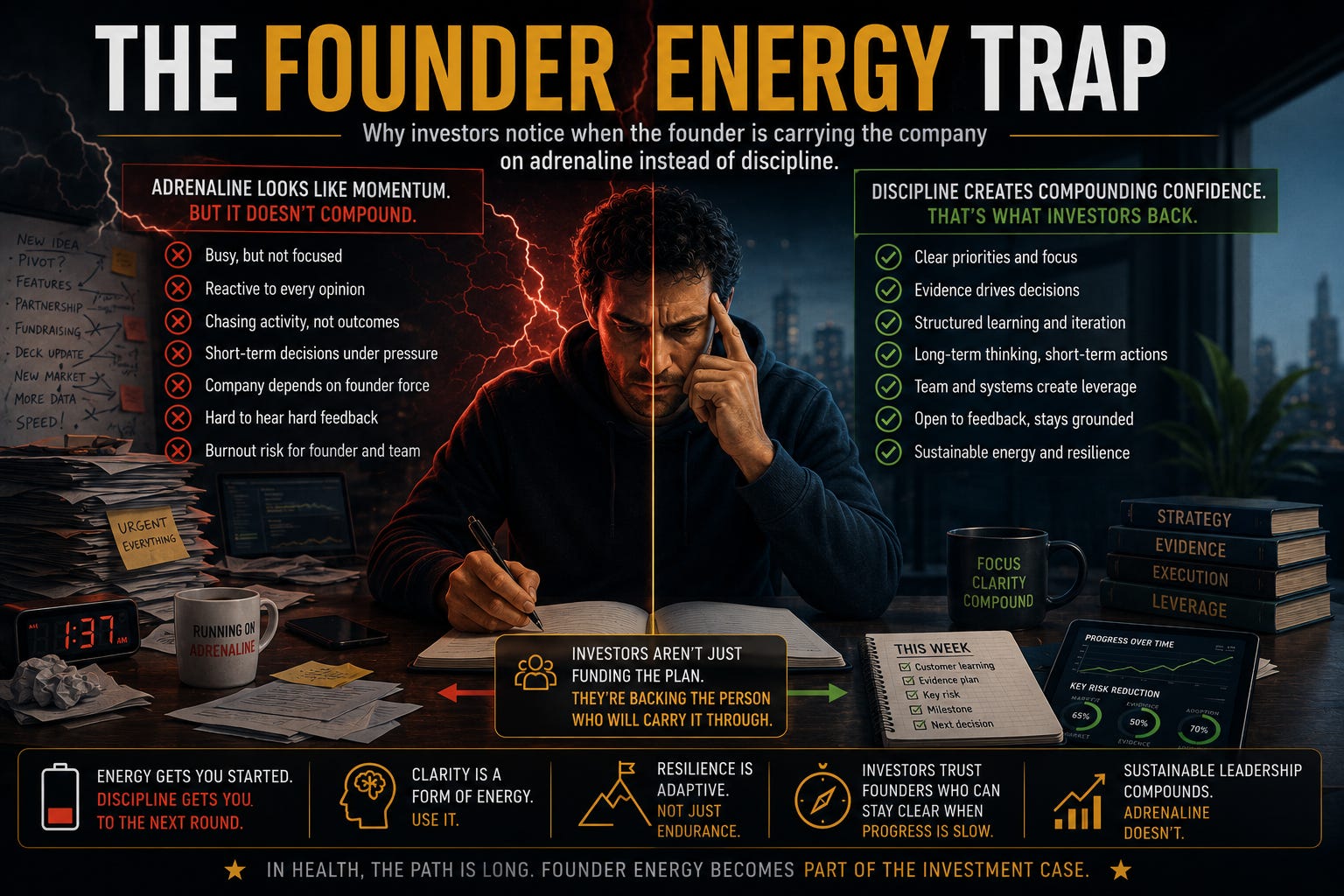
The founder energy trap is difficult to spot because adrenaline can look like momentum. The founder is busy. The calendar is full. Investor conversations are happening. The team is building. The pipeline is active. The founder is posting, pitching, following up, attending events, updating materials, taking advice, and creating movement around the company.
From the outside, that can look impressive. From the inside, it can feel necessary. Early-stage companies often survive because founders push. There are moments where urgency matters. There are times when the founder needs to create energy before the market gives it back.
But adrenaline is not the same as operating discipline. A founder can be busy and still not be reducing the right risks. A company can be visible and still not be getting sharper. A founder can take many meetings and still not know which investor concerns keep repeating. A team can build quickly and still not know which product decision matters most. The company can feel alive, but still not be learning in a structured way.
This is where investors become careful. They want to know whether the founder’s energy is producing clarity or only motion. Is the company becoming more focused after each market interaction? Is the pitch improving because the founder understands the objections better? Is the product roadmap being shaped by evidence or anxiety? Is the founder choosing priorities or reacting to noise?
Adrenaline can help a founder start. Discipline is what helps the company compound.
Some markets allow founders to move quickly through mistakes. Health is less forgiving. The cost of chaotic energy is higher because the system is slower, more regulated, more evidence-driven, and more stakeholder-heavy. A founder who reacts to every conversation can easily lose months. A founder who changes direction after every advisor call can confuse the team. A founder who expands the product after every pilot discussion can increase implementation risk. A founder who chases every investor comment can blur the fundraising story.
Health founders need energy, but they also need restraint. They need to know when to push and when to wait. They need to know which feedback matters and which feedback is noise. They need to know which risk must be reduced now and which risk can be addressed later. They need to know when a delay is normal and when it is a signal that the strategy is wrong.
This is one of the reasons founder stamina matters. Stamina is not just the ability to work long hours. It is the ability to remain clear when progress is slow. It is the ability to keep making good decisions when the market does not move at the speed the founder wants. It is the ability to stay disciplined after rejection, after ambiguity, after setbacks, and after the tenth conversation that ends with “keep us updated.”
Investors know that health companies rarely move in straight lines. They are not looking for founders who never get tired or frustrated. That would be unrealistic. They are looking for founders who can build a company that is not dependent on emotional spikes. The best founders create systems, rhythms, and decision rules that allow the company to keep moving even when founder energy fluctuates.
That is a very different signal.
At the earliest stage, every company depends heavily on the founder. That is normal. The founder sells the vision, recruits the first team, speaks to customers, raises capital, builds the narrative, manages advisors, and holds the whole thing together before the company has real structure. Founder force is part of the beginning.
But investors become concerned when founder force remains the only operating system. If every customer relationship depends on the founder, every investor update depends on the founder, every product decision depends on the founder, every strategic choice depends on the founder, and every internal rhythm depends on the founder’s personal energy, the company starts to look fragile.
This does not mean the founder should disappear from the centre of the company. Early companies need founder leadership. But leadership is not the same as carrying every part of the business personally. A founder who cannot translate energy into process eventually becomes the bottleneck.
Investors notice this in subtle ways. They ask about the team, and the founder answers as if they are still doing everything. They ask about customer learning, and all the insight sits in the founder’s head. They ask about sales, and every relationship is founder-led. They ask about execution, and the company has no clear operating cadence. They ask about priorities, and the founder gives a long list of everything happening at once.
This creates a concern that the company may only move when the founder pushes it. That may be enough for the first phase, but it is not enough for institutional capital. Investors want to see that the founder can create leverage. They want to know that the company is becoming more than one person’s intensity.
Founders often think energy is about passion, speed, and persistence. Those things matter, but clarity is also a form of energy. A clear founder creates momentum because people know what matters. The team knows what to focus on. Advisors know where to help. Investors know what the round is designed to prove. Customers understand the value. The company moves with less wasted motion.
A founder without clarity creates a different kind of energy. It may feel intense, but it becomes expensive. The team keeps shifting priorities. The deck keeps changing without becoming stronger. The product roadmap grows without a sharper wedge. Investor conversations create anxiety instead of insight. Customer feedback becomes noise instead of evidence.
This is why investors value founders who can simplify the company without making it shallow. A clear founder can say what matters now, what can wait, and why. They can explain the current risk, the next milestone, and the logic behind the round. They can explain why they are saying no to certain opportunities, features, markets, or partnerships. They are not calm because the company is easy. They are calm because they have organised the difficulty.
That kind of clarity gives investors confidence. It tells them the founder is not only working hard, but thinking clearly. It also tells them the company may use capital more intelligently. Capital does not solve chaos. In many cases, capital accelerates chaos. A founder who lacks clarity before the round may simply spend more money on unfocused activity after the round.
Investors know this. That is why founder clarity matters so much.
Founders often confuse resilience with endurance. They think resilience means continuing no matter what, taking every call, working longer, pushing harder, and refusing to slow down. There is value in persistence, but endurance alone is not enough. A founder can endure for a long time and still keep making the same mistake.
Real resilience is adaptive. It is the ability to absorb reality and change intelligently. It is the ability to hear difficult feedback without collapsing or becoming defensive. It is the ability to separate rejection from information. It is the ability to preserve ambition while adjusting strategy. It is the ability to keep the company moving without pretending every signal is positive.
This is especially important in health because founders face long periods where the market gives mixed signals. A hospital may love the concept but delay adoption. An investor may like the problem but pass on the round. A pilot may generate learning but no revenue. A strategic partner may stay close but not commit. A clinician may champion the product but have no budget authority. The founder has to interpret these signals without becoming either cynical or delusional.
Investors are reading that ability. They want to know whether the founder can stay honest when the market is slow. They want to know whether the founder can keep learning when things do not convert. They want to know whether the founder can manage disappointment without losing discipline. They want to know whether the founder can remain ambitious without turning every delay into a story that hides the truth.
That is resilience. Not endless energy, but disciplined adaptation.
Founder energy becomes a red flag when it starts to feel disconnected from evidence. The founder is excited, but the market has not responded. The founder is certain, but the data is still early. The founder is moving fast, but the customer is not moving with them. The founder is adding activity, but the company is not becoming easier to believe.
Investors may also worry when the founder seems too reactive. Every investor comment changes the pitch. Every advisor suggestion changes the roadmap. Every customer request becomes a feature. Every slow conversation creates a new strategy. This kind of reactivity can be exhausting for the team and confusing for the market. It also suggests the founder may not yet have enough internal conviction to filter external noise.
Another red flag is when the founder cannot distinguish urgency from panic. Urgency has focus. Panic has motion. Urgency says, “This is the risk that matters now, and this is how we are reducing it.” Panic says, “We are doing everything because everything feels important.” Investors can usually tell the difference.
The strongest founders do not need to look calm all the time. Startups are hard. Fundraising is emotional. Health is slow. But they do need to show that their energy is being converted into disciplined company building. Investors are not looking for perfect emotional control. They are looking for leadership that can survive pressure without becoming chaotic.
The deeper question investors are asking is whether the founder has an operating rhythm that can support the next stage of the company. A founder can push hard for a few months on adrenaline, but a health company may take years to build. That means the founder needs a rhythm that allows learning, execution, decision-making, and communication to continue without depending entirely on emotional intensity.
A strong operating rhythm usually shows up in how the founder runs the company. There is a clear sense of priorities. There is a disciplined way of reviewing customer learning. Investor feedback is captured and interpreted rather than emotionally absorbed. Product decisions connect to evidence. Team meetings are not just updates, but places where the company decides what matters. The founder can explain what has changed, what has been learned, what still needs to be proven, and what the company is doing next.
This does not require a large team or heavy process. Early companies should not become bureaucratic. But even small teams need rhythm. Without rhythm, the company becomes dependent on founder urgency. With rhythm, the company starts to compound.
This matters in fundraising because investors are not only funding the next set of activities. They are funding the founder’s ability to turn capital into progress. If the founder has no operating discipline before the round, the investor may worry that more capital will create more activity without enough value creation. If the founder can show a clear rhythm, investors can believe that capital will be used with intention.
The founder’s rhythm also affects communication. Investors trust founders who can communicate consistently without drama. They do not need every update to be positive. They need the founder to be clear. What happened? What did the company learn? What changed? What remains difficult? What is the next decision? A founder who can communicate this way signals control even when the company is still early.
This is where founder energy becomes part of the investment case. Investors know the plan will change. They know the market will push back. They know health timelines will test the company. They want to believe the founder will remain disciplined through that process. Not because they are calm by nature, but because they have built habits that keep the company honest.
The best founders do not carry the company on adrenaline alone. They build a rhythm that turns energy into execution. They create systems that help the company learn from the market, focus on the right risks, and communicate progress clearly. They do not wait until after the round to become disciplined. They show discipline before the round, so investors can believe the next round of capital will amplify the right behaviour.
This is why founder energy is not a soft issue. It is not separate from the company. It affects hiring, fundraising, customer conversations, product decisions, investor trust, and the way the company handles setbacks. In a long, difficult market like health, founder energy becomes visible because the company cannot hide behind speed forever.
The founder who looks energetic but chaotic creates concern. The founder who looks exhausted but disciplined may still be trusted. The founder who combines urgency with clarity, resilience with honesty, and ambition with operating discipline is much easier to back.
Founder energy matters, but not in the way many founders think. Investors are not looking for endless enthusiasm. They are looking for sustainable leadership.
They want to see a founder who cares deeply, but does not confuse intensity with progress. They want to see urgency, but not panic. They want to see ambition, but not denial. They want to see resilience, but not blind endurance. They want to see a founder who can move through slow markets, difficult feedback, delayed adoption, investor rejection, and operational pressure without losing clarity.
This matters because health companies are not built in one burst of energy. They are built through long periods of uncertainty. The founder has to keep the company alive, but also make it sharper. They have to create momentum, but also make good decisions. They have to absorb feedback, but also filter it. They have to lead with conviction, but also remain honest about what is not yet working.
That is the balance investors notice.
The founder energy trap is believing that more intensity will solve what only discipline can solve. It will not. Intensity can start the company, but discipline is what makes the company investable.
In health, where the path is long and the pressure is real, investors are not only asking whether the founder can push.
They are asking whether the founder can last.
This is also one of the reasons we are building HealthVC Summit Founders Day in Zurich on 3 September 2026.
Founders Day is designed for healthtech and life science founders who want to move beyond passive networking and get into the right rooms with investors and strategic partners. We are curating a maximum of 100 founders, with pre-scheduled investor meetings, sector-focused showcase opportunities, and conversations around market access, partnerships, capital, and international growth across Europe, China, and Saudi Arabia.
The goal is simple: help serious founders build better companies, create real partnerships, and meet the people who can help them move forward.
Founder applications are now open:
https://www.healthvcsummit.com/
P.S. Want to Stay Informed: Subscribe to HealthVC Pro, The Operating System for Founders & Emerging Managers
Stop guessing. Start executing.
HealthVC Pro gives founders, GPs, and LPs direct access to the most actionable tools in European venture capital today:
💥 A live, filterable database of 3,400+ investors, by stage, region, thesis, and type
📬 Proven outreach scripts to secure meetings with LPs, co-investors, and angels
📊 Real-world pitch decks, frameworks, and fundraising playbooks that actually work
🔍 Monthly updates to investor data, not some dusty PDF or scraped list
💬 Founding Members get async feedback on decks and messaging
Whether you’re raising your first round or deploying your third fund, this is your tactical edge.
Subscribe now and operate like a pro.
Don’t forget to check out the HealthVC on YouTube and The Terminology of Venture Capital on Amazon.
Until next time, keep venturing forward!
No posts
Comments
Nothing yet. Say the first thing.
Sign in to join the conversation.