
Dear Readers,
We’re partnering with TechBBQ 2026.
We’re excited to announce that HealthVC/Clarma Capital is partnering with TechBBQ 2026, taking place on 26–27 August at Bella Center Copenhagen.
TechBBQ brings together 10,000+ attendees, 1,500+ investors, 3,000+ startups, and 340+ speakers for two days focused on startups, capital, innovation, and the future of the European ecosystem.
Known as the home of founders, builders, and bold ideas, TechBBQ is where the people building and backing the next generation of companies come together.
For us, this partnership is about being part of the room where real conversations happen, connections are made, and new opportunities begin.
At HealthVC, we care about helping founders build better companies, understand capital, and connect with the investors and partners who can help them grow.
We look forward to joining the TechBBQ community in Copenhagen this August.
Join us at TechBBQ 2026
26–27 August
Bella Center Copenhagen
Tickets are limited:
https://techbbq.dk/buy-tickets/
Welcome to the latest edition of the HealthVC newsletter.
HealthVC is the go-to newsletter for founders, LPs, and emerging managers who want to master fundraising, build institutional-grade data rooms, and understand how investors actually make decisions.
Some startups are not rejected because the opportunity is bad. They are rejected because the company is too hard to understand.
This happens more often than founders realise. The founder may be working on a serious problem. The product may be useful. The science may be strong. The market may be large. The team may be credible. The company may even have early traction, clinical interest, pilot activity, or strategic conversations. But when the founder explains the business, the story does not land. The investor cannot clearly understand what the company does, who it serves, why it matters now, what has been proven, what still needs to be proven, and why this round of capital changes the company’s value.
That is a problem because investors do not invest in what they cannot understand well enough to defend.
A founder may believe the investor should spend more time trying to understand the company. They may think the complexity is obvious because they live inside it every day. They may assume that once the investor sees the product, reads the deck, joins another call, or reviews the data room, the opportunity will become clear. Sometimes that is true. But often the issue is not lack of information. The issue is lack of clarity.
This is the company that cannot explain itself. It is not necessarily a bad company. It may be an early company, a technical company, a scientific company, a platform company, or a company operating in a difficult market. But if the founder cannot explain the problem, buyer, product, evidence, market, milestone, and investment case clearly enough, the company becomes difficult for investors to carry internally.
Clarity is not a cosmetic layer on top of fundraising. It is part of the investment case. A founder who can explain the company clearly signals that they understand the company deeply. A founder who cannot explain the company clearly creates doubt, even when the opportunity itself may be strong.
Investors are not only listening for excitement. They are listening for structure. They are trying to understand what kind of company this is, what risk they are being asked to underwrite, what evidence exists today, and what needs to happen next. If the founder makes that difficult, the investor has to work too hard before conviction can form.
This friction matters because investors see many companies. They are constantly deciding where to spend time, which opportunities deserve deeper work, which companies are ready for diligence, and which stories can be discussed with partners or investment committees. A company that is difficult to understand may not always receive the time needed to decode it.
The founder may think the investor has missed the point. In reality, the founder may not have made the point clearly enough.
In health, this is especially important because the underlying businesses can already be complex. There may be science, clinical validation, regulation, reimbursement, workflow change, data protection, procurement, behaviour change, and market access. Investors do not expect health companies to be simple, but they do expect the founder to make the complexity understandable. If the founder adds narrative confusion on top of business complexity, the company becomes harder to believe.
A clear explanation does not remove risk. It organises risk. It helps the investor understand which risks matter, which risks have been reduced, which risks remain, and why the next milestone is worth funding. That is why clarity is so valuable. It does not make the company less ambitious. It makes the ambition easier to underwrite.
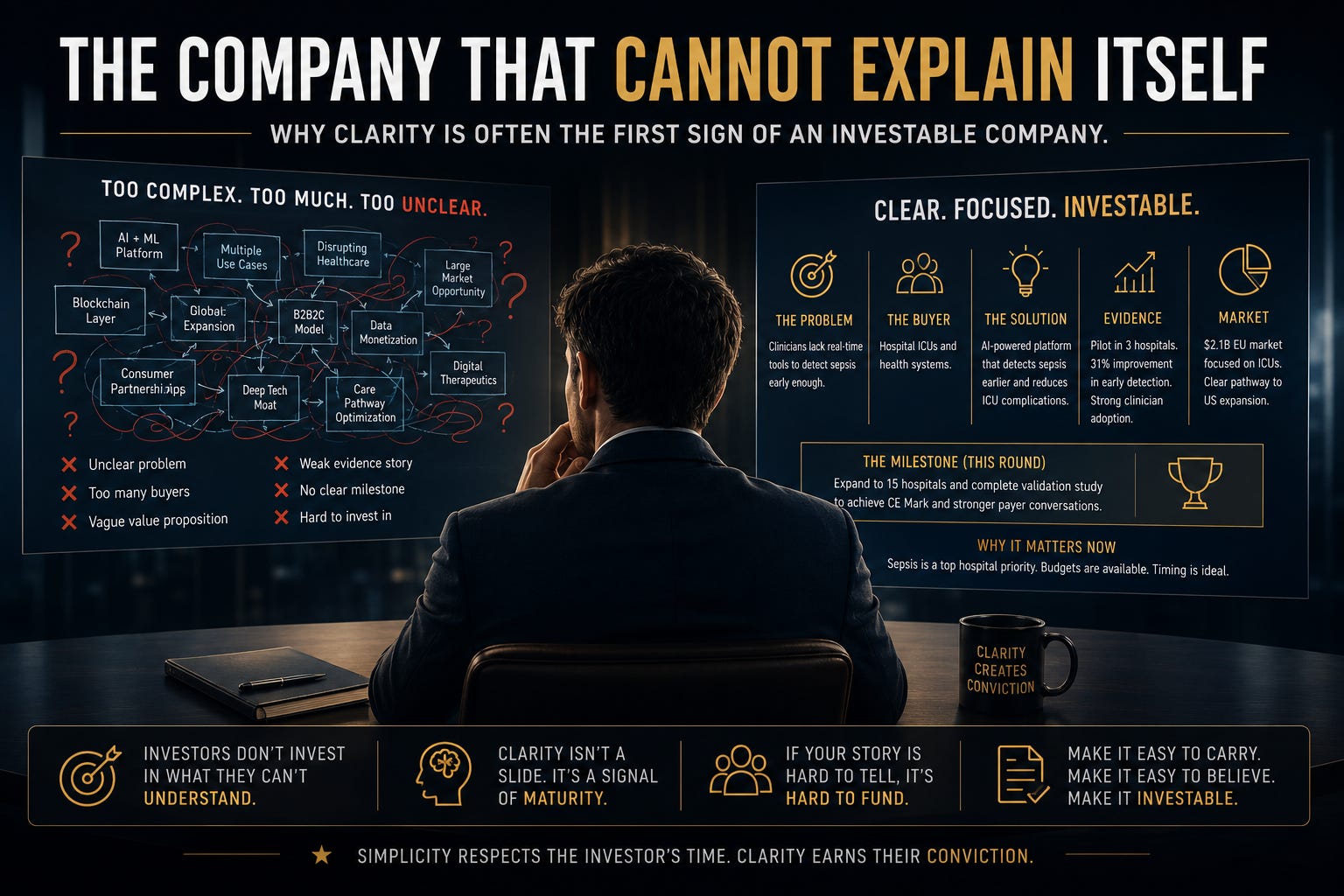
One of the reasons companies become hard to explain is that the founder understands too much. This sounds strange, but it is common. The founder has spent months or years living inside the problem. They know the history, the edge cases, the product decisions, the scientific nuance, the customer feedback, the market context, the regulatory details, the investor objections, and every possible future direction.
Because the founder sees the whole picture, they often try to explain too much at once. They include every use case, every stakeholder, every feature, every market, every possible buyer, and every long-term application. The result is not a richer story. It is a heavier one.
Investors do not need the whole company at once. They need the entry point. They need to understand the first thing that matters. What is the problem? Who has it? Why does it matter now? What does the product change? What evidence supports that claim? Who pays? What does this round prove? If those questions are not clear, the rest of the detail becomes noise.
This is one of the hardest shifts for founders. Clarity often requires leaving things out. Not because they are irrelevant forever, but because they are not the first thing the investor needs to believe. A platform may have many future applications, but the investor still needs to understand the first wedge. A scientific company may have deep technical nuance, but the investor still needs to understand the first value inflection. A healthtech product may support many stakeholders, but the investor still needs to know who the initial buyer is.
The strongest founders know how to simplify without making the company shallow. They do not strip away the complexity. They sequence it.
A founder is not only explaining the company to the person on the call. They are giving that person the language needed to explain the company to someone else. This is one of the most important parts of fundraising.
Your investor champion needs to carry the story internally. They may need to explain it to a partner. They may need to discuss it in a Monday meeting. They may need to write a memo. They may need to defend the deal to an investment committee. They may need to bring in advisors, co-investors, clinical experts, regulatory consultants, or strategic partners.
If the company is difficult to explain, the investor has to become the translator. That is a risky position for the founder. The investor may like the opportunity, but if they cannot explain it clearly to others, the deal becomes harder to move forward.
This is where many founders underestimate the importance of narrative discipline. They think the pitch is only about creating excitement in the first meeting. It is not. The pitch also needs to survive when the founder is not in the room. The story has to be clear enough that someone else can repeat it accurately, defend it under pressure, and explain why it matters.
A company that can be explained clearly is easier to share. A company that is easier to share is easier to discuss. A company that is easier to discuss is easier to diligence. A company that is easier to diligence is easier to fund.
That does not mean the story should be simplistic. It means the core logic should be strong enough to travel.
When founders struggle to explain the company, they often assume the deck needs to be redesigned. Sometimes it does. A clearer structure, better visuals, sharper slides, and better sequencing can help. But the deeper issue is often not the deck. It is the thinking beneath the deck.
If the founder cannot explain the company in a clear conversation, the deck will not fix the problem. It may make the company look more polished, but it will not make the strategy clearer. The investor may still struggle to understand the buyer, the market entry, the evidence, the milestones, or the business model.
This is why fundraising materials often expose founder confusion. A deck that tries to explain too many things usually reflects a company that has not made enough choices. Too many market slides may hide the fact that the first market is unclear. Too many product slides may hide the fact that the core use case has not been proven. Too many traction slides may hide the fact that the traction is not yet strong enough. Too many future applications may hide the fact that the first wedge is weak.
A good deck is not a collection of information. It is a sequence of belief. It should help the investor move from problem to solution, from solution to evidence, from evidence to market, from market to milestone, and from milestone to investment logic. If the founder cannot create that sequence, the investor may leave the meeting with interest but not conviction.
The goal is not to make the company sound simple. The goal is to make the investment case coherent.
Another reason companies fail to explain themselves is that founders speak in the wrong language for the audience. Scientific founders often speak in scientific language. Clinical founders speak in clinical language. Product founders speak in product language. Commercial founders speak in sales language. Each language has value, but investors need the company translated into investment language.
Investment language does not mean hype. It means explaining the business through the questions investors are trying to answer. What risk exists today? What evidence reduces that risk? What does this round prove? Why does that proof matter? Who will care if the company succeeds? What makes the company more valuable after the next milestone?
A scientific explanation may show why the technology is impressive, but it may not explain why the company is fundable. A clinical explanation may show why the product is needed, but it may not explain who pays. A product explanation may show what the tool can do, but it may not explain why adoption will happen. A market explanation may show that the problem is large, but it may not explain the first customer.
This translation matters because investors are not only evaluating whether the company is meaningful. They are evaluating whether it can become valuable. That requires the founder to connect the product, market, evidence, team, and financing plan into one clear story.
The best founders can move between languages. They can explain the science to scientists, the workflow to clinicians, the value to buyers, and the investment case to investors. They do not force every audience to interpret the company through the founder’s preferred language.
Investors often treat clarity as a signal. A founder who can explain the company clearly usually understands the company better than a founder who needs twenty minutes to reach the point. Clear founders have usually made hard choices. They know what matters now and what can wait. They know the difference between the long-term vision and the current financing milestone. They know which risks are central and which are secondary.
This is why clarity feels like maturity. It shows that the founder has moved beyond raw possibility and into strategic discipline. They are not trying to make the company sound bigger by adding more use cases, more markets, more stakeholders, more features, and more future options. They are making the company more investable by showing where value begins.
This does not mean every clear company is a good investment. It also does not mean every complex company is bad. But a clear company is easier to evaluate. Investors can understand the assumptions. They can test the evidence. They can discuss the risks. They can see what the next round of capital is designed to change.
A company that cannot explain itself makes all of that harder. Investors may still be interested, but they will have to spend more energy just to understand what they are looking at. In a competitive fundraising market, that is not a small problem.
Clarity gives the founder an advantage because it reduces unnecessary friction. It lets investors spend their energy evaluating the opportunity rather than decoding the story.
One of the places where unclear companies struggle most is the milestone. The founder may be able to explain the product and the market, but when asked what the next round of capital actually proves, the answer becomes vague.
They say the money will be used to build the team, continue product development, run pilots, expand the market, strengthen partnerships, generate evidence, and prepare for the next phase. Some of that may be true, but it does not explain the value creation logic. Investors need to know what the company will become after the round that it is not today.
This is where clarity matters most. A milestone should not be a list of activities. It should be a change in the company’s risk profile. What will investors believe after this round that they cannot believe today? What evidence will exist? What decision will be made easier? What risk will be reduced? What next investor, customer, partner, or acquirer will care?
If the founder cannot explain that, the round becomes harder to fund. The company may need money, but investors do not fund need. They fund progress. They fund the possibility that today’s uncertainty can become tomorrow’s value.
A clear milestone gives investors something to underwrite. It tells them why this financing matters and what success looks like. An unclear milestone makes the company feel like it is raising to keep going rather than raising to become more valuable.
Comments
Nothing yet. Say the first thing.
Sign in to join the conversation.