
What is the past? How far from us is it, really? How psychologically inaccessible to us are the billions of people who have lived and died and left their geologic and archaeological marks behind? These are the questions that are defining the reception of Christopher Nolan’s The Odyssey.
Complaints about historical inaccuracy are obviously absurd when discussing a fantasy blockbuster film based on an epic poem based (presumably) on a collection of tall tales that were orally recited. Even if we bracket the fantastical elements, the bags of wind and the pig-witches, amateur military historians will still have to specify which history they want The Odyssey to be accurate to. Homer’s texts are period pieces themselves, so Nolan inherits a story that sometimes represents the late bronze age accurately enough but sometimes superimposes its own period onto the then five hundred year old world that it narrates.
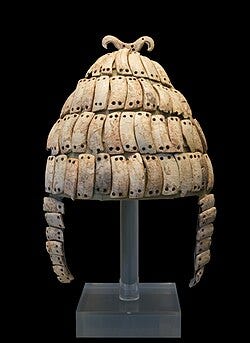
It would have been both a little cool and a little stupid if Nolan made Matt Damon wear the boar tusk helmets that amazingly appear both in the archaeological late bronze age record and in The Iliad. But if Nolan gave his cast long tower shields during the sack of Troy, he would be accurate to what we know about Mycenean technology but inaccurate to the small round shields of the poems. Period inaccuracy is a relatively recent idea in drama — a Globe production of Julius Caesar or Antony and Cleopatra would probably have dressed their cast in then contemporary aristocratic clothes rather than Roman costume. “Accuracy” is obviously a poorly defined term of critique.
However the silliness of these debates do reveal an interesting discomfort and uncertainty over our relationship with the stories of the past. How much do we want to recognise the world that is portrayed in historical storytelling, and how much do we want to be confronted with its strangeness and inaccessibility? Should Damon and the rest of the cast be portraying people who we might meet and understand with our contemporary brains? Or should they be inscrutably defined by relationships with worlds and gods that we cannot know? Jon Repetti represented the later camp pretty well when he tweeted “I want an Odyssey adaptation (and an Odyssey translation) that makes you feel in your bones how profoundly different the archaic Greeks were from us. Basically space aliens. Nolan is just fundamentally not interested in that kind of estrangement.”
Homer is probably too enmeshed in Western Civilisation (or “western” “civilisation”) for an adaptation to ever feel wholly strange. The suitors and the Cyclops and the trojan horse are all too familiar. But the characters’ psychology in the Greek epics does feel more remote than even the plays that were probably written about 200 years afterwards. This transition — from Homer to Aeschylus, Sophocles and Euripides — is what Bruno Snell traces in his book The Discovery of the Mind in 1946. He writes that “Homer’s man does not yet regard himself as the source of his own decisions; that development is reserved for tragedy.” This is probably why Freud uses the tragideans and not Homer to explicate his theories.
I felt this staged in the film where Lupita Nyong’o’s Clytemnestra appears like she does in the Oresteia, or even like she does in Marina Carr’s adaptation Girl on the Altar. She does what you or I would do if a husband demanded you celebrate him for the mad war he won. If he demanded you anoint him with oils for his wisdom in slaughtering your baby daughter and for his strength in raping and butchering strangers.
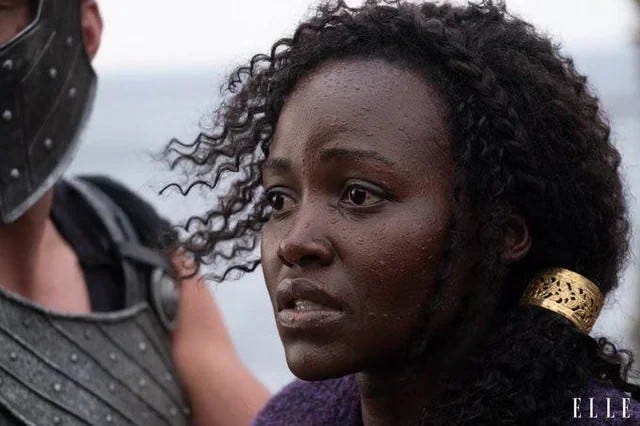
Agamemnon: You’re wrong as you’re wrong about everything. I was fond of the child.
Clytemnestra: You put up with her as long as you thought you could bring me to heel. You allowed her live as long as I toed the line. But the second I refused you, you threw us to the wolves.
Agamemnon: I’m going to hang you in chains in front of your precious children.
Clytemnestra: Do that.
Cassandra: She flings the goblet aside and takes up an axe that’s lying among a pile of spears, maces, daggers.
Here is a woman who is recognisably alive to blood and to misogyny and to the things you can and can’t swallow. She’s not an alien, in fact it would be easier if she was. You recognise her when she looks out at you, you who watch her. She’s a person.
And in Nolan’s film, this is the kind of person that Odysseus becomes when he finally returns home. He feels guilt and shame and disgust and dread, and his shipwreck is careening towards bitter tragic horror, not epic glory. But what caused this? Did something change in Odysseus? Or was it the world?
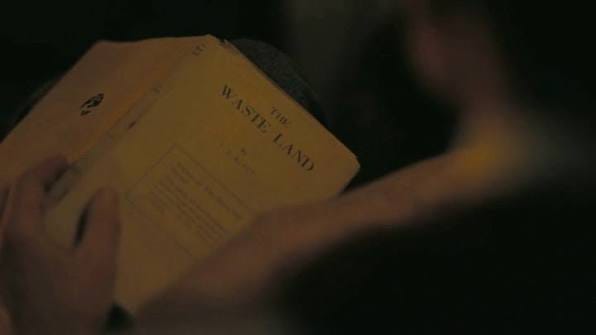
In Oppenheimer, Nolan also stages a man on this threshold between one kind of society and the next one. The Trinity test makes for a very material before and after, the detonation released radioactive material into the world that couldn’t exist before Los Alamos and will be written into Earth’s geological record for millions or even billions of years. But the film also dramatises this changing world through twentieth century modernism, Cillian Murphy broods over T.S. Eliot’s The Wasteland and stares at Picassos. He turns to his fellow quantum physicist:
You embrace the revolution in physics, can’t you see it everywhere else? Picasso, Stravinski, Freud, Marx...
This perhaps alludes to Virginia Woolf’s famous assertion that “on or around December 1910, human character changed.” The stage for these changes was atomic, but it was also the human mind. The human subject in the twentieth century lost their centre and everything was, like the new physics, entangled and uncertain.
Oppenheimer, of course, wasn’t a literary modernist. He didn’t change the human mind with stream-of-consciousness narration, he displaced it with a bomb. And he feels horror about that, he styles himself a prophet of doom to try and return to what was lost. But it’s no good, the world has changed and so have all our minds. This “American Prometheus” brought fire and in so doing made us new types of human.
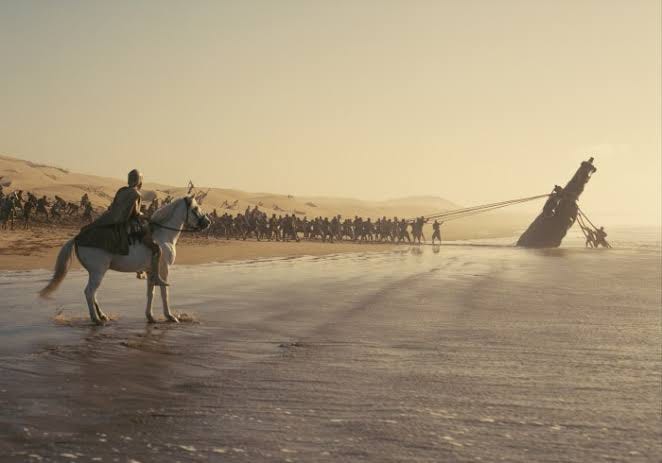
The twist of The Odyssey, such as it is, is that Odysseus feels he has broken the world with the trojan horse. He views his crowning mythic achievement of ingenuity as a broken pact with the gods, as a Promethean sin. We see him and his Navy SEAL coded team open the gates of Troy and let slip an atomic bomb’s worth of rape1 and fire into the city. He watches his men behead a young priestess played by Zendaya and we realise that Athena, who has appeared to Odysseus throughout the film, shares a face with this unnamed and terrified victim of his invention.
This internalised shame and disgust is Nolan’s ultimate explanation for why so few Greek’s made it home from Troy. They became a different, more horrifying, type of people with different, more horrifying, types of minds. And importantly, they became recognisable to our contemporary brains in a way that they probably wouldn’t have been when they set out on their epic. In a clever touch, Nolan implies that the “Sea People”, a hypothetical group of raiders who are often blamed for the Bronze Age Collapse, were actually Trojan warriors like Odysseus and his crew who continued their rape and plunder. They couldn’t go home, because they are different people now. People we recognise.
Nolan isn’t asking whether or not the “real” Odysseus would feel guilt and horror for what he did in a way that is recognisable to us. He is asking what produces the conditions that in turn produce these forces of guilt and horror. Across his last two films he points towards stories and art, revolutionary works of modernism like The Wasteland. And, presumably, poems like The Odyssey and The Iliad which we can argue did a lot of work to produce what we now think of as Greek civilisation.
But more importantly perhaps, the modern mind is produced by innovative violence, new technologies of slaughter. The direct blood on Oppenheimer and Odysseus’ hands are viscerally apparent, but Oppenheimer is also blamed for the Cold War that ruined his life and Odysseus is blamed for the bronze age collapse that he and his men brought home from Troy.
He isn’t telling a story about our particular violent minds transposed onto the remote past. He is telling us the origin story.
The sexual violence of the film is heavily implied but never explicitly portrayed or shown. This is an understandable aesthetic choice, but leaves the thematic horror strangely unarticulated.
Comments
Nothing yet. Say the first thing.
Sign in to join the conversation.