
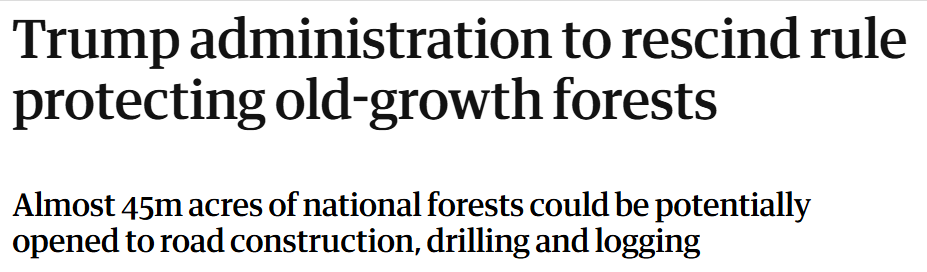
The Guardian reports that the Trump administration wants to rescind the “Roadless Rule” which protects roadless wilderness areas, much of which are old growth forests.
Trump administration to rescind rule protecting old-growth forests
Part of the justification, not to say excuse, to rescind the Roadless Rule is that we need to get into those forests and remove “hazardous fuels,” another word for valuable timber.
Those who seek to protect old growth forests make the mistake of conceding that there is something called “hazardous fuels.” The term hazardous fuels is one of those deceptive timber industry terms they use to justify logging.
And when I say “timber industry,” this includes the US Forest Service, because they are in the logging business. They make money from timber sales. It is deeply embedded in the organization’s culture and priorities.
I would assert that the only “hazardous fuels” are those that exist within 100 feet of a home or structure. Certainly when you get a mile or more away from a home or municipal area, as are the vast majority of acreage in national forests, a wildfire poses no threat to municipal structures that is not best dealt with by home hardening, i.e., making the home fireproof, via fireproof roofs, ember proof vents, cleaning gutters of leaves and pine needles, etc.
The mythology about “hazardous fuel” and the need for “forest thinning” and “active management” are used to justify endless logging. The timber industry is able to get into our national forests and remove trees that are valuable to them and pose no fire hazard whatsoever to the remote municipalities that they are claiming to protect.
Article:
“Active forest management is not an option. It’s essential,” said Tom Schultz, the forest service chief. “More than 40% of inventoried roadless areas, primarily in the west, have high or very high wildfire hazard potential. And only 5% of those areas have received hazardous fuels reduction treatments since 2014.”
But Craven of the Sierra Club said: “The administration’s attempt to blame the roadless rule for worsening wildfire risk ignores both the facts and the rule itself. Roads generally lead to more ignitions and result in more wildfires – not fewer.
“And, the roadless rule has always allowed for targeted actions to reduce hazardous fuels. What it does not allow is using wildfire as an excuse to open some of America’s most intact public forests to industrial exploitation and new road construction.”
Tom Schulz leads with tired old anti-scientific logging industry talking points.
Craven of the Sierra Club correctly asserts that more roads cause more ignitions, but he concedes the existence of “hazardous fuels.”
Maybe he does this because he is assuming arguendo (for the sake of argument) that the Roadless Rule allows “hazardous fuels” to be removed.
But we don’t know what he was thinking and arguably this concession is a mistake, because it is this false and powerful idea that gives logging companies access to our public forests on false pretenses.
We are to believe that our forests need “active management” and “forest thinning” and the removal of “hazardous fuels.”
None of this keeps people safe, and all of it seriously degrades our public forests for the sake of private profit. This degradation destroys wildlife habitat, while releasing megatons of carbon into the atmosphere. It is also a cause of drought, which causes wildfires to burn hotter and travel faster.
Another troublesome issue here is not understanding how old growth forests fit into natural ecological cycles. If we value the wildlife habitat that forests provide, we will understand that old growth forests need to be allowed to burn according to natural cycles. Old growth forests and burned forests both provide great habitat. But there needs to be an emphasis on leaving the old growth forest alone both before and after a fire.
If you would like to continue this conversation, please consider joining us for the course:
Wildfires Mythology vs. Reality – Fall 2026 - Biodiversity for a Livable Climate
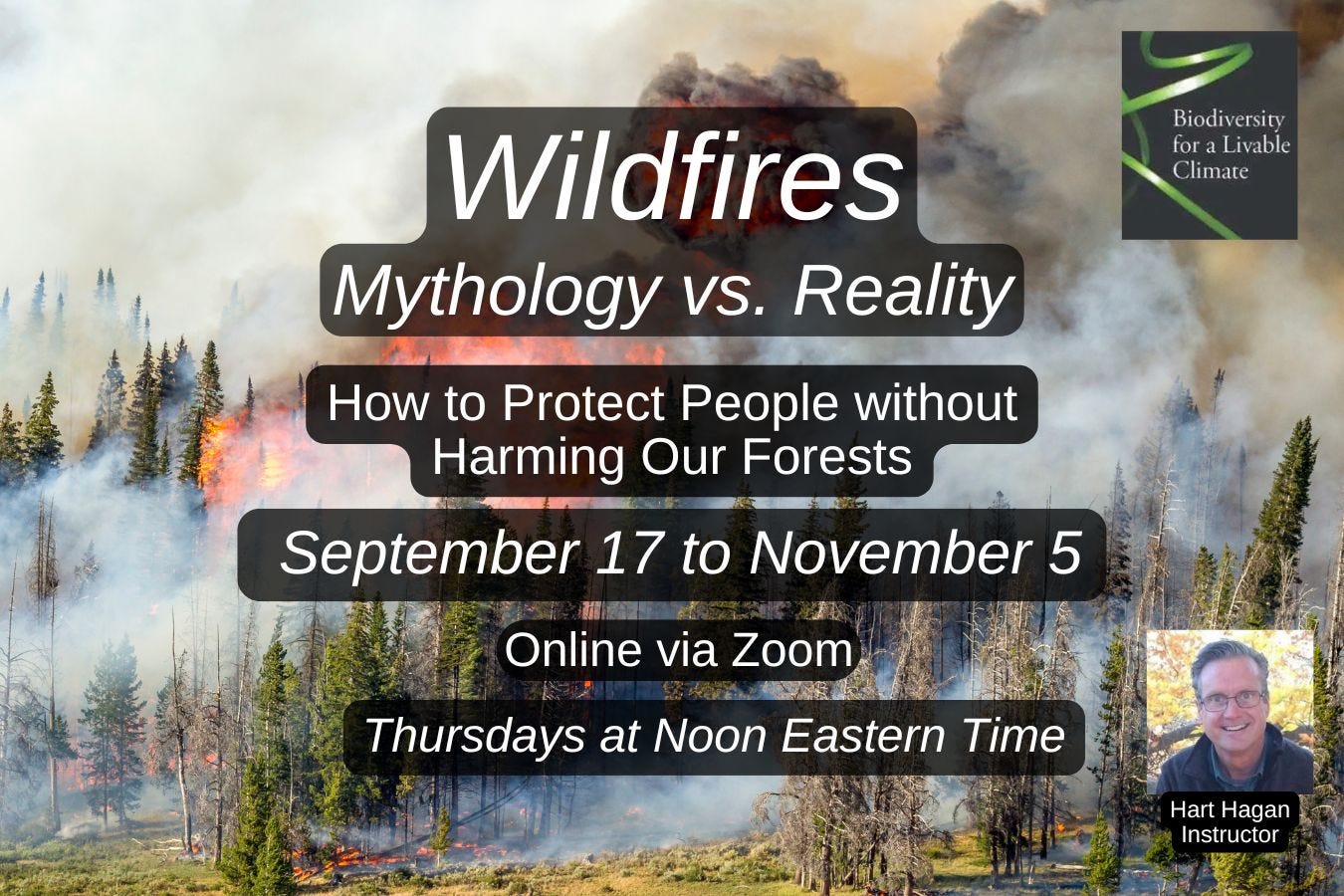
This is really a speaker series, featuring some of North America’s leading experts in wildfire ecology, including how to keep people safe while saving our forests for habitat and carbon storage.
No posts
Comments
Nothing yet. Say the first thing.
Sign in to join the conversation.