
New York Times article: Lake Powell Hits Lowest Level On Record As Water Crisis Continues - The New York Times
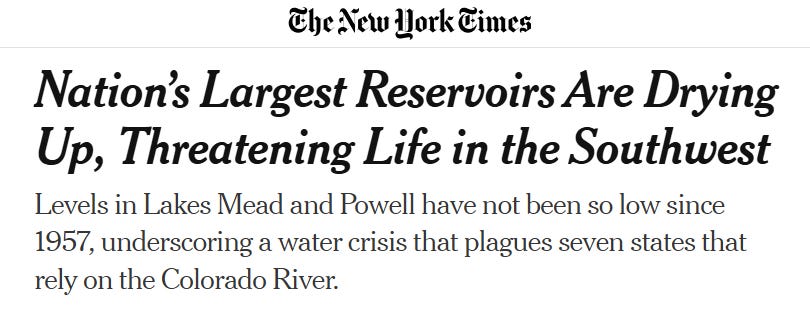
The article reports that Lakes Mead and Powell, the two largest reservoirs in the American West have reached historic lows. Scientists and policymakers are trying to understand the problem and wondering what to do.
As ever, I assert that the New York Times is not reporting responsibly, which I hope to make clear, below.
Brad Lancaster in Rainwater Harvesting presents research that small watersheds are much more efficient at retaining water and not losing it to seepage and evaporation, whereas large watersheds are highly inefficient, losing much water to evaporation and seepage. But here we are, focusing on large reservoirs in large watersheds.
If we wanted to solve water problems in the arid West, we would explore how to turn the landscape into a sponge, by improving the soil and setting the stage for more vegetation in our farms, forests and landscapes.
Article:
“The water shortage could have dire implications for growing Sun Belt cities such as Phoenix, for key industries including agriculture and data centers, and for hydroelectric dams that power millions of homes across the Southwest.”
Buried within the word “agriculture” are a hundred major questions we should be asking, like:
Are we actually growing food?
Would we organize “agriculture” this way if “We The People” had a choice?
Are we degrading the land, or are we improving it?
Are we conducting “agriculture” according to the best available science?
The answer to all questions, seems to be no.
Article:
“The shrinking reservoirs are the immediate result of record-low snowpack this winter, which was erased by record heat in the spring. Melted snowpack creates most of the Colorado’s flow during the dry summer months. But as the Southwestern climate has grown hotter and drier, the river’s flow has become smaller and less reliable.”
Questions to be asked:
Are we doing what we can to cool temperatures and increase precipitation in this region?
Are we doing what we can to turn the landscape into a sponge and capture rainfall?
Do current forestry and agricultural practices make the situation better or worse?
Kathryn Sorensen, the director of research at the Kyl Center for Water Policy at Arizona State University [says],
“Mother Nature is in charge of this system.”
Really?
But in the very next paragraph, they say:
“At the same time, a booming population in the Southwest and intensive agriculture mean that the region is consuming far more water than the river can now provide.”
As always, they focus on how much water “agriculture” consumes. That’s fair, since industrial agriculture does consume most water that is consumed by humans …
But …
They don’t talk about how regenerative agriculture not only consumes less water but turns the landscape into a sponge, so that much of the water consumed can be sourced locally, often right there on the farm.
They don’t even ask the question of whether much of our cropping systems could be rain-fed, or that much of our livestock could be watered from small rain-fed ponds, or at least collected locally and transported short distances via gravity and pipes.
Article:
“Agriculture is the biggest user of the Colorado River, with alfalfa and other sources of livestock feed accounting for nearly half of the water consumed. Municipal water systems use about a quarter.”
Yes, alfalfa (hay) is one of the most water-intensive crops. So they ought to be talking to Gabe Brown in North Dakota to see how he minimizes hay, and uses less than most ranchers in Texas, much further south.
They end with the question: “What is being done to shore up the reservoirs?”
The answer, as usual, is to decide who gets to use less water. Fair enough, but they are talking about what regions get to use less water, not which activities are using more than their fair share of water.
And this whole conversation took place, as noted above, without a word about how to improve the condition of the land so that it captures more rainfall, and even brings more rainfall. Trees bring rain, if the forests are large enough and mature enough to activate the biotic pump.
If you would like to continue this conversation, please consider joining me in the upcoming course:
Wildfires Mythology vs. Reality – Fall 2026 - Biodiversity for a Livable Climate
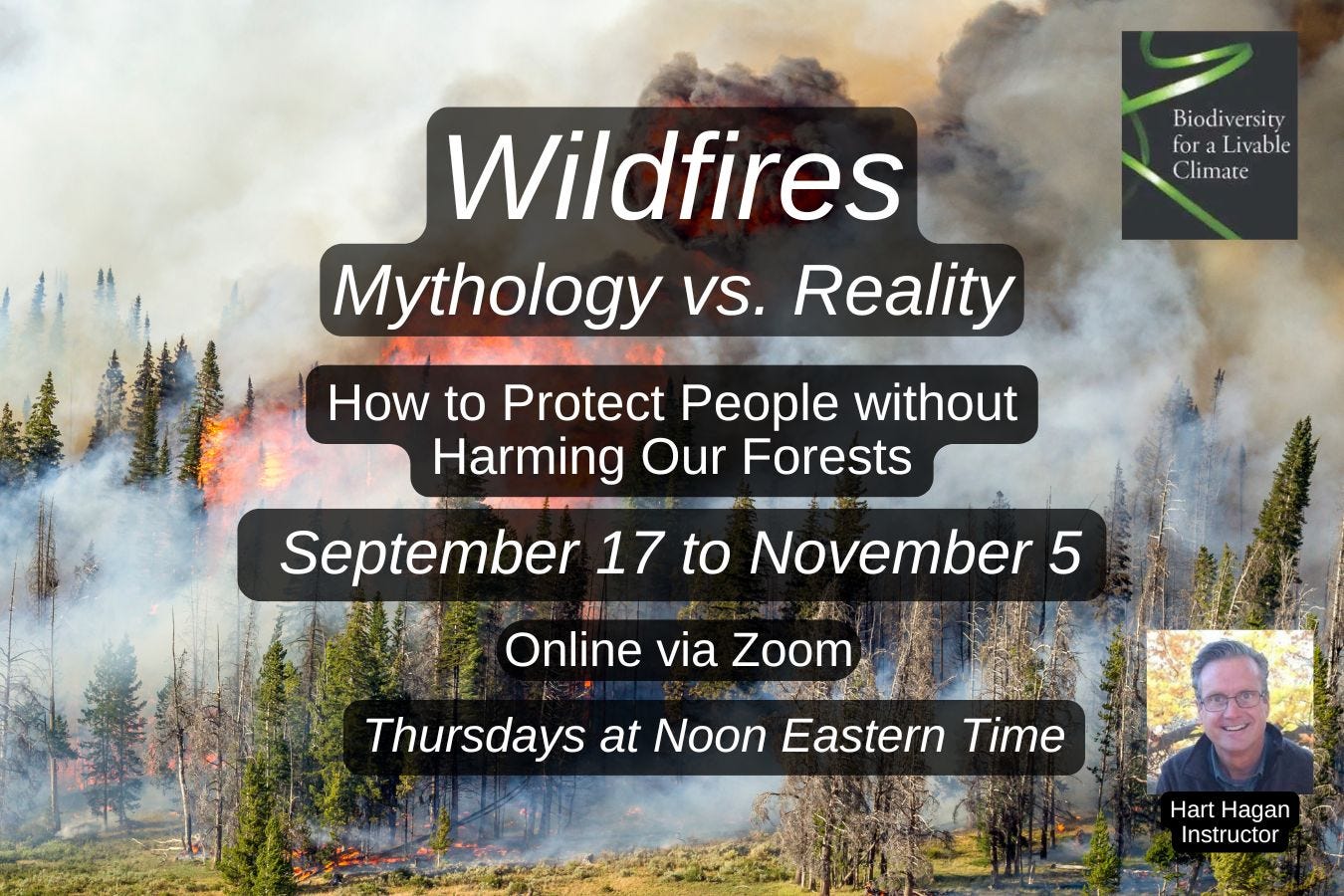
What do wildfires have to do with water? Everything, because a misguided wildfire policy is used to hammer our forests.
Here’s how.
In this article we have discussed the reservoirs that depend on the Colorado River watershed. This is only one of many watersheds where our forests are subject to “wildfire pretense logging,” i.e., logging that falsely pretends to protect people from wildfires.
Eight years as a climate reporter has led me to believe that protecting our forests is Job One in addressing climate change and that bad wildfire policy is the primary threat to our forests.
I hope you can join us.
Wildfires Mythology vs. Reality – Fall 2026 - Biodiversity for a Livable Climate
No posts
Comments
Nothing yet. Say the first thing.
Sign in to join the conversation.