
Happy Sunday! Just back from Stern Grove Festival. It was great to see some of you there :) In the meantime, the robots got political 🤖 Thirty-five thousand Hyundai workers walked off the line in the auto industry’s first strike over humanoid robots, on the very day Hyundai completed its takeover of Boston Dynamics. Samsung answered by standing up a whole new robotics division with $13B behind it, and Travis Kalanick came back swinging with $1.7B for physical AI 🏭 The labor debate we all knew was coming has arrived, and I think we’ll look back at this week as the moment it got real. Let’s get into it 🚀.
🪧 Hyundai workers stage the first auto-industry strike over humanoid robots — the same day Hyundai finalizes its Boston Dynamics takeover
🇰🇷 Samsung forms a new Robotics eXperience (RX) division with a ~$13B humanoid manufacturing push, led by the ex-Hyundai robotics chief
💰 Travis Kalanick’s Atoms lands $1.7B led by a16z to build physical AI for food, mining, and transport
🥊 A humanoid loses its head at Shenzhen’s new URKL fight league and keeps fighting — 400M views in 72 hours
🐦 MIT’s FAAV robot swims like a puffin, then bursts out of the water and flies
🦾 Agility Robotics opens a Digit training center in Fremont — right in Tesla’s backyard
🛰️ Besxar flies reusable semiconductor “Fabships” to space on a Falcon 9 booster and brings them back
👉 Add your company to the next issue of HardTech Reads
Tens of thousands of union workers at Hyundai’s Ulsan complex in South Korea staged partial walkouts, the first factory stoppage in auto history triggered by humanoid robots. The union wants written guarantees that no Atlas robot enters a Korean production line without labor-management approval, plus a higher retirement age and salary protections against automation quietly eroding hours. The timing was cinematic: the escalation landed on the same day Hyundai finalized its full acquisition of Boston Dynamics, with plans to deploy more than 25,000 Atlas units across Hyundai and Kia plants starting at the Georgia Metaplant in 2028.
This is the story I’ve been telling founders to prepare for. Deployment at scale was always going to meet organized labor, and how Hyundai handles this negotiation will set the template for every automaker watching. Worth following closely.
Samsung established a dedicated Robotics eXperience (RX) division, led by EVP Lee Dongkun, the former Hyundai robotics strategist who oversaw the electric Atlas and Spot programs at Boston Dynamics. CEO TM Roh will personally supervise the unit, which plans robotics research hubs in the US, China, and Japan alongside its Seoul headquarters. Samsung says it intends to start manufacturing humanoid robots within the year and will invest roughly ₩19T (~$13B) in production facilities in Gumi. After years of CES robot teasers, poaching the man who commercialized Atlas signals Samsung is done with demos.
Agility Robotics is opening a 60,000-square-foot humanoid training facility in Fremont, California, up the highway from the factory where Tesla plans to build Optimus. The site is where Digit will learn new skills in mock environments matching customer facilities, with CEO Peggy Johnson saying more than 30 customers are in talks about deployments. Digit is already earning revenue moving totes for Amazon, GXO, Schaeffler, and Toyota Motor Manufacturing Canada, with $300M in contract orders secured. Digit version 5, expected this fall, will sense humans and work outside robot-only zones.
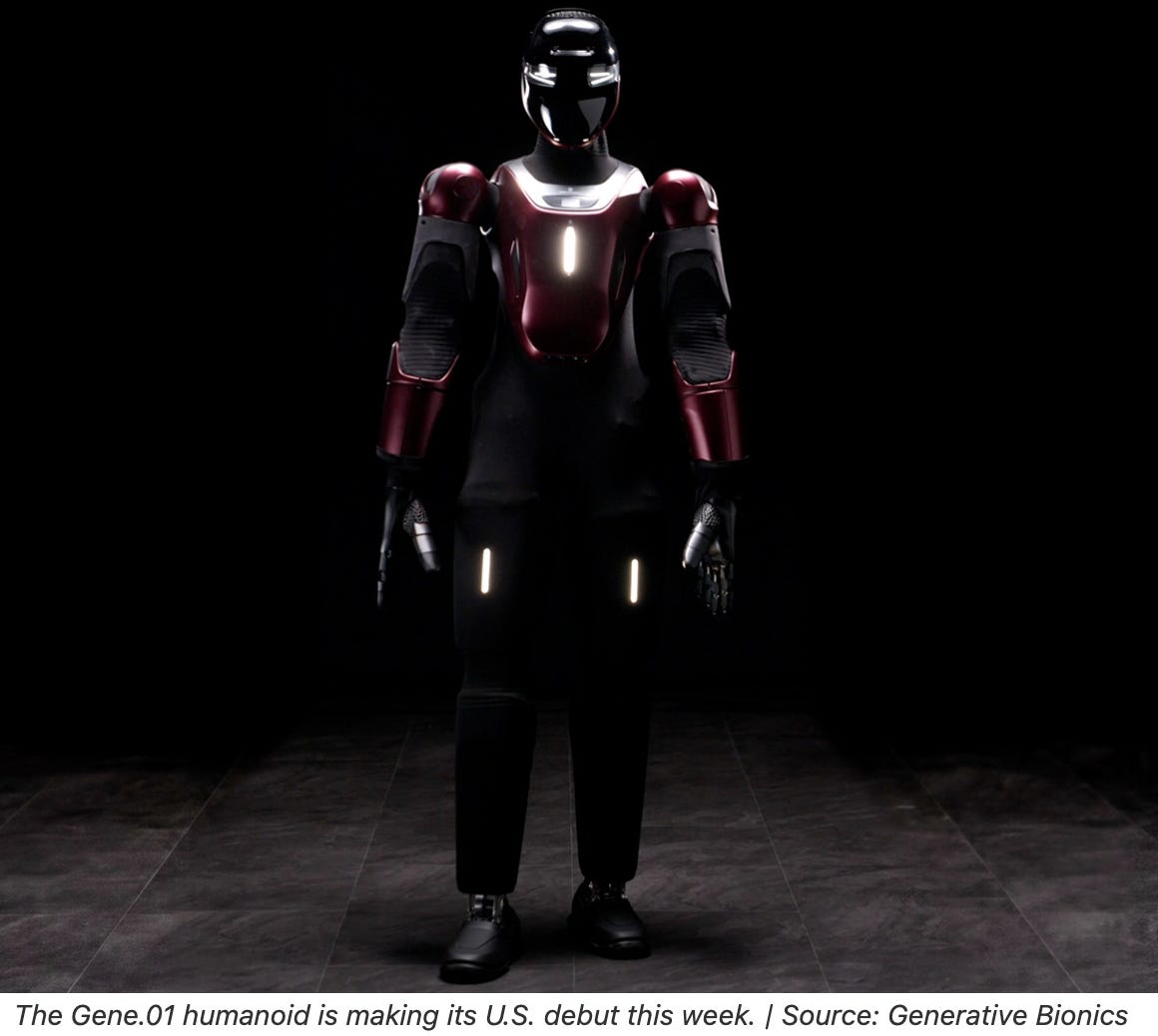
Italian startup Generative Bionics, spun out of 15 years of iCub research at the Istituto Italiano di Tecnologia, unveiled Gene.01, a humanoid wrapped in full-body tactile skin that senses touch, temperature, proximity, and force before and during contact. Built in six months, the robot made its US debut at AMD Advancing AI in San Francisco, walking the halls of Moscone Center. The company is backed by an $81M seed led by CDP Venture Capital with AMD Ventures, Eni Next, and Tether, and is already adapting the platform for shipyard work with Fincantieri. It’s also open-sourcing the robot model for physical AI developers.
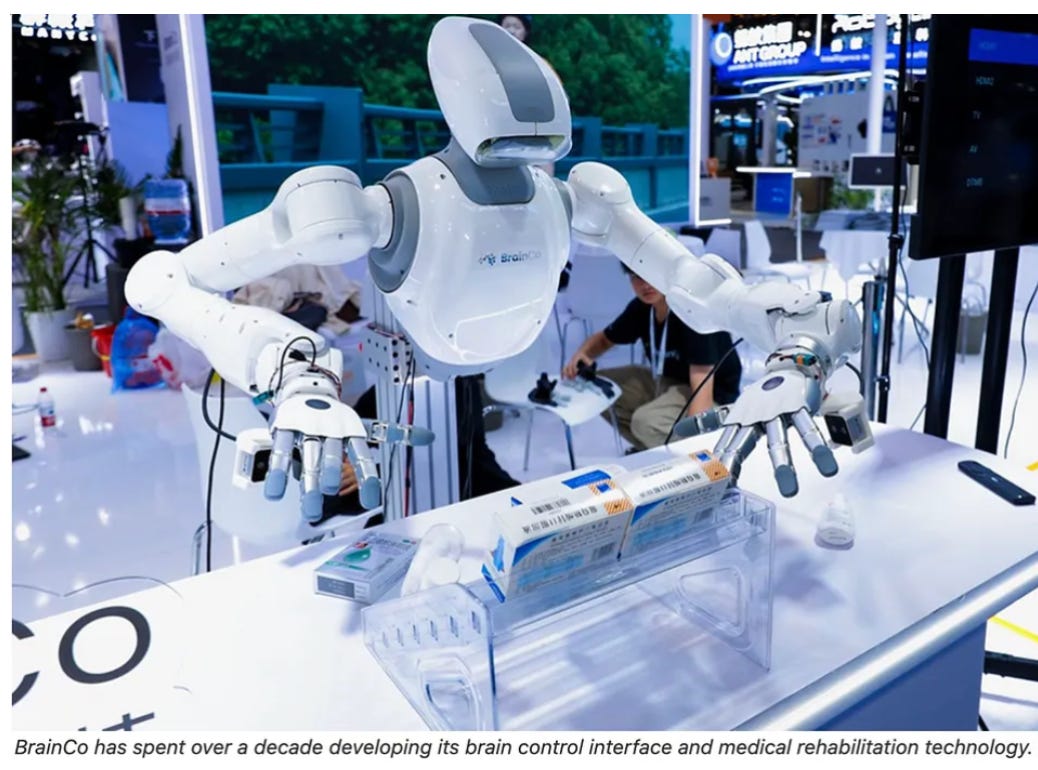
At WAIC, Harvard Innovation Lab-incubated BrainCo demonstrated a brain-computer interface platform where a person wearing a lightweight EEG headset thought about grabbing a cap, and a robotic arm reached out and did it, all in under 200 milliseconds. The demo arm handled precision tasks like grasping a cup and picking up an apple. BrainCo’s data-collection stack records not just what a person’s hands are doing but what their brain is telling those hands to do, EEG signals included, a data layer nobody else in embodied AI is capturing. The Somerville, Massachusetts company already ships three robotic products, including the Revo 3 dexterous hand.
BionIT Labs, the Italian company behind Adam’s Hand, a fully adaptive myoelectric prosthesis developed for people with limb loss, is now offering the hand as dexterity hardware for humanoids and service robots after demonstrating it on two robot platforms at CES 2026. Founder Giovanni Zappatore built the original mechanism for his engineering thesis (his first 3D printer was a gift from his grandmother), then spent years getting it onto patients before robotics came knocking. A hand engineered to survive daily human life brings a robustness bar most robotic grippers never had to meet.
A hand built to give people back their grip is now teaching machines how to have one. This is my favorite kind of hardtech story, and the founders are doing a really great job building it from Puglia of all places.
NEURA Robotics is establishing NEURA Gym RWTH Aachen, a 3,000-square-meter physical AI training facility at the Hightech Campus Melaten, integrating around 20 university institutes and opening access to companies validating robots for production workflows. It’s the latest node in a planned network of ten NEURA Gyms across Europe, the US, and China aimed at the industry’s biggest bottleneck: real-world training data. Five locations should be operational by end of 2026, including one at Munich Airport with TU Munich. The rollout rides on NEURA’s Series C of up to $1.4B, the largest ever for a full-stack robotics company.
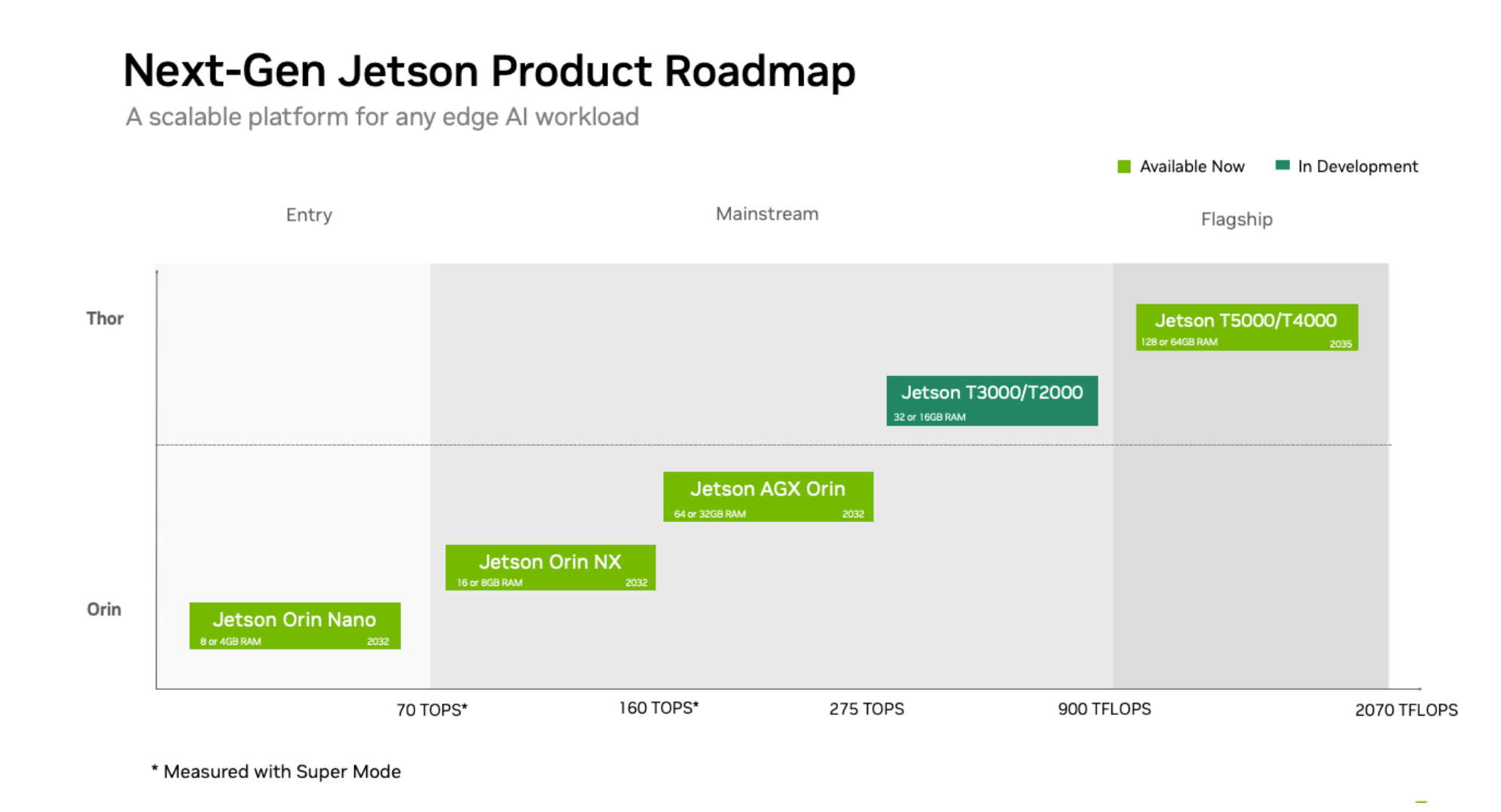
NVIDIA introduced the Jetson Thor T3000 and T2000, two Blackwell-based compute modules built to push physical AI into mainstream robotics and edge devices. The T3000 delivers up to 865 FP4 TFLOPS from a 1536-core Blackwell GPU with 32GB of memory, while the T2000 offers 400 TFLOPS in an even smaller envelope, both about half the size of the existing T4000/T5000 modules. Developers get T3000 emulation support this month through JetPack 7.2.1, with both modules shipping in Q1 2027. Cheaper, smaller robot brains are exactly what the mid-market humanoid and AMR makers have been waiting for.
Engineers at MIT and EPFL built the FAAV, a flapping-wing robot under 300 grams that swims like a puffin, punches through the surface at a 70-degree pitch, and flies away, no feet-paddling required. In tests in Lake Geneva, the robot swam at nearly 1 m/s and flew at 6 m/s using one pair of flexible wings for both mediums, matching the performance of real diving birds. The results published in Science point toward a new class of aerial-aquatic drones that could sample dangerous ocean zones, monitor algal blooms, or inspect ports at a fraction of the cost of crewed vessels.
The Ultimate Robot Knockout Legend (URKL), the world’s first free-combat league for full-sized humanoids, opened at Shenzhen’s Nanshan Cultural and Sports Center with 32 teams all piloting EngineAI’s 1.73m T800. The moment everyone’s talking about: White Eagle landed a head kick that left Matador’s head dangling by a cable, and the robot kept punching, kicking, and scrambling back to its feet anyway. The league says the opening gala passed 320M cumulative views in 72 hours, with the decapitation clip alone topping 400M plays. Finals run November through December, and yes, the Terminator comparisons write themselves.
The latest YC cohort has a distinctly hardtech flavor. Aktoria Robotics offers “human-as-an-API” teleoperation: when a robot gets stuck, a trained operator takes over in under a second, and the team has demonstrated operators in India driving robots in San Francisco at 158ms latency. SubVysion builds AI-powered AR maps of underground utilities so contractors can dig without hitting gas lines, and Daqstra is an AI-native orchestration layer for physical R&D test infrastructure in aerospace, energy, and robotics.
I love seeing founders move past generic software agents and take AI into robotics, infrastructure, and labs. The execution is much harder there, but so is the defensibility!!
Besxar Space Industries, the Washington, DC startup founded by early OpenAI employee Ashley Pilipiszyn, flew two reusable microwave-sized manufacturing pods on a Falcon 9 first-stage booster alongside a Starlink launch. The Fabships rode through an 8-minute trip to near-space and returned with the booster for analysis, the first of 12 booked SpaceX flights testing whether the vacuum of space can produce ultra-pure semiconductor substrates. The bet: orbit as a cleaner fab environment than anything we can build on Earth. Ambitious infrastructure plays that challenge where manufacturing happens, not just how, are exactly what this newsletter is for.
A school district in upstate New York is piloting Sally, a humanoid robot teaching assistant from Realbotix, in its high school AI and robotics courses this summer. Sally provides AI tutoring plus 24/7 homework support through a platform called Optio, in a district serving a predominantly Indigenous and economically disadvantaged community. Officials frame the program as expanding equitable access to AI resources for students who’d otherwise never interact with a humanoid before college. Robots teaching kids about robots: the loop is now closed.
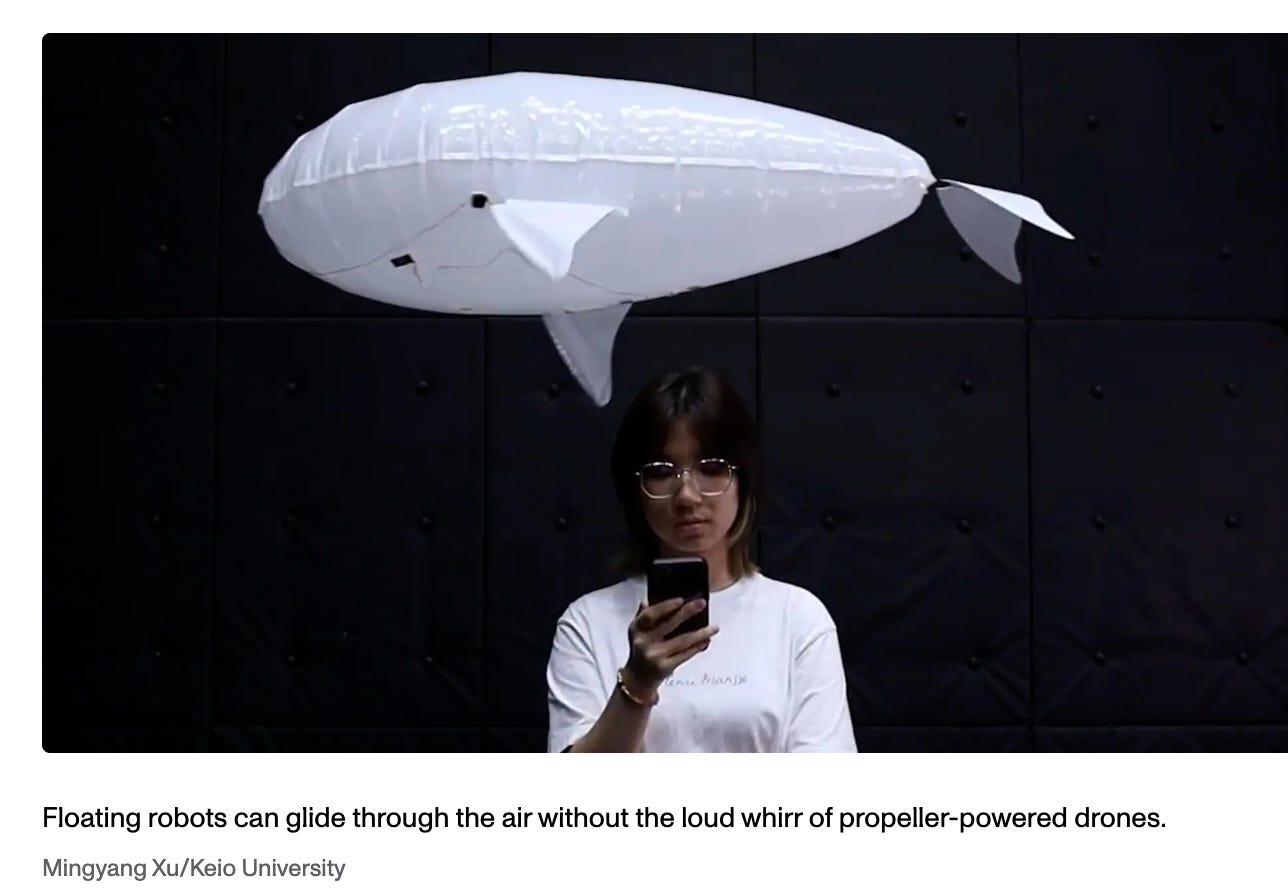
Japanese researchers built a soft, helium-filled companion robot that drifts silently through indoor spaces instead of rolling on wheels or buzzing with propellers. Inspired by Studio Ghibli and Tinker Bell, the prototype can wake you up, deliver reminders, dance along with you, and keep you company while you work, and it’s soft enough for safe physical contact. It’s a counterpoint to the hard-shelled humanoid race: companionship robotics doesn’t have to look human at all.
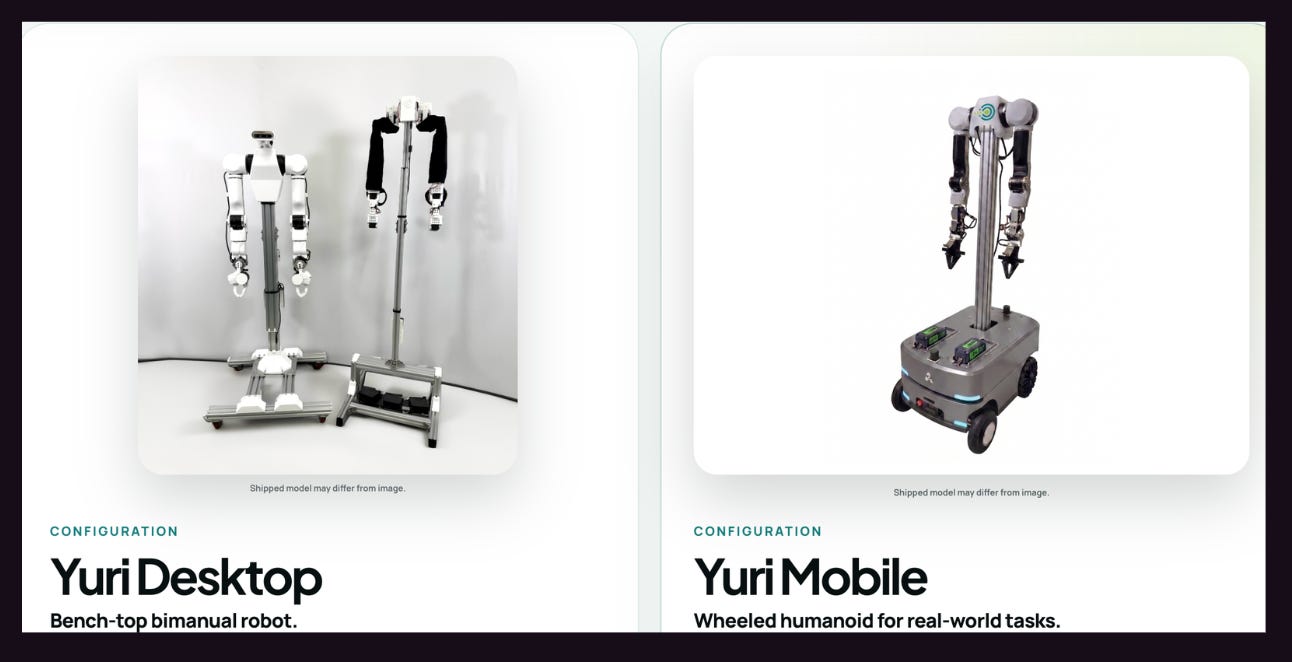
Texas-based Sensori Robotics is shipping Yuri, a dual-arm robot built on the open-source OpenArm platform, in bench-top and wheeled mobile configurations aimed at physical AI researchers. The system pairs two 7-DOF arms with force-feedback leader arms for teleoperation, an NVIDIA Jetson AGX Orin brain, and comes preconfigured for ROS 2, LeRobot, and VLA training out of the box. It’s part of a wider wave of affordable, open research humanoids putting serious data-collection hardware within reach of small labs.
➡️ Atoms — Travis Kalanick’s physical AI holding company spanning Atoms Food (CloudKitchens), Atoms Mining, and Atoms Transport, building “atoms-based computers” where manufacturing is the CPU and transportation is the network. Raised $1.7B in equity funding, led by a16z (Ben Horowitz joins the board), with Bain Capital, Fifth Wall, Chemistry, A, K5 Global, SV Angel, and Uber*. Location: Los Angeles, USA.
➡️ Helsing — Munich defense tech company building AI-enabled strike drones, underwater surveillance systems, and autonomous software, with HX-2 drones already supplied to Ukraine. Raised $1.8B in Series E at an $18B valuation, Europe’s biggest defense-startup round ever, from Dragoneer, Lightspeed, Iconiq, Growth Equity at Goldman Sachs Alternatives, JPMorganChase, CPP Investments, General Catalyst, and Plural. Location: Munich, Germany.
➡️ BRINC — builds American-made 911 response drones for police and fire departments, targeting a BRINC drone at every one of the ~80,000 public safety facilities in the US. Raised $125M, led by Motorola Solutions, with Index Ventures and Figma founder Dylan Field. Location: Seattle, USA.
➡️ microagi — founded by former Red Bull Racing and Mercedes F1 engineers, fine-tunes off-the-shelf robots with its Atlas software and leases them to factories ready to work. Raised $55M in seed funding, the largest seed round in German history, led by Hummingbird, with Northzone and LocalGlobe. Location: Munich, Germany.
➡️ Monumental — operates a fleet of 150+ autonomous bricklaying robots on construction sites in the Netherlands and UK, run on its Atrium AI platform. Raised $32M in Series B, led by Khosla Ventures, with Plural and Hummingbird. Location: Amsterdam, Netherlands.
➡️ Xynova — Chinese developer of dexterous robotic hands planning to hit annual production of 10,000 hands by year-end. Raised ¥500M (~$74M) in Series A, led by Meituan, with Xiaomi and NIO Capital. Location: China.
➡️ Hyperion Robotics — runs robotic microfactories that 3D-print low-carbon concrete infrastructure parts near project sites, cutting production time up to 3x and CO2 up to 70%. Raised $7.4M in growth funding, co-led by Course Corrected and the EIC Fund, with RE Ventures, Lifeline Ventures, Übermorgen Ventures, and PC Rettig Impact & Co. Location: Espoo, Finland.
➡️ Groyyo — AI-powered manufacturing and supply-chain platform helping Asian factories digitize production, procurement, and shop-floor tracking for global fashion brands. Raised $9.3M in the first close of a targeted $20M round, led by Cornerstone Ventures, with participation from existing investors. Location: Gurugram, India.
How Much Is Robot Deployment Data Worth? — Chris Paxton’s contrarian essay on deployment data flywheels. His argument: most robot deployments are tightly constrained by design, so the data they generate rarely teaches the model anything new, and even Tesla’s millions of driving miles didn’t produce full autonomy on their own. A useful antidote to this week’s “deployment metrics” euphoria out of WAIC, and worth reading before you underwrite any data-flywheel pitch.
September 2026 — DeepTech Week - Austin, TX- see you there!
RoboBusiness 2026 — October 19–21, Santa Clara Convention Center. The flagship event for commercial robotics developers.
🌍 Global Hard Tech Events: hardtechnews.com
🤝 Passionate about HardTech? Have comments, want to share some thoughts or ask about sponsorships? Let’s connect!
👉 Want to feature your company in HardTech Reads? Apply Here
👉 Want to schedule a meeting directly, check my schedule.
#AI #Robotics #Humanoids #HardTechReads #Startups #DeepTech #Automation #PhysicalAI
No posts
Comments
Nothing yet. Say the first thing.
Sign in to join the conversation.