
Greetings from cloudy San Francisco 🌉 I’ll be in NY 🗽 for a bit to get some sun so ping me if you are there in August. Excited to see you!😎
Eh, how can it be that every week I’m more amazed than a week before by what’s happening in the HardTech world! It’s like really (!) the most exciting market by far! Walden walked out of Toyota Research Institute with $300M and robots already working a factory shift, humanoid surgeons removed gallbladders from live pigs in a world first, and in Korea 35,000 Hyundai workers staged the first humanoid-robot strike in history and it’s not all!✊🤖 Deployment is here, and it’s getting real for everyone so there are more and more interesting stories from out there. Let’s get into it!
Ah and a quick reminder, I launched a new publication 📚 HardTech Deep Dives
🏭 Walden Robotics comes out of stealth with a $300M seed at a $1.1B valuation — a Toyota Research Institute spinout with robots already in production at a Toyota plant
🩺 Surgeons remotely pilot humanoid robots to remove gallbladders from live pigs — a world first, using $20K Unitree G1 robots
✊ Hyundai workers stage the first-ever humanoid-robot strike — 35,000 workers demanding no Atlas enters a plant without a labor agreement first
🚀 Machina Labs wins a Lockheed Martin qualification contract for the JASSM missile program — robotic RoboForming goes defense-critical
💰 LimX Dynamics closes a ~$200M pre-IPO round at $2.21B — “Listing is a must,” as 100+ Chinese humanoid firms race to go public
🏠 Weave Robotics launches Isaac 1 — a $7,999 home humanoid that folds laundry and makes beds, shipping this fall
👉 Add your company to the next issue of HardTech Reads
The biggest launch of the week comes from Cambridge, Massachusetts. Walden Robotics — founded by MIT professor Russ Tedrake and the Toyota Research Institute team behind Diffusion Policy and Large Behavior Models — emerged from stealth with a $300M seed round at a $1.1B valuation, co-led by Toyota and Deviation Capital, with NVIDIA, Boeing, Samsung Ventures, Prologis Ventures, and CoreWeave Ventures along for the ride.
What sets Walden apart isn’t the check size — it’s that its general-purpose robots have been doing useful work in production at a Toyota plant in North America since February, going from first pilot to real work in under two months. No demo videos, no “coming in 2027.” Working robots, day one. This is exactly the bar I want every humanoid company measured against!
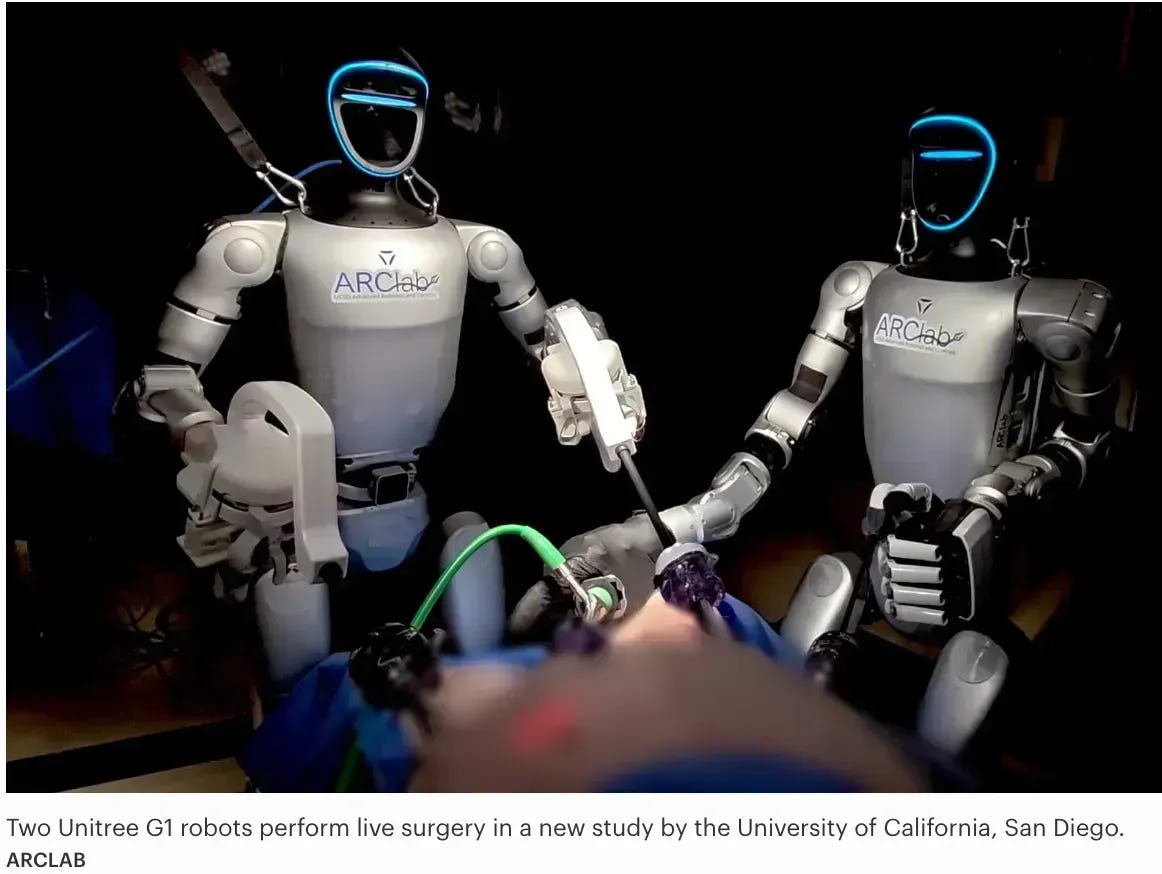
One of the most striking milestones I’ve seen all year: surgeons at UC San Diego remotely piloted two teleoperated humanoid robots to remove gallbladders from live pigs, in minimally invasive procedures published in Nature. The robots weren’t autonomous — skilled human surgeons controlled every movement — but the hardware doing the work was a pair of ~$20,000 Unitree G1 humanoids, not a $2M specialized surgical system.
The implication is what makes this matter. If this approach reaches clinical readiness, general-purpose humanoids could bring robotic-assisted surgery to smaller hospitals and rural clinics that could never afford a dedicated surgical robot. Physical AI meeting healthcare access — I’m fascinated to see where this goes.
We knew this moment would come — it just arrived faster than most expected. About 35,000 Hyundai workers in Korea staged rolling four-hour walkouts, the first factory strike anywhere explicitly triggered by plans to put humanoid robots on the line. Hyundai intends to deploy more than 25,000 Boston Dynamics Atlas robots across Hyundai and Kia plants, and the union’s headline demand is blunt: not a single robot enters a workplace without a labor-management agreement first.
The economics explain the urgency. Atlas units cost an estimated $130,000–140,000 in early production, but Hyundai projects roughly $30,000 once cumulative output passes 50,000 units. A capable $30,000 robot that runs three shifts and never files a grievance changes the math for every automaker — and every union at Tesla, BMW, Toyota, and BYD is watching how Korea plays out. The abstract debate about robots and jobs just became very concrete.
Machina Labs secured a landmark qualification contract from Lockheed Martin to support the JASSM program — the first time a component built with its robotic “RoboForming” technology has advanced to qualification for a US defense missile system. Machina’s workcells put two industrial robots on opposite sides of a metal sheet, forming precision parts like a blacksmith would, in lot sizes as small as one.
The contract runs through Machina Factory 3, a 200,000 sq ft intelligent factory designed for up to 50 RoboCraftsman cells, compressing production timelines from months to days. As CEO Ed Mehr put it: missile programs aren’t constrained by design, they’re constrained by production. This is the reindustrialization thesis playing out in real time — robotic manufacturing as the answer to a defense industrial base under pressure.
Shenzhen’s LimX Dynamics closed a pre-IPO round of nearly $200M at a $2.21B valuation, led by IDG Capital, Apple supplier Lens Technology, and Abu Dhabi’s Stone Venture. Founder Will Zhang was refreshingly direct about the strategy: “Listing is a must.” He compares the moment to China’s EV startups — once the technology matures, a company that fails to list risks vanishing.
The context is staggering: China now has well over 100 humanoid companies, embodied AI investment hit ¥47B (~$6.95B) in Q2 alone — roughly six times a year earlier — and Unitree, EngineAI, DeepRobot, and Leju are all lining up for listings. What sets LimX apart: more than half of its orders come from overseas, with a multi-year push planned to ship thousands of humanoids to the Middle East. The consolidation phase is coming, and everyone knows it.
Fresh off announcing its SPAC listing, Agility Robotics CEO Peggy Johnson published six policy recommendations for keeping the US competitive in humanoids: close the gap on internationally sourced components (China holds ~90% of permanent magnet capacity for motors!), adopt a coordinated national robotics strategy, prioritize industry-led safety standards, fund workforce development, lower automation barriers for small manufacturers, and establish clear government procurement pathways.
This is essential reading for anyone tracking the US-China robotics race. The uncomfortable truth Johnson names: America’s humanoid leaders currently can’t build their robots without Chinese components. Fixing that is a decade-long project, and it starts with policy attention now.
👉 Learn more
San Francisco’s Weave Robotics introduced Isaac 1, a wheeled home humanoid that folds laundry, tidies rooms, makes beds, and puts away toys — priced at $7,999 or $449/month, with deliveries starting this fall. The robot telescopes from 3 ft to 5’9”, runs eight hours on a charge, and wraps its frame in soft fabric with a cartoon face designed to be approachable rather than intimidating.
I love the privacy details here: physical shutters on the head cameras make clear when the robot is working, and the charging dock includes a privacy screen. After years of “the home robot is coming,” we now have 1X’s NEO, UBTech’s U1, and Weave’s Isaac all offered to consumers within months of each other. The home robot race is officially on!
The Salamanca City Central School District in Western New York — a small rural district on the Seneca Nation reservation — will be one of the first in the country to put a humanoid robot in a classroom this fall. “Sally,” built by Realbotix, comes with silicone skin, lifelike expressions, and an AI avatar students can access on laptops for homework help, personalized tutoring, and real-time translation in 100+ languages. The package cost the district $57,590.
The deployment has sparked real debate — some see a forward-looking equalizer for underserved students, others worry about AI creep in schools. Either way, it’s a fascinating signal: humanoids are entering not just factories and warehouses, but classrooms. The frontier keeps expanding.
👉 Feature your company in HardTech Reads
➡️ Walden Robotics — full-stack Physical AI company deploying general-purpose robots that learn on the job, spun out of Toyota Research Institute. Raised $300M in Seed at a $1.1B valuation, co-led by Toyota and Deviation Capital, with NVIDIA, Boeing, Samsung Ventures, and Prologis Ventures. Location: Cambridge, USA.
➡️ AI² Robotics — builds wheeled humanoid AlphaBots powered by its Alpha Brain vision-language-action model, targeting logistics, manufacturing, and retail. Raised ~$735M at a ~$2.8B valuation from CICC Capital, GSR Ventures, Moutai Group, and state-backed funds. Location: Shenzhen, China.
➡️ LimX Dynamics — full-size humanoids and multi-form robots with more than half of orders coming from overseas. Raised ~$200M in Pre-IPO at a $2.21B valuation, led by IDG Capital, Lens Technology, and Stone Venture. Location: Shenzhen, China.
➡️ Kraken Technology Group — autonomous defense vessels including the crewless K5, with an Anduril US shipbuilding partnership. Raised $175M in Series B at a $1B valuation, led by DTCP with the British Business Bank and NATO Innovation Fund. Location: UK.
➡️ Nous Research — open-source AI agents and language models behind the Hermes agent (~214K GitHub stars). Finalizing a $75M+ round at a $1.5B valuation, led by Robot Ventures with USV. Location: Austin, USA.
➡️ Cytronic — robotic fulfillment-as-a-service for D2C ecommerce brands, founded by Shyp’s Kevin Gibbon, with facilities in Chicago and Dallas. Raised $13.5M in Seed, led by Slow Ventures. Location: USA.
➡️ Dogtooth Technologies — robotic fruit pickers for delicate crops like strawberries, working with commercial farms for 10 seasons. Raised £14M ($18.8M) in Series B from 24 Haymarket, EMV Capital, and ACF Investors. Location: Cambridge, UK.
➡️ HIVE Autonomy — installs a “silicon brain” plus sensors to turn existing fleets of industrial machinery into autonomous systems. Raised £11.2M ($15M) in Seed, led by SuperSeed Ventures. Location: UK.
➡️ Luffy AI — neuroplastic neural networks that let robot brains adapt in real time, retrofittable to existing equipment. Raised £8.1M ($10.8M) in Series A, led by Business Growth Fund with Momenta Ventures and Bow Capital. Location: UK.
➡️ 6thSense — sensor-loaded gloves plus egocentric glasses capturing human dexterity data for robot training. Raised $500K in Pre-seed, led by Y Combinator. Location: San Francisco, USA.
Humanoid Robotics in 2026: The Race From Pilot to Platform — KraneShares’ deep dive is one of the best single overviews of where the industry actually stands: JAL’s humanoids at Haneda, BMW’s 1,250 operational hours with Figure, the actuator supply chain bottleneck (40–60% of bill of materials!), and why building an Optimus without Chinese suppliers would cost 3x more. Their framing of “the CATL lesson” for humanoid component makers is worth the read alone.
Actuate 2026 — August 18–19, San Francisco. The robotics and automation builders’ conference. Let me know if you are coming!
🤝 Passionate about HardTech? Have comments, want to share some thoughts or ask about sponsorships? Let’s connect!
👉 Want to feature your company in HardTech Reads? Apply Here
👉 Want to schedule a meeting directly, check my schedule.
#AI #Robotics #Humanoids #HardTechReads #Startups #DeepTech #Automation #PhysicalAI #HardTechDeepDives
No posts
Comments
Nothing yet. Say the first thing.
Sign in to join the conversation.