
On 3rd August 1968, during the Bratislava Conference between the Soviet Union and its Warsaw Pact allies, a letter for Leonid Brezhnev was quietly slipped to Soviet Politburo member Petro Shelest in the men’s bathroom. The handover had been arranged by the KGB station chief in Bratislava – but at a conference among communist allies, why did a letter for Brezhnev have to change hands in secret?
The answer lay in the crisis unfolding inside Czechoslovakia. The conference had been convened in response to the Prague Spring, the programme of political liberalisation launched earlier that year by Czechoslovak leader Alexander Dubček. Promising ‘socialism with a human face’, Dubček’s reforms alarmed Moscow and intensified long-standing tensions within the Communist Party of Czechoslovakia (KSČ). The letter secretly passed to Shelest therefore came not from outside the party, but from within its own leadership.
Written by five pro-Moscow hardliners in the KSČ, the letter stated that the ‘political management of society’ had ‘eluded the control of the party’s Central Committee.’ It claimed that ‘the press, radio and television, which are effectively in the hands of right-wing forces, have influenced popular opinion to such an extent’, that there was an ‘imminent danger of counterrevolution’. It concluded with an ‘urgent request and plea’ for Soviet ‘intervention and all-round assistance.’
Strengthening the case for intervention:
The so-called ‘letter of invitation’ did not mark the beginning of Moscow’s campaign against the Prague Spring. From the moment Alexander Dubček introduced reforms in January 1968, the KGB began infiltrating pro-reform and independent organisations across Czechoslovakia, whilst the Soviet leadership pressured the KSČ to reverse course.
By late July, Brezhnev and Dubček were locked in tense bilateral talks at Čierna nad Tisou railway station, where the Soviet leader repeatedly pushed for ‘personnel changes’ within the KSČ. Several days later, at the Bratislava Conference, Warsaw Pact states issued a communiqué declaring their:
‘Unbreakable solidarity and their high degree of vigilance against each and every effort by imperialism, and also by all other anti-communist forces, to weaken the leading role of the working class and the communist parties.’
Against this backdrop, the letter served an important purpose for Moscow. Though kept secret, it reassured the Soviet leadership that influential allies within the KSČ would support intervention and a possible change of leadership. After months of inconclusive negotiations with Dubček, Brezhnev adopted a far harder line – one that would culminate less than three weeks later in the military occupation of Czechoslovakia.
Fraught conversation: The Brezhnev - Dubček transcripts:
During their talks at Čierna nad Tisou, Brezhnev had secured assurances from Dubček that he would make key personnel changes within the KSČ and the media. On 9th August 1968, six days after the Bratislava Conference, Brezhnev telephoned Dubček to check on his progress.
Brezhnev: “We understand perfectly well that it is the rightists who are doing such things…we are gaining the impression that the commitments we approved with you in Čierna nad Tisou are not being fulfilled…in such circumstances Alexander Stepanovic [Dubček], I wanted to ask in what way we can help?”
Dubček: “I understand your concerns comrade Brezhnev. But at the moment I am not asking for any assistance.”
Dubček was forced to tread a careful line, he sought to preserve his programme of liberalisation whilst avoiding an open challenge to Soviet authority in the Eastern Bloc. In the hope of reassuring Moscow and shifting the blame onto more radical elements, Dubček remarked, “we also attribute everything negative in our activities to right-wing tendencies.” For Brezhnev, however, this was insufficient, and he looked for a more concrete commitment, declaring:
“We are now living through a very trying period. In many ways it will define our future links and relations…I have come to the conviction, the firm conviction, that you have the strength and people in the Presidium – the healthy forces – on whom you can rely and who will give you everything. The only serious matter is your decision.”
Once again, Dubček maintained that the party was working toward the agreements made at Čierna nad Tisou, but argued that any changes required approval from the Central Committee plenum. When Brezhnev asked whether a date had been set for this session, Dubček replied, “on Tuesday we’ll consider this question.” The session was scheduled for 13th August, which gave Dubček four days of breathing space.
Brezhnev’s ultimatum:
On 13th August, Brezhnev made another call to Dubček. In a considerably longer exchange, the Soviet leader made clear his view that the Czechoslovak authorities had failed to take sufficient action to rein in the press.
Brezhnev: “We have little time, and so let me get straight to the point. I’m again turning to you with anxiety about the fact that the mass media in your country are not only incorrectly depicting our conferences in Čierna nad Tisou and Bratislava, but are also stepping up their attacks against the healthy forces and continuing to purvey anti-Sovietism and anti-Socialist ideas.”
Dubček: “I have already told you what actions we are taking to put an end to the anti-Soviet and anti-socialist manifestations in the mass media…we’re not able to restore order in the operations of the mass media in just two to three days.”
Brezhnev began to turn the screw, telling Dubček:
“You must resort to concrete measures…we said that it was essential to dismiss Pelikan. This would be the first step needed to restore order in the mass media.”
Jiří Pelikán, the director of Czechoslovak Television, was an influential figure within the Prague Spring and was regarded by Moscow as one of its leading proponents. Dubček defended Pelikán, arguing that to the best of his knowledge, there had been no further attacks on the Soviet Union Brezhnev, however, remained unmoved:
“How can you say such a thing when literally all the newspapers – Literární Listy, Mladá fronta, Reportér, Práce – every day are publishing anti-Soviet and anti-party articles?”
Brezhnev pointed in particular to an article published in Literární Listy on 8th August, which he described as a “full-blown, vicious attack” against the USSR. Dubček dismissed it as an isolated case, and insisted that steps were already being taken:
“We’re opposed to this article and are now taking appropriate measures…we had a meeting with members of the press. The session condemned the reporters at the newspapers you were speaking about for their incorrect actions, and a decision was reached there to put an end to all polemical expressions.”
At this point, Brezhnev put an end to Dubček’s attempts to deflect. Addressing him more personally, using the Slavic diminutive “Sasha” for Alexander, Brezhnev made clear that the issue was not discussion but control:
“Sasha, that’s not the point – whether you had a meeting with members of the press or not. What we agreed about was not just to hold some meeting. We agreed that all mass media – the press, the radio, and the television – would be brought under the control of the CPCz Central Committee and the government.”
Dubček fell silent. His efforts to buy time and preserve some degree of freedom for the media had reached their limit, and Brezhnev delivered an ominous ultimatum:
“I must candidly say to you Sasha, that by dragging your feet in the fulfilment of these obligations, you’re committing outright deceit and blatantly sabotaging the decisions we jointly reached…we are considering new independent decisions.”
Faced with Brezhnev’s harshest accusation yet, Dubček played his final card – the proposed federalisation of Czechoslovakia. Originally a Slovak demand for equal representation and an end to Czech centralism, federalisation had become one of the most significant reforms of the Prague Spring. Dubček argued that the constitutional process would delay Moscow’s demanded personnel changes until October, but Brezhnev remained unconvinced, remarking, “This is just one more sign that you’re deceiving us”. A remarkably frank exchange followed:
Brezhnev: “This obviously will compel us to reevaluate the whole situation, and resort to new, independent measures.”
Dubček: “Comrade Brezhnev, you should resort to all the measures that your Politburo believes are appropriate.”
Brezhnev: “But if that’s how you are going to answer me, I must say to you, Sasha, that this is a flippant statement.”
Dubček: “I’m not able to answer in any other way. We’re working very hard to carry out the agreement. But in these conditions over the last week to ten days, we haven’t yet fully coped with it.”
Although the relationship appeared to be at breaking point, Brezhnev returned once more to the personnel changes he desired, stating:
“What troubles me most of all is that you haven’t dismissed the three whom we agreed to dismiss, and this leaves a very big question. If you’re sincerely convinced that you must release Cisar, Kriegel and Pelikan…then I’m deeply convinced that a sincere effort on your part would allow you to do this very easily and very simply.”
Brezhnev then asked whether Dubček had relayed their talks at Čierna nad Tisou to comrade Vasil Bil’ak. When Dubček confirmed that he had, Brezhnev replied, “It’s good that you did so Sasha. These are your most dependable and closest friends.”
The irony was striking, Bil’ak was already working against the Prague Spring. In fact, he had been one of the five signatories of the secret ‘letter of invitation’ handed to Soviet leaders at the Bratislava Conference, urging intervention against the reform movement.
Operation Danube:
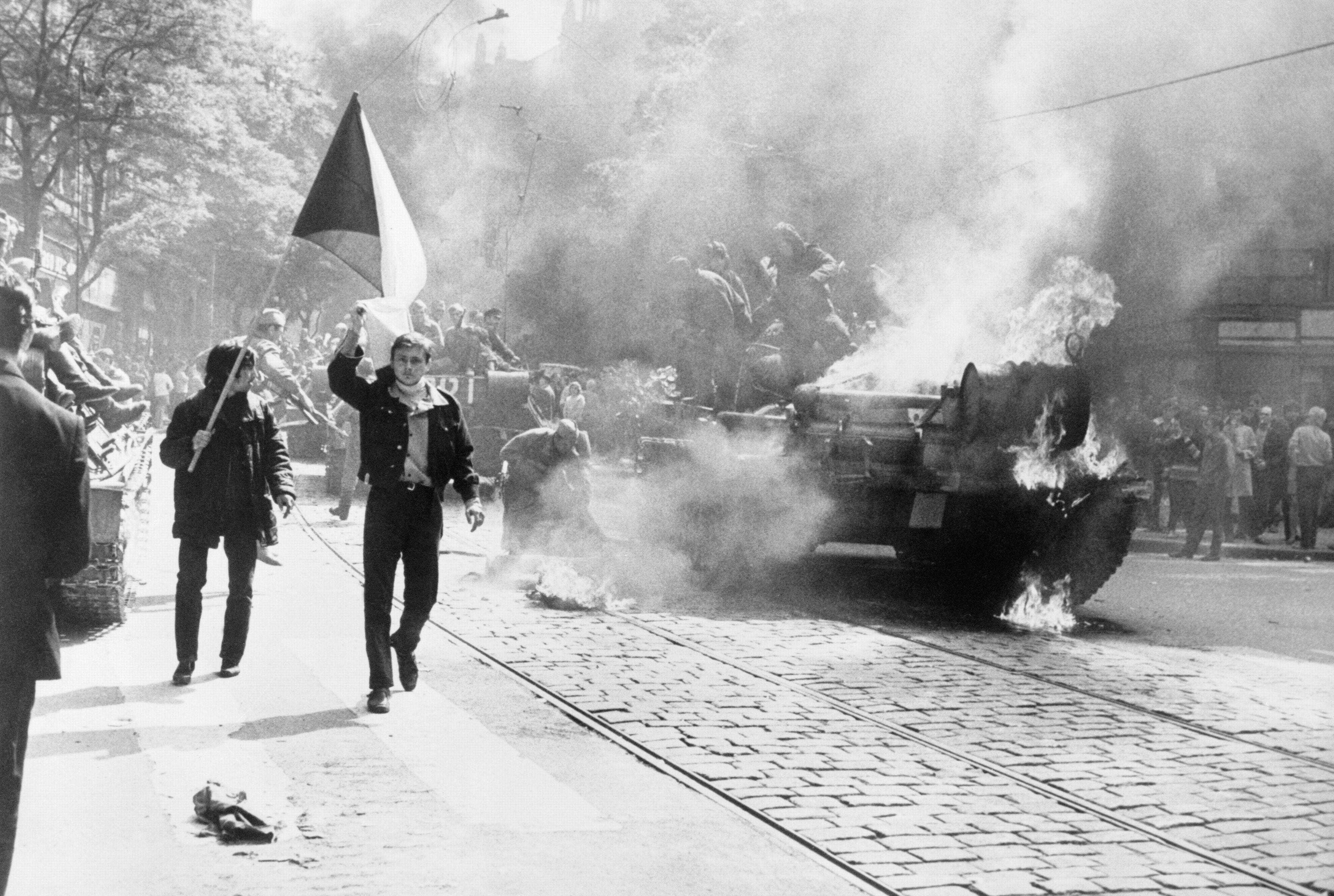
At Brezhnev’s request, Hungarian leader János Kádár arranged a final meeting with Dubček in an attempt to persuade him to rein in the Prague Spring reforms. By the time they met on 17th August, however, Moscow had already decided on military intervention, and preparations for ‘Operation Danube’ were almost complete. Within weeks, 500,000 Warsaw Pact troops had crossed into Czechoslovakia and established a military occupation.
On the day of the invasion, the KSČ hastily issued a statement condemning military action whilst urging citizens ‘to remain calm and to refrain from putting up any resistance against the advancing troops.’ Although the Czechoslovak military stood down, civilians mounted widespread resistance, and it wasn’t until April 1969 that a pro-Soviet leadership under Gustáv Husák was finally established and began reversing the reforms of the Prague Spring.
The Brezhnev-Dubček conversations are therefore the final record of a failed attempt to preserve the Prague Spring, before Soviet power was imposed by force. Dubček’s challenge to Soviet authority had revealed the ideological fracture between reform-minded communists and Moscow’s doctrine of limited sovereignty. Although the Prague Spring was ultimately crushed, the events of 1968 would endure as a powerful symbol of resistance within the Eastern Bloc. Two decades later, the Velvet Revolution of 1989 finally ended one-party communist rule in Czechoslovakia, with Dubček returning to public life as chairman of the Federal Assembly – vindication for the leader whose attempt to reform socialism had once brought Soviet tanks into Prague.
Photo source: The Central Intelligence Agency, Public domain, via Wikimedia Commons.
Bibliography:
Primary Sources:
The ‘Letter of Invitation’ from the Anti-Reformist Faction of the KSČ Leadership, August 1968, National Security Archive.
Transcript of Leonid Brezhnev’s Telephone Conversation with Alexander Dubček, 9th August 1968, National Security Archive.
Transcript of Leonid Brezhnev’s Telephone Conversation with Alexander Dubček, 13th August 1968, National Security Archive.
Statement by the KSČ CC Presidium Condemning the Warsaw Pact Invasion, 21st August 1968, National Security Archive.
Keesing’s Record of World Events, Volume 14, August 1968, Czechoslovakia, Page 22891, via Stanford University.
No posts
Comments
Nothing yet. Say the first thing.
Sign in to join the conversation.