
‘Even in England before I left to take up my appointment, we felt that apart from the chances of climate, the risk of coming to an untimely end at the hands of an expert swordsman must be taken into account.’
~Sir Ernest Mason Satow.
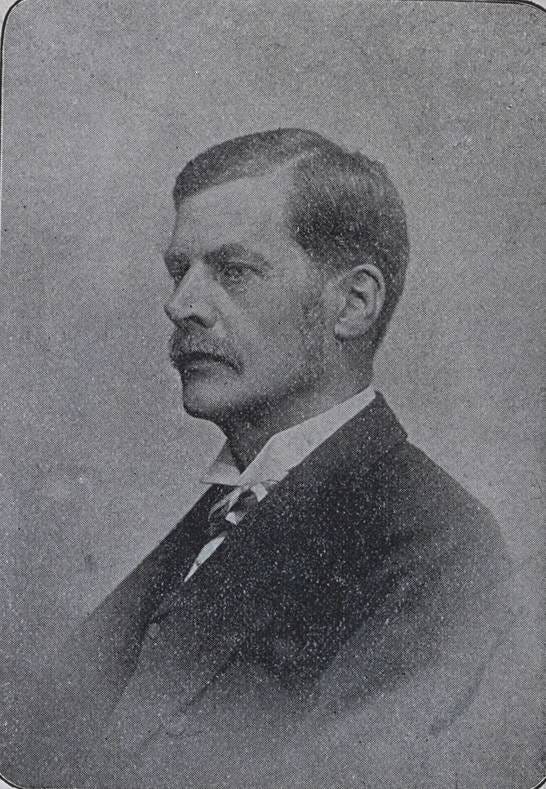
The former Bishop of Oxford, Francis Paget, once described Sir Ernest Mason Satow as:
‘Quite delightful – a diplomatist of the very best type, strong, able, quiet, cultivated, humorous, with great and wide experience.’
There is every reason to agree with Paget’s assessment. During his first posting to Japan as an interpreter, Satow evaded attacks by samurai, witnessed Britain’s gunboat diplomacy against powerful feudal domains, and lived through the upheavals of the Boshin War and the Meiji Restoration.
Throughout this turbulent period, Satow’s command of Japanese and extensive network of local contacts gave the Foreign Office a clear understanding of Japan’s rapidly changing political landscape. The respect he earned among leading Japanese statesmen also proved invaluable in his later appointments as British minister to Japan and China. Ultimately, Satow helped shape British diplomacy at a time when his ‘political masters in London, and many local compatriots out East, [held] a deep, fundamental, Western-centric distrust of Asians, and particularly Japanese.’
Despite his influence, Satow remains somewhat overlooked. He wrote more about his experiences in diaries and memoirs than many historians have written about his contribution to British diplomacy. Satow, however, would likely have been untroubled by this – a firm believer in professional modesty, he warned that a diplomat:
‘Must be on his guard against the notion that his own post is the centre of international politics, and against an exaggerated estimate of the part assigned to him in the general scheme.’
By all accounts, Satow was an austere, diligent scholar whose strength was careful observation not self-promotion. Those qualities shaped his many works, including A Guide to Diplomatic Practice, which remains, more than a century after its publication, the definitive English-language work on the principles of classical diplomacy.
Today, Satow is remembered chiefly for his books, but behind them stood one of Britain’s most perceptive and quietly influential diplomats.
Satow’s route to Japan:
At seventeen, Satow was studying classical and modern European languages at University College London, when he found an advertisement seeking student interpreters for service in China and Japan. Already a gifted linguist, he later recalled that ‘having gained the first place in the public examination, I chose Japan.’
After a brief period of preparation in China, Satow sailed for Japan in September 1862, and his first glimpse of the country left a lasting impression:
‘I thought no scenery in the world could surpass it. Irregular-shaped hills, covered with dark-green trees, lined the whole southern coast, and above them rose into the air for 12,000 feet and more the magnificent cone of Fuji.’
Behind this striking landscape, however, lay a country in political turmoil. Japan’s opening under Western pressure after more than two centuries of relative isolation had provoked fierce opposition, and Satow arrived amid growing violence against foreigners. The previous year, an attack on the British legation had wounded its secretary, Laurence Oliphant, and barely a week after Satow’s arrival, British merchant Charles Richardson was killed by the entourage of the Satsuma daimyō after failing to give way to their procession. Satow, however, remained characteristically unfazed, writing that ‘while everyone in my immediate surroundings was in a state of excitement…I quietly settled down to my studies.’
That calm and studious temperament would define Satow’s career, and his linguistic talents would soon prove invaluable. As he later reflected in A Diplomat in Japan:
‘The literature of Japan was almost entirely unknown to Europeans, and the existing keys to the language were ridiculously inadequate…the foreign representatives were at a loss to appreciate the exact nature of the political questions that confronted them.’
British gunboat diplomacy:
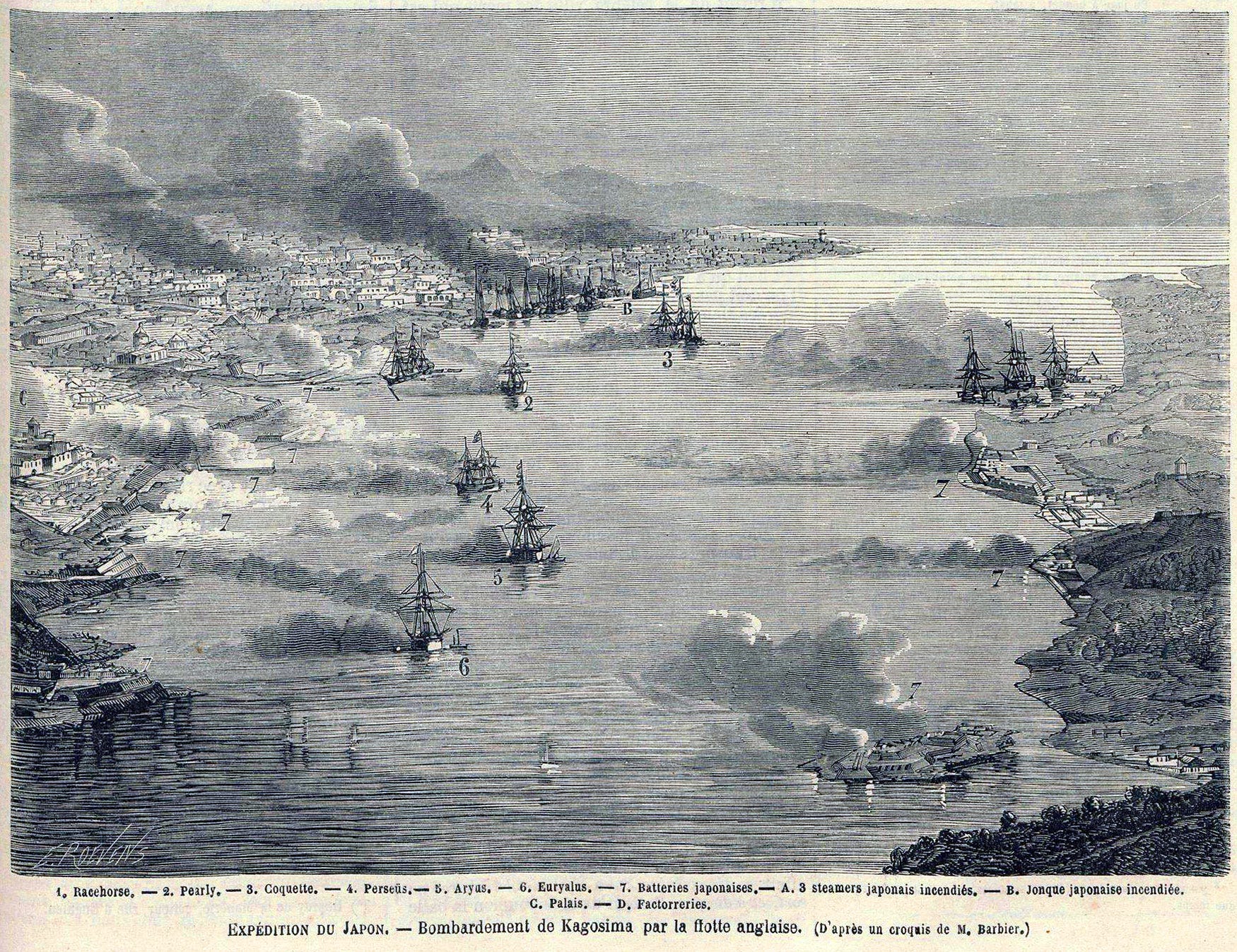
Following the murder of Charles Richardson, Britain demanded an apology and compensation from both the Tokugawa Shogunate – the military government which ruled Japan – and the powerful Satsuma Domain, whose samurai had carried out the attack. Although the shogunate complied, Satsuma refused to surrender Richardson’s killers or pay £25,000 in compensation to his family. As a result, Satow’s first major adventure in Japan came in 1863, when he joined HMS Argus as part of a seven-ship Royal Navy squadron dispatched to Kagoshima to enforce British demands.
What began as an exercise in gunboat diplomacy quickly escalated into open conflict. After the British seized three steamships in the harbour to force negotiations, Kagoshima’s coastal batteries opened fire. The Royal Navy responded by burning the captured vessels and bombarding the town, in what Satow described as ‘an awful and magnificent sight’. Reflecting on the destruction, he wrote:
‘We had bombarded and destroyed the greater part of the forts and town, probably killed a good many persons who were innocent of Richardson’s murder, and had thereby elevated what was in the beginning a crime against public order into a casus belli.’
Comments
Nothing yet. Say the first thing.
Sign in to join the conversation.