
This is a two-part post on Sir Ernest Satow’s Guide to Diplomatic Practice
Begin by reading part one HERE.
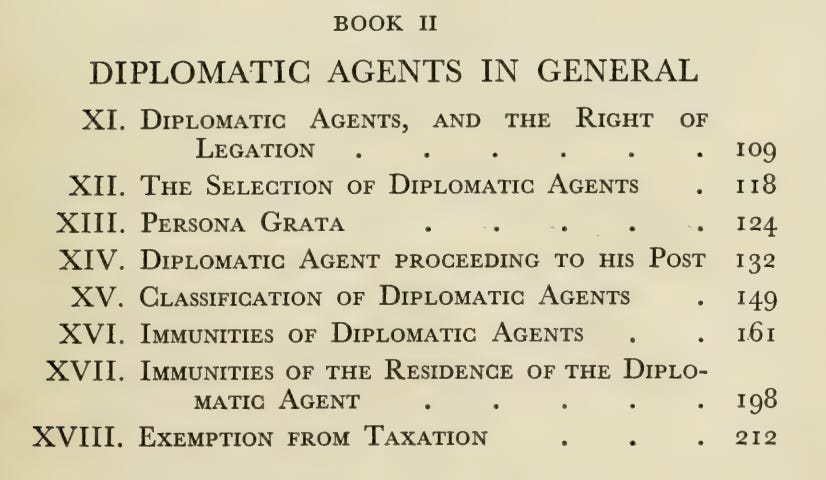
Chapter IX: Advice to Diplomatists:
In this chapter, Satow compiles advice from leading statesmen on the art of diplomacy. Among the highlights is a letter from the first Earl of Malmesbury to Lord Camden, with guidance for his nephew’s entry into the British Foreign Office:
‘The first and best advice I can give a young man on entering this career, is to listen, not to talk–at least, not more than is necessary to induce others to talk. I have in the course of my life, by endeavouring to follow this method, drawn from my opponents much information, and concealed from them my own views, much more than by the employment of spies or money.’
With regards to diplomatic documents, the Earl of Malmesbury offered a simple rule:
‘Not to allow any opponent to carry away an official document, under the pretext that he wishes “to study it more carefully”; let him read it as often as he wishes, and, if it is necessary, allow him to take minutes of it, but both in your presence.’
Satow’s own advice on official documentation and writing diplomatic dispatches was equally direct:
‘Never place an adjective before a noun if it can be spared; it only weakens the effect of a plain statement. Above all, do not attempt to be witty.’1
The same principle of restraint applied beyond the written word to a diplomat’s conduct more generally. Satow issues a reminder on the importance of humility, warning that a diplomat:
‘Must be on his guard against the notion that his own post is the centre of international politics, and against an exaggerated estimate of the part assigned to him in the general scheme.’
Chapter XII: The Selection of Diplomatic Agents:
Although aristocratic and royal women often shaped international affairs through social networks and informal influence, the prevailing attitudes of the 18th and 19th centuries largely excluded them from formal diplomatic posts. Even so, as Satow noted, they remained subject to scrutiny:
‘If the diplomatist suggested for appointment as ambassador or envoy is married, the social gifts, character, religion, past history, or original nationality of his wife may be an important ingredient in the determination of his appointment.’
A rigid criteria was similarly applied to the men up for diplomatic postings. Satow declared ‘some, if not all’ of the below were considered essential qualities:
‘Good temper, good health and good looks. Rather more than average intelligence, though brilliant genius is not necessary. A straightforward character, devoid of selfish ambition. A mind trained by the study of the best literature, and by that of history. Capacity to judge of evidence. In short, the candidate must be an educated gentleman.’
In 1604, English diplomat Henry Wotton inadvertently cast doubt over his straightforward character after signing a book for a friend and German merchant in Augsburg. Wotton wrote:
‘An ambassador is an honest man, sent to lie abroad for the good of his country.’
Wotton intended a pun on ‘lie’, meaning both ‘to deceive’ or ‘to reside’. Unfortunately the Latin translation did not adequately demonstrate this double meaning. When rediscovered years later, the quote was seized upon by a critic of King James I, and used as evidence of the supposed moral failings of his court. The king was angered and embarrassed, and Wotton was forced to write an apology.
Chapter XVI: Immunities of Diplomatic Agents:
Diplomatic immunity stands as an exception to the general rule that all persons and property within a sovereign state fall under its jurisdiction. These immunities are granted on the understanding that they are reciprocal, and that any infringement by one state would jeopardise its own representation abroad. Satow writes:
‘It is the duty of the government to which they are accredited, to take all necessary measures to safeguard the inviolability of diplomatic agents and to protect them from any act of violence or insult.’
A diplomatic crisis therefore ensued when, in 1708, the Russian ambassador in London, Monsieur de Mathveof, was forcibly arrested in the streets after a group of merchants accused him of unpaid debts. Although he was swiftly bailed, Queen Anne ordered the Secretary of State to offer an immediate apology and demanded that the offending merchants be brought to trial.
Unsatisfied with the response, Mathveof left Britain without ceremony, and the British envoy in St Petersburg, Lord Whitworth, was tasked with repairing the damage. At a public audience with Peter the Great, Whitworth again expressed the Queen’s regret for the insult, and to underscore Britain’s sincerity, a procession of twenty carriages was sent to Mathveof’s residence to escort him to the audience.
The incident ultimately prompted the passage of the Diplomatic Privileges Act 1708, placing diplomatic immunity on a statutory footing for the first time.
Chapter XXI: Termination of a Mission:
A diplomatic agent’s posting might come to an end for several reasons, including recall at the request of the host government.
In 1898, as tensions rose between the United States and Spain over Cuba, a private letter from the Spanish minister in Washington, Señor Dupuy de Lôme, was intercepted in Havana and published in the New York Journal. In it, he described President McKinley as:
‘Weak and a bidder for the admiration of the crowd, besides being a would-be politician who tries to leave open a door behind himself while keeping on good terms with the jingoes of his party.’
The United States minister in Madrid subsequently demanded his recall, on the basis that Señor de Lôme could not be trusted for ‘frank and sincere intercourse between this country and Spain.’
A similar case arose in 1915, when the United States requested the recall of the Austro-Hungarian ambassador to Washington, Constantin Dumba. Dumba was implicated in a scheme to incite strikes in American munitions factories – which were supplying the Allied war effort. Despite the seriousness of the allegations, Washington remained keen to preserve cordial relations with Austria-Hungary and accordingly asked the Allied powers to guarantee Dumba safe passage home through its naval blockade of the Central Powers.
Resignation:
And with that, my dear subscribers, this whirlwind of diplomatic advice and anecdotes comes to an end. I leave you with the distinctly British resignation Satow attributes to a departing Foreign Secretary:
‘I have the honour to inform you that the King has been graciously pleased to accept my resignation of the office of His Majesty’s Principal Secretary of State for Foreign Affairs, and to confide the seals of this department to [the next article, coming to your inbox soon] ’.
Sir Ernest Mason Satow, A Guide to Diplomatic Practice, (Sothis press, 2023.) Original publisher (Longmans Green and Co, 1917.)
No posts
Comments
Nothing yet. Say the first thing.
Sign in to join the conversation.