
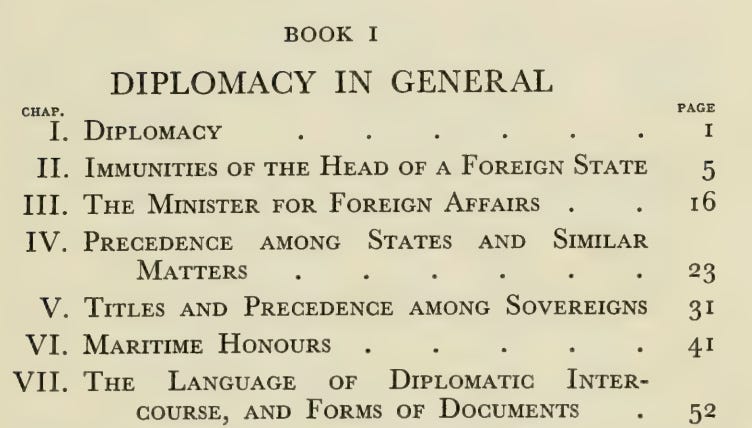
In 1917, the retired British diplomat Sir Ernest Mason Satow published A Guide to Diplomatic Practice. At first glance, it is exactly what the title suggests, a practical manual, formatted more like a school textbook than a literary classic. Nevertheless, it is widely regarded as the definitive English-language work on the principles and etiquette of classical diplomacy.
A talented linguist and one of Britain’s foremost experts on East Asia, Satow spent decades in the British Diplomatic Service, including a stint as minister to Japan from 1895 to 1900. Only after this distinguished career did he write his influential Guide, which has remained continuously in print for over a century. Curiously, whilst Satow’s book became a classic, the man himself has largely faded from view.
This article is not a biography of Satow or an examination of his influence on British foreign policy – that deserves an essay of its own (and one I’ll write for paid subscribers). Instead, I’ll let A Guide to Diplomatic Practice speak for itself.
At 495 pages, it is no pamphlet, but fortunately I’ve scoured (almost) all of them to bring you the most interesting passages. So, without further ado, assume the privileges of a foreign ambassador:
I have the honour to be, with the highest consideration,
Your Excellency’s obedient servant.1
Chapter I: Diplomacy in General.
Where else would a guide begin than with a definition of its subject. In Satow’s words:
‘Diplomacy is the application of intelligence and tact to the conduct of official relations between governments of independent states, extending sometimes also to their relations with vassal states.’
Satow, however, is quick to note that diplomatic definitions and terminology continually evolve. In English, practitioners were once known as ‘diplomatists’, with ‘diplomat’ gradually displacing the former term by the 19th century. Looking further back, Satow cites François de Callières’ 1716 treatise, De La Manière De Négocier Avec Les Souverains (On the Manner of Negotiating with Sovereigns). In Callières’ work, ‘diplomatist’ is never mentioned; instead, he refers to ‘un habile négociateur’ (a skilful negotiator.)
In ending the first chapter, Satow draws a sharp distinction between the responsibilities of diplomats and that of the governments they represent. Therefore, when speaking about the diplomacy of a country:
‘We do not mean the management of its international affairs by its agents residing abroad, but their direction by the statesman at the head of the department.’
In other words, whilst diplomats can execute policy, they do not make it. According to Satow, many observers are tempted to blame individual ‘agents’ for foreign policy blunders, but ‘the real responsibility necessarily rests with the government concerned.’
Chapter IV: Precedence Among States and Similar Matters:
For centuries, few issues preoccupied diplomats more than precedence. The Pope once played a prominent role in determining the hierarchy of European rulers, but disputes over whose representatives ranked above others were frequent until the Congress of Vienna standardised diplomatic precedence in 1815.
One such dispute arose in 1633, when King Christian IV of Denmark announced the marriage of his son. The French ambassador, the Comte d’Avaux, and his Spanish counterpart, the Marques de la Fuente, were unable to agree over who should have the seat of honour at the celebration. Despite Danish ministers offering various compromises, a frustrated d’Avaux eventually declared:
“I will give the Spanish ambassador the choice of the place which he regards as the most honourable, and when he shall have taken it, I will turn him out and take it myself.”
An ambassadorial duel was averted when de la Fuente claimed urgent business elsewhere and did not attend the ceremony.
The Franco-Spanish rivalry over precedence resurfaced in 1661, during the Swedish ambassador’s ceremonial entry into London. As the French and Spanish ambassadors’ coaches converged to join the customary procession, both claimed the place of honour. An armed clash soon broke out in which Spanish servants hamstrung two French horses, wounded a French postillion, and dragged the coachman from his seat. Outraged, King Louis XIV of France threatened war unless the Spanish ambassador, Charles de Watteville, was punished. Philip IV of Spain ultimately yielded, recalling de Watteville from his post in London.
Chapter VII: The Language of Diplomatic Intercourse:
Latin was once the common language of European diplomacy, before being gradually supplanted by French. By the end of the sixteenth century, French had become so dominant that the King of France wrote in Latin only to the King of Poland.
Even so, as Satow’s examples prove, the language of diplomacy remained a source of contention. In 1851, when the President of the German Federal Diet requested that official notes addressed to the body should be translated into German, British Prime Minister Lord Palmerston refused. Palmerston told the British representative that in the opinion of Her Majesty’s Government, every state was:
‘Entitled to use its own language in official communications, on the ground that it is more certain of expressing its meaning in its own language.’
Satow recounts another incident involving Otto Von Bismarck. After Bismarck decreed that official correspondence with his ministry should be conducted only in German, French, English or Italian, the Russian diplomat Baron Budberg submitted several complaints in Russian. Receiving no reply, Budberg visited in person, at which time Bismarck commented, ‘Reply? What to? I have seen nothing from you.’ Bismarck subsequently admitted that a pile of Russian documents had been set aside because no one in the department spoke Russian, and ‘anything in an undecipherable language was pigeon-holed.’ According to Bismarck, Budberg thereafter agreed to write in French.
Sir Ernest Mason Satow, A Guide to Diplomatic Practice, (Sothis press, 2023.) Original publisher (Longmans Green and Co, 1917.)
No posts
Comments
Nothing yet. Say the first thing.
Sign in to join the conversation.