
This next oven story ends not merely in the doldrums, but in real tragedy. It features Rabbi Hiyya bar Ashei, an Amora of the 2nd-3rd generation in Babylonia and a student of Rav’s. It goes like this:
רַבִּי חִיָּיא בַּר אָשֵׁי הֲוָה רְגִיל כׇּל עִידָּן דַּהֲוָה נָפֵל לְאַפֵּיהּ הֲוָה אָמַר: ״הָרַחֲמָן יַצִּילֵנוּ מִיֵּצֶר הָרָע״. יוֹמָא חַד (שְׁמַעְתִּינְהוּ) [שְׁמַעְתֵּיהּ] דְּבֵיתְהוּ, אֲמַרָה: מִכְּדֵי הָא כַּמָּה שְׁנֵי דְּפָרֵישׁ לֵיהּ מִינַּאי, מַאי טַעְמָא קָאָמַר הָכִי? יוֹמָא חֲדָא הֲוָה קָא גָרֵיס בְּגִינְּתֵיהּ. קַשִּׁטָה נַפְשַׁהּ, חָלְפָה וְתָנְיָיה קַמֵּיהּ. אֲמַר לַהּ: מַאן אַתְּ? אֲמַרָה: אֲנָא חָרוּתָא דַּהֲדַרִי מִיּוֹמָא. תַּבְעַהּ. אֲמַרָה לֵיהּ: אַיְיתִי נִיהֲלַי לְהָךְ רוּמָּנָא דְּרֵישׁ צוּצִיתָא. שְׁוַור, אֲזַל אַתְיֵיהּ נִיהֲלַהּ.כִּי אֲתָא לְבֵיתֵיהּ הֲוָה קָא שָׁגְרָא דְּבֵיתְהוּ תַּנּוּרָא, סָלֵיק וְקָא יָתֵיב בְּגַוֵּיהּ. אֲמַרָה לֵיהּ: מַאי הַאי? אֲמַר לַהּ: הָכִי וְהָכִי הֲוָה מַעֲשֶׂה. אָמְרָה לֵיהּ: אֲנָא הֲוַאי. לָא אַשְׁגַּח בַּהּ, עַד דִּיהַבָה לֵיהּ סִימָנֵי. אָמַר לַהּ: אֲנָא מִיהָא לְאִיסּוּרָא אִיכַּוַּונִי. כׇּל יָמָיו שֶׁל אוֹתוֹ צַדִּיק הָיָה מִתְעַנֶּה עַד שֶׁמֵּת בְּאוֹתָהּ מִיתָה.
Our protagonist, Rabbi Hiyya bar Ashei, had a habit of falling on his face and praying to God to be saved of his evil inclination. One day, his wife overheard him, and said (presumably to himself), “I don’t know how many years it’s been since he’d been intimate with me, why is he praying like this?” It is for us to imagine how the wife felt, but some external information can illuminate this. First, it is worthwhile to state that the Mishna and the Talmud place the responsibility to sexually satisfy one’s partner on the husband—the obligation to provide the wife with her “onah” (m.Ketubot 5:6; b.Ketubot 62a). Elsewhere, the majority of sages permits all acts of pleasure between a husband and wife in bed (b.Nedarim 20a-b). Bearing this in mind, Rabbi Hiyya is remiss in his service to his wife. It is perhaps also worth mentioning that, according to Rav Nissim Gaon’s commentary on b.Shabbat 109a, Rabbi Hiyya is his wife’s second husband; she had been married to his teacher, Rabbi Zeira, and married the student after the death of her first husband, which perhaps adds a layer of awkwardness and distance to the marriage (דביתהו דזעירי אינסיבא ליה לר' חייא בר אשי עבדא ליה ולא אכל אמרה ליה לרבך עבדי ואכל ואת לא אכלת.)
The Maharal, commenting in 16th century Prague, builds a backstory that compounds the wife’s suspicion with sexual frustration and perhaps some anger, too:
הוה סברה הא דפריש מינה מחמת זקנה הוא לכך לא קשטה עצמה כל אותם השנים אבל השתא דשמעה מיניה להתפלל להצילו מיצה”ר אי הוה פריש משום זקנה לא הוה צריך להתפלל ומ”ט קאמר הכי ולכך ראתה השתא לקשט עצמה בפניו וק”ל
He explains that the wife had attributed the husband’s sexual celibacy to his old age, and thus did not bother to groom herself all those years. It was only when she heard him pray that she realized that his celibacy was not for lack of temptation; rather, there was temptation, but she was not its source.
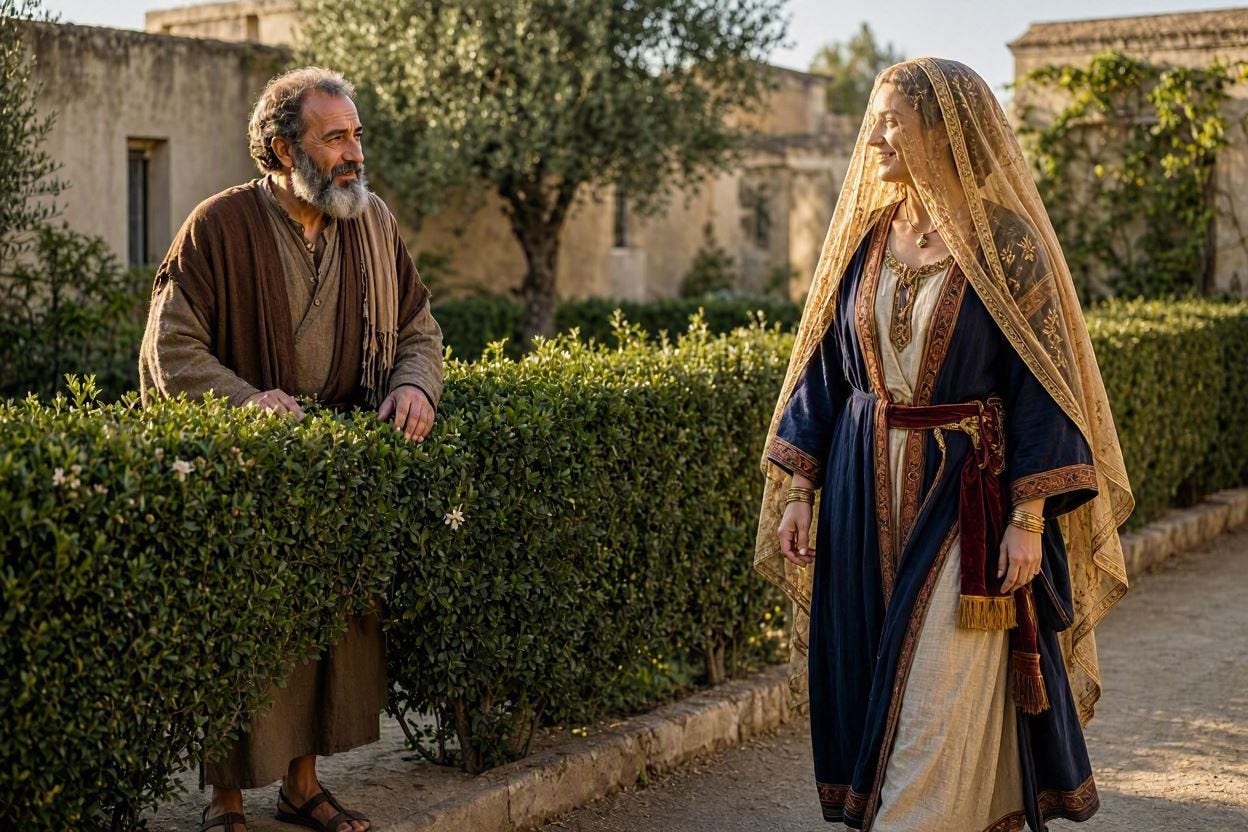
Anyway, Rabbi Hiyya’s wife comes up with a plan: she adorns herself and, when her husband works in the garden, she passes by the house as if she’s casing it, back and forth. Let’s imagine the moment he sees by watching this awesome scene from the film noir masterpiece Gun Crazy:
Rabbi Hiyya asks her, “who are you?” and his wife answers, “I am Herutha, coming home from work.” The pseudonym is not a fluke. In Ruth Calderon’s rereading of this story she highlights that Herutha, from the word heruth, liberty, symbolizes the sensations of the wife who, in disguise, finds release from the shackles of modesty imposed by her community and the men in her life. I like that Calderon reads something into this beyond merely an experiment or prank on one’s husband, though it is ironic, perhaps, that this release comes in the form of impersonating a sex worker. In all the retellings of this story, people assume that Herutha was a famous courtesan of the time (I’m not sure why; I haven’t seen her referenced anywhere else in the Talmud), but apparently not famous enough to be known to Rabbi Hiyya. Alternatively, one would have to credit his wife for a superb disguise, or realize that the two had not been sexually intimate (or even particularly close) for a very long time, enough for him to forget her body, her scent, and her mannerisms.
I like this madonna/whore duality because (a) it explains some of Rabbi Hiyya’s sexually avoidant personality, and (b) because if we accept Rav Nissim Gaon’s take on the wife having been married to Rabbi Hiyya’s teacher previously, it can explain why he has put his wife on a punishing, cold pedestal that she can’t wait to descend from.
Anyway, Rabbi Hiyya solicits “Herutha”—again, using the word tav’a, from the root תבע, to suggest assertiveness and sexual urgency—and she asks, as payment, for a pomegranate from the very top of the tree. He hurries, picks one, and hands it to her. Here, the story tactfully falls silent, and we are to assume that the deed was done—though we are not told where (presumably, you guys, right there in the garden, because we’re later told her came back home and she obviously would have nowhere else to take him!) or how.
Why a pomegranate for payment? Ben Yehoyada finds symbolism in the fact that the payment is a fruit that stands in for a panoply of mitzvot:
והא דבקשה הרמון כדי שאחר כך יהיה זה לסימן אך כונה עוד לרמוז כי הוא עודנו מלא מצות כרמון דלא נכשל באשה נכריה אלא זו אשתו היא.
If we accept this take, it is a hint that the man is filled with righteousness, and that in fact, no sin took place, because he slept with his own wife. In other words, Rabbi Hiyya’s downfall is a great example of what we might call, in the criminal law world, mens rea without actus reus: he did not actually perform the physical element of the offense, but operated within the bad mental state. Another way of looking at this is as what criminal law scholars would refer to as an impossible attempt—an attempt that is, apriori, sure to fail. But halakhic ethics and law are not the same, and in his commentary on this story, HaMeiri, commenting in 13th century Provence, reminds us that thought crimes are crimes:
לעולם יזהר אדם שלא להשקיע שום הרהור עבירה בלבו שההרהור מביא לידי מעשה וכל שהרהר בעבירה והשביע את יצרו מצד הרהורו אע”פ שלא עשה עבירה הואיל ובמחשבת עבירה היה עון הוא וצריך כפרה
Anyway, I’m sure you’re all raring to get to the denouement, so let’s go for it. It looks like Rabbi Hiyya takes his time in the garden after “Herutha” leaves because, when he gets home, his wife is already there, firing up the oven (as in Rabbi Tzaddok’s story, the woman who instigated the transgression is also firing up the implement of punishment). Rabbi Hiyya crawls into the oven, and his wife, echoing Rabbi Tzaddok’s matronitha, asks him, “Dude, what gives?” He proceeds to tell her exactly what happened. We are not told how long she keeps up the facade, but I think the story hints that, to her credit, she doesn’t milk the situation very long: she says, “it was me.” Then, we’re tersely told that Rabbi Hiyya “did not pay attention to her.” There’s something deeply painful about this. This man has just had passionate sex with a woman he found so appealing that he violated his marriage vows. His wife is telling him that it was her, and rather than entering into an intense argument with her, he remains silent. If there ever was an anxious-avoidant couple dynamic, this is it. Or perhaps he’s feeling so guilty for what he’s done that he is unable to contain this additional plot wrinkle. The wife gives him some signs that it was her (the story tactfully leaves this opaque). And, rather than fall to his knees and beg his forgiveness, he (dryly, I imagine, and so does Calderon) responds that it doesn’t matter: his intent was to sleep with a prostitute, not with her.
The terse style of this ending unpacks unimaginable cruelty. After the intense pleasure—the sense that she can still entice her retiring husband into passionate lovemaking, but through an act of deceit—the sinning man is so embroiled in the religious aspect of his downfall and punishment that he does not take any steps to atone, or rectify the situation, vis-a-vis the person he wronged. Perhaps his response is tinged with resentment for being tricked. Perhaps he cannot yet digest the levels of complexity of this complicated event. Perhaps it takes a while for his mind to catch up with his body, thrown from the heights of pleasure to the depths of mortification.
The end of the story is tersely punitive: it says that Rabbi Hiyya suffered great agony until he died (Ben Yehoyada hypothesizes that his malaise stemmed from the burns he suffered in the oven). The reader is left with several ways to make sense of this authorial reproach. The most facile one is that, as HaMeiri points out, the sin did happen because it was in his thought, and he’s being punished for the intent to commit adultery.
This straightforward interpretation is somewhat supported by the halakhic context of the story, which is a discussion of the need to avoid the risk of being alone with a woman. Yet again, though, this story stands out against the backdrop of the other stories in the series. The first story in the series (b.Kiddushin 81a) sees Rav Amram climb a heavy ladder toward a group of captive women that had been brought to Neharde’a and slept on the roof. Halfway through, he called out: “There is fire in the house of Amram!” The other rabbis told him that he was embarrassing everyone, as his intentions were evident. He replied that embarrassment in this life was better than incineration in the next, and as a fiery apparition departed his body and he told it that he had overcome the fire of evil inclinations (a nice parallel to Rabbi Tzadok’s story, or at least to the Ben Yehoyada interpretation of that story). The other three stories—featuring Rabbi Meir, Rabbi Akiva, and Pleimo—all involve the righteous sage mocking those who transgress, only to be tried by Satan masquerading as a pauper or a beautiful woman. In our story, of course, the instigator of temptation is not Satan, but rather Rabbi Hiyya’s wife. In our story, it is arguably the protagonist’s excessive and performative piety, rather than his unfounded sense of moral superiority, that is his downfall (though both could be seen as examples of hypocrisy). And, our story has an interesting halakhic segue: a discussion of a husband undoing his wife’s Nazirite vow, in a gender reversal of our narrative.
I think, though, that the terse narrative leaves room for the interpretation I prefer: that the real wrongdoing here is not the sexual act which, after all, happened within the marriage, but for the self-centeredness, the performative self-mortification, the indulgence of one’s penitence at the expense of actually delivering meaningful penitence by reconciling with the person Rabbi Hiyya wronged with his cruel remarks.
Comments
Nothing yet. Say the first thing.
Sign in to join the conversation.