
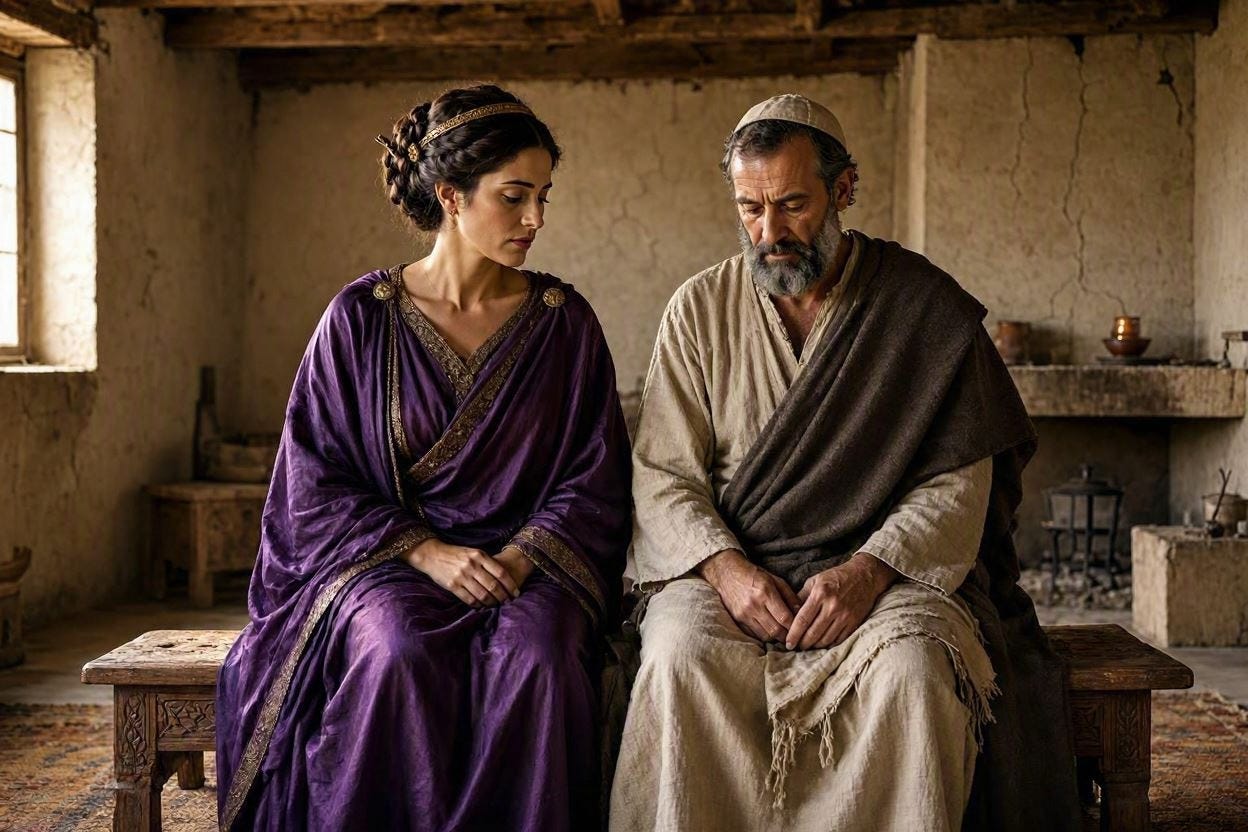
This story involves Rabbi Tzadok, an early Tanna from the days of the fall of the temple and the early Yavne study hall, and it goes like this:
רַבִּי צָדוֹק תְּבַעְתֵּיהּ הָהִיא מַטְרוֹנִיתָא, אֲמַר לַהּ: חֲלַשׁ לִי לִיבַּאי וְלָא מָצֵינָא, אִיכָּא מִידֵּי לְמֵיכַל? אֲמַרָה לֵיהּ: אִיכָּא דָּבָר טָמֵא. אֲמַר לַהּ: מַאי נָפְקָא מִינַּהּ? דְּעָבֵיד הָא – אָכֵול הָא. שְׁגַרַת תַּנּוּרָא, קָא מַנְּחָא לֵיהּ. סָלֵיק וְיָתֵיב בְּגַוֵּיהּ. אֲמַרָה לֵיהּ: מַאי הַאי? אֲמַר לַהּ: דְּעָבֵיד הָא – נָפֵיל בְּהָא. אַמְרַהּ לֵיהּ: אִי יָדְעִי כּוּלֵּי הַאי – לָא צַעַרְתָּיךְ.
The matrona, or matronitha, is a mainstay supporting character in many Talmudic stories. She is a Roman woman of noble descent who engages directly with the rabbis, as an intellectual partner, a romantic or sexual temptress, and sometimes a practitioner of occult arts. She is unique in the Talmudic landscape in that she operates outside the patriarchal structures, suggesting that the patriarchal model should be mediated through variables such as age, status, and wealth.
In this story, a matronitha not only flirts with Rabbi Tzadok, but rather makes some form of sexual demand on him (the root תבע implies something coercive or aggressive, or at least assertive). At some point during the encounter—the story is vague as to when, exactly—Rabbi Tzadok says, “my heart is weak and I can’t find.” One might think of this as the classic scenario “the mind is strong but the flesh is weak”; that Rabbi Tzadok suggests that the problem is with his heart, suggests that it’s not exactly the sort of problem that viagra can fix, but rather an issue of lacking fortitude or conviction.
He asks if there’s anything to eat. The matronitha, notably, says, “there is, an impure thing.” This is also notable: she didn’t just nab a stranger, any stranger, from the street. She knows that he is Jewish and eats kosher, which already suggests her sensitivity and consideration. She might even know him personally, though, as we will see, perhaps not very well. Rabbi Tzadok replies: “Who cares? Whoever does this, eats this.”
It’s unclear from this whole exchange how eager, or determined, Rabbi Tzadok is to go through with this. His passivity, as we saw, is already hinted at with the verb tvaateih (תְּבַעְתֵּיהּ), which highlights her assertiveness. It’s also unclear how far along our protagonists were in their liaison when Rabbi Tzadok retreats. One possibility is that they’ve gone as far as they could and Rabbi Tzadok, well, couldn’t deliver. Another possibility is that he stopped them at an earlyish phase and thought that having something to eat would embolden him and bolster his confidence; or, perhaps, he’s trying to derail the whole tryst and, not to put to fine a point on it, friendzone the matronitha by sharing a meal.
We also don’t know what tone he uses. One interpretation could be that he feels he’s already crossed a threshold, so he’s happy to embrace the impure food with the kind of glee with which a dieter might polish off a whole box of oreos after deviating a bit from their calorie count. But what makes more sense to me is that he says this with a certain despair, feeling that, given what he’s already done, redemption is beyond his reach.
Remember that, according to what we know from archaeological evidence and especially reconstruction evidence, household ovens were not perpetually lit. Fueling them was costly and labor intensive, and rather pointless if they were not being used. And so, the matronitha fires up her oven and pushes in, let’s say, a tupperware full of shrimp scampi. If Rabbi Tzadok is already distressed at this point, she hasn’t noticed yet; maybe too ablaze with desire to notice that the joy is not mutual, maybe handling her own disappointment with the unsuccessful encounter. So, even if he meant what he said cynically, she apparently doesn’t get it and takes him at his word.
To her probable shock and astonishment, Rabbi Tzadok then climbs and sits inside the oven, next to the scampi. She says to him (while he’s still in the oven? who knows?), “what gives, man?!” Rabbi Tzadok replies, “whoever does this, falls into this.”
What he says follows the pattern of what he said when he asked for food, which suggests that he was already feeling downcast before. The “falls into this” part suggests that, to him, the oven fires are a metaphor for the fires of hell, the fires of judgment, the fires of death, etc. In other words, he is play-acting, or rehearsing, his fate later.
The matronitha responds, “if I had known all this, I would not have distressed you.”
It’s interesting to point out that, in his commentary on this vignette, Ben Yehoyada—Rabbi Yosef Haim of Baghdad, a 19th-century commenter—interprets Rabbi Tzadok’s performance as the source of his salvation. He comments:
ולכן אמר לו שתעשה לו כדי שתבעיר התנור באש ואז הפיל עצמו לתוך האש ולא נשרף ולא נכוה מדה כנגד מדה דהיצר הרע של העבירה הוא אש המחמם לבו של אדם ומבעיר בו אש התאוה וכמו שאמרו בגמרא לקמן על רב עמרם חסידא דאשבעיה ליצריה דיפוק מיניה ונפק כי עמודא דנורא ואמר ליה חזי דאת נורא ואנא בשרא ועדיפנא מינך.
ולכן רבי צדוק שנתגבר וכיבה אש יצרו נעשה לו נס שלא נכוה באש הגשמי ולא שלט בו ונכבה חומו כנגדו וזו האשה בראותה כך נבהלה על המראה הזה ולכן כח הטומאה שבקרבה נחלש ונתחרטה על הדבר ואמרה אי ידעי כולי האי לא צערתיך ובודאי אם לא חלש כח טומאתה לא היתה אומרת כן או אפשר שאמרה כן על דרך דאמרי אינשי חסריה לגנבא נפשיה לשלמא נקיט כי הבינה שלא תוכל לפתותו ברצונו ואם תאנוס אותו לא תוכל לו לכך אמרה כן שתעזוב בקשתה בכבוד.
In other words, for Ben Yehoyada, there is something saintly about Rabbi Tzadok’s gesture: it is not an act of suicidal despair, but a carefully crafted symbolic act. He is telling the woman, “look, burning my flesh in the fire is better than rubbing it against yours,” but without being impolite. He also suggests that the fire did not actually harm Rabbi Tzadok—a miracle that he deserved because of his heroic control of his desires. This, in turn, leads to a “weakening of the power of impurity” that the matronitha has, and to her realization that not only can she not seduce him, she will not be able to coerce him, and therefore her retort is there just to save face.
While this take has the appeal of making the story a little bit like a duel between wizards, I don’t think it fully explains everything that happened here. First of all, we already know that Rabbi Tzadok was not seized with desire before his entry into the oven; rather, the encounter ended, or stopped abruptly, in disappointment, so I’m not sure he can take all the spiritual credit for what ensued. Moreover, we’ve already seen that the matronitha is somewhat of a class act, so the idea that she’s using some sort of superpower of impurity seems not only unfair, but out of character. Her eventual response suggests that she would not have sought him as a partner to begin with had she known what a big deal it was.
This in itself is interesting: she knew him enough to know that being offered a non-kosher meal could be a problem for him, but not enough to know that their liaison was such a big deal. This portrays her as a liberated woman, for whom liaisons outside of marriage are not a big deal, who treated Rabbi Tzadok as an equal, someone who she expected would have a similar outlook on the matter. Her response shows some kindness, unless one imagines her smirking a bit while saying it.
To be fair to Ben Yehoyada, his interpretation is grounded in the Talmud commentary that surrounds our story. The topic of the day is miracles performed for righteous men who resist temptation, and Rabbi Tzadok’s story is bracketed by two stories, for a total set of three. It is preceded by a story about Rav Hanina bar Papi who, to resist an amorous matronitha, says an incantation that results in him sprouting boils and scabs (b.Kiddushin 39b), and followed by a story about Rav Kahana, who came into contact with an amorous matronitha in the context of his basket-weaving job; he tells her he wants to groom himself some, ascends to the roof and jumps, only to be saved by the prophet Elijah, who also gives him some money so that he doesn’t have to keep working at a trade that puts seductive women in his path (b.Kiddushin 40b). What is unique to the Rabbi Tzadok story is that his actions are not an intentional magical device, nor is there an obvious effort to deceive the matronitha. It seems to be an act borne out of genuine shame, resulting in a moment of empathy and understanding between the partners to the snafu.
Comments
Nothing yet. Say the first thing.
Sign in to join the conversation.