
As I might have mentioned, I’m working on a research project that involves five Talmudic stories with a peculiar theme: rabbis that crawl into hot ovens. These are usually domestic stories involving serious shame or embarrassment, and they stand out because of how peculiar they are.
The deep Jewish discomfort with burning human remains in ovens, which has created a deep-seated distaste for cremation, long precedes the horrors of the Holocaust. In Tractate Sanhedrin, the Talmud highlights the importance of burying the dead, even for executed convicts.[1] Biblical episodes involving death by burning were traditionally read as marks of disgrace or tragedy, implying obliteration of the dead.[2]
Underlying this was the belief that the body belongs to God rather than the individual, making cremation a form of destroying divine property. Maimonides’ principle of bodily resurrection also mattered: Jewish tradition held that a specific bone survives decay and enables resurrection in the messianic era, a process cremation was thought to disrupt.[3]
By the 19th century, rabbis like Isaac Elhanan[4] argued that cremation implicitly rejected the doctrine of resurrection, sharpening religious resistance as European cremation movements grew. Even contemporary Jewish burial practices evince deep discomfort and ambivalence toward cremation, which is a source of struggles against Hevra Kadisha and the Orthodox monopoly over Jewish burial in Israel.[5] So deep is this discomfort that in my Life Cycle class at HUC, one of our hypotheticals involved a family interested in cremation at a synagogue with a policy of not conducting funerals with the urn on display.
Against this backdrop, it is hard to imagine institutional religious endorsement for a situation in which a person crawls into an oven—a deeply outlandish, discomfiting scenario. And yet is deeply outlandish and discomfiting. And yet, as I mentioned, there are five such stories in the Talmud. What are these stories doing there?
My plan for the paper is t situate this intriguing motif in historical, archaeological, and literary context. I argue that these stories are a peculiar genre of their own, distinct from the more common stories of rabbinic piety. Inspired by Yuval Fraenkel’s methodology of reading Talmudic stories according to genre conventions[6] I identify several idiosyncrasies in these stories, which make them akin to stories of honor-related struggles and violence in the Babylonian Talmud: their relative removal from the halakhic issues that surround them, the terseness of the narrative, the suspension of judgment or facile conclusions about the appropriateness of the act, the important role of gender, women, and the household, and the psycho-spiritual implications of entering a hellish dimension. I also employ a comparative lens, examining self-mortification practices in the surrounding Christian, Zoroastrian, Manichean, and Roman cultures, which offer a clue as to why these stories have no parallels in the Yerushalmi Talmud.
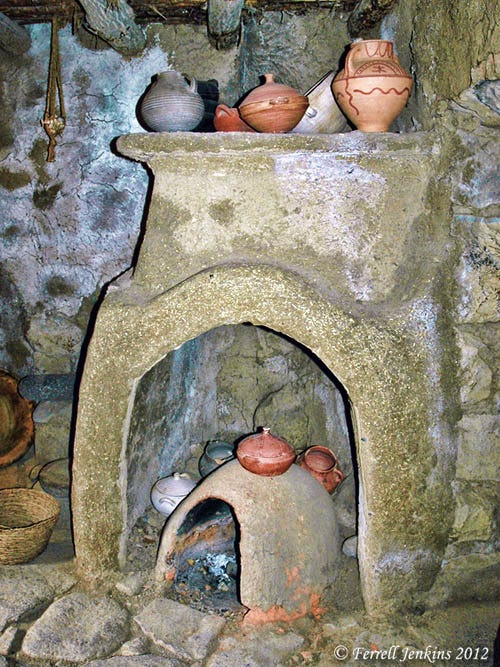
Let’s start with some evidence from material culture. The stories, in which these peculiar activities presumably take place in a hot oven large enough to fit a person within a domestic space, raise questions about the feasibility of such an event, or at least about whether this would be within the realm of the imaginable for period readers. What do we know, from material culture and from the Talmudic and related sources, about the size of such ovens, their typical location, and the possibility of having a hot oven at the ready for such a spontaneous action?
Rabbinic sources identify two types of cooking implements: the tannur, which would have been larger, and the smaller kupaḥ or kirah, probably a portable brazier-style heater.[1] Early archaeological research of households during this period tended to conflate the various types of ovens and refer to all of them as tannur, but newer works, particularly those of experimental anthroarchaeologists, are more careful in their taxonomy.[2] In her multi-year project examining ovens throughout the territory encompassing modern-day Jordan, Lebanon, and Israel, Noor Mulder-Heymans found four types of ovens.[3] The first and most common was the Tannur, a clay bread oven of a slightly conical form about one meter high and 40-50 cm wide. The tannur would be fueled with manure or wood through a small opening at the base or at the top. The longevity of the heat would allow the cooking of meat after the bread was finished. The second type, the Tabun, is a clay bread oven shaped like a small igloo or hut, wide on the bottom (c. 60 cm and wider) and on the top varying from a small hole to a wide one (c. 40 cm) and about 45 cm high. Fueled with the same materials and in the same manner, the Tabun would sometimes be partly dug into the floor. The third baking device, the Saj, is a domed metal pan, still in use among the Bedouin community and in Ethiopia,[4] on which one can bake thin flatbreads; the fourth oven, the Waqdiah, a combination of a tannur and a saj, was a domed conical 80-100-cm-high clay construction with a large frontal opening and a metal shelf for baking (in a regular tannur, in the absence of the shelf, the baker would place or throw the dough onto the clay walls). In some places, this last implement was used as a chicken cot. The researchers experimented with building their own tannur; the construction took three days, and they were able to bake bread and cook lentils, with a lengthy burn time. Ann Killebrew et al. were able to recreate a tannur and a tabun based on their dig in Qasrin, both of which performed well and kept their temperature for twelve hours.[5]
In some locations, such as Tel Hadar, ovens were found in communal areas, conveniently close to the granary and the pottery storage place.[6] In the Druze village of Abtaa, some ovens were community gathering places, but some were in private homes. In Qara, a village near Damascus, the researchers found a tannur in a courtyard behind a private home. In the suburbs of Aleppo, the researchers found an ovenhouse adjacent to a courtyard surrounded by the living quarters of several families. Excavations of a Byzantine-era neighborhood in Qasrin, in the Golan Heights, revealed several ovens located inside rooms in private homes.[7] Similar privately used ovens were found within a Sasanian-era housing complex in Nippur.[8]
The distinction between public and private baking areas is illuminated by Susan Weingarten. While diets in Palestine and Babylonia differed—the latter consisted of more meat and more beer—both cultures deeply appreciated bread. In some settings, Weingarten explains, women baked bread at home, whereas in others the bread was baked communally by professional bakers.[9]
In congruence with these findings, the Talmudic sources portray a mixed picture. In tractates Eruvin[10] and Bava Metzia,[11] shared courtyard ovens are the default assumption. The legal challenges (who owns the heat, who can use the oven on Shabbat, who is liable for fires) only make sense if neighbors routinely shared a single oven in a shared courtyard (hatzer).[12]
Weingarten’s comments on the proliferation of professional bakers is echoed in the figure of the naḥtom, the professional baker, who appears frequently in the Talmud,[13] suggesting that especially for bread at scale, people bought from or used a communal facility. In at least one story in the Jerusalem Talmud, the baker is known by name as Rabbi Yehuda, and his profession is mentioned in a story unrelated to baking.[14] While the purity laws regarding ovens in Mishna Kelim and the respective Talmudic discussions assume that the oven is a household possession,[15] The discussions in Mishna Eruvin and the respective Talmudic elaborations assume an oven which, regardless of location, is accessible to multiple parties, and in at least one case sequentially so.[16] Even if ovens were privately owned, their regulation tracks the excavation evidence in suggesting that people lived in close proximity: Tosefta BB warns to keep a distance from neighbors’ walls to prevent damage from heat or vibration.[17]
Talmud-era ovens were heated with diverse fuel sources: wood, straw, stubble, or dried dung (גללים). Because of the prohibition to light fire on Shabbat, the halakhic disputes call for distinctions between the different sources in terms of the heat generated and its longevity.[18] The concept of hatmanah—placing food in a preheated oven[19]—presupposes that, if left unfueled, the oven cools gradually, requiring legal workarounds. The concept of a swept and covered oven, a tannur garuf ve-katum,[20] as a safe cooking vessel for Shabbat suggests that the oven cools gradually after cooking. While communal ovens, or those operated by professional bakers, may have been fired more frequently, the cost of fuel and the labor involved suggest that they would not be perpetually fired without purpose.
Here’s what I get from this so far: ovens located in people’s private homes would rarely be large enough to fit a person, and even if so—it would be very, very crowded. They also would likely not be hot, unless someone in the household, usually the woman, were preparing to bake at that time or just finished cooking something. Communal ovens might be larger, and the odds of them being hot are higher, but that would expose our protagonist to the more public opprobrium of the neighbors, which is less likely in cases involving deep personal shame over a sexual or moral failing (as is the case in these stories). All of this situates these stories in a more imaginary realm for contemporary readers (not an actual occurrence, but maybe something they could imagine happening). I’ll post the stories themselves, with some commentary, over the next few days.
[1] M.Shabbat 3:2; Shulhan Arukh: Orah Hayyim 257:8.
[2] Ebeling, Jennie, and Menahem Rogel. “The tabun and its misidentification in the archaeological record.” Levant 47, no. 3 (2015): 328-349.
[3] Noor Mulder-Heymans, “Archaeology, experimental archaeology and ethnoarchaeology on bread ovens in Syria.” Civilisations: Revue internationale d’anthropologie et de sciences humaines 49 | 2002, 197-221
[4] Lyons, Diane, and A. Catherine D’andrea. “Griddles, ovens, and agricultural origins: An ethnoarchaeological study of bread baking in highland Ethiopia.” American Anthropologist 105, no. 3 (2003): 515-530.
[5] Ann E. Killebrew, Billy J. Grantham and Steven Fine. A “Talmudic” House at Qasrin: On the Use of Domestic Space and Daily Life During the Byzantine Period. Near Eastern Archaeology 66:1–2 (2003)
[6] Noor Mulder-Heymans, “Archaeology, experimental archaeology and ethnoarchaeology on bread ovens in Syria.” Civilisations: Revue internationale d’anthropologie et de sciences humaines 49 | 2002, 197-221
[7] Ann E. Killebrew, Billy J. Grantham and Steven Fine. A “Talmudic” House at Qasrin: On the Use of Domestic Space and Daily Life During the Byzantine Period. Near Eastern Archaeology 66:1–2 (2003); Baker, Jill L. Culinary Technology of the Ancient Near East: From the Neolithic to the Early Roman Period. Taylor & Francis, 2024.
[8] Zettler, Richard L. “Nippur under the Third Dynasty of Ur.” Velles Paralles: Ancient Near Eastern Studies in Honor of Miguel Civil on the Occasion of His Sixty-fi fth Birthday. Aula Orientalis 9 (1991): 251-81.
[9] Susan Weingarten, Ancient Jewish Food in its Geographical and Cultural Contexts: What’s Cooking in the Talmuds? Studies in the History of the Ancient Near East. (London: Routledge, 2025).
[10] For example:
[11] For example:
[12] The concept of a hatzer
[13] E.g., b.Bava Metzia 21b:8; b.Bava Metzia 101b:3; b.Shabbat 18b:2; b.Beitzah 17a:9; Pesachim 42a:6.
[14] y.Chagigah 2:1:10.
[15] E.g., m.Kelim 5:6-7.
[16] m.Eruvin 3:4.
[17] Webber, Alan. “Building Regulation in the Land of Israel in the Talmudic Period.” Journal for the Study of Judaism in the Persian, Hellenistic, and Roman Period 27, no. 3 (1996): 263–88.
[18] b.Shabbat 20b.
[19] E.g., b.Shabbat 35b:7; b.Beitzah 17b:2; y.Terumot 3:2:7.
[20] E.g., Shabbat 36b:4.
[1] b.Sanhedrin 46b.
[2] Bar, Shaul. “The punishment of burning in the Hebrew Bible.” Old Testament Essays 25, no. 1 (2012): 27-39. Also see: Bar, Shaul. “Death by stoning in the Hebrew Bible and in post-Biblical traditions.” Old Testament Essays 34, no. 3 (2021): 789-805; Feldt, Laura. “Destruction, Death, and Drama: Narratives of Religiocide in the Hebrew Bible.” Numen 68, no. 2-3 (2021): 132-156.
[3] Kirschner, Robert S. “Maimonides’ fiction of resurrection.” Hebrew Union College Annual (1981): 163-193.
[4] Ferziger, Adam S. “The Hamburg cremation controversy and the diversity of German-Jewish orthodoxy.” Leo Baeck Institute Year Book 56, no. 1 (2011): 175-205.
[5] Gazith, Zohar. A Good Death. Tel Aviv: Resling, 2016.
[6] Fraenkel, Yuval. The Fragility of the Mind (Jerusalem: Magnes, 2026).
Comments
Nothing yet. Say the first thing.
Sign in to join the conversation.