

One of the biggest misconceptions I had when I first started my business was thinking there would eventually come a point where everything was “set.”
I’d build the website, create the products, write the emails, put a few systems in place, and then I’d finally be able to focus on growing the business instead of constantly working on it.
It didn’t take very long to realize that’s not how businesses work.
The business kept changing. Customers asked different questions. New products meant new processes. Software evolved. What worked when we were serving a handful of customers wasn’t always the best approach once we were serving hundreds or thousands.
For a while, I found that frustrating. It felt like I was never quite caught up.
Now I see it differently.
A business that never needs to change probably isn’t growing.
One of the healthiest habits we’ve developed over the years is simply accepting that every system has a shelf life. It may work beautifully for a season, but eventually you’ll outgrow it, discover a better way, or notice that it’s creating more work than it used to. That’s not a sign that you built it wrong. It’s simply the natural result of running a business that’s constantly evolving.
The mistake most of us make is treating improvement like a special project.
We tell ourselves we’ll update our systems when things quiet down. We’ll document our processes after this launch. We’ll rewrite that confusing email next month or finally organize our files once we get through the busy season.
The trouble is that there’s almost always another busy season waiting around the corner.
If you’ve been in business for any length of time, you’ve probably discovered that work has a way of expanding to fill whatever time you have available. Waiting for the perfect opportunity to improve your business often means waiting forever.
That’s why I’ve come to believe that improvement works much better as a habit than as an event.
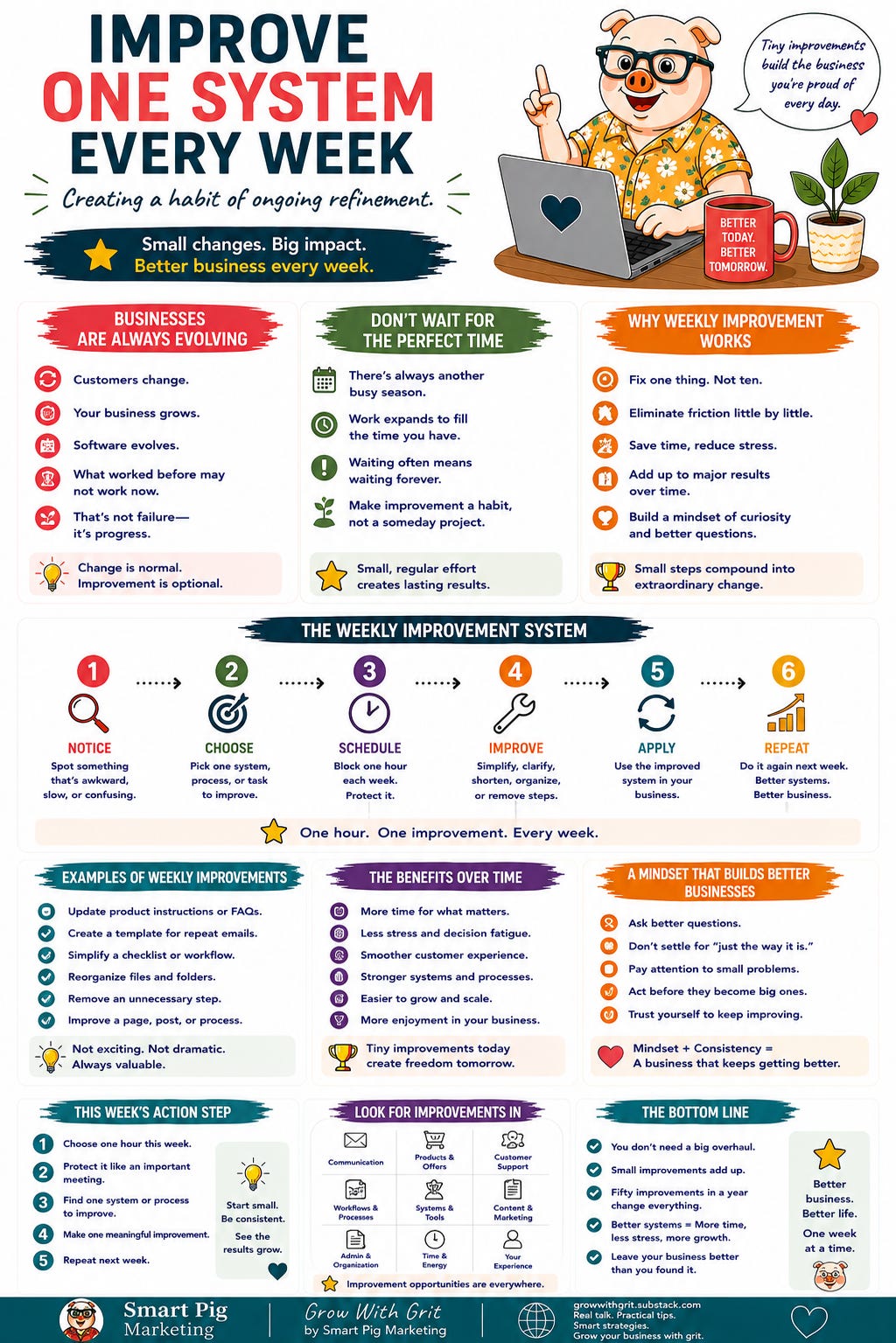
Instead of setting aside an entire weekend to overhaul everything, set aside a small amount of time every week to improve one thing.
Not ten things.
One.
It doesn’t have to be complicated.
Perhaps you notice that customers keep asking the same question, so you update your product instructions. Maybe you create a template for an email you’ve written dozens of times. You simplify a checklist, reorganize a folder that’s become cluttered, or remove an unnecessary step from a process that’s gradually grown more complicated over the years.
None of those improvements is particularly exciting. In fact, if someone asked what you accomplished that afternoon, you might struggle to come up with an answer that sounded impressive.
The interesting part is what happens six months later.
Instead of carrying around dozens of little frustrations, you’ve quietly eliminated them one by one. The business becomes easier to run, not because you had one brilliant idea, but because you’ve stopped tolerating unnecessary friction. Every week you’ve left the business just a little better than you found it, and eventually those improvements begin to compound in ways that are difficult to appreciate while they’re happening.
I’ve noticed something else about this approach.
It changes the way you think.
When something isn’t working well, you stop accepting it as “just the way things are.” Instead, you begin asking better questions.
Why does this take so long?
Could this be simpler?
Do I really need this step anymore?
Is there an easier way to do this?
Those questions have a way of changing how you run your business. They encourage curiosity instead of frustration. Instead of working around problems for months, you start looking for small opportunities to solve them.
Over time, that mindset becomes far more valuable than any individual improvement.
You begin trusting yourself to build a better business, one decision at a time.
I think that’s one of the biggest differences between businesses that continue improving year after year and those that gradually become harder to run. The successful ones aren’t necessarily built by people with better ideas. They’re often built by people who keep paying attention. They notice when something feels awkward, repetitive, or unnecessarily complicated, and rather than living with it indefinitely, they make time to improve it.
Not because it’s urgent. Because they know small problems have a habit of becoming bigger ones when they’re ignored.
Ready to try this for yourself? Choose one hour each week that belongs to your business rather than your daily workload. Protect it the same way you’d protect a meeting with your best customer.
During that hour, don’t answer emails. Don’t create something new. Don’t try to catch up on everything you’ve fallen behind on.
Simply look for one system, one process, or one recurring task that could be a little easier than it was last week. Then improve it.
If you do that consistently for a year, you’ll make more than fifty thoughtful improvements to your business. None of them will feel life-changing on their own. Together, they’ll create a business that’s simpler to run, easier to grow, and a lot more enjoyable to own.
Comments
Nothing yet. Say the first thing.
Sign in to join the conversation.