

Have you ever finished a week feeling as though you worked constantly but didn’t seem to get very far?
You answered emails. You crossed things off your to-do list. You handled customer questions, posted on social media, and squeezed in a little work on your latest project whenever you could find a spare half hour. Looking back, it’s hard to point to anything you did wrong. In fact, you were probably busy from the moment you sat down at your desk until the moment you shut your computer down for the evening.
And yet something still feels stuck.
I think most business owners have experienced that feeling at one time or another. Our first instinct is usually to assume we need to work harder or become more productive. We start looking for a better planner, another app, or a different way to organize our schedule because we assume the problem is how we’re managing our time.
Sometimes that’s true.
More often, though, I’ve found the problem isn’t that everything in the business needs attention.
It’s that one part of the business is quietly holding everything else back.
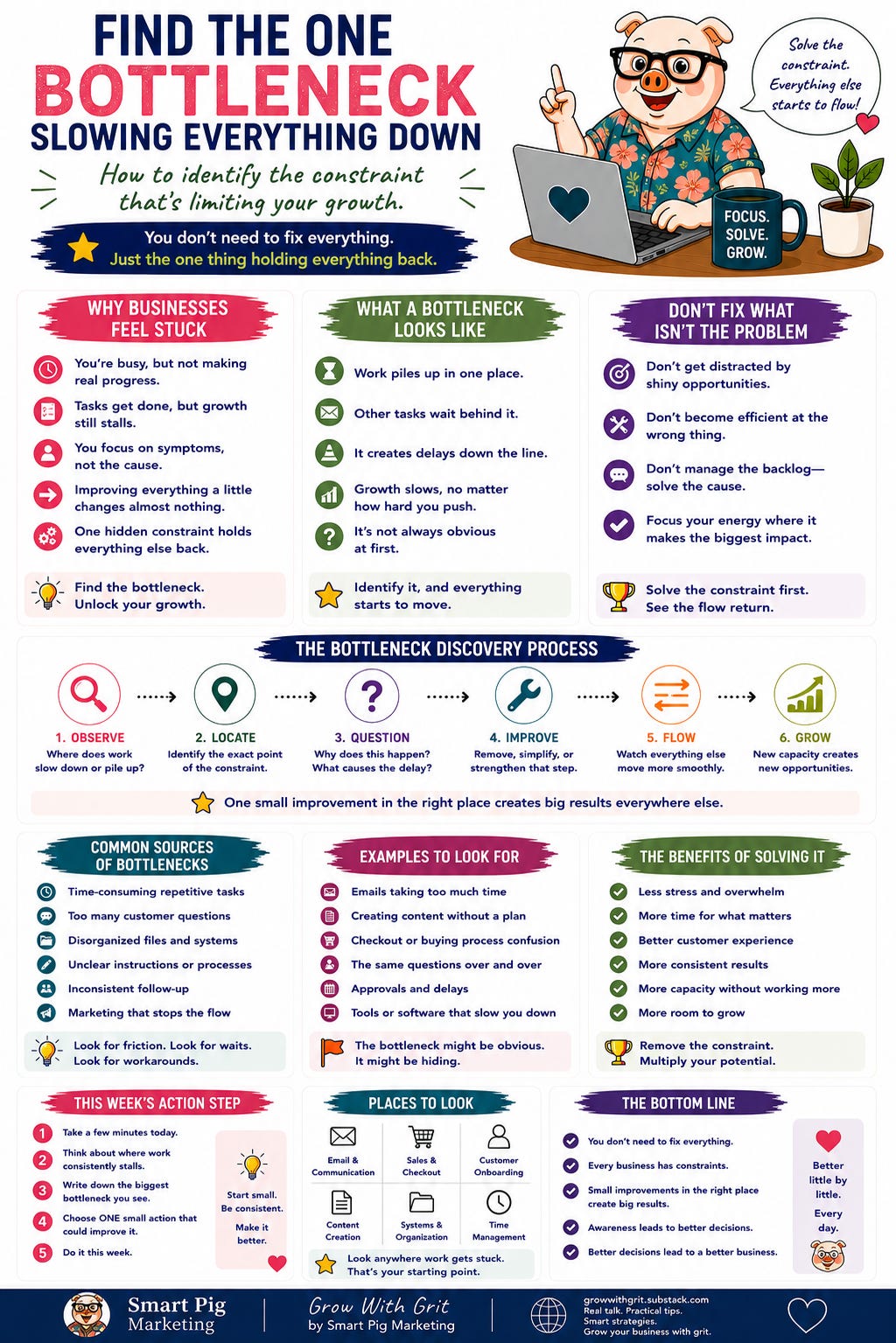
One of the most valuable lessons Tracy and I have learned over the years is that businesses rarely slow down evenly. Growth almost always gets held up at one point in the process. Until you identify that point, improving everything else doesn’t usually make much difference.
Think about traffic on the highway for a moment.
You can widen three miles of road, add another lane, and improve the entrance ramp, but if traffic still has to squeeze through one construction zone farther down the road, that’s where the cars are going to pile up. Everything behind it continues to slow down because the real problem was never the parts of the highway that were flowing smoothly.
Businesses behave in much the same way.
It’s easy to spend time improving areas that are already working reasonably well because those improvements feel productive. You redesign your website, organize your files, create better graphics, or finally clean out your inbox. None of those things is wasted effort, but they may not change the overall health of the business if the real problem is somewhere else entirely.
I’ve learned that when a business feels as though it’s pushing against an invisible wall, it’s worth asking a different question.
Instead of asking, “What should I improve next?” try asking, “Where does work keep getting stuck?”
The answer isn’t always obvious at first because we tend to notice the symptoms before we notice the cause.
You might tell yourself you’re struggling to publish consistently, when the real issue is that you’re spending so much time answering customer emails that you never have uninterrupted time to write.
You might think sales have slowed because you need better marketing, when in reality leads are already coming in but your follow-up process is inconsistent, so potential customers quietly slip away before you ever have a chance to help them.
Or perhaps you keep telling yourself you need to create more products when the ones you already have are generating the same customer questions week after week because your instructions could be clearer.
Those situations look very different on the surface, but they all have something in common.
The thing that’s slowing the business down isn’t necessarily the thing demanding the most attention.
It’s the place where everything else begins to wait.
I think that’s why bottlenecks can be so frustrating. We often spend our energy fixing the visible problems instead of the underlying one. We become incredibly efficient at managing the consequences without ever addressing the cause.
I’ve certainly done that more times than I’d like to admit.
There have been seasons where Tracy and I worked hard to become faster at tasks we probably shouldn’t have been spending so much time on in the first place. We improved our ability to handle the backlog instead of asking why the backlog kept appearing. It wasn’t wasted effort—we learned a lot—but looking back, we would have made far more progress by solving the problem upstream instead of downstream.
Once you’ve identified the bottleneck, the temptation is to fix everything around it.
I’d encourage you to resist that temptation.
Give yourself permission to stay focused on that one area until it begins to move more freely. Maybe that means documenting a process that’s always lived in your head. Maybe it’s rewriting an email that generates unnecessary replies, simplifying a customer workflow, creating a template, or removing a step that no longer serves a purpose.
Whatever the solution turns out to be, you’ll often find that improving the bottleneck creates benefits far beyond that single task. When one part of the business becomes easier, everything connected to it starts flowing a little more smoothly as well.
Of course, solving one bottleneck doesn’t mean you’ll never have another one.
As your business grows, new constraints will appear. That’s perfectly normal. In fact, it’s usually a sign that you’re making progress. Every stage of business has its own challenges, and every stage asks different questions of you as an owner.
The goal isn’t to build a business with no bottlenecks.
The goal is to recognize today’s biggest constraint and give it your attention before you worry about everything else.
That’s often where the greatest opportunity for growth is hiding.
Take a few minutes today to think about where work tends to stall in your business.
Where does work consistently begin to pile up? What task, if it became easier, would make everything else feel a little lighter?
Start there. You don’t need to solve every problem this week.
You simply need to remove the obstacle that’s slowing everything else down.
Comments
Nothing yet. Say the first thing.
Sign in to join the conversation.