

A few weeks ago I was looking for a product online. Within a few minutes I’d narrowed it down to three different businesses, all selling something remarkably similar. The prices were close enough that they didn’t really matter. The products looked comparable, and each company claimed to have excellent customer service. On paper, there wasn’t much separating them.
And yet I still spent another twenty minutes trying to decide which one deserved my money.
I found myself doing what I suspect most of us do without even thinking about it. I started looking beyond the product itself. I read the About page. I looked for customer reviews. I clicked through a few blog posts to get a sense of who was behind the business. I even glanced at their social media accounts, not because I expected to find a special offer there, but because I wanted to know whether they felt like a real business run by real people.
By the time I finally made my decision, it wasn’t because one product was dramatically better than the others.
It was because one business simply felt more trustworthy.
I think that’s an important distinction because most of us spend a lot of time trying to improve our marketing without stopping to think about what our marketing is actually trying to accomplish. We work on headlines, sales pages, social media posts, email campaigns and product descriptions, all in the hope that they’ll persuade someone to buy.
But persuasion isn’t usually the biggest obstacle.
Uncertainty is.
Every purchase involves a little uncertainty, even if we don’t consciously think about it that way. Whether we’re buying a digital product, hiring someone to provide a service, or ordering from an online shop we’ve never used before, we’re trying to reduce risk. We wonder whether the product will actually solve the problem it promises to solve. We wonder whether anyone will answer if we need help and whether the business will stand behind what it sells if something goes wrong. Long before customers compare features or prices, they’re looking for reasons to believe they’re making a safe decision.
That’s why I’ve come to think of trust as one of the most valuable marketing assets a business can have.
A good sales page might convince someone to take a closer look. A great advertisement might persuade them to visit your website. Trust is what makes them comfortable enough to click the buy button.
Once Tracy and I started looking at marketing through that lens, it changed the kinds of conversations we had about our own business. We spent less time asking how we could make our sales copy more persuasive and more time asking whether we’d answered the questions a customer was likely to have before they reached the sales page in the first place. We looked at our email sequences differently. We paid more attention to product instructions. We became much more intentional about following up with customers after a purchase because we realized the relationship didn’t begin when someone joined our email list or ended when they completed an order.
Every interaction was shaping the way people felt about our business.
That’s something I think is easy to underestimate.
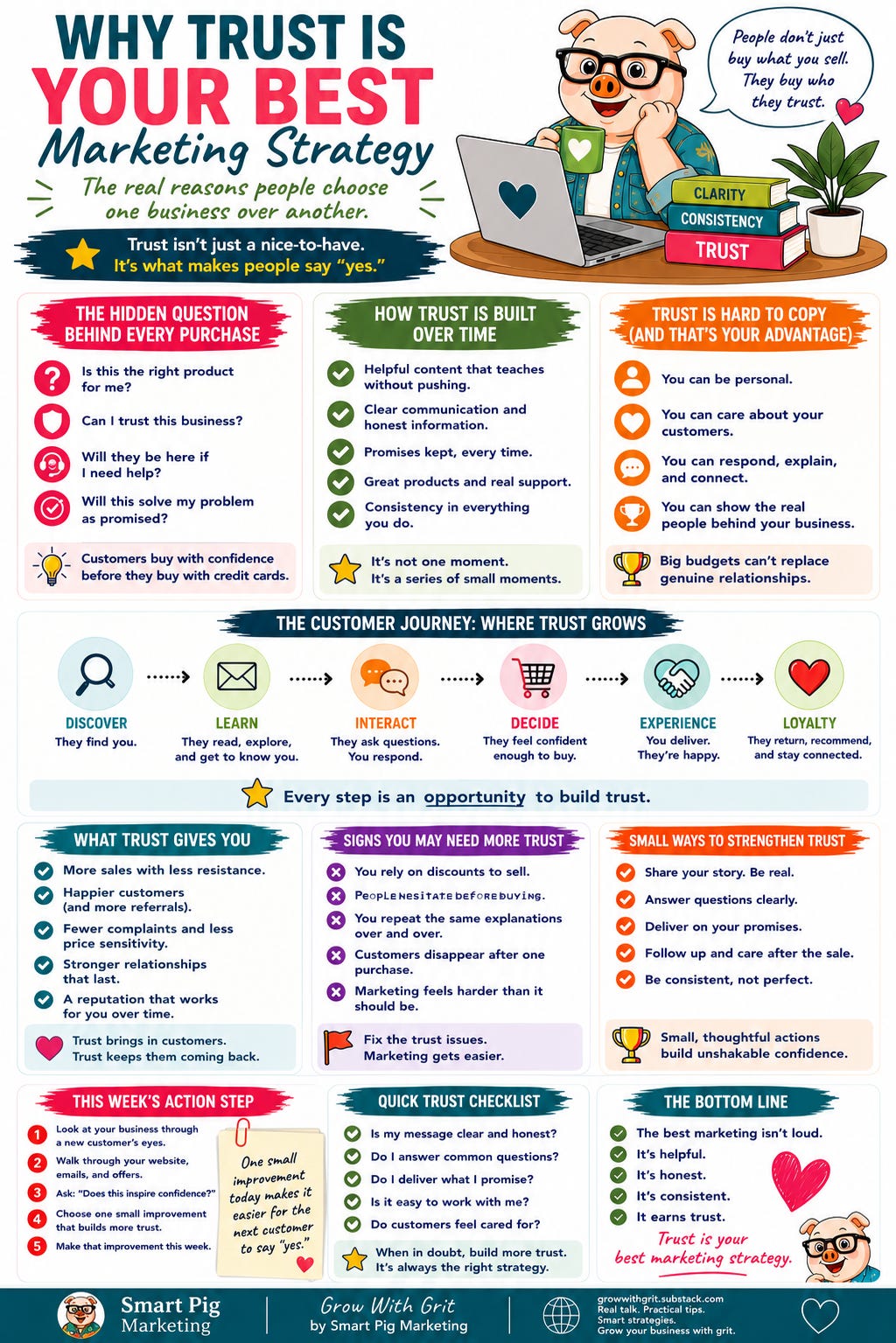
Trust is rarely built in one dramatic moment. It grows through a series of small experiences that, taken together, create confidence. Someone discovers a helpful article on your website and leaves having learned something useful. A few days later they download a free resource that genuinely helps them solve a problem. They join your email list and find that your newsletters are educational instead of relentlessly promotional. Eventually they send you a question and receive a thoughtful reply instead of an automated response that never really answers what they asked.
None of those moments is particularly remarkable on its own, and that’s exactly why they’re so powerful. Customers aren’t usually looking for one grand gesture that convinces them to buy. They’re quietly collecting evidence. Every interaction answers the same underlying question: Can I trust this business? By the time someone finally reaches your sales page, they’ve often been forming that opinion for days, weeks or even months.
I think that’s one of the reasons consistency matters so much in marketing, although perhaps not for the reasons we usually hear about.
We often talk about consistency because of algorithms or visibility. We’re told to keep posting on social media so we stay in people’s feeds or to send regular emails so subscribers don’t forget who we are. There may be some truth to that, but I think consistency serves a much more important purpose.
Consistency tells people what they can expect from you.
Every helpful article, every promise you keep, every customer email you answer and every product that delivers what you said it would becomes another small reason for someone to believe they’ll have a good experience the next time they buy from you. Over time, your reputation becomes less about what you say in your marketing and more about what customers have repeatedly experienced for themselves.
That’s one area where small businesses have an advantage that often goes unnoticed.
Large companies may have bigger advertising budgets, but they also tend to feel distant. Small businesses have the opportunity to be personal. We can answer emails ourselves. We can admit when we’ve made a mistake. We can remember returning customers, explain why we made certain decisions and allow people to see the humans behind the business. Those moments don’t just create good customer service. They create trust, and trust is incredibly difficult for competitors to copy.
Looking back, I don’t think the businesses I’ve remained loyal to over the years necessarily had the lowest prices or the flashiest marketing. They were the businesses that consistently did what they promised they would do. They communicated clearly, treated me fairly and gave me confidence that if something ever went wrong, they’d make it right.
That’s why I believe trust isn’t simply one part of your marketing strategy.
It is your marketing strategy.
Everything else you do—from the content you create to the emails you send, the products you build and the way you care for your customers—either strengthens that trust or weakens it. Once you start looking at your business that way, marketing stops feeling like a series of campaigns and starts feeling like the process of earning confidence, one interaction at a time.
Spend a little time looking at your business through the eyes of someone who has never heard of you before.
Visit your website. Read your About page. Sign up for your own newsletter. Walk through the same experience a new customer would have and pay attention to how it feels. As you do, don’t ask yourself whether everything looks polished. Ask whether it inspires confidence. Does it answer the questions a new customer is likely to have? Does it make your business feel approachable? Does it leave someone with the sense that you’ll do what you say you’ll do?
If the answer is yes, keep building on that foundation. If not, resist the temptation to redesign everything at once. Trust isn’t usually strengthened through one dramatic change. More often, it’s built through dozens of thoughtful improvements that make it a little easier for the next customer to feel confident saying, “Yes, this is the business I want to buy from.”
Comments
Nothing yet. Say the first thing.
Sign in to join the conversation.