

It’s funny how often we think business success arrives all at once.
We picture someone launching the perfect product, discovering a brilliant marketing strategy, or making one decision that suddenly changes everything. Those stories are easy to tell because they’re dramatic, and they’re certainly the ones that tend to get shared the most. They also make us feel as though we’re always one breakthrough away from finally getting where we want to be.
The longer I’ve been in business, though, the less I believe that’s how most businesses actually grow.
When Tracy and I look back over the past twenty years, we can certainly point to some important milestones. There were products that performed better than expected, marketing campaigns that brought in a lot of new customers, and decisions that opened doors we hadn’t anticipated. But if you asked me what really shaped our business over the long term, I don’t think I’d point to any of those things first.
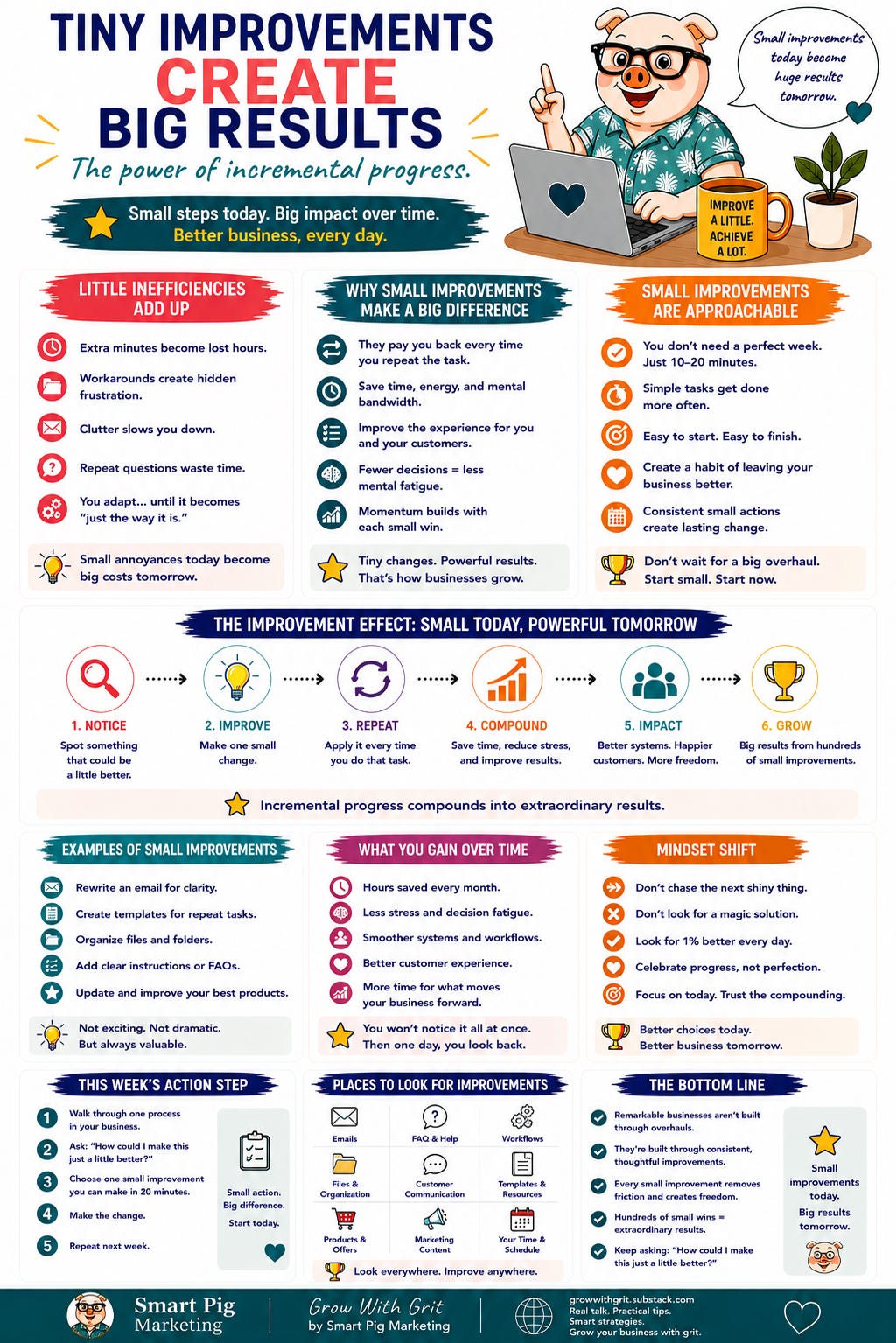
I’d point to the hundreds of small improvements we made along the way.
Most of them weren’t exciting enough to mention in a newsletter. They certainly weren’t the kind of thing you’d post about on social media. They were the quiet jobs that tend to get squeezed into an afternoon when you have an extra half hour. We rewrote an email that wasn’t getting the response we hoped for. We simplified instructions because customers kept asking the same question. We reorganized files so we could find them more quickly, documented a process we’d been keeping in our heads, or spent a little time improving a product that was already selling well instead of rushing off to create something new.
At the time, none of those jobs felt particularly significant. Looking back, I can honestly say they were some of the most valuable work we ever did.
One of the reasons I think those improvements matter so much is because businesses have a way of collecting little inefficiencies without us even realizing it. We get used to them in exactly the same way we get used to little annoyances around the house. Maybe the kitchen drawer sticks unless you pull it a certain way, or one of the cupboard doors doesn’t quite close properly anymore. Perhaps there’s a light bulb you’ve been meaning to replace for weeks, but life carries on well enough that you never quite get around to it. After a while, those little workarounds become normal. You stop seeing them because they’ve become part of everyday life.
Businesses aren’t any different.
You spend a few extra minutes every week answering the same customer question because you never updated your FAQ. You rewrite an email you’ve written dozens of times before because you still haven’t created a template. You click through three different folders to find a document because your filing system made sense five years ago but has gradually become cluttered as the business has grown. None of those things seems important enough to stop what you’re doing and fix it, so you simply adapt.
The trouble is that every one of those little workarounds asks for a tiny bit of your attention. One extra click isn’t a problem. Rewriting one email isn’t a problem. Spending three minutes looking for a file isn’t a problem either. But when those little frustrations are repeated day after day, week after week, they quietly become part of the cost of running your business. We often think we’re busy because we have too much work to do, when in reality we’re spending a surprising amount of our day navigating unnecessary friction that we’ve simply learned to tolerate.
That’s one of the reasons I no longer believe the answer is always to look for something new.
It’s easy to convince ourselves that the next piece of software, the next planner, or the next marketing strategy will finally make everything easier. Occasionally that’s true, but far more often we’ve discovered that the biggest improvements came from making what we already had work a little better. A clearer email creates fewer customer questions. Better instructions reduce confusion. A simple checklist means you no longer have to rely on memory every time you complete a recurring task. Those aren’t dramatic changes, but they improve the experience for both you and your customers every single time that process repeats.
I think that’s why small improvements have such a powerful effect over time. They don’t simply solve today’s problem. They continue paying you back every time you repeat that task in the future. A template you create today might save you five minutes next week, another five minutes the week after that, and hundreds of small pockets of time over the course of a year. Just as importantly, it removes one more decision from your day, and I’ve become convinced that reducing unnecessary decisions is one of the best ways to reduce mental fatigue.
There’s another benefit to working this way that I didn’t appreciate when I was first starting out.
Small improvements are approachable.
Most of us don’t have an entire week available to redesign our business from the ground up. If we convince ourselves that meaningful progress requires a major overhaul, we’ll probably keep postponing it until we “have more time.” As you’ve probably discovered, that perfect week rarely appears on its own.
Improving one thing is different.
Almost all of us can find twenty minutes to rewrite an email, simplify a checklist, clean up a folder, or make one customer process a little easier to follow. Those jobs don’t feel overwhelming, which means they actually get done. The more often you complete them, the more momentum you build, and before long you’ve created a habit of leaving the business just a little better than it was yesterday.
I think that’s a far more sustainable way to grow.
Instead of waiting for the next breakthrough, you’re constantly paying attention to little opportunities to make things simpler, clearer, and easier. Most of those improvements won’t seem remarkable in the moment. In fact, if someone asked what you accomplished that afternoon, you might struggle to come up with an answer that sounded impressive.
A year later, though, the picture looks very different.
Your customer experience is smoother. Your systems are easier to follow. Your recurring tasks take less time. You spend less energy solving the same problems over and over again, and more time doing the work that actually moves the business forward. It’s difficult to point to the single improvement that made the difference because no single improvement did.
It was all of them together.
That’s why I believe remarkable businesses are rarely built through occasional overhauls. More often, they’re built by people who keep asking one simple question:
“How could I make this just a little better?”
If you ask that question often enough—and take the time to act on the answer—you may be surprised by how different your business looks a year from now.
Comments
Nothing yet. Say the first thing.
Sign in to join the conversation.